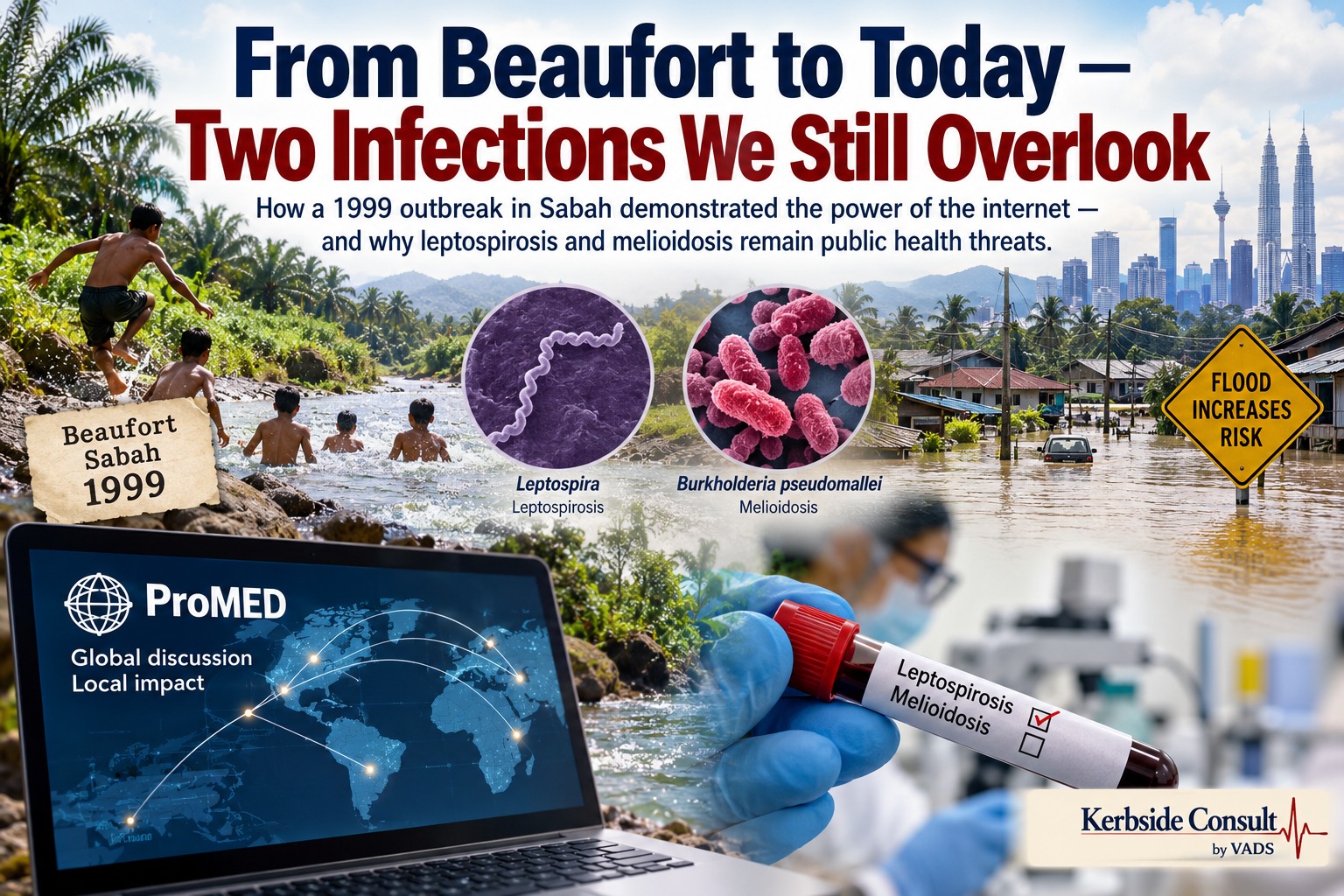
In October 1999, a group of boys and young men became ill after swimming in a creek near an oil palm plantation in Beaufort, Sabah. One 15-year-old died. Within days, the outbreak was being discussed on ProMED, the internet-based infectious disease reporting network, by clinicians far from Sabah.[1], [2]
I wrote about those events in Cybermed on Vads Corner in 1999. I wrote then that it was “yet another example on how the Internet has crossed boundaries, religion and culture in dissemination, sharing and exchange of information.”[1] Twenty-seven years later, diagnostic technology and disease surveillance have advanced considerably. Yet leptospirosis and melioidosis are still with us. Why?
Contents
- A tragedy in Beaufort
- What the internet said, and what the laboratory found
- Two infections, one differential
- Malaysia today
- Beyond Malaysia
- From ProMED to artificial intelligence
- What should Malaysia do differently?
- Closing reflection — Technology changes; vigilance must not
- Sources & further reading
1. A tragedy in Beaufort
Between 13 and 21 October 1999, 46 boys and young men aged eight to 19 years were admitted to Beaufort Hospital after swimming in a creek at Kampung Kebatu. Thirty had symptoms, including fever, vomiting, body ache, headache, chest pain and cough; 16 had none. A 15-year-old died of haemorrhagic shock following pulmonary haemorrhage. Onset ran from 11 to 19 October. A case-control study linked the illness to swimming in the creek (p<0.0001). Flooding and stagnation of the creek after heavy rain in the first week of October may have contributed to the timing.[2]
2. What the internet said, and what the laboratory found
On 22 October 1999, Falzon Dennis of the Malta Ministry of Health posted to ProMED that leptospirosis was a distinct possibility, given a stream, Southeast Asia and oil palms, with melioidosis less likely.[1], [3]
A month later, on 20 November, Prof Lam Sai Kit posted serology on 45 paired samples. Twenty showed a fourfold rise to Burkholderia pseudomallei alone, five to Leptospira (L. biflexa) alone, and two to both. He cautioned that in endemic countries pseudomallei serology is often hampered by raised antibody levels in healthy people, and that the results must be read with the clinical and epidemiological data.[1], [3]
The peer-reviewed investigation tested 44 paired sera by microscopic agglutination test (MAT) for leptospirosis. Five pairs seroconverted and three had a fourfold rise, the paper’s two criteria for recent infection (8 of 44). Eighteen pairs were positive at 1:320 or more in both samples and 18 were negative; 16 of 22 cases tested were IgM positive. No serum was available from the boy who died, whose diagnosis was clinical. Tests for malaria, typhoid, scrub typhus, dengue and hantavirus were negative, and blood and urine cultures grew nothing. All 30 cases had swum in the creek, against 26 of 104 controls (p<0.0001), and the patients responded to doxycycline, amoxicillin or penicillin. The authors concluded that leptospirosis was the cause and the creek the source.[2]
Prof Lam is thanked in the paper for accepting the blood samples for serology, so his 45 pairs and the paper’s 44 may overlap. His posting lists the same negative tests as the paper, nearly word for word, and also notes that no sample was available from the boy who died, so both may well describe the same patients. Melioidosis is not mentioned anywhere in the paper, and its pseudomallei results are not reported.[2], [3]
The historical significance lies not in a remote diagnosis replacing local investigation, but in electronic communication helping clinicians consider the right possibilities while local public health and laboratory work established the evidence. And it left an uncomfortable lesson: when two environmental infections share a creek, a rainy season and a febrile boy, one positive test does not settle the matter.
3. Two infections, one differential
Leptospirosis is caused by pathogenic Leptospira species. Infection commonly follows contact of damaged skin or mucous membranes with water or soil contaminated by urine from infected animals. It can cause fever, headache and muscle pain, progressing in severe cases to kidney injury, jaundice or pulmonary haemorrhage.
Melioidosis is caused by Burkholderia pseudomallei, an environmental bacterium found in soil and water. It can cause pneumonia, abscesses, bloodstream infection and septic shock. Diabetes is a major risk factor: 45% of the 1,148 culture-confirmed patients in the Darwin study had diabetes, though infection can occur without recognised underlying illness.[4]
Both can resemble other acute febrile illnesses, including dengue. Exposure history and appropriate testing matter. PCR and serology have roles in leptospirosis according to the stage of illness; culture remains central to diagnosing melioidosis. Treatment differs substantially. Melioidosis typically needs an intensive intravenous phase followed by prolonged oral therapy, while leptospirosis treatment depends on severity. Clinicians should consult the current Malaysian National Antimicrobial Guideline rather than historical regimens.[5]
4. Malaysia today
The Ministry of Health Annual Report 2024 recorded 2,445 laboratory-confirmed leptospirosis cases with 46 deaths (a reported case fatality rate of 1.9%), and 876 melioidosis cases with 139 deaths, a crude fatality of about 16% by simple calculation. These are reported surveillance figures, not estimates of all infections.[6]
Flooding, freshwater recreation, agriculture and other outdoor work can increase environmental exposure. Urban rodent infestation and drainage problems are also relevant to leptospirosis. Malaysia’s diabetes burden is especially pertinent to melioidosis. The challenge is to improve prevention, clinical recognition and access to reliable laboratory diagnosis without assuming that every post-flood fever has the same cause.
5. Beyond Malaysia
Leptospirosis occurs worldwide, especially in tropical and subtropical regions. A systematic review estimated about 1.03 million cases (95% CI 434,000–1,750,000) and 58,900 deaths (95% CI 23,800–95,900) a year. These are modelled estimates from 2015, not current reported totals.[7]
Melioidosis is well recognised in Southeast Asia and northern Australia, although its distribution is wider and incompletely measured. A modelling study estimated about 165,000 cases (95% credible interval 68,000–412,000) and 89,000 deaths (36,000–227,000) a year, and suggested the disease is severely underreported in the 45 countries where it is known to occur.[8]
The Darwin Prospective Melioidosis Study followed 1,148 culture-confirmed patients over 30 years. Median annual incidence was 20.5 per 100,000 population, and 80% of infections occurred in the wet season (November to April). Overall, 12% of patients died; mortality fell to 6% over the last five years.[4] The Darwin cohort and Malaysia’s national notifications use different populations and methods and should not be compared directly.
The broader lesson is that surveillance and laboratory capacity determine not only how fast infections are recognised, but also how much of their burden becomes visible.
6. From ProMED to artificial intelligence
The 1999 postings were an early form of digitally enabled outbreak intelligence. Today’s surveillance can combine laboratory notifications, genomic sequencing, electronic reports and automated analysis. AI may help detect patterns or prioritise signals, but it can also amplify unreliable reports or produce plausible but incorrect explanations.
A surveillance signal is a reason to investigate, not proof of causation. Beaufort showed this long before AI: a confident early suggestion, an ambiguous serology and a final answer that came only from fieldwork and the laboratory.
7. What should Malaysia do differently?
Diagnostic methods, microbiological identification and antimicrobial management have all improved since 1999. But the availability of a test does not mean it is requested, that the specimen reaches the laboratory promptly, or that the patient can reach appropriate care. Rural referral, timely communication of results and clinician familiarity still decide outcomes.
Practical priorities include continuing education for frontline clinicians; dependable specimen referral and microbiology networks; clear public advice about recreational water, floodwater, protective clothing and wound care; attention to people with diabetes who are at risk of severe melioidosis; and closer coordination among public health, veterinary and environmental agencies. These need sustained implementation and accountability more than another technological slogan.
Closing reflection — Technology changes; vigilance must not
When I wrote about Beaufort in 1999, I was struck by how quickly medical knowledge could cross borders. Today, information travels in seconds and AI can process volumes of data that once seemed unimaginable.
But sharing knowledge is only the beginning. What matters is whether it reaches the clinician, the laboratory, the public health officer and, ultimately, the patient in time.
The internet connected clinicians in 1999. The test, twenty-seven years on, is whether it reaches the next boy at the creek in time.
Sources & further reading
- Vadivale M. The Beaufort Cases - Leptospirosis and Melioidosis. Cybermed. Berita MMA. 1999 Nov;29(11). Vads Corner. Source
- Koay TK, Nirmal S, Noitie L, Tan E. An epidemiological investigation of an outbreak of leptospirosis associated with swimming, Beaufort, Sabah. Med J Malaysia. 2004;59(4):455-9. Source
- ProMED-mail. Undiagnosed illness, swimmers – Malaysia (Beaufort) (02), posted by Falzon Dennis, 22 October 1999; and (05), posted by Lam Sai Kit, 20 November 1999. Archived at ProMED-mail and reproduced in [1].
- Currie BJ, Mayo M, Ward LM, Kaestli M, Meumann EM, Webb JR, et al. The Darwin Prospective Melioidosis Study: a 30-year prospective, observational investigation. Lancet Infect Dis. 2021;21(12):1737-46. Source
- Ministry of Health Malaysia. National Antimicrobial Guideline. Section A16: Tropical Infections. Accessed 23 October 2026. Source
- Ministry of Health Malaysia. Annual Report 2024. Putrajaya: Ministry of Health Malaysia; 2025. p. 82. Source
- Costa F, Hagan JE, Calcagno J, Kane M, Torgerson P, Martinez-Silveira MS, et al. Global morbidity and mortality of leptospirosis: a systematic review. PLoS Negl Trop Dis. 2015;9(9):e0003898. Source
- Limmathurotsakul D, Golding N, Dance DAB, Messina JP, Pigott DM, Moyes CL, et al. Predicted global distribution of Burkholderia pseudomallei and burden of melioidosis. Nat Microbiol. 2016;1:15008. Source