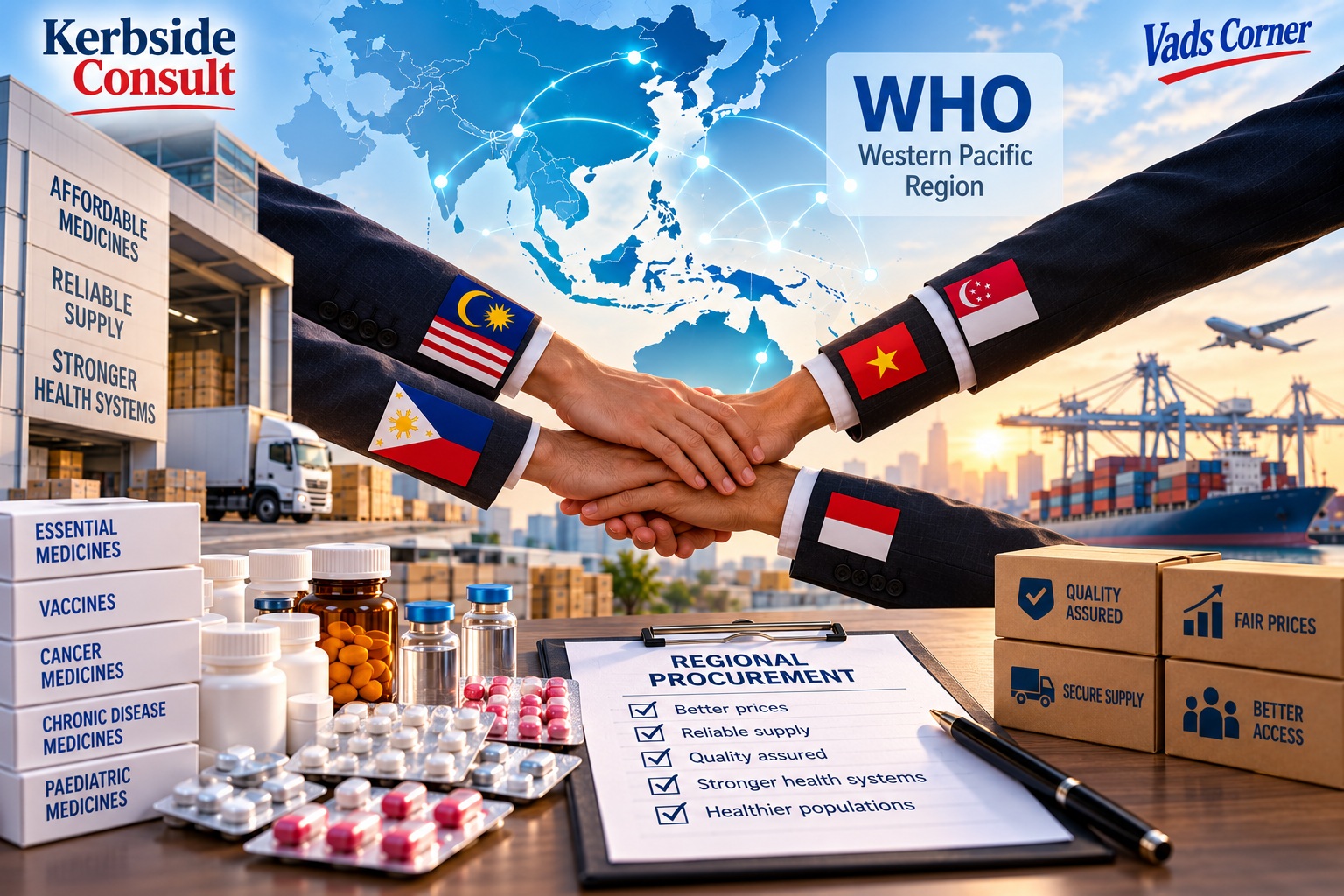
Malaysia has asked the WHO to consider an urgent pilot in which countries buy selected medicines together. This week in Manila, Health Minister Dzulkefly Ahmad put the proposal to a ministerial roundtable held alongside the WHO Western Pacific Regional Committee meeting.[1] His reasons will be familiar to anyone who has chased a stock-out: disrupted supply chains, jittery markets, heavy reliance on imported active pharmaceutical ingredients (APIs), and geopolitical conflict making all of it worse.[1]
The attraction is obvious: combine purchasing power, negotiate better terms, reduce the risk of shortages. But proposing a mechanism is not the same as making one work. The WHO’s own paper for the roundtable calls the discussion exploratory and says it is not meant to set up a specific regional mechanism; the Secretariat wants guidance on consultations, evidence gathering and feasibility work.[2] Put plainly: Malaysia is asking for a pilot; the paper is asking for a study. I have not yet found a report of how the roundtable ended.
So what is being proposed, does buying together actually work, what should we buy, and where does it come unstuck? That is what this piece tries to answer, kerbside rather than boardroom.
A word on where I stand. I am an independent consultant to the pharmaceutical industry, and I have worked in the Ministry of Health and, earlier, at Servier, Sanofi, Celgene, BMS and Novavax. No company sponsored or reviewed this article, and I have no financial interest in the proposal.
Contents
Why should Malaysia care?
Because we are a small buyer in a world where API supply is concentrated. The president of the Malaysian Association of Pharmaceutical Suppliers described Malaysia as virtually dependent on imports for medicine security, with China and India the largest API suppliers, and dependence highest for newer, more complex products such as biologics, of which Malaysia has only one local manufacturer.[3] That is an industry body speaking to the press, so read it as a view from the importers’ side, but it matches how the WHO paper describes supply breaking down: shortages of raw materials or APIs, concentrated supplier bases, and poor visibility of stocks and manufacturing capacity.[2]
There is a household-budget side too. In many countries medicines are the largest part of out-of-pocket health spending, and although the share of people in the Region facing financial hardship from health costs fell to 27% in 2022 from 40% in 2000, nearly 600 million still do.[2]
And there is a price side. An analysis of 2010–2014 procurement, co-authored by a Ministry of Health staff member, looked at a basket of 205 medicines worth about a quarter of the medicines budget, and found that the public sector paid roughly two to three times international reference prices (quantity-weighted ratio 2.2 in 2010 and 1.9 in 2014; expenditure-weighted 3.2 and 2.9). After allowing for the source and category of medicine, the three purchasing routes did not differ significantly. The authors pointed to fragmented buying across ministries and routes and to Malaysia not buying jointly with regional countries, and they recommended pooled procurement options. They also noted that higher Malaysian regulatory requirements, such as PIC/s good manufacturing practice and bioequivalence studies, may add to prices, so the ratio is not a like-for-like overpayment. The data are now a decade old, and new and more specialised medicines were excluded.[32]
What is on the table
- A pilot, not a grand scheme. Pooled buying for selected medicines that have healthy supplier competition and a clear shared need, run transparently.[1]
- An ASEAN Medicines Security Dashboard. An early-warning tool linking prices with supply distribution, stock availability and manufacturing capacity.[1] ASEAN already has a price-sharing platform, PIEMEDS, to build on,[7] and WHO’s own access roadmap commits to better market information on supply, demand and price.[23]
- A manufacturing alliance. Price monitoring alone cannot guarantee medicine security; joint investment is needed to cover production gaps.[1]
- Accountability. A lead country under the 2026–2030 Plan, with funding accountability and clear key performance indicators.[1]
At home, the minister said, Malaysia already pools procurement across government health facilities, keeps a three-month medicine buffer stock, and has led the ASEAN Drug Security and Self-Reliance (ADSSR) initiative.[1] Pooled buying is only one of five ideas in the WHO paper, alongside faster access to rare and critical products such as antidotes and antitoxins, regulatory reliance, shared warning of shortages, and regional emergency readiness. The paper adds that strong national systems remain the foundation, with voluntary collaboration added where it solves a defined problem.[2]
Does buying together work?
Pooling is not new. The Gulf states and PAHO’s vaccine Revolving Fund began buying together in the late 1970s,[4] the Eastern Caribbean states decided to pool in 1986,[10] and PAHO’s Strategic Fund for medicines followed in 2000.[8] The best synthesis I found is a 2022 systematic review of 44 empirical studies. Of those, 29 reported on price, and most saw prices fall after pooling; 11 looked at availability, with mixed results. The authors warn that the literature leans towards success stories, because attempts that failed rarely get written up.[4] The experience falls into rough groups.
Established programmes. The Global Drug Facility for TB medicines sits under the Stop TB Partnership with United Nations backing, gave grants to buyers at the start, and gave high-burden countries a seat in its governance.[13] The Eastern Caribbean service worked because the members were small, similar states with one currency and enforced participation, and suppliers were given reasons to bid: central payment, standard procedures and long-term framework agreements. Even there, demand forecasting was sometimes wrong.[13], [4]
Implementation difficulties. The Pacific Island countries never got started: they differ widely in size, money and health needs, several already bought from Australia and New Zealand at relatively low prices, some feared extra administrative costs, and there was wariness over who would lead.[13] For a Western Pacific pilot this is the closest precedent, and the least comfortable. The East African Community began work in 2005 and had made limited progress by 2024, stalling for years for lack of dedicated funding and ownership before a dedicated organisation was set up.[14] The Asthma Drug Facility had no clear structure or dedicated staff and faded.[13]
Limited evidence of extra savings. Two findings caution against assuming that size alone buys price. A difference-in-differences analysis of the Global Fund’s voluntary pooled procurement found that it reduced the ex-works price of generic efavirenz by 16.2% (19.1% on delivered price, P < 0.001) between 2009 and 2013, yet neither transaction volume nor the number of generic manufacturers was statistically associated with price, and prices were already falling steadily over the period.[26] A study of seven lower- and middle-income countries compared prices across purchasing channels for 40 essential molecules (2015–2017; 33 of the 40 had generics, over 95% of observations). Centralised public buying obtained prices about 15% lower on average, but the advantage shrank as the supplier market became more concentrated and vanished at high concentration. This is an observational comparison within countries, not a before-and-after of a regional pool, and the authors could not separate stronger bargaining power from volume discounts.[29] Separately, in Sanming, China, a 24-month time-series study found that adding centralised procurement to a zero mark-up policy produced no significant further fall in hospital drug or total spending, and spending trends resumed rising. The authors suggest hospitals had little incentive to cut purchase prices and that a centralised system already existed.[27] That is one city, a short study, and spending rather than prices, so it is a caution, not a verdict on Chinese policy.
Mixed. The European Court of Auditors found that the EU Commission signed COVID-19 vaccine contracts worth €71 billion for up to 4.6 billion doses and secured enough for at least 70% of adults by the end of summer 2021. But the EU started later than the UK and US, two manufacturers fell seriously short in the first half of 2021, most contracts had no provisions for supply disruption, and the process was never properly benchmarked.[15]
Conditions matter more than the label. Colombia and Mexico both turned to pooling for patented medicines. As the review reads it, Colombia’s laws allowed it to buy through the PAHO Strategic Fund and its stakeholders were aligned; Mexico’s law restricted imports of patented products to the patent holder, and its early savings faded.[4] PAHO reports large savings from its own funds,[9] but that is the operator describing its own results.
Elsewhere now. The African Pooled Procurement Mechanism sits under the African Union and Africa CDC; Ghana signed a memorandum of understanding with Africa CDC on 21 August 2026, and a regional meeting in Accra in November is due to agree the supply catalogue.[17] The EU’s Critical Medicines Act, proposed in March 2025,[16] reached provisional agreement between Council and Parliament on 12 May 2026; both must still endorse it and formally adopt it after legal-linguistic revision.[30] The Council’s December 2025 position would make resilience criteria take precedence over price for critical medicines and cut to six the number of member states needed to request collaborative procurement;[30] a Brussels office reports the final compromise at five, with joint procurement still voluntary and the wording on award criteria not yet final.[31] A WHO workshop with the EU’s HERA on pooled procurement for health emergencies was held in Kuala Lumpur in June 2026; it concerns emergency products, not routine medicines.[18] (Africa and HERA rest on single news reports.) ASEAN’s own five-year ADSSR plan, endorsed in September 2026, includes a regional procurement and buffer-stock mechanism, with Malaysia co-leading five priority areas.[5], [6], [7]
What should Malaysia buy together?
Nobody has published a product list. Lane 1 is what the minister asked for; Lane 2 is my own proposal.
Lane 1: what Malaysia asked for. Selected medicines with healthy supplier competition and clear shared needs, bought transparently.[1] In practice that means multi-source generics. PAHO’s Strategic Fund began its chronic-disease list with 16 essential medicines for hypertension, diabetes, cardiovascular disease and cancer.[8] Low-margin products whose API comes from few sources are the obvious candidates for supply security.[3] My screening test: at least three qualified suppliers, presence on most members’ essential medicines lists with credible forecasts, a standard formulation with decent shelf life, and API from more than the two dominant sources. Start with a basket small enough to measure, perhaps eight to ten products. Contracts should set a minimum remaining shelf life on delivery; WHO’s expert committee has endorsed developing guidance because agencies’ rules differ.[25] Quality needs a gate: Delhi’s pooled system tendered competitively, pre-qualified suppliers on explicit criteria including minimum annual turnover, and inspected manufacturers; 7 of 27 firms inspected were rejected. The programme staff who wrote it up reported a documented quality failure rate below 1%, but had no baseline, and could not sustain independent inspections of all vendors for lack of funds. They also estimated savings of nearly 30% of the drug bill.[28] Those are the programme’s own estimates, from one state. WHO prequalification already offers a quality gate that buyers can lean on.[24]
Rare and critical low-volume items, such as antidotes, antitoxins and some paediatric formulations, are a separate case in the WHO paper.[2] Price is not the point there; shared visibility of stock and advance arrangements with suppliers matter more.[2]
Lane 2: what I would add. The products that cost most and matter most to patients are not generics: originator cancer drugs, costly chronic-disease therapies, rare-disease treatments, and low-volume devices such as adrenaline auto-injectors. The minister’s test of healthy supplier competition would leave these out. I would not.
My proposal is an open tender, followed by negotiation. The case rests on volume. Pooled across several countries, volume is the one thing a region can offer a company, and an open call puts originators, generics and biosimilars at the same table instead of deciding beforehand who may bid. The tender sets the benchmark; the negotiation with shortlisted bidders deals with what a tender cannot, such as the price of a single-source product and the supply terms. One caution on my own argument: volume gets companies to the table, but the evidence that volume itself sets the price is thin; one analysis found no association,[26] and another, built almost entirely on generics, could not separate volume from bargaining power.[29] That is why I want the negotiation step.
That shape has been tried, and the closest example is India’s National Cancer Grid. It pooled demand from 23 centres for 40 high-value oncology and supportive-care drugs. Forty-six vendors bid; 33 passed pre-qualification; generic and innovator products had separate reserve prices; group negotiation followed. It reported savings of 23% to 99% (median 82%) against maximum retail prices, with the contracts taking a year from set-up and negotiated prices valid for two years.[20] Those are savings against list prices, not against what centres actually paid, and they were larger for generics than for innovator and newly patented drugs.[20] It also shows the limit of a tender: dasatinib was dropped because its single-source supplier never quoted, and cetuximab and iohexol went the same way.[20] For those I would negotiate directly rather than wait for a bid.
Other experience points the same way. Colombia bought hepatitis C treatment centrally through PAHO’s Strategic Fund; a one-year assessment reported prices falling by more than 90% and 96% of those completing treatment cured, though it was not a controlled comparison.[19] Malaysia’s own 2017 government-use licence for sofosbuvir was set against a course price that DNDi, an advocacy organisation, put at about US$70,000, with a US$300 course agreed for a Pharco combination.[21] It has failed too: the first Belgium–Netherlands joint pricing pilot collapsed in 2017 when talks with Vertex over a cystic fibrosis drug ended without a price (trade press, partly paywalled).[22]
Originators, biosimilars and generics cannot be judged by identical tender rules. A shared design would need to settle clinical equivalence, a common health technology assessment, regulatory approval in each member, intellectual-property limits on who may supply, and each country’s own reimbursement rules. What it would take, in my view: a small group of willing members, not all 38; two or three products picked for burden and for a credible alternative, such as biosimilars arriving or a curative therapy; a published price benchmark; a legal basis in each country;[4] and measures set in advance. Companies will worry about one low price spilling into other markets, and a region running from Japan to small Pacific islands makes that worse. How a mixed-income group answers that is the real test.
What could go wrong?
- Competition cuts both ways. Bigger, less frequent tenders could squeeze out small suppliers and cost us in the long run. The review found this plausible but not demonstrated.[4] The review also suggests multiple-winner contracts rather than winner-takes-all, to keep competition and cover production disruption; that is a proposal, not a tested result.[4]
- Buyers need their house in order. Accurate forecasting, funding and a compatible legal basis recur as preconditions.[4] Stalling in East Africa and fading in the Asthma Drug Facility both trace to money and ownership,[14], [13] and who leads, and what each country gives up, sank trust in the Pacific.[13] The minister’s call for a lead country and funding accountability[1] addresses exactly this.
- Local preference needs care. In the same Malaysian analysis, local generics were bought at lower relative prices than imported generics or originators (median price ratios 1.45, 2.14 and 4.04), yet bulk buying of them did not bring prices near reference levels. The authors suggest a fixed price handicap for local producers instead of blanket preference, to keep price pressure on them.[32] That matters for any regional tender.
- Who is “the region”? The Western Pacific region has 38 countries and areas, from large economies to small Pacific islands.[11] ASEAN does not sit neatly inside WHO’s map: Thailand, Myanmar, Indonesia and Timor-Leste belong to the South-East Asia Region.[12] A Western Pacific pilot and an ASEAN dashboard are two different memberships. The real question is whether Malaysia is better served by strengthening ADSSR or by joining an additional WHO-facilitated programme, and the answer may differ for price negotiation and for emergency stock security.
- Savings are not guaranteed. Where prices are already low, as in parts of the Pacific, the case rests on reliability, quality and lower administrative cost, and should be made that way.[13]
- Buy resilience, not just price. The EU experience says contracts need supply-disruption terms and a hard look at suppliers’ production chains before signing.[15]
- Start small and measure from the first order. East African authors recommend a phased approach,[14] and the EU auditors faulted the lack of benchmarking.[15]
How would we measure success?
Agree these before the first order, and publish them:
- Actual purchase-price savings against comparable historical prices, including freight and administration.
- Fewer stock-outs and treatment interruptions.
- Delivery reliability and product quality.
- Time from procurement decision to patient access.
- Number of patients receiving treatment.
- Contract management, audit findings and supplier performance, reported openly.
My perspective
Buying medicines together is not a new idea, nor a guaranteed route to cheaper medicines. The evidence says pooling can work when members share clear objectives, have dependable financing and accept common rules, and that size alone does not set the price.
For Malaysia, I would start with a limited, transparent pilot for a handful of generic medicines, while separately exploring an open tender followed by negotiation for the expensive innovative treatments that matter most to patients. Both should be judged against what we pay now and what patients actually receive. The shopping list is the easy part. The harder part is the habits of the buyers behind it: forecasting honestly, paying on time, and sticking together when a cheaper offer walks past.
In the end, success should not be measured by how much governments announce they have saved, but by whether patients get safe, effective medicines when they need them.
This is my personal opinion, not the view of any current or former employer, client or organisation. It rests on public sources available on 21 October 2026, including news reports I have labelled as such, and the picture may change. It is not policy, legal or investment advice.
Sources & further reading
- Malaysia calls for WHO-led pooled medicine purchasing amid supply risks. Malay Mail (Bernama), 21 Oct 2026 (journalistic source) [cited 2026 Oct 21]. Source
- WHO Regional Office for the Western Pacific. Ministerial roundtable: Regional health essential stockpile and pooled procurement mechanism. WPR/RC77/10, 8 Sep 2026 [cited 2026 Oct 21]. Source
- Medicine prices not rising yet but API costs to hit soon: importers. CodeBlue, 30 Apr 2026 (journalistic source; views of the Malaysian Association of Pharmaceutical Suppliers) [cited 2026 Oct 21]. Source
- Parmaksiz K, Pisani E, Bal R, Kok MO. A systematic review of pooled procurement of medicines and vaccines: identifying elements of success. Globalization and Health 2022 (PMID 35690779). Source
- ASEAN rolls out five-year plan to secure essential medicines for 600 million. Bernama, 10 Sep 2026 (journalistic source) [cited 2026 Oct 21]. Source
- ASEAN laksana pelan lima tahun jamin bekalan ubat-ubatan penting. Bernama (Bahasa Malaysia), 10 Sep 2026 (journalistic source) [cited 2026 Oct 21]. Source
- ASEAN member states pledge to strengthen cooperation on regional drug security. Bernama, 28 May 2025 (journalistic source) [cited 2026 Oct 21]. Source
- PAHO. Countries have access to affordable medicines for hypertension and other chronic diseases through the PAHO Strategic Fund. 8 Apr 2013 (states the Fund was created in 2000) [cited 2026 Oct 21]. Source
- PAHO. Regional Revolving Funds: a health cooperation success story. 2024 (savings figures are the operator’s own) [cited 2026 Oct 21]. Source
- OECS Pharmaceutical Procurement Service (pooling decided in 1986). Indiana University Pain & Policy Studies Group [cited 2026 Oct 21]. Source
- Singapore Ministry of Health. Minister Ong Ye Kung to attend the 77th WHO Regional Committee Meeting for the Western Pacific. 16 Oct 2026 (38 member states and areas) [cited 2026 Oct 21]. Source
- WHO South-East Asia. History of WHO in South-East Asia (regional membership) [cited 2026 Oct 21]. Source
- Parmaksiz K, van de Bovenkamp H, Bal R. Does structural form matter? A comparative analysis of pooled procurement mechanisms for health commodities. Globalization and Health 2023;19:90 (PMID 37996877). Case studies of OECS, Pacific Island Countries, Global Drug Facility and Asthma Drug Facility. Source
- Parmaksiz K, Asingizwe D, Gichohi AK, Karengera S. Towards regional access to medicines: the development of the East African Community pooled procurement mechanism. J Pharm Policy Pract 2024;17:2390653 (PMID 39175662). Source
- European Court of Auditors. EU COVID-19 vaccine procurement: sufficient doses secured after initial challenges, but performance of the process not sufficiently assessed. Special Report 19/2022, press release 12 Sep 2022 (I read the press release, not the full report) [cited 2026 Oct 21]. Source
- EU Critical Medicines Act Seeks to Enhance Supply and Access Requirements. Sidley Austin, 22 Jul 2025 (law-firm summary of a legislative proposal; current status not checked) [cited 2026 Oct 21]. Source
- Ghana joins African pooled procurement to unlock vaccine market access. Ghana News Agency, 7 Sep 2026 (journalistic source) [cited 2026 Oct 21]. Source
- WHO and HERA push regional pooled procurement for health emergencies. Devdiscourse, 11 Aug 2026 (journalistic source; workshop held in Kuala Lumpur, 8 Jun 2026) [cited 2026 Oct 21]. Source
- Evaluating the centralized purchasing policy for the treatment of hepatitis C: the Colombian case. Pharmacol Res Perspect 2019 (PMID 31857910). One-year policy implementation assessment. Source
- A National Cancer Grid pooled procurement initiative, India. Bull World Health Organ 2023 (PMID 37638358). Source
- DNDi welcomes Malaysia move to access affordable treatments for hepatitis C. 20 Sep 2017 (advocacy organisation press release; price figures are DNDi’s) [cited 2026 Oct 21]. Source
- First Benelux joint pricing and reimbursement pilot fails over Vertex’s Orkambi. Pink Sheet (Citeline), 16 Jun 2017 (trade press, partly paywalled; I read the opening only) [cited 2026 Oct 21]. Source
- World Health Organization. Access to safe, effective and quality-assured health products and technologies: roadmap for WHO action 2025–2030. Geneva: WHO; 2025 (ISBN 978-92-4-011204-9) [cited 2026 Oct 21]. Source
- World Health Organization. Department of Regulation and Prequalification: strategic action plan 2025–2028. Geneva: WHO; 2025 [cited 2026 Oct 21]. Source
- WHO Expert Committee on Specifications for Pharmaceutical Preparations: fifty-third report. WHO Technical Report Series No. 1019. Geneva: WHO; 2019, section 12.2.1 (shelf-life for supply and procurement) [cited 2026 Oct 21]. Source
- Kim SW, Skordis-Worrall J. Can voluntary pooled procurement reduce the price of antiretroviral drugs? A case study of efavirenz. Health Policy Plan 2017;32:516–526 (PMID 28052986). Source
- He Y, Dou G, Huang Q, et al. Does the leading pharmaceutical reform in China really solve the issue of overly expensive healthcare services? Evidence from an empirical study. PLoS One 2018;13:e0190320 (PMID 29338038). Source
- Chaudhury RR, Parameswar R, Gupta U, Sharma S, Tekur U, Bapna JS. Quality medicines for the poor: experience of the Delhi programme on rational use of drugs. Health Policy Plan 2005;20:124–136 (PMID 15746221; full text read; authors are programme staff). Source
- Dubois P, Lefouili Y, Straub S. Pooled procurement of drugs in low and middle income countries. Eur Econ Rev 2021;132 (accepted manuscript, December 2020, read in full; their VoxEU column of 30 Jan 2021 summarises it) [cited 2026 Oct 21]. Source
- Council of the European Union. New rules for critical medicines in the EU (the critical medicines act) [explainer]. Brussels: Council of the EU; 2026 [cited 2026 Oct 21]. Source
- Political Agreement on the Critical Medicines Act. Deutsche Sozialversicherung Europavertretung (German social insurance office in Brussels), 28 May 2026 (secondary source; wording of Article 18 not final) [cited 2026 Oct 21]. Source
- Hamzah NM, Perera PN, Rannan-Eliya RP. How well does Malaysia achieve value for money in public sector purchasing of medicines? Evidence from medicines procurement prices from 2010 to 2014. BMC Health Serv Res 2020;20:509 (PMID 32503539; full text read; first author is at the Ministry of Health Pharmaceutical Services Division). Source