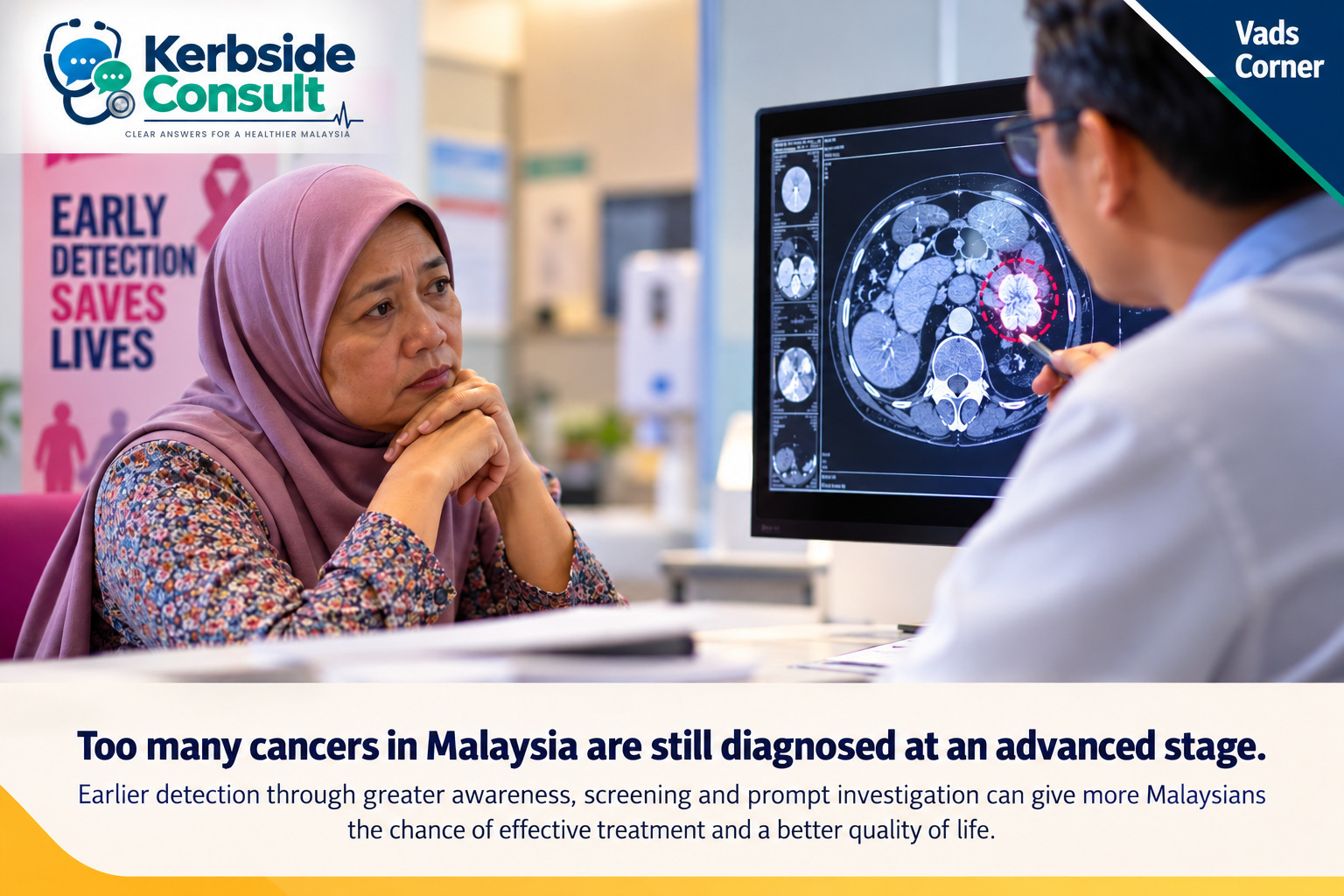
Cancer is not always announced by pain. For many Malaysians, the first diagnosis arrives when the disease is already advanced. This article examines why that happens, what individuals can do, and what the healthcare system must do better.
Contents
- What the Malaysian registry actually says
- What do the newer official figures show?
- Why are diagnoses delayed?
- Screening is not the same as diagnosing symptoms
- What Malaysia has promised, and how it compares
- Affordable public healthcare — but are cancers being diagnosed early enough?
- Unproven cures: a quiet cause of delay
- Cancer awareness: practical do’s and don’ts
- What Malaysia should improve
- Conclusion
- Sources & further reading
What the Malaysian registry actually says
The Malaysia National Cancer Registry recorded 168,823 new cases in 2017–2021. A stage was recorded for 76,125 of them (45.1%). Among those, 24.6% were stage III and 40.2% stage IV, a combined 64.8%[1]. That is 64.8% of staged cases, not of all cancers: stage is missing for more than half of registered cases, and better staging completeness is itself an urgent priority.
A single average hides very different cancers. Breast, colorectal and lung cancers are the most common overall, and by age-standardised rate colorectal cancer leads in men and breast cancer in women[1]. The table sets each cancer’s incidence beside its stage at diagnosis and compares it with the 2012–2016 report.
| Cancer | ASR | Stage recorded, 2012–16 → 2017–21 | Stage III–IV, 2012–16 | Stage III–IV, 2017–21 |
|---|---|---|---|---|
| Breast (women) | 38.9 | 62.3% → 57.9% | 47.9% | 49.7% |
| Colorectal (men) | 18.8 | 55.2% → 51.9% | 72.4% | 73.7% |
| Colorectal (women) | 13.7 | 56.6% → 52.6% | 73.1% | 73.5% |
| Lung (men) | 16.0 | 60.3% → 44.6% | 93.6% | 95.5% |
| Prostate | 9.3 | 40.2% → 45.4% | 68.6% | 63.3% |
| Cervix | 6.0 | 69.6% → 59.9% | 41.0% | 46.6% |
| Liver (men) | 8.4 | 40.7% → 20.1% | 85.5% | 86.0% |
Stage III–IV is stage III plus stage IV among cases with a recorded stage. ASR = age-standardised incidence rate per 100,000, 2017–2021. Sources:[1], [2].
Two things stand out. First, advanced presentation has not eased. Stage III–IV was 63.7% of staged cases in 2012–2016 and is 64.8% now[1], [2]. The share was unchanged or slightly higher for breast, colorectal, lung and liver cancers, higher for cervical cancer (41.0% to 46.6%) and lower for prostate cancer (68.6% to 63.3%). Second, stage recording fell for every cancer in the table except prostate, most sharply for liver (40.7% to 20.1% in men) and lung (60.3% to 44.6% in men).
Because staging completeness and case capture both changed, with the registry citing its web-based notification system from 2018 and mandatory reporting from 2020, these comparisons do not show whether the underlying situation has worsened or improved[1], [2].
Method note: the figures above come from the December 2025 full report, whose data reflect the status at 31 December 2024[1]. The registry’s shorter summary booklet, compiled from notifications up to 31 December 2023, gives slightly different stage percentages (for example breast 50.5%, colorectal 74.9% in men and 74.4% in women)[3].
What do the newer official figures show?
More recent official counts exist, but they say nothing about stage. The Health Minister told the Dewan Rakyat, citing the National Cancer Registry, that new cases were 40,570 in 2022 and 38,814 in 2023 (79,384 combined)[4]. The Department of Statistics Malaysia reported 19,180 deaths attributed to neoplasms in 2024[5]. Case totals are not a stage distribution, and a difference between years should not be read as a change in risk without checking registry completeness and population-adjusted rates. Deaths cannot show what proportion of patients presented at stages I–II. For stage at diagnosis, the 2017–2021 registry report remains the latest comprehensive national distribution identified for this review[1].
Why are diagnoses delayed?
Delays may occur before the first consultation, during primary-care assessment, while awaiting investigations or referral, and between diagnosis and treatment. Fear, cost, distance, stigma and poor health literacy may contribute; so can limited appointment capacity, imaging, endoscopy, pathology and referral coordination[6].
Malaysian research separates three intervals, which need different remedies: presentation (from noticing a symptom to first seeking care), diagnostic (from first presentation to confirmed diagnosis) and treatment (from diagnosis to starting treatment).
A retrospective cohort in six public tertiary centres, analysing 340 women with breast cancer, found median intervals of 2.4 months before presentation, 26 days for diagnosis and 21 days from diagnosis to treatment; the median from first symptom to treatment was 4.9 months[7]. The authors counted presentation as delayed beyond three months, and diagnosis and treatment as delayed beyond one month each. By those thresholds, 35%, 41.8% and 36.2% of women were delayed at the three stages[7]. These figures describe the study participants, not all Malaysian patients.
A separate cross-sectional study of 476 patients with breast, colorectal, nasopharyngeal or cervical cancer, diagnosed in 2015–2020 at seven public hospitals or oncology centres, found presentation delay (more than 30 days from symptom onset to first healthcare visit) in 54.2%, with a median of 60 days. Most patients (80%) discovered their first symptom themselves and only a third acted immediately; 47% cited long waiting times during doctor’s visits among the potential barriers[8]. None of the barrier factors reached statistical significance, so the study cannot show that delay is caused mainly by public-hospital waiting times.
It is unfair to place the burden entirely on patients. A person who seeks help but cannot obtain a timely diagnostic test has not failed the system; the system has failed to respond adequately. The evidence points to two complementary remedies: help people recognise and act on persistent warning symptoms, and audit the time from first healthcare contact to definitive investigation and treatment.
Screening is not the same as diagnosing symptoms
Screening tests are offered to people without symptoms, according to age and risk. A person with unexplained bleeding, a persistent lump or another concerning symptom needs clinical evaluation even if younger than the usual screening age or previously screened.
Population screening should only be expanded where effective tests, confirmatory diagnosis and timely treatment can all be delivered[6], [9]. For colorectal cancer, stool-based screening may be practical, but a positive test requires follow-up, commonly colonoscopy. In a five-year evaluation of opportunistic iFOBT screening in 583 public health clinics (2014–2018), 11,872 of 127,957 people screened tested positive, and colonoscopy was recorded for 6,491 of them, about 55% if all were among the positives[10].
What Malaysia has promised, and how it compares
National targets
The Ministry of Health’s National Strategic Plan for Cancer Control Programme 2021–2025 set a target to downstage breast, colorectal and cervical cancers at diagnosis by 25% by 2030, against the 2012–2016 registry baseline[11]. The Ministry’s Roadmap Towards Downstaging of Breast Cancer in Malaysia 2025–2035 now adopts the three breast targets below: at least 60% of cases diagnosed at stage I or II, diagnostic evaluation within 60 days of presentation, and at least 80% of patients receiving multimodality treatment[12].
The National Strategic Plan for Colorectal Cancer 2021–2025 is more concrete. It targets screening coverage of 40% among adults aged 50–75 by 2030, up from 10.8% in the 2019 National Health and Morbidity Survey, and a 25% reduction in late-stage colorectal cancer: stage III–IV falling from 72.4% to 54.4% in men and from 73.1% to 54.8% in women. It also proposes a patient navigation pathway to reduce defaulting between screening and treatment[13]. The 2017–2021 registry figures are 73.7% and 73.5%[1], so Malaysia is further from, not closer to, those targets, and the late-stage share of breast and cervical cancer also rose (table above). These are policy targets, not evidence that they have been achieved.
Malaysia already has cancer-control policies and screening services. The question is whether they consistently reach eligible people, investigate abnormal results promptly and reduce advanced-stage diagnoses.
International benchmarks
International benchmarks are more defensible than a league table of neighbouring countries, but they must be compared cancer by cancer, not with the share of all staged cancers diagnosed early.
For breast cancer, the WHO Global Breast Cancer Initiative aims for at least 60% of invasive cancers diagnosed at stage I or II, diagnostic evaluation, imaging, tissue sampling and pathology within 60 days, and at least 80% of patients completing a full course of multimodality treatment[14]. Among staged female breast cancers in 2017–2021, 15.8% were stage I and 34.5% stage II: 50.3% at stages I–II, 9.7 percentage points below the stage benchmark[1], [14]. The Malaysian multicentre study found a median diagnostic interval of 26 days, inside the 60-day target, although the longest interval reached 9.3 months[7]. No national figure for treatment completion was identified for this review.
For cervical cancer, WHO’s 2030 targets are 90% of girls fully vaccinated against HPV by age 15; 70% of women screened with a high-performance test by age 35 and again by age 45; and 90% of women with precancer treated and 90% of women with invasive cancer appropriately managed. The elimination threshold is fewer than four new cases per 100,000 women a year[15]. Malaysia’s own action plan describes opportunistic Pap-smear coverage as “dismal”, averaging about 25% over 2015–2020[16]; a 2026 draft Commonwealth case study repeats 25% as the current baseline among eligible women, without a year or source of its own[17]. The 25% is a five-year average of opportunistic cytology, and the WHO target is for a high-performance test at ages 35 and 45, so the apparent 45-point gap is illustrative, not a validated like-for-like comparison. Malaysia has introduced subsidised HPV DNA self-sampling for eligible women aged 30–65 through LPPKN[18], but availability is not verified national coverage.
What other countries do
South Korea’s National Cancer Screening Program offers biennial endoscopy (or an upper gastrointestinal series) for gastric cancer to adults aged 40 and older, alongside colorectal, breast and cervical screening and targeted liver and lung screening in high-risk groups[19], [20]. It is a useful model of organisation, but universal gastric endoscopy should not simply be transplanted: stomach cancer ranks ninth among Malaysian men (ASR 3.4 per 100,000) and is outside the top ten in women[1].
Taiwan expanded publicly funded biennial faecal immunochemical testing (FIT) in January 2025 to adults aged 45–74, and to those aged 40–44 with a first-degree relative with colorectal cancer[21]. A positive FIT requires a timely diagnostic colonoscopy, not a repeat stool test. Taiwan’s health authority cites associations of regular screening with a 29% reduction in late-stage colorectal cancer incidence and a 35% reduction in mortality; these are programme-level estimates, not guaranteed individual benefits[21]. A later Taiwanese release quotes 34% and 40% for the same two outcomes[22]. In March 2026 it reported more than 1.67 million people screened since the expansion, about 30% more than in the comparable prior period[22]. Higher uptake is encouraging, but stage and mortality trends need continued evaluation.
Australia’s National Bowel Cancer Screening Program mails a free home FIT kit every two years to people aged 50–74, and people aged 45–49 can request one[23]. Singapore’s Healthier SG Screening offers subsidised cervical and colorectal screening through CHAS general practitioner clinics, free for Healthier SG–enrolled citizens at their enrolled clinic, with breast screening at selected polyclinics[24]. In each case the test is only the first step: a free test or an invitation does not by itself guarantee completed diagnostic follow-up.
Affordable public healthcare — but are cancers being diagnosed early enough?
Malaysia starts with an important advantage: a broad network of government hospitals and Klinik Kesihatan offering highly subsidised care. Under the Ministry of Health’s Fees (Medical) Order 1982, a Malaysian citizen referred by a government medical officer pays RM1 at a general outpatient clinic, nothing for the first specialist clinic visit and RM5 for each follow-up[25]. These are consultation arrangements; specific procedures may carry separate charges.
Malaysia also operates PeKa B40 for eligible Sumbangan Tunai Rahmah (STR) recipients and registered spouses aged 40 and above. It provides free general health screening at participating private clinics, with referral to Ministry of Health facilities when indicated. The programme page lists a health and family-history review, a physical examination (including a clinical breast or prostate examination for those at risk) and blood and urine tests, but no mammography, colonoscopy or low-dose CT. It also pays RM1,000 to cancer patients who complete treatment at a Ministry hospital (RM300 on starting, RM700 on completing) and offers transport assistance, capped at RM500 for Peninsular Malaysia and RM1,000 for Sabah, Sarawak and Labuan.[26]
It would therefore be misleading to describe high consultation fees as the principal explanation for late diagnosis in Malaysia, and affordability does not guarantee that every diagnostic investigation is immediately available. The policy challenge is to make early-detection pathways reliable and equitable, not simply cheaper.
Unproven cures: a quiet cause of delay
Complementary approaches are used alongside conventional cancer care. Selected practices such as mindfulness, exercise programmes and acupuncture may help some patients cope with symptoms or treatment side effects when used appropriately[27], [28]. In a convenience sample of 100 breast cancer survivors in northern Peninsular Malaysia, nutritional supplements and vitamins were the most common complementary products, and the authors noted that such use has been associated with delays in obtaining treatment[29]. That is a small, single-region study, not a national estimate.
Alternative therapies are used instead of evidence-based treatment. There is no convincing evidence that special diets, supplements, coffee enemas or other advertised “natural cures” can replace potentially curative cancer treatment. Some products may cause toxicity or interfere with anticancer medicines[27], [28], [30].
Patients should tell their oncology team about all herbs, supplements and other treatments they use. A second medical opinion is reasonable; delaying or abandoning effective care for an unproven remedy may be dangerous.
Cancer awareness: practical do’s and don’ts
DO: Seek assessment for persistent or worsening unexplained symptoms, new lumps, altered bowel habits, unusual bleeding, non-healing sores, unexplained weight loss or persistent cough. Seek urgent care for severe bleeding, coughing up blood, new neurological deficits or other serious symptoms. Ministry of Health guidance asks doctors to refer within two weeks for unexplained rectal bleeding, altered bowel habit, significant weight loss, unexplained iron-deficiency anaemia or a palpable abdominal or rectal mass[31], and for women over 35 with symptoms or signs of breast cancer[32].
DO: Take part in recommended screening; learn your family history; ask when test results will be available; and ensure an abnormal result is followed through to diagnosis or a clear plan. Discuss HPV and hepatitis B vaccination where appropriate. Ministry of Health guidance offers screening for average-risk adults aged 50–75 with an iFOBT, followed by colonoscopy if positive[31], and a screening mammogram every two years for women aged 50–74 in the general population, from age 30 for those at high risk[32]. WHO’s guide on early diagnosis is written for policy-makers and programme managers, so it supports the system actions in the next section rather than advice to individuals[6].
DON’T: Postpone evaluation because symptoms are painless or embarrassing, or because you feel otherwise well.
DON’T: Rely on private whole-body scans or blood-test panels instead of recommended screening. Ask your doctor which tests suit your age and risk.
What Malaysia should improve
Build public awareness without fear-based messaging; shorten referral-to-diagnosis intervals; improve endoscopy, imaging and pathology capacity; track positive screening tests to resolution; and ensure equitable access across rural and urban populations.
Then measure it. Publish, annually and by cancer type: staging completeness; the share diagnosed at stages I–II and III–IV; HPV screening coverage on WHO-compatible definitions; diagnostic completion; and the intervals from first presentation, or an abnormal screening result, to diagnosis and treatment. Case counts alone cannot tell the public whether earlier diagnosis is improving.
A screening programme is not successful simply because more tests are performed. Its value depends on appropriate follow-up and access to effective treatment.
Conclusion
Cancer awareness is not about living in fear. It is about recognising meaningful changes, seeking timely advice and ensuring that the healthcare system can respond. Earlier diagnosis requires both informed patients and an accountable, accessible health service.
Sources & further reading
- National Cancer Registry Department, Institut Kanser Negara, Ministry of Health Malaysia. Malaysia National Cancer Registry Report 2017–2021 (Publication No. 9) [Internet]. Putrajaya: Ministry of Health Malaysia; December 2025 [cited 2026 Oct 21]. Source
- National Cancer Registry Department, National Cancer Institute, Ministry of Health Malaysia. Malaysia National Cancer Registry Report 2012–2016. Putrajaya: Ministry of Health Malaysia; 2019. Source
- National Cancer Registry Department, Institut Kanser Negara. Summary of the Malaysia National Cancer Registry Report 2017–2021 (ref. MOH/P/IKN/11.24). Putrajaya: Ministry of Health Malaysia. Listed at the Ministry’s publication page. Source
- Hasif Idris. PARLIMEN: Kes kanser baharu turun [Parliament: new cancer cases fall]. Utusan Malaysia. 13 October 2025. Reply by the Minister of Health in the Dewan Rakyat, citing the National Cancer Registry. Source
- Department of Statistics Malaysia. Statistics on causes of death, Malaysia, 2025 [Internet]. Putrajaya: DOSM; 2025 (reports deaths in 2024) [cited 2026 Oct 21]. Source
- World Health Organization. Guide to cancer early diagnosis [Internet]. Geneva: World Health Organization; 2017 [cited 2026 Oct 21]. Source
- Mohd Mujar NM, Dahlui M, Emran NA, et al. Breast cancer care timeliness framework: a quality framework for cancer control. JCO Glob Oncol. 2022;8:e2100250. doi:10.1200/GO.21.00250. Source
- Gyeltshen T, Teh HS, Loo CE, et al. Factors influencing presentation delay among cancer patients: a cross-sectional study in Malaysia. BMC Public Health. 2024;24:1260. doi:10.1186/s12889-024-18643-2. Source
- World Health Organization. Promoting cancer early diagnosis [Internet]. Geneva: WHO; [publication date not shown] [cited 2026 Oct 21]. Source
- Tamin NSI, Razalli KA, Sallahuddin SN, Chan HK, Hassan MRA. A 5-year evaluation of using stool-based test for opportunistic colorectal cancer screening in primary health institutions across Malaysia. Cancer Epidemiol. 2020;69:101829. doi:10.1016/j.canep.2020.101829. Source
- Ministry of Health Malaysia. National Strategic Plan for Cancer Control Programme 2021–2025 [Internet]. Putrajaya: Ministry of Health Malaysia; 2021 [cited 2026 Oct 21]. Source
- Family Health Development Division, Ministry of Health Malaysia. Roadmap towards downstaging of breast cancer in Malaysia 2025–2035: take the next step. Putrajaya: Ministry of Health Malaysia; 2025. Listed on the Ministry’s strategic plans page, 7 April 2026. Source
- Ministry of Health Malaysia. National Strategic Plan for Colorectal Cancer 2021–2025. Putrajaya: Ministry of Health Malaysia; 2021. Source
- International Agency for Research on Cancer. Global Breast Cancer Initiative: programme targets and implementation [Internet]. Lyon: IARC; [publication date not shown] [cited 2026 Oct 21]. Source
- World Health Organization. Global strategy to accelerate the elimination of cervical cancer as a public health problem [Internet]. Geneva: WHO; 2020 [cited 2026 Oct 21]. Source
- Ministry of Health Malaysia. Action plan towards the elimination of cervical cancer in Malaysia 2021–2030. Putrajaya: Family Health Development Division, Ministry of Health Malaysia; 2021. p. 13. Source
- Commonwealth Secretariat. Cervical cancer elimination across the Commonwealth: country case studies. Malaysia chapter [Internet]. Draft report; 2026 [cited 2026 Oct 21]. Source
- Government of Malaysia. Cervical cancer screening programme (HPV DNA test) by LPPKN [Internet]. Putrajaya: Government of Malaysia; 2026 [cited 2026 Oct 21]. Source
- Ministry of Health and Welfare, Republic of Korea. National Cancer Screening Program [Internet]. Sejong: Ministry of Health and Welfare; 2026 [cited 2026 Oct 21]. Source
- Lee K, Suh M, Choi KS. Current status of the National Cancer Screening Program in Korea: history, achievements, and future directions. J Prev Med Public Health. 2025;58(4):337–347. Source
- Health Promotion Administration, Ministry of Health and Welfare, Taiwan. Expanding colorectal cancer screening [Internet]. Taipei: Health Promotion Administration; 2025 [cited 2026 Oct 21]. Source
- Health Promotion Administration, Ministry of Health and Welfare, Taiwan. Colorectal cancer screening and follow-up [Internet]. Taipei: Health Promotion Administration; 2026 [cited 2026 Oct 21]. Source
- Australian Government Department of Health, Disability and Ageing. About the National Bowel Cancer Screening Program [Internet]. Canberra: Department of Health; [publication date not shown] [cited 2026 Oct 21]. Source
- Health Promotion Board, Singapore. Healthier SG Screening (Screen for Life) [Internet]. Singapore: HealthHub; [publication date not shown] [cited 2026 Oct 21]. Source
- Ministry of Health Malaysia. Perintah Fi (Perubatan) 1982 (Jadual A), as amended 2017: charges for Malaysian citizens [Internet]. Putrajaya: Ministry of Health Malaysia [cited 2026 Oct 21]. Source
- Ministry of Finance Malaysia. Skim Peduli Kesihatan untuk Kumpulan B40 (PeKa B40) [Internet]. Putrajaya: Ministry of Finance Malaysia, Manfaat portal [cited 2026 Oct 21]. Source
- National Cancer Institute. Complementary and alternative medicine for patients [Internet]. Bethesda (MD): National Cancer Institute; 2025 [cited 2026 Oct 21]. Source
- National Center for Complementary and Integrative Health. Cancer and complementary health approaches: what you need to know [Internet]. Bethesda (MD): NCCIH; 2021 [cited 2026 Oct 21]. Source
- Knight A, Hwa YS, Hashim H. Complementary alternative medicine use amongst breast cancer patients in the Northern region of peninsular Malaysia. Asian Pac J Cancer Prev. 2015;16(8):3125-30. doi:10.7314/apjcp.2015.16.8.3125. Source
- National Cancer Institute. Popular diets, supplements, and cancer [Internet]. Bethesda (MD): National Cancer Institute; 2024 [cited 2026 Oct 21]. Source
- Ministry of Health Malaysia. Clinical practice guidelines: management of colorectal carcinoma. Quick reference for healthcare providers [Internet]. Putrajaya: Ministry of Health Malaysia; [year not stated on document] [cited 2026 Oct 21]. Source
- Ministry of Health Malaysia, Academy of Medicine of Malaysia. Clinical practice guidelines: management of breast cancer, third edition. Quick reference for healthcare providers [Internet]. Putrajaya: Ministry of Health Malaysia; [year not stated on document] [cited 2026 Oct 21]. Source