Preamble
A clinical trial may begin with a scientific question, but turning that question into a study involving patients is another matter altogether.
For years, Malaysia had capable doctors, hospitals treating large numbers of patients and pharmaceutical companies interested in conducting clinical research. Yet having all these ingredients did not necessarily mean that a clinical trial could be conducted efficiently, consistently and to international standards.
I remember the considerable groundwork involved in conducting clinical trials in Malaysia in the early 1990s. Finding an interested investigator was often only the beginning. We had to develop study protocols, design case report forms, obtain ethics and regulatory approvals, train study teams, monitor the conduct of trials, manage and validate data, undertake statistical analyses, prepare clinical study reports and eventually assist investigators with manuscript preparation for publication.
And there were the everyday challenges — recruiting suitable patients, ensuring follow-up visits, resolving incomplete documentation, dealing with equipment problems and finding time for research in already busy clinical departments.
I also had the opportunity to see the development of Malaysia's clinical-research infrastructure from the inside. I served on the National Committee for Clinical Research (NCCR) as a representative of the Pharmaceutical Association of Malaysia (PhAMA), as recorded in the committee's archived membership list. I was involved in some of the early groundwork, including the development of our Good Clinical Practice guidelines. It was a period of considerable learning and collaboration, and I was pleased to have played a small part in helping clinical research take root in Malaysia. [1]
Over time, Malaysia began building the infrastructure, institutions and professional workforce needed to answer those questions.
This article follows two earlier Kerbside Consult pieces. The Clinical Trial Has Changed examined the evolution of Good Clinical Practice and the standards governing clinical trials. Medical Research in Malaysia: From Participant to Contributor explored the broader development of Malaysia's medical-research infrastructure.
Here, I want to tell another part of that story: how Malaysia developed the ecosystem needed to conduct industry-sponsored clinical trials, the people and institutions that helped build it, and what still needs to be done.
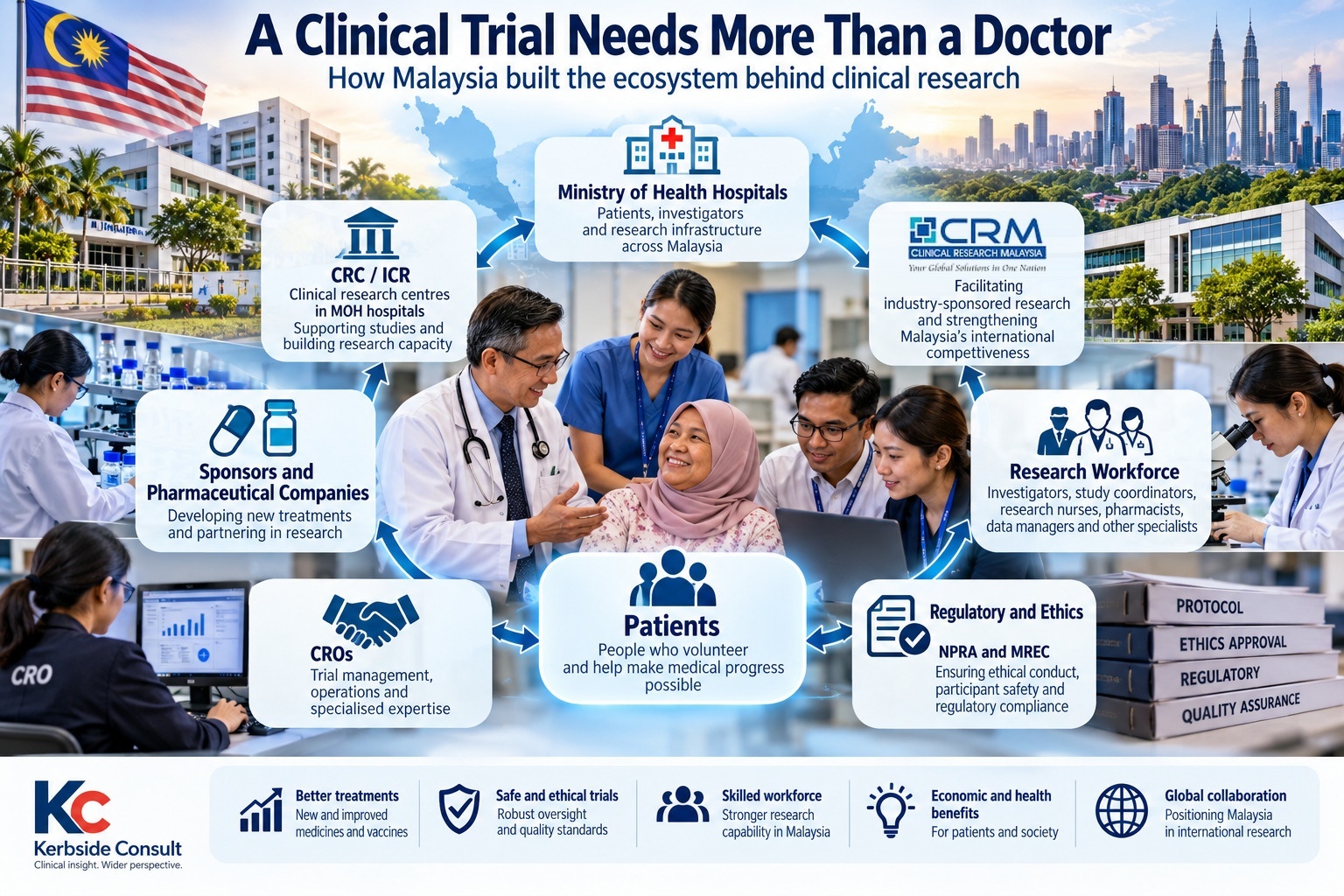
Because, as we shall see, a clinical trial needs more than a doctor.
1. Before There Was a System
Clinical trials were being conducted in Malaysia long before CRC or CRM.
Pharmaceutical companies were already bringing multinational studies here, and Malaysian investigators were participating in them. International companies generally worked to international standards even before Malaysia formalised its own GCP framework.
But much depended upon individual investigators and individual institutions.
A doctor might be enthusiastic about research.
Enthusiasm did not provide a study coordinator, research nurse, statistician, secure document storage, contracting system or protected research time.
Nor did it provide a national mechanism through which a sponsor could identify suitable hospitals, investigators and patients.
Clinical research needed somewhere to live.
The NCCR's own 2010 Bulletin captured the principle behind this effort. In his foreword, then Director-General of Health Tan Sri Dr Ismail Merican stressed that building a clinical-research environment was not the responsibility of the Ministry of Health alone. It required stakeholders to work together, with attention to ethical conduct, investigator training and benefits for patients and the public. That was the institutional groundwork needed to move beyond individual enthusiasm. [2]
2. Giving Clinical Research a Home — and Patients
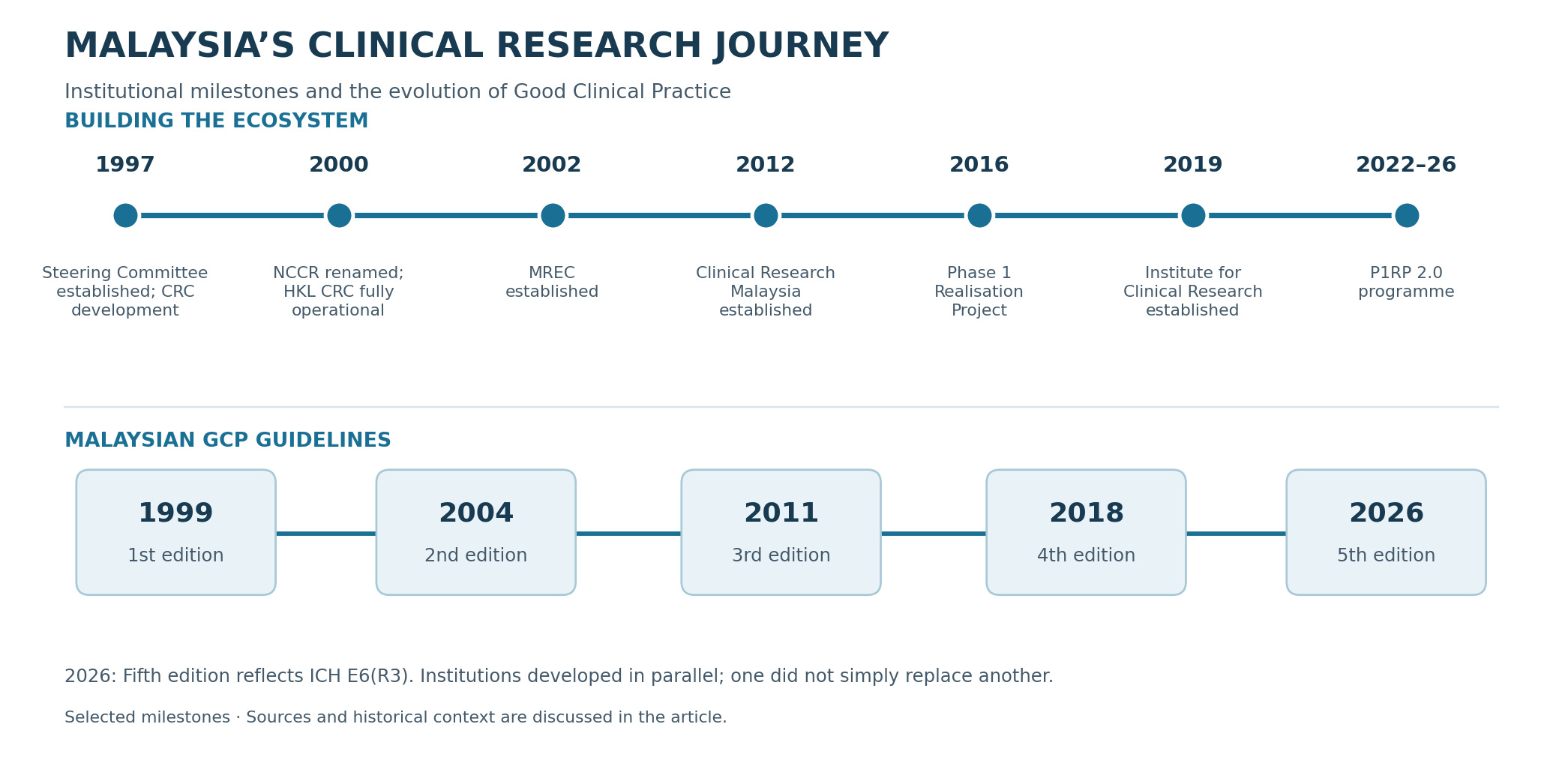
The origins of Malaysia's Clinical Research Centre (CRC) go back to 1997, with the first fully operational CRC established at Hospital Kuala Lumpur in 2000. [3]
The network gave investigators access to shared expertise and practical support beyond their own hospitals.
Access to patients.
The Ministry of Health runs an extensive nationwide system of public hospitals and other healthcare facilities serving large and diverse patient populations.
A sophisticated research centre without suitable patients cannot recruit.
A hospital with thousands of potentially suitable patients but without trained investigators, coordinators and research infrastructure cannot reliably conduct a clinical trial either.
CRC helped bring the two together.
It began connecting research capability with the patients needed for clinical studies.
3. Building the Early CRC
Institutions ultimately depend on people.
But more than two decades later, it is easy to assign individuals roles that were shared, evolving or poorly documented at the time. The institutional record provides the safer starting point.
Between 2001 and 2002, three original units emerged: Clinical Epidemiology, Evidence-Based Medicine and Clinical Trials. [3]
The leadership record is clearer. Dato' Dr Zaki Morad Mohd Zaher served as Director of the National CRC from 2000 to 2006, followed by Dr Lim Teck Onn from 2007 to 2010. Contemporary registry records also document Dr Ding Lay Ming in CRC management and registry-support work during this early period. [4]
The Clinical Trial Unit subsequently became an important component of the developing research infrastructure.
Beyond the national leadership, hospital-based CRC teams also built practical trial capability. At Hospital Pulau Pinang, Dato’ Dr Ong Loke Meng headed the hospital’s CRC from 2003, and described conducting investigator-initiated and industry-sponsored trials in a 2017 CRM interview. [5]
In parallel, the Steering Committee for Clinical Research in Malaysia—established in 1997 and renamed the National Committee for Clinical Research (NCCR) in 2000—was helping build the rules, standards and people around the emerging system. [6]
The NCCR secretariat also provided continuity across this period. Dr Ramli Bin Abdul Ghani, formerly with NPRA, served as Secretary of the NCCR up to 2009. Dr Kamaruzaman Bin Saleh, a former NPRA Director, served as Secretary from 2010 to 2017. Dr Zaril Harza bin Zakaria, currently with NPRA, has served as Secretary of the NCCR since 2018. These were NCCR roles supporting the national clinical-research framework, distinct from the leadership of CRC itself.
NCCR helped develop the Malaysian GCP framework and the people needed to apply it. Its terms of reference covered training in Good Clinical Practice (GCP), Good Laboratory Practice (GLP) and biostatistics, including accredited course requirements and national training for trainers and researchers. [6][7]
This mattered. A country could build research centres, but without investigators and other healthcare professionals trained to conduct trials to recognised GCP standards, those centres could not reliably deliver international clinical research. A standardised GCP syllabus and exit examination introduced in 2011 subsequently provided a formal certification pathway; NCCR reports that more than 14,000 healthcare personnel have received GCP certificates under that system. [8]
GCP certification, of course, does not by itself make someone an experienced clinical-trial investigator. But it created a common baseline of formal training across doctors, pharmacists, nurses and other research personnel upon which practical trial experience could be built.
NCCR's wider work also included clinical-research facility standards, introductory GLP courses and a GLP subcommittee, bioequivalence guidance, guidance for drug-related trials and investigational products, herbal-product research guidance, and work to harmonise ethical-review standards and procedures. [7]
It also addressed whether the research facilities themselves were ready. NCCR established procedures for the accreditation of clinical facilities conducting GCP-compliant studies and undertook preliminary inspection visits to major hospitals and clinical facilities, identifying deficiencies and advising on improvements needed for compliance. A dedicated Site Visit subcommittee assessed the strengths and weaknesses of clinical-research infrastructure and the actions required to improve it. [7][9]
This early site-assessment and quality-assurance work should be distinguished from formal regulatory GCP inspection. The Malaysian regulatory inspection framework was subsequently developed under the pharmaceutical regulator; today NPRA conducts GCP inspections of trial sites and may also inspect sponsors, CROs, clinical laboratories, archives and other relevant facilities. The purpose is to protect participants, verify compliance and assure the credibility and integrity of clinical-trial data. [10]
The Medical Research and Ethics Committee (MREC), established in 2002, provided the independent ethical-review mechanism for research involving human subjects conducted within or related to MOH facilities, patients, data or personnel. [11]
Malaysia was therefore building several parts of the ecosystem at roughly the same time: the places where research could be done, the people trained and certified to conduct it, the systems for assessing and assuring quality, and the governance needed to conduct research properly.
One of CRC’s less appreciated contributions was helping to move clinical research beyond what an interested doctor could attempt alongside routine clinical work, towards an activity supported by trained teams and institutional infrastructure.
4. From Hospitals to a Network
Between 2003 and 2009, the CRC system expanded into a network of 14 centres under the National CRC. [3]
The significance was not just the number of centres, but the ability to work across them.
A sponsor looking for patients with a particular cancer, cardiovascular condition, infectious disease or other illness need not depend upon one investigator in one hospital.
Investigators and potential participants could increasingly be identified across multiple MOH centres.
But the network became the asset.
CRC was also developing capabilities that mattered beyond individual trials. Its involvement in clinical registries — including support for the National Renal Registry, a period during which the National Cancer Registry operated under CRC, and the later National Cardiovascular Disease Database — helped build experience in systematic data collection, clinical epidemiology, statistics, information technology and multicentre collaboration. [12][13][14]
That work sat within a wider Malaysian evidence infrastructure that included national population surveys such as NHMS. The broader development of those surveys, registries and their relationship to population health is discussed separately in Medical Research in Malaysia: From Participant to Contributor. [15]
5. The One-Stop Centre
The next problem was access.
A pharmaceutical company or CRO might know that Malaysia had investigators and patients. But how did it find them? How did it approach multiple MOH hospitals? Who dealt with feasibility, contracts, institutional processes and the practical problems of getting a study started?
Contracts have to be negotiated. Budgets have to be agreed. Investigational products stored correctly. Study visits must follow a protocol. Data have to be entered and queries resolved. Serious adverse events must be reported within defined timelines.
Indemnity and insurance were equally important. Sponsors and institutions needed clear arrangements for liability, including insurance or indemnity against specified trial-related claims and provisions for treating and compensating participants who suffered trial-related injuries. These safeguards were essential to responsible clinical research. [16]
And when the monitor arrives, the documentation has to demonstrate that the required procedures were followed.
Delivering a trial requires infrastructure around the investigator: research nurses, study coordinators, pharmacists, laboratory support, data management, statistics, contracts, quality systems, and ethics and regulatory expertise.
The National CRC developed a One-Stop Centre to make the MOH clinical-research environment easier for industry to navigate. CRM’s inaugural bulletin documents this early work and Dr Lim Teck Onn’s involvement. [17]
Another important piece arrived in 2007: the National Medical Research Register (NMRR). It provided an online portal through which research could be registered and linked to ethical review, helping move clinical research away from fragmented institutional pathways towards a more coordinated national system. [17]
Instead of expecting an international sponsor to discover Malaysia hospital by hospital and investigator by investigator, the system increasingly offered a point of entry into a larger clinical-research network.
Malaysia was learning not merely how to participate in research, but how to deliver a trial.
6. A Clinical-Research Industry Begins to Appear
Clinical research was also becoming a profession outside government. International contract research organisations (CROs) were already managing studies for multinational sponsors, while Malaysian organisations were developing their own capabilities.
Local organisations followed different paths. Info Kinetics developed early-phase clinical and bioanalytical services in Penang. MySMO began in 2008 within the CRC-linked research ecosystem, became a full CRO in 2010 and was succeeded operationally by MyXMO in 2014.
Klinsel was established in 2009. Veras Research developed from the earlier work of Azmi Burhani Consulting and had obtained BioNexus status by 2010; Questra Clinical Research was founded in 2011. [18][19][20][21][22][23][24]
These were not identical businesses. Their work spanned site operations, trial management, bioanalysis, bioequivalence and later-phase studies. Klinsel was among the Malaysian companies contributing to the growth of the domestic contract research industry. [25]
Malaysia was building more than a network of investigators. It was developing a clinical-research workforce and a domestic service industry capable of supporting increasingly complex trials.
7. Clinical Research Becomes Economic Policy
Under Malaysia's Economic Transformation Programme, healthcare became one of the National Key Economic Areas. Clinical research was identified as an Entry Point Project aimed at creating a supportive ecosystem and increasing Malaysia's attractiveness as a location for international clinical trials. [26]
A multinational company deciding where to place a study may compare Malaysia with Singapore, Thailand, South Korea, Taiwan, China, India and other countries.
But so do speed, predictable processes, reliable recruitment, experienced sites, contracting, cost and confidence that the country will deliver what it promised.
8. Industry Tells Malaysia What Is Missing
In 2011, the Pharmaceutical Association of Malaysia (PhAMA) Clinical Research Task Force produced a White Paper on the ETP clinical-research project. [27]
It makes fascinating reading today because it records what the pharmaceutical industry thought before CRM was established.
The White Paper identified problems involving site infrastructure, dedicated research personnel, investigator recognition and protected research time, training, quality, access to patients, research networks, timelines, administrative processes and stakeholder coordination. [27]
It proposed leveraging and building upon the existing CRC network. [27]
The envisaged role for Clinical Research Malaysia was that of an enabler and facilitator.
It was conceived because quite a lot already existed—but the pieces did not always work together efficiently enough for Malaysia to compete internationally.
9. CRC & CRM: Two Complementary Arms of Malaysia’s Ministry of Health
Within the Ministry of Health, Malaysia developed two complementary structures to support clinical research. The Clinical Research Centre (CRC) network, under the Institute for Clinical Research (ICR), supports a broad range of clinical research, including investigator-initiated studies, registries, research training and capacity-building. Clinical Research Malaysia (CRM), established in 2012 as an MOH-owned organisation, focuses on facilitating industry-sponsored clinical trials.
Their roles overlap in hospital practice, but their mandates differ. Neither institution replaced the other.
The National CRC continued and was rebranded as the Institute for Clinical Research (ICR) in 2019. [3]
Its network of 37 CRCs continues to support clinical research within Ministry of Health hospitals, including investigator-initiated as well as industry-sponsored research. [3][28]
Hospital Ampang provides a particularly good illustration. Its CRC today includes personnel from the hospital, ICR and Clinical Research Malaysia working within the same centre. [29]
CRCs were never restricted to investigator-initiated studies. Depending on their facilities and expertise, they can support industry-sponsored clinical trials, investigator-initiated trials, epidemiological studies, registries and other clinical or health-services research. CRM has a more specialised mandate to facilitate industry-sponsored studies. The distinction is one of primary responsibility, not an exclusive division of research. ICR functions · CRC Seremban services
| Area | CRC / ICR network | CRM |
|---|---|---|
| Main purpose | Develop and support research capacity in MOH institutions | Facilitate and manage industry-sponsored research |
| Research supported | Industry-sponsored trials, investigator-initiated trials, epidemiology, registries and other clinical research | Primarily industry-sponsored studies |
| Typical contribution | Research facilities, methodology, biostatistics, training and investigator support | Feasibility, site identification, coordinators, contracts, budgets and sponsor-facing processes |
| Overlap | Both may support the same hospital trial, alongside the investigator, sponsor, CRO, ethics committee and regulator | |
The continuing contribution of the CRC network is reflected in the Ministry of Health Annual Report 2024 (ICR section, p. 238). It reports that ICR and its network of CRCs collectively conducted 824 research projects in 2024: 519 investigator-initiated research projects and 305 industry-sponsored research projects. These figures demonstrate the breadth of CRC-supported research alongside its work in methodology, training and scientific dissemination. The same MOH Annual Report 2024 separately reports CRM’s activities (CRM chapter, p. 368), including 267 new sponsored-study approvals in 2024. These figures describe different reporting measures—CRC/ICR research projects and CRM new study approvals. Some industry-sponsored studies conducted at MOH hospitals may be represented in both systems, but the published aggregate figures do not establish how many. The figures therefore cannot be added to estimate unique national trials or used to compare institutional performance. Their appearance in separate chapters of the MOH report does not, by itself, demonstrate that MOH has double-counted studies in a consolidated national total.
ICR’s own dashboard gives a more current picture, as at the third quarter of 2026. It describes a nationwide network of 37 Clinical Research Centres, four research centres, two units and two first-in-human centres. For 2025 as a full year, it lists 504 IIR/IIT research projects, 5,866 research consultations, 16,480 personnel trained and 231 publications. For January to September 2026, it lists 505 IIR/IIT research projects, 17,750 personnel trained and RM 15.64 million in research funding secured, compared with RM 3.53 million for 2025 as a whole. [30] The dashboard counts a different set of projects from the MOH Annual Report figures above, so the two should be read as separate series.
Nor is the wider system limited to these two organisations. University medical centres and private hospitals have developed their own research facilities and specialist expertise. Their capabilities differ, and not every centre has a dedicated early-phase or first-in-human unit.
| Institution | Research contribution or facility |
|---|---|
| University Malaya Medical Centre (UMMC) | Clinical Investigation Centre (CIC), a one-stop clinical-research and trial facility Institutional source |
| Universiti Kebangsaan Malaysia (UKM / HCTM) | Clinical Trial Unit established in 2019, supporting trial management, training and affiliated hospital trial wards Institutional source |
| Universiti Sains Malaysia (USM) | Clinical Trial Unit at the School of Medical Sciences, Health Campus, Kubang Kerian, Kelantan Institutional source |
| IMU University / MOH | Joint IMU–MOH Clinical Trial Unit at Klinik Kesihatan Seremban, supporting industry-sponsored and investigator-initiated studies in primary care Institutional source |
| Monash University Malaysia | Clinical, population-health and epidemiological research; no separately verified dedicated Malaysia-campus clinical-trial unit Institutional source |
| Management & Science University (MSU), Shah Alam | MSU Clinical Centre of Excellence (MyCeLL), with clinical research facilities supporting trials and related research; distinct from the MOH CRC/ICR network. MSU |
| Manipal University College Malaysia (MUCM), Melaka | Its Research Management Centre, established in 2022, supports medical and health-sciences research, grant management, laboratory development and institutional collaborations. A dedicated industry-sponsored clinical-trials centre has not been verified. MUCM Research Management Centre |
| Sunway Clinical Research Centre (SCRC) | Sunway Clinical Research Centre, established in 2009; a research ward was planned for 2026 (opening status not confirmed) Institutional source |
| Subang Jaya Medical Centre (SJMC) | Clinical Trial Unit and publicly listed specialist trials, including haematology and oncology Institutional source |
| Penang: Hospital Pulau Pinang and Hospital Seberang Jaya | MOH CRC and clinical-trial support in Penang, including Hospital Seberang Jaya; complemented by CRM’s Penang operations office launched in November 2025 Institutional source CRM Penang announcement |
These are illustrative examples, not a comprehensive inventory or a claim that all facilities have equivalent capabilities. What matters is how their different strengths can work together to support sound research and patient care.
10. Clinical Research Malaysia Arrives
Clinical Research Malaysia (CRM) emerged from this developing system, with a distinct role alongside CRC and ICR. [31] Formerly a unit under CRC, CRM became a separate Ministry of Health-owned entity on 15 June 2012. [32] Datuk Dr Teoh Siang Chin was CRM’s founding CEO. His professional history records involvement from August 2011 to July 2012, spanning the preparatory period and formal establishment of CRM. [33][34] Dr Mohamed Ali Abu Bakar subsequently served as CEO. [17] CRM’s Bulletin, Issue 04 (2014), also records that, following Dr Mohamed Ali’s departure at the end of the third quarter of 2014, Dr Shahnaz Murad, then Deputy Director-General of Health (Research and Technical Support), assumed the responsibilities of acting CEO pending a new appointment. [35] Dr Akhmal Yusof has led CRM since 2015. [36]
Its role was practical: help sponsors and CROs identify investigators and sites, undertake feasibility, support trial budgets and agreements, provide trained study coordinators and facilitate the operational processes surrounding sponsored research. CRM also invested in operational support for contracting and ethics/regulatory interfaces, helping reduce avoidable delays while retaining the necessary safeguards. [37]
The contemporary bulletins show what this meant on the ground. In 2014, the new clinical-trial clinic at Hospital Tengku Ampuan Rahimah, Klang, brought together dedicated consultation, procedure and specimen-handling facilities through cooperation between the hospital, CRC and CRM. [35] By 2016, CRM was describing practical support for study budgets, payments to investigators and coordinator placements, while CRC continued to run hospital-based research activities. This was an operating partnership, not a simple change of name. [38]
10.1 Building the Research Workforce and Network
CRM’s Trial Connect 2024 feasibility poster gives a measure of this behind-the-scenes work: its cumulative investigator database grew from 1,148 in 2015 to 2,275 in 2023. Matching a sponsor’s protocol with capable investigators and appropriate sites had become an organised activity rather than a hospital-by-hospital search. [39]
The study coordinator deserves particular attention. This is not simply an administrative role: dedicated coordinators are an essential part of delivering industry-sponsored research safely, consistently and on time. [40]
The principal investigator retains overall responsibility, but much of the daily machinery of a trial—appointments, documentation, samples, data, queries and communication—depends upon trained research personnel.
The need for dedicated clinical-trial support was not theoretical. A 2016 account by Matron Lim Chooi Eng described how even an experienced nurse had to learn the specialised systems, procedures and documentation demanded by a clinical trial. In a 2021 CRM interview, Sarawak General Hospital rheumatologist Dr Teh Cheng Lay recalled having to find her own study coordinator and manage trial work herself when she began research. Experience at the bedside was indispensable, but it did not automatically provide the operational skills or protected time required for research. [21][41]
Building investigators without building the people around them would never have been enough. CRM helped develop a professional pathway for research personnel while supporting hospitals with coordinators and training. Its 2025 annual report records an increase from 130 study coordinators in 2019 to 211 in 2025. [42]
Study coordination also became a career, not merely a temporary assignment. CRM’s 2024 materials describe progression from clinical-trial administrator to senior study coordinator and technical or managerial roles, alongside a 12-week foundation programme combining teaching and practical experience at MOH sites. A separate training poster reports 39 activities involving 1,047 participants from 2021 through the first quarter of 2024. These figures describe CRM’s programmes, not all Malaysian clinical-research training. [43]
10.2 Did the Trials Come?
They did.
CRM’s 2025 Annual Report records 276 sponsored studies approved in 2023, the highest annual total in its 2012–2025 series, followed by 267 in 2024 and 228 in 2025. Across 2012–2025, the report records 2,800 cumulative sponsored-study approvals. These are approvals, not a count of studies completed or patients enrolled. [42]
The regional position improved as the 2023 data were consolidated. CRM subsequently reported Malaysia as No. 1 in Southeast Asia in sponsored clinical-research study volume, in a mid-2024 announcement. The reporting date and metric matter: this should not be confused with separate regional readiness rankings. [44]
CRM reported 83% average recruitment achievement among 61 studies that completed enrolment in 2025. This defined cohort should not be mistaken for a national recruitment success rate or compared directly with differently calculated historical measures. [42]
For sponsors, the number of studies was only part of the equation. A study also had to start predictably. CRM’s operational role brought feasibility assessment, identification of suitable sites, budget and contract support, and study coordination into a more organised pathway. Ethics and regulatory reviews remained the responsibilities of their respective authorities; CRM could help sponsors navigate the process, not replace those decisions. The practical value was less avoidable delay and greater confidence in planning a multinational trial.
Recruitment was another test of the system. CRM’s 2024 poster reports 26,712 participants recruited into industry-sponsored research from 2012 to 2023. As of 1 April 2024, it recorded 120 actively recruiting protocols across 330 trial sites supported by CRM study coordinators. These are programme-specific measures, not a count of all clinical trials in Malaysia. [45]
A country can have excellent investigators, sophisticated hospitals and efficient processes, but if it repeatedly promises patients and fails to recruit them, sponsors will eventually take their studies elsewhere.
Malaysia has therefore demonstrated something more important than an ability to attract protocols. CRM’s 2025 Annual Report records 3,252 skilled jobs created in clinical research and RM1.86 billion in cumulative gross national income attributed to sponsored research over 2012–2025. These are CRM-reported cumulative economic indicators, not the number of people currently employed, nor a measure of patient benefit. [42]
10.3 Moving Earlier — First-in-Human
For many years, Malaysia's strength was predominantly in later-phase clinical trials.
That is valuable research.
But participating earlier in drug development requires another level of capability.
In 2016, CRM launched the Phase 1 Realisation Project, supported by the Ministry of Health, to develop Malaysia's capability for early-phase and particularly First-in-Human (FIH) research. [46]
Regulators needed specialised expertise. Sites needed appropriate facilities. Investigators and research teams required additional training. Risk-management systems and regulatory frameworks had to be developed.
P1RP was built on five connected pillars: Phase I guidelines, people development, scientific and regulatory capability, preparation and accreditation of trial sites, and risk management. The aim was not simply to open a ward for early-phase studies, but to create the expertise and safeguards needed to conduct them responsibly. [47]
The initial P1RP programme concluded in 2021, having established an important foundation for early-phase research. Accreditation and the first-in-human milestones at individual sites followed on different timelines; completion of the programme should not be confused with every site being ready for every type of early-phase study. [46]
The foundations at Sarawak General Hospital (SGH) were laid earlier. The Ministry of Health took a strategic decision in 2007 to build a purpose-built clinical research centre inside a MoH hospital, with the groundbreaking led by Tan Sri Dr Mohd Ismail Merican, then Director-General of Health. This was done while Datuk Amar Dr Sim Kui Hian headed the Clinical Research Centre at SGH. [48][49][50] The centre began operating from its new building in November 2016, and in December 2023 it received full accreditation from NPRA as a Phase 1 unit for first-in-human trials. [49][48]
An early landmark preceded that. In December 2019, Sarawak General Hospital became the first facility in Malaysia to be provisionally accredited under NPRA’s Phase 1 Unit Accreditation Programme. Its first early-phase study, in patients with thalassaemia or myelodysplastic syndrome, was a first-in-patient haematology study led by Dr Chew Lee Ping, who was recognised as the first global recruiter for it. That study was reviewed by CRM’s Scientific Review Panel, which first met in November 2020, and MREC gave ethics approval in March 2021. [41][51] The hospital’s first-in-human (FIH) work followed in oncology, led by medical oncologist Dr Voon Pei Jye, with a 2023 FIH trial in advanced solid tumours. [52]
Malaysia subsequently began participating in global FIH programmes, with early-phase/FIH centres at Hospital Ampang and Sarawak General Hospital. [46][53]
That represents an important change.
Malaysia was no longer joining drug development only at the late stage, after the early work had been done elsewhere.
It could now take part at the very start, when a new medicine is first given to people.
A CRM Trial Connect 2024 poster records the next stage, P1RP 2.0 (2022–2026), with further training for regulators and investigators, site development and improved access for early-phase biologics research. It also reports first-in-human oncology studies at Sarawak General Hospital in 2023 and 2024, and a first-in-patient haematology study at Hospital Ampang. Such milestones help explain why multinational sponsors might increasingly consider Malaysian sites for compounds earlier in development; they do not prove that P1RP alone caused individual investment decisions. [47]
A sponsor considering a first-in-human study is entrusting a site with an investigational product at a stage when human safety and pharmacology may still be uncertain. That requires confidence in the investigator, but also in dose-escalation oversight, emergency preparedness, pharmacy and laboratory systems, safety reporting, monitoring and regulatory scrutiny. CRM’s work on P1RP addressed that wider system. The subsequent participation of Malaysian sites in international early-phase programmes is evidence of progress, although no single sponsor decision should be attributed to P1RP without direct confirmation.
11. If a Sponsor Has a Trial, Where Does It Begin?
For a pharmaceutical company or CRO planning an industry-sponsored study, the practical question is not simply whether to approach CRC or CRM. It is where the right patients, investigators and facilities can be found—and which organisations can support the work.
A sponsor seeking several MOH hospital sites may approach CRM for feasibility, site identification and operational coordination, while engaging the investigators and each hospital’s CRC or research office for local study conduct. Where a university or private hospital is involved, its own clinical-trial unit, research office and institutional procedures also matter. An appointed CRO may undertake delegated monitoring and trial-management activities, but the sponsor retains responsibility for appropriate oversight.
| Study requirement | Practical starting point |
|---|---|
| Finding suitable investigators and MOH sites | CRM feasibility and site-identification services, together with potential investigators and hospital research teams |
| A trial at an identified MOH hospital | Principal investigator and hospital CRC or research office; involve CRM where its coordination, contracting or study-coordinator services are used |
| University or private-hospital sites | Institutional clinical-trial unit or research office and investigator, following that institution’s approval and contracting arrangements |
| Early-phase or first-in-human research | A site with demonstrable phase-appropriate facilities, experienced personnel, safety systems and applicable authorisations—not simply any hospital offering trials |
Whichever route is chosen, the protocol still requires appropriate ethics review, applicable regulatory authorisation and institutional permissions. Neither CRC nor CRM substitutes for those decisions. The sensible sequence is to select scientifically suitable sites, assess their real capabilities, and then agree who will handle each operational responsibility.
They are components of an ecosystem.
12. What Does the Patient Gain?
Clinical research can easily become a conversation about trial numbers, investment and international competitiveness.
The patient should not disappear from it.
For some patients—particularly those with cancer, rare diseases or conditions for which existing treatment has failed—a clinical trial may provide access to an intervention otherwise unavailable.
But an experimental treatment is not necessarily a better treatment.
That is precisely why it is being studied.
The ethical foundation therefore remains unchanged regardless of how economically valuable clinical research becomes: informed consent, scientific validity, independent ethical review, appropriate regulation and protection of participants must come first.
A successful clinical-research ecosystem should not be judged simply by the number of trials conducted, but by the quality of the research, the protection of participants and the lasting benefits it brings to patients and the healthcare system.
There is another question: what remains after the study ends? A well-run trial can leave trained nurses, coordinators, pharmacists and investigators, along with stronger documentation and safety systems. But these benefits are not automatic. Continuity of care and any access to investigational treatment after a trial require careful planning; participation does not guarantee continued treatment. The lasting test is whether patients and hospitals benefit after the sponsor has departed.
13. From Research Destination to Research Nation
The Twelfth Malaysia Plan sought to promote Malaysia as a regional clinical-research hub. [54]
The Thirteenth Malaysia Plan (2026–2030) goes further. It calls for health research institutions to be strengthened as centres of excellence for clinical research in Southeast Asia, linked to precision medicine, research, innovation and commercialisation. [55]
For many years, success understandably meant attracting more international clinical trials to Malaysia.
But should that remain our principal measure?
There is a difference between being very good at executing somebody else's research question and asking an important question ourselves.
Industry-sponsored research brings investment, technology, experience, training and access to innovative therapies.
Investigator-initiated and locally conceived research asks questions that may never become commercial priorities but matter greatly to Malaysian patients and our health system.
A mature ecosystem should be capable of doing both. Building the next generation of research professionals—including through new study-coordinator training pathways—matters as much as attracting the next sponsor. CRM has also announced an initiative to support investigator-initiated research, a useful sign that the system is looking beyond externally sponsored protocols. [56]
14. The Next Trial
Looking back, Malaysia has come a long way. What began with committed investigators, individual hospitals and a relatively small group of people determined to develop clinical research has grown into a substantial national ecosystem.
Much credit must go to the Ministry of Health and the pioneers who laid the foundations. The establishment of the CRC network, the early work of the national clinical-research committees, the development of Malaysian GCP guidelines, research ethics and regulatory systems, the training of investigators and research personnel, and eventually the establishment of CRM were not isolated achievements. Each helped build upon the work of those who came before.
Nor should we overlook the contributions of our hospitals, universities, research nurses, study coordinators, pharmacists, regulators, CROs and pharmaceutical sponsors. Above all, there are the patients who agreed to participate in clinical research, often without knowing whether they would benefit personally.
Today, Malaysia has demonstrated that it can attract and conduct multinational clinical trials, develop a professional research workforce and participate in increasingly sophisticated studies, including early-phase research. These achievements deserve recognition. They did not happen overnight, nor did they happen by accident.
Having been involved in some of those early efforts, I find it particularly satisfying to see how far Malaysia has progressed.
But perhaps the greatest tribute we can pay to those pioneers is not simply to celebrate what they built. It is to build upon it.
What important research will the rest of the world one day come to Malaysia for?
The next measure of Malaysia’s success should not simply be how many global trials come here.
It should be how much important research begins here.
Acknowledgment
I am grateful to Dr Kamaruzaman Bin Saleh, former Director of the National Pharmaceutical Regulatory Agency (NPRA), Ministry of Health Malaysia, and Secretary of the National Committee for Clinical Research (NCCR) from 2010 to 2017, and to Dr Zaril Harza bin Zakaria, NPRA, Secretary of the NCCR since 2018, for their review of this piece and their critical feedback. The judgements and any errors remain mine.
Sources worth your time
- 1. National Committee for Clinical Research (NCCR) — archived Ministry of Health website screenshots, “Members of NCCR”, page 7. Lists Dr Muruga Vadivale as the PhAMA representative. Historical presentation provided by Dr Kamaruzaman Bin Saleh (archival copy; no verified public URL).
- 2. National Committee for Clinical Research (NCCR). Bulletin 1 (2010), pp. 1–2, especially the foreword by Tan Sri Dato’ Seri Dr Haji Mohd Ismail Merican. Official NCCR bulletin PDF.
- 3. Institute for Clinical Research (ICR), Ministry of Health Malaysia — Institutional History. CRC origins, development of the original units, network expansion and transition to ICR. Source.
- 4. National Institutes of Health / Ministry of Health Malaysia — CRC retrospective; National Cataract Surgery Registry. The NIH retrospective records Dato’ Dr Zaki Morad Mohd Zaher as NCRC Director (2000–2006) and Dr Lim Teck Onn (2007–2010); contemporary registry documentation records Dr Ding Lay Ming in CRC management and registry-support work. NIH retrospective; registry record.
- 5. Clinical Research Malaysia — CRM Bulletin, Issue 13 (2017). Contemporary profile of Dato’ Dr Ong Loke Meng (printed p. 11) and early research ecosystem, including Phase I guidance. Direct PDF (Issue 13).
- 6. National Committee for Clinical Research (NCCR) — Background and Terms of Reference. Establishment of the Steering Committee in 1997, renaming as NCCR in 2000, and its mandate for clinical-research policy, infrastructure and training including GCP, GLP and biostatistics. Source.
- 7. NCCR — Services, Guidelines and Subcommittees. GCP curriculum and training, clinical-research facility standards, GLP, bioequivalence, regulatory guidance, herbal-product research and harmonisation of ethical-review procedures. Source.
- 8. NCCR — GCP Training Programmes. Accredited GCP training, standardised syllabus and exit examination, and GCP certification statistics. Source.
- 9. NCCR — Sub-committee on Site Visit for Clinical Research Infrastructure. Established to identify strengths and weaknesses in research-centre infrastructure and drive improvements needed for clinical research. Source.
- 10. National Pharmaceutical Regulatory Agency — Good Clinical Practice Inspections. Current regulatory framework for inspection of trial sites, sponsors, CROs, laboratories and other relevant establishments, including participant protection, GCP compliance and data integrity. Source.
- 11. National Institutes of Health — NIH Guidelines for Conducting Research in MOH Institutions & Facilities. MREC was established in 2002 to provide independent ethical review for relevant MOH research involving human subjects. Source.
- 12. Malaysian Society of Nephrology — National Renal Registry. The Dialysis and Transplant Registry began in 1992; CRC subsequently provided epidemiological, statistical and information-technology support. Source.
- 13. Ministry of Health Malaysia — Malaysian National Cancer Registry Report 2007–2011. Population-based cancer registration began in 1993; the National Cancer Registry was operating under CRC in 2002 and was later reorganised within MOH. Source.
- 14. National Cardiovascular Disease Database. National cardiovascular registry initiative formally launched in 2006. Source.
- 15. Institute for Public Health — National Health and Morbidity Survey. Malaysia’s national population-health surveillance programme, included here only as complementary research infrastructure. Source.
- 16. National Pharmaceutical Regulatory Agency. Malaysian Guideline for Good Clinical Practice, Fifth Edition (2026), Section 3.14: insurance, indemnification and treatment/compensation for trial-related injury. NPRA guideline PDF.
- 17. Clinical Research Malaysia — CRM Bulletin, Issue 01. CRM’s inaugural bulletin provides a contemporary account of the 2007 NMRR launch and Dr Lim Teck Onn’s role in establishing the One-Stop Centre and NMRR. Issue 01 (May 2013) also records Dr Mohamed Ali Abu Bakar as CEO. Source.
- 18. Clinical Research Malaysia — Home-grown CRO directory. Source.
- 19. Info Kinetics — Company history and clinical research services. Source.
- 20. MyXMO — History of MySMO and MyXMO. Source.
- 21. Clinical Research Malaysia — Bulletin Issue 10; Veras Research and Azmi Burhani Consulting. Source.
- 22. APEC — Regulatory Reform: Case Studies on Promoting Innovation (2014); Questra founding year. Source.
- 23. Veras Research — company website; relationship with Azmi Burhani Consulting. Source.
- 24. Questra Clinical Research — company website; clinical-trial and bioequivalence services. Source.
- 25. Klinsel — Malaysian clinical research organisation. Klinsel.
- 26. Government of Malaysia — Economic Transformation Programme, Healthcare NKEA. Clinical research as an Entry Point Project and the development of a supportive ecosystem. Source.
- 27. Pharmaceutical Association of Malaysia Clinical Research Task Force. White Paper — Economic Transformation Program (ETP), Entry Point Project 2: Healthcare – Clinical Research, 2011. Source.
- 28. Institute for Clinical Research — Centre for Coordination of Clinical Research Network (CCRN). Coordination of the national CRC network. Source.
- 29. Institute for Clinical Research — CRC Hospital Ampang. Example of hospital, ICR and CRM personnel working within the same CRC. Source.
- 30. Institute for Clinical Research (ICR), Ministry of Health Malaysia — Dashboard (2025 full year; 2026 up to Q3). Source.
- 31. Clinical Research Malaysia — institutional website. Background and role in industry-sponsored research. CRM.
- 32. Clinical Research Malaysia — A Guide to Conducting Clinical Trials in Malaysia. CRM’s official guide records its formation on 15 June 2012 as a dedicated not-for-profit entity supporting industry-sponsored research. Source.
- 33. Datuk Dr Teoh Siang Chin — professional employment history. Self-reported founding CEO appointment, August 2011–July 2012. LinkedIn profile.
- 34. Careta — 2018 biographical profile of Dr Teoh Siang Chin. Identifies Dr Teoh as founding CEO of Clinical Research Malaysia. Published profile.
- 35. Clinical Research Malaysia — CRM Bulletin, Issue 04 (third quarter 2014). Contemporary record of the acting-CEO transition, revised ethics-review timelines, the Klang clinical-trial clinic and the initial seven Prime Sites. Direct PDF (Issue 04).
- 36. Clinical Research Malaysia — Our Leadership. CRM's official leadership profile states that Dr Akhmal Yusof has headed CRM as Chief Executive Officer since 2015. Source.
- 37. Clinical Research Malaysia — Institutional account of clinical-research ecosystem development, process support and research capability. Source.
- 38. Clinical Research Malaysia — CRM Bulletin, Issue 08 (2016). Contemporary account of study-coordinator staffing, trial-budget services, hospital CRC activities and Prime Sites. Direct PDF (Issue 08).
- 39. CRM Trial Connect 2024 — Feasibility: Initiatives and Impacts (Business Development Department). Original CRM poster.
- 40. Clinical Research Malaysia — Study Coordinators: Making a Difference in Clinical Trial Conduct in Malaysia (Journal for Clinical Studies, 2023). Source.
- 41. Clinical Research Malaysia — CRM Bulletin, Issue 21 (January–July 2021). Dr Teh Cheng Lay’s first-person account of early trial coordination and the development of site support; also the first-in-patient haematology study at Sarawak General Hospital. Direct PDF (Issue 21).
- 42. Clinical Research Malaysia — Annual Report 2025. Sponsored-study approvals, recruitment, study coordinators and cumulative economic indicators. Source.
- 43. CRM Trial Connect 2024 — Clinical Operations career development and training posters. Original CRM poster.
- 44. Clinical Research Malaysia / Bernama — 2023 regional clinical-research performance, reported in mid-2024. Source.
- 45. CRM Trial Connect 2024 — Navigating Patient Recruitment in Clinical Trials. Original CRM poster.
- 46. Clinical Research Malaysia — Phase 1 Realisation Project. Development of Malaysia's early-phase and First-in-Human capability. CRM Annual Reports.
- 47. CRM Trial Connect 2024 — Advancing Early-Phase Research through P1RP 2.0. Original CRM poster.
- 48. DayakDaily — “20 years of dedication, from scratch to hatch: SGH’s Clinical Research Centre attains full accreditation as Phase 1 trial centre”, 21 December 2023. Source.
- 49. About Us - Clinical Research Center Sarawak General Hospital (CRC SGH). History of the centre, its new building (November 2016) and NPRA Phase 1 accreditation. Source.
- 50. YouTube — video on the Clinical Research Centre, Sarawak General Hospital, Kuching. Video.
- 51. Clinical Research Malaysia — Phase 1 Realisation Project Report (P1RP), 2016–2021. Accreditation of Sarawak General Hospital (December 2019), the first FIH study there, and the Scientific Review Panel timeline. Source.
- 52. Clinical Research Malaysia — “Sarawak General Hospital Achieves Milestone in First in Human Clinical Trials”, 16 October 2024. Dr Voon Pei Jye (FIH, advanced solid tumours) and Dr Chew Lee Ping (first global recruiter, first-in-patient study). Source.
- 53. Clinical Research Malaysia — Annual Report 2023 / Sponsored Clinical Research Performance. Sponsored-study numbers, MOH participation, regional ranking and early-phase development. Annual Report 2023; CRM summary.
- 54. Government of Malaysia — Twelfth Malaysia Plan 2021–2025. Promotion of Malaysia as a regional clinical-research hub. Source.
- 55. Government of Malaysia — Thirteenth Malaysia Plan 2026–2030. Clinical-research centres of excellence, precision medicine, research, innovation and commercialisation. Executive Summary.
- 56. Bernama / Clinical Research Malaysia — “CRM Launches RM250,000 Fund To Advance Investigator-Initiated Clinical Research In Malaysia”, 1 October 2026. Announces the CRM Research Endowment Fund. Source.