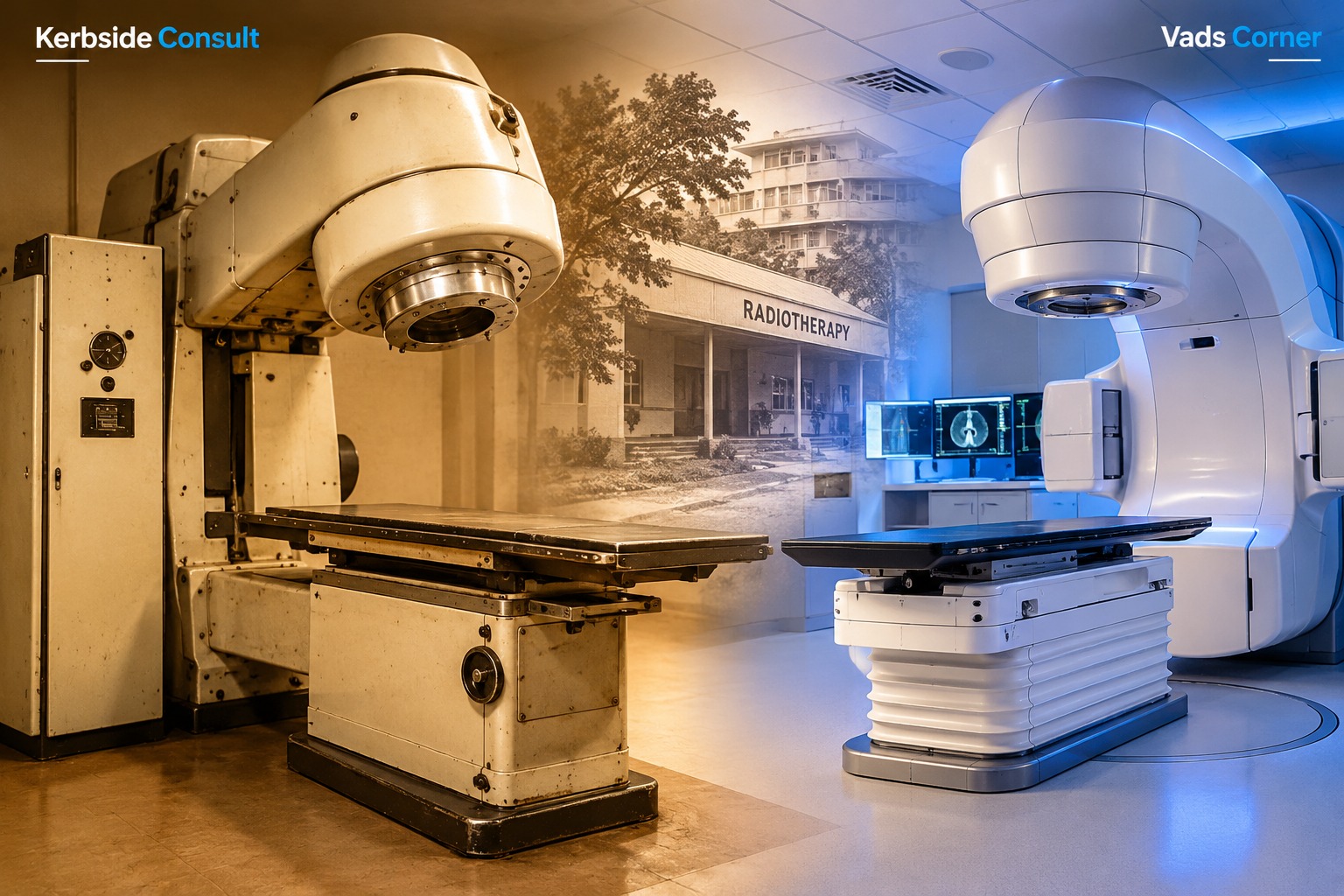
In October 1951, a patient in Canada received cancer treatment using gamma rays from radioactive cobalt-60. The machine became known as the “cobalt bomb” — an alarming name for a technology designed to save lives.
For Malaysia, this is also a story of pioneering specialists, public investment, community fundraising and a question that remains relevant: does acquiring newer technology necessarily improve access to treatment?
Contents
- From Radium to the Cobalt Bomb
- Cancer Treatment in Malaya Before Cobalt-60
- Dato’ Dr S.K. Dharmalingam — A Pioneer of Malaysian Cancer Care
- The Cobalt Bomb Enters Parliament
- Penang: A Machine Funded by the Community
- Expanding Radiotherapy Beyond Kuala Lumpur
- Why Linear Accelerators Took Over
- Is Cobalt-60 Obsolete?
- The Responsibility After Treatment Ends
- Seventy-Five Years Later: The Malaysian Lesson
- Sources & further reading
1. From Radium to the Cobalt Bomb
After the discoveries of X-rays in 1895 and radium in 1898, radiotherapy developed using radium and relatively low-energy X-ray machines. Treating deep tumours was difficult without exposing overlying tissues to substantial doses.
Cobalt-60, produced by irradiating cobalt-59 in a reactor, emits gamma rays of approximately 1.17 and 1.33 MeV. Its 5.27-year half-life means that treatment times increase as the source decays and eventual replacement is necessary[1].
The first clinical cobalt-60 treatment took place in London, Ontario, on 27 October 1951[2]. A parallel programme in Saskatoon, led by Harold Johns of the University of Saskatchewan[1], treated its first patient on 8 November 1951, after 11 weeks of calibration[3]. The two Canadian teams worked independently yet cooperatively, and both units became prototypes for the first commercially available units, then called “cobalt bombs”[4].
2. Cancer Treatment in Malaya Before Cobalt-60
Radiotherapy services in Malaya preceded independence. Radium and orthovoltage X-ray treatments were available in selected hospitals, but equipment, trained personnel and dedicated facilities were limited. In the 1950s, Kuala Lumpur General Hospital’s radiotherapy department operated from modest premises, and visiting specialists contributed to service provision[5].
3. Dato’ Dr S.K. Dharmalingam — A Pioneer of Malaysian Cancer Care
In 1960, Dato’ Dr S.K. Dharmalingam returned from specialist training at Middlesex Hospital in Britain and was appointed the first Malaysian consultant radiotherapist. He helped move cancer care beyond a small radiotherapy service towards a comprehensive institution with specialist personnel, beds, facilities and modern equipment[5], [6], [7].
His efforts contributed to government support for the Institute of Radiotherapy, Oncology and Nuclear Medicine at Kuala Lumpur General Hospital. Construction began in 1967 and was completed in November 1968. The institute expanded treatment facilities and included accommodation arrangements for patients travelling from outside Kuala Lumpur[5], [6].
In 1966, Dharmalingam founded the National Cancer Society of Malaysia[8], strengthening the country’s capacity for cancer education, care and support. By 1975, as Malaysia’s representative at a World Health Organization working group in Manila on comprehensive cancer control, he reported that efforts were being made to introduce a cancer registration scheme, and that the Society was supporting a cervical cytology screening programme in several states[9]. His legacy encompasses specialist treatment, professional development and community support.
4. The Cobalt Bomb Enters Parliament
On 26 April 1961, presenting the Development Estimates in the Dewan Ra’ayat, the Minister of Health and Social Welfare, Dato’ Ong Yoke Lin, said that the new General Hospital in Kuala Lumpur would include a cancer unit equipped with “a Cobalt 60, or commonly known as ‘Cobalt Bomb’”. He added that the country now had its own radiotherapist, recently returned from specialist training in the United Kingdom, and a physicist then training in Canada[10].
This is evidence of a government proposal, not proof that the machine was installed or commissioned. The exact date and location of Malaysia’s first operational cobalt-60 teletherapy unit remain unconfirmed. The institute completed in 1968 was documented as having a betatron and two 6 MV linear accelerators, illustrating that several megavoltage technologies formed part of Malaysia’s early development[5].
5. Penang: A Machine Funded by the Community
Mount Miriam Hospital opened in February 1976; for its first three years it cared mainly for patients with terminal cancer[7]. A historical account describes businessman Koh Pen Ting helping to organise fundraising after his wife required cancer treatment. Local donors reportedly raised RM480,000 in a single gathering[11], [12].
In 1979, Mount Miriam installed a cobalt-60 machine, identified in a historical account as a Theratron 780 and as the first radiotherapy service in Penang[7]. The episode illustrates the role of community philanthropy in extending cancer treatment beyond established public-sector centres[7], [11], [12].
6. Expanding Radiotherapy Beyond Kuala Lumpur
Sarawak General Hospital established its radiotherapy and oncology department in August 1985; a cobalt-60 unit was installed in 1996. Cobalt machines and linear accelerators coexisted for many years. A review published in 2006 recorded 19 radiotherapy and oncology centres, 25 linear accelerators and seven cobalt-60 teletherapy machines in Malaysia at the time of writing[5].
The growth of equipment did not remove the practical difficulties faced by patients travelling long distances for repeated treatment.
7. Why Linear Accelerators Took Over
Cobalt-60 units were relatively robust, but radioactive decay, source replacement, security requirements and beam-shaping limitations posed challenges[13], [14]. Linear accelerators progressively offered greater flexibility in energy and treatment delivery[13]. Techniques including three-dimensional conformal therapy, intensity-modulated radiotherapy and image guidance improved the ability to shape dose distributions[15].
Yet advanced equipment requires trained clinicians, physicists, radiographers, engineers, reliable power, quality assurance and maintenance[13]. A machine that is unavailable cannot help the patient waiting for treatment.
8. Is Cobalt-60 Obsolete?
Not entirely. Gamma Knife radiosurgery continues to use multiple cobalt-60 sources for selected intracranial conditions[16], and some brachytherapy systems use cobalt-60[17].
Malaysia’s Secondary Standard Dosimetry Laboratory also uses cobalt-60 as a reference radiation source for calibrating radiotherapy dosimeters. A replacement source was commissioned in January 2023; an account described calibration support for 42 radiotherapy centres[18]. This is a metrology role, not evidence that 42 centres use cobalt teletherapy.
9. The Responsibility After Treatment Ends
Unlike a linear accelerator, which generates its therapeutic beam when operating, a cobalt-60 source remains radioactive even when its machine is switched off. Safe storage, source security, regulated transport and end-of-life management must therefore be planned from the outset. Malaysia’s legislators recognised this early: in March 1968 the Dewan Negara (Senate) passed the Radioactive Substances Bill, which prohibited the manufacture, sale, storage, import, export and use of radioactive materials without a permit and established a six-member Radiological Advisory Committee to advise the Minister of Health[19].
Seventy-Five Years Later: The Malaysian Lesson
Malaysia has moved far beyond its early radiotherapy services, but treatment access is more than an equipment count. It includes timely diagnosis, staffing, maintenance, treatment scheduling and the costs of travelling to a distant centre. Figures from different years and definitions should not be treated as a direct measure of improvement.
The story of cobalt-60 is ultimately about the scientists, doctors, physicists, radiographers, nurses, administrators and donors who made treatment possible. Dato’ Dr S.K. Dharmalingam’s work reminds us that institutions and people matter as much as machines.
A sophisticated machine does not treat a patient if it is unavailable, broken down, inadequately staffed or too far away to reach.
Sources & further reading
- Van Dyk J, Battista JJ, Almond PR. A retrospective of cobalt-60 radiation therapy: “The atom bomb that saves lives”. Med Phys Int J. 2020;Special Issue, History of Medical Physics 4:327. Source
- London Health Sciences Centre. Our history: first cobalt-60 treatment, 27 October 1951. Source
- University of Saskatchewan. Cobalt-60 timeline: first patient treated, 8 November 1951. Source
- Parks Canada. Development of the cobalt-60 beam therapy unit (Cobalt Bomb). Source
- Lim GCC. Clinical oncology in Malaysia: 1914 to present. Biomed Imaging Interv J. 2006;2(1):e18. doi:10.2349/biij.2.1.e18. Source
- Hospital Kuala Lumpur. Radiotherapy and Oncology: departmental history. Source
- Lim KG. The History of Medicine and Health in Malaysia. Petaling Jaya: Lim Kean Ghee; 2016. Source
- Union for International Cancer Control (UICC). National Cancer Society of Malaysia: membership profile. Source
- World Health Organization Regional Office for the Western Pacific. Final report: Working Group on the Organization of Comprehensive Cancer Control Programmes, Manila, 22–29 October 1975 (ICP/CAN/001). Manila: WHO/WPRO; 17 December 1975. Source
- Parliament of the Federation of Malaya. Dewan Ra’ayat debates. 26 Apr 1961. Vol. III, no. 6, col. 637 (Development Estimates 1961, Heads 123 and 124, Subhead 220: New Hospitals). Source
- Mount Miriam Cancer Hospital. The history of Mount Miriam. Source
- Penang Monthly. Mount Miriam Cancer Hospital: a legacy of hope and love. Source
- International Atomic Energy Agency. Human Health Campus: Radiotherapy equipment. (accessed 24 October 2026). Source
- Ravichandran R, Barman B, Datta G, Kannan R. External beam radiotherapy with telecobalt machine: tissue deficiency compensation in head-and-neck region and effect on skin reactions. J Med Phys. 2019;44(2):135–138. doi:10.4103/jmp.JMP_20_19. Source
- International Atomic Energy Agency. Transition from 2-D radiotherapy to 3-D conformal and intensity modulated radiotherapy. IAEA-TECDOC-1588. Vienna: IAEA; 2008. Source
- Mendel JT, Schroeder S, Plitt A, et al. Expanded radiosurgery capabilities utilizing Gamma Knife Icon. Cureus. 2021;13(3):e13998. doi:10.7759/cureus.13998. Source
- Wen A, Wang X, Wang B, et al. Comparative analysis of 60Co and 192Ir sources in high dose rate brachytherapy for cervical cancer. Cancers (Basel). 2022;14(19):4749. doi:10.3390/cancers14194749. Source
- Konsoh @ John Konsoh Sangau, Secondary Standard Dosimetry Laboratory, Malaysian Nuclear Agency. New cobalt-60 source boosts Malaysia’s radiotherapy calibration capabilities. News from Members: SSDL, Malaysia. Asia Pacific Metrology Programme; 13 October 2025. Source
- Parliament of Malaysia. Dewan Negara (Senate) official report, vol. IV, no. 10, 7 March 1968, cols. 1437–1440 (Radioactive Substances Bill). Source