We have learnt how to update our vaccines. Our surveillance, interpretation and public-health decisions must evolve alongside them.
Another COVID-19 variant, another alarming headline. Media reports in early October 2026 described an “American COVID” variant linked to an autumn rise in the United Kingdom, accompanied by lists of symptoms.[14] One British newspaper offered 14.[15] The nickname refers to XFG, also called Stratus, a lineage that became dominant in the United States.[14] The label caught my attention, but the more interesting story lies elsewhere.
I began documenting COVID-19 on Vads Corner in January 2020, when the illness was still being investigated as pneumonia of unknown cause.[23][24] (I returned to that stage of an outbreak, before the diagnosis, in “Pneumonia of Unknown Origin”.[22]) Six years later, SARS-CoV-2 continues to evolve, and vaccine manufacturers can adapt their products to circulating variants. Yet the surveillance needed to inform those decisions has become less comprehensive.
We are getting better at updating vaccines. Are we becoming less certain about what the virus is doing?
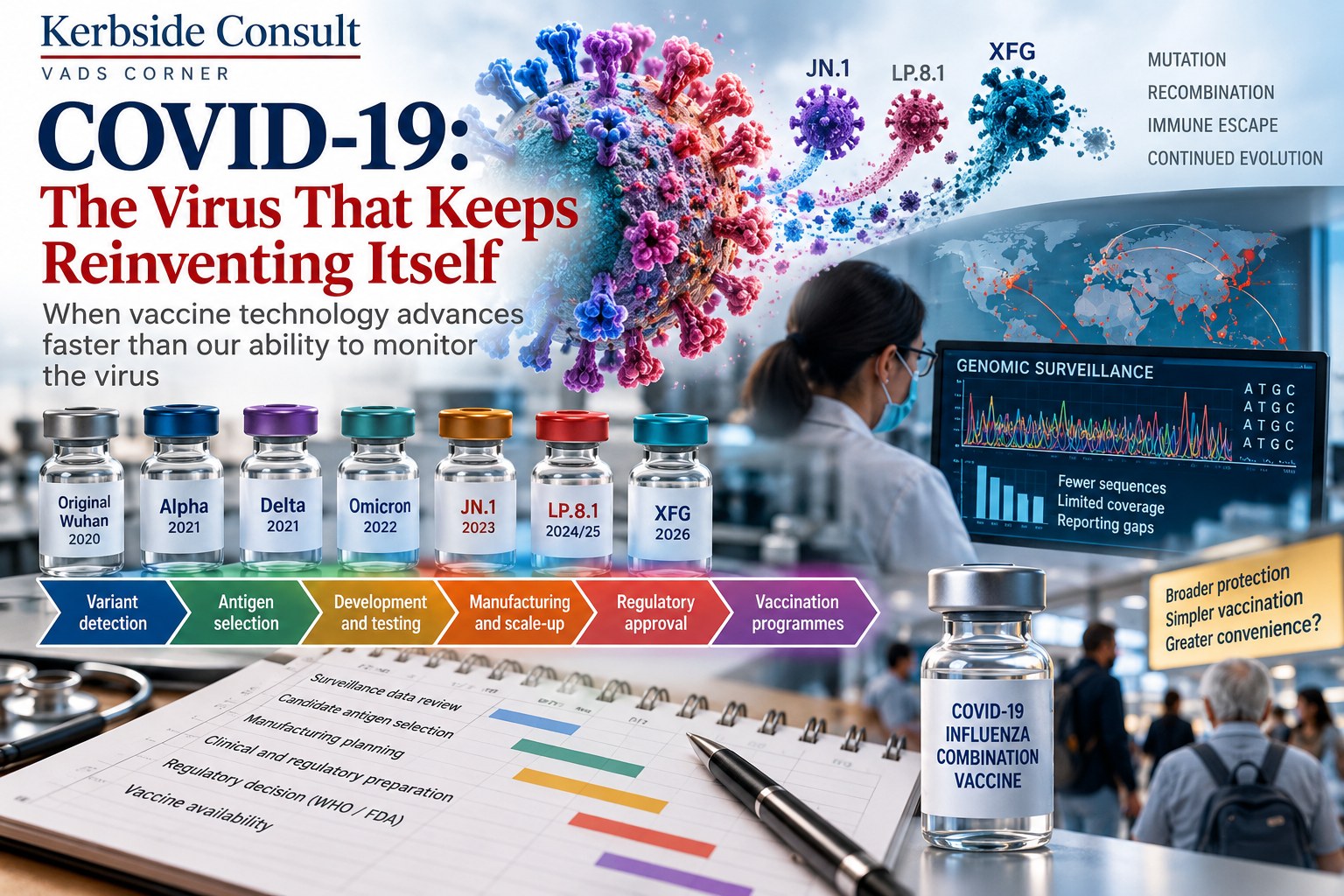
1. Evolution in an Immune Population
The emergence of Alpha, Delta and Omicron changed the course of the pandemic. Today, competition among Omicron-related lineages is occurring in populations with extensive immunity from vaccination, previous infection or both. Variants can gain an advantage through altered transmissibility or partial escape from existing antibodies, without necessarily causing more severe illness.
The XFG lineage is not an entirely new October 2026 discovery: WHO designated it a variant under monitoring on 25 June 2025.[1] On WHO’s COVID-19 dashboard, XFG accounted for 49% of submitted sequences in the week ending 23 August 2026, up from 29% in the week ending 26 July.[2] These are proportions of submitted sequences, not estimates of the proportion of all infections worldwide. WHO’s page states that XFG and the other variants under monitoring do not pose additional public-health risks relative to other currently circulating SARS-CoV-2 variants.[2]
That does not mean nothing is happening. In the UK, the national surveillance report of 24 September 2026 showed the weekly COVID-19 hospital admission rate rising to 1.20 per 100,000 in week 38, from 0.81 the week before, with hospital laboratory positivity up from 5.9% to 7.0%.[16] A rise from a low base is a reason to watch, not a measure of a more dangerous virus.
Unlike influenza, whose segmented genome allows reassortment, SARS-CoV-2 has a non-segmented RNA genome and can undergo recombination. I have discussed influenza’s distinct evolutionary mechanism in “The Next Pandemic May Already Be Mixing”;[20] it need not be repeated here.
A rising share of sequences is a signal to look harder, not yet a measure of harm.
2. A Variant Is Not a Nationality
The expression “American COVID” is misleading. WHO’s 2015 guidance discouraged naming new infectious diseases after geographical locations because of the risk of stigma and economic harm. In 2021, WHO introduced Greek-letter labels for important SARS-CoV-2 variants.[3][4] A country that first detects a lineage may simply have stronger sequencing capacity. A virus does not have a nationality.
Nor does a list of 14 symptoms define a variant. Fever, sore throat, cough and fatigue overlap across SARS-CoV-2 lineages and other respiratory infections. Clinical severity must be assessed through reliable epidemiological and clinical evidence, not symptom headlines.
A lineage has a name. It does not have a nationality.
3. The Surveillance Paradox
WHO’s May 2026 vaccine-composition statement describes persistent and increasing gaps and delays in reporting cases, hospitalisations and deaths. Genomic surveillance has similar problems, with low numbers of samples sequenced and limited geographical diversity.[5] The organisation’s dashboard similarly warns that declining and unrepresentative surveillance and sequencing efforts make it harder to assess known variants and to detect new ones or recombinants.[2] Even the UK report carries a caution: its lineage table for cases sequenced on 17–30 August 2026 notes that the most recent figures should be interpreted with caution.[16]
That does not mean surveillance has ceased. It means we must be more cautious about interpreting trends. A rise in the proportion of a lineage among sequenced samples does not automatically establish an equivalent rise among all infections. Likewise, fewer reported cases may reflect reduced testing rather than reduced transmission.
Other tools can partly fill the gap. Wastewater and sentinel-site monitoring track community-level trends without depending on individual testing. Malaysia has used both: in a statement of 2 January 2023, the Ministry of Health reported supplementary surveillance from June to December 2022, with sewage sampled from aircraft at international entry points and 301 samples from 15 sentinel locations, one in each state, intended as early warning of virus trends and variants.[18] I have not found a current public report from that programme, so I cannot say how far it still contributes. Wastewater tells us about a community, not about individual patients, and it does not replace clinical surveillance. But the question for any country is whether the sources that remain add up to a representative picture.
The scientific challenge is no longer simply to identify a mutation. It is to determine whether a change affects infection patterns, immune escape, severe disease or the usefulness of existing vaccines. I wrote about the harder problem of how much confidence information deserves in “We Don’t Know Yet”;[21] it applies here too.
Fewer data points do not mean fewer questions.
4. When WHO and the Regulators Choose Different Antigens
WHO’s Technical Advisory Group on COVID-19 Vaccine Composition met on 7–8 May 2026 and, in its statement of 16 May, retained monovalent LP.8.1 as the preferred antigen, reaffirming its December 2025 recommendation. It also accepted XFG or NB.1.8.1, and other approaches that show broad, robust neutralising antibody responses or efficacy against circulating variants.[5]
Regulators went a different way. After its advisory committee met on 28 May 2026, the US FDA advised manufacturers to use a monovalent JN.1-lineage XFG vaccine; the committee had been briefed on manufacturing timelines and reviewed circulating variants, antigenic characterisation, vaccine effectiveness and immunogenicity data.[6] On 29 May, the European Medicines Agency’s Emergency Task Force recommended XFG for the 2026/2027 campaign, judging that it would give the best protection against JN.1-family subvariants and against BA.3.2, while noting that LP.8.1 vaccines could still be considered.[8]
These decisions should not be read as a scientific disagreement over whether vaccination works. The groups looked at overlapping evidence and weighed it differently. WHO also noted that BA.3.2, antigenically distinct from JN.1 descendants, is rising globally but has not displaced them where it has been detected, and that sequence numbers are low and should be interpreted cautiously.[5] Vaccine antigen selection is necessarily forward-looking; no authority can know precisely which lineage will dominate months later.
From antigen selection to commercial reality
For manufacturers, antigen selection is only one step in a much longer process. Bringing an updated vaccine to market requires advance planning across research, process development, raw-material procurement, manufacturing capacity, quality testing, regulatory affairs and distribution. Much of this preparatory work must begin before WHO issues its recommendations or a national regulator announces its formulation decision.
The 2026 timeline illustrates the point. The FDA and EMA decisions came at the end of May; by 17 August, trade press was reporting four updated XFG vaccines approved in the United States,[9] and the FDA’s Nuvaxovid page, updated on 27 August, lists the 2026–2027 formula.[7] That shows the machinery can deliver within a single season. It does not show that it is faster than in earlier years, which would need a comparison I have not made. What it does show is that the update is no longer the slow step. The evidence on which the choice is made is.
Some activities can proceed in parallel, but others depend on the final antigen choice. Companies must balance the cost of preparing candidates that may not be selected against the risk of starting too late to meet a vaccination season. Getting the choice right therefore matters scientifically, operationally and commercially; the exact lead times and regulatory requirements differ by product and market.
From my experience in the vaccine industry, meeting these timelines depends on early cross-functional coordination, not simply a rapid response after an announcement. This is another reason timely, representative genomic surveillance matters: it informs substantial development and investment decisions while the virus continues to evolve.
Different choices from overlapping evidence are not a failure of science. They are what forecasting under uncertainty looks like.
5. mRNA and Recombinant Protein Vaccines
The Pfizer-BioNTech and Moderna vaccines deliver mRNA instructions enabling cells to make a spike antigen. Novavax uses manufactured recombinant spike protein with its Matrix-M adjuvant. These are different ways of presenting an antigen to the immune system; both platforms can be updated as the virus changes. Nuvaxovid is now marketed by Sanofi, not Novavax, in select markets including the US; Novavax supplies the vaccine.[12]
Trade-press reports of the 2026–2027 US approvals list four XFG vaccines: Comirnaty (approved for adults 65 and older and for ages 5–64 with at least one high-risk condition), Spikevax (65 and older, and 6 months–64 with a high-risk condition), mNEXSPIKE (65 and older, and 12–64 with a high-risk condition) and Nuvaxovid (65 and older, and 12–64 with a high-risk condition).[9] The FDA’s own page describes the 2026–2027 Nuvaxovid formula as 5 mcg of recombinant spike glycoprotein from XFG with 50 mcg of Matrix-M adjuvant per dose.[7]
Having served in Medical Affairs leadership for Novavax in the Asia-Pacific region, I saw at close quarters the scientific, clinical and regulatory demands of introducing a protein-based COVID-19 vaccine. That experience is worth acknowledging, but it is not a reason to favour one platform without comparative evidence.
The more important question is not whether a platform is fashionable, but whether an updated product offers meaningful protection against severe disease in the people who need it. Neutralising-antibody results are informative, but they are not identical to clinical efficacy.
The platform matters less than whether the updated vaccine protects the people most at risk.
6. What Does This Mean for Malaysia?
Malaysia has moved beyond the emergency phase of COVID-19, but that should not be confused with the end of viral circulation. Sustainable sentinel respiratory surveillance, representative sequencing, and monitoring of hospitalisations and severe disease remain valuable. Malaysian policy must be guided by Malaysian epidemiology and national regulatory decisions, not simply copied from WHO advice or US product authorisations.
The most recent Malaysian variant figure I can find is a year old. In September 2025, the Ministry of Health reported XFG as 8.2% of cases in the variant breakdown for epidemiological week 35 of 2025, identified through genomic surveillance, in a week with 594 reported cases, down from 681 the week before.[17] By October 2025, the European regulator reports, XFG had peaked at 74% of sequenced infections globally.[8] Shares change quickly, which is why dated local data matter. I have not found a published 2026 Malaysian equivalent; the Ministry’s data portal is where one should appear.[19]
Nor have I found a published decision on which 2026–2027 formulation Malaysia will use. That is for the Ministry of Health and the National Pharmaceutical Regulatory Agency, and, as the WHO and regulator choices above show, more than one antigen can be defended.
For older adults, immunocompromised people and others at high risk, decisions about vaccination and timely antiviral treatment should follow current local guidance and individual clinical assessment.
Malaysian decisions need Malaysian data.
7. Where Do We Go From Here?
A new variant is not automatically a new emergency. Equally, fewer headlines and fewer tests do not prove that the virus has stopped evolving. We now have multiple adaptable vaccine platforms, antiviral treatments and much greater clinical experience than in January 2020.
The next challenge is to preserve enough timely, representative evidence to know when a change matters and how to respond.
We have learnt how to update our vaccines. Our surveillance, interpretation and public-health decisions must evolve alongside them.
Disclosure
I previously held a senior Medical Affairs role with Novavax in the Asia-Pacific region. This article is an independent educational commentary, not a product endorsement.
Sources and further reading
A. WHO — Variant Tracking, Surveillance & Naming
- World Health Organization. Tracking SARS-CoV-2 variants. (XFG designated a variant under monitoring, 25 June 2025; page updated July 2026.)
- World Health Organization. COVID-19 dashboard. (XFG share of submitted sequences, weeks ending 26 July and 23 August 2026; accessed 8 October 2026.)
- World Health Organization. WHO issues best practices for naming new human infectious diseases. 8 May 2015.
- World Health Organization. WHO announces simple, easy-to-say labels for SARS-CoV-2 Variants of Interest and Concern. 31 May 2021.
- World Health Organization. Statement on the antigen composition of COVID-19 vaccines. 16 May 2026.
B. Regulators & Vaccine Evidence
- US Food and Drug Administration. COVID-19 Vaccines (2026–2027 Formula) for Use in the United States Beginning in Fall 2026. 29 May 2026.
- US Food and Drug Administration. Nuvaxovid. (Page updated 27 August 2026.)
- European Medicines Agency. ETF recommends updating COVID-19 vaccines to target XFG variant. 29 May 2026.
- US Pharmacist. FDA approves four updated COVID-19 vaccines for 2026–2027. 17 August 2026. (Trade-press report; the FDA’s own approval pages for Comirnaty, Spikevax and mNEXSPIKE should be checked directly.)
- Shinde V, Woo W, Marchese AM, et al. Safety and immunogenicity of a COVID-19-Influenza Combination nanoparticle vaccine (CIC) containing SARS-CoV-2 recombinant spike and quadrivalent influenza hemagglutinin with Matrix-M adjuvant: a phase 1/2 clinical trial. Hum Vaccin Immunother. 2026;22(1):2689794. doi:10.1080/21645515.2026.2689794
- Novavax. Novavax and Sanofi announce co-exclusive licensing agreement to co-commercialize COVID-19 vaccine and develop novel COVID-19–influenza combination vaccines. 10 May 2024.
- Novavax. Novavax reports second quarter 2026 financial results and operational highlights. 6 August 2026. (Sanofi leads commercial activity for Nuvaxovid in select markets, including the US; Novavax supplies the vaccine.)
- Rudman Spergel AK, Wu I, Deng W, et al. Immunogenicity and safety of influenza and COVID-19 multicomponent vaccine in adults ≥50 years: a randomized clinical trial. JAMA. 2025;333(22):1977–1987. doi:10.1001/jama.2025.5646
C. Media, United Kingdom & Malaysia
- WION. ‘American Covid’ drives autumn surge in UK. 2 October 2026. (Example of the press reports discussed; media source, not a scientific one.)
- Mackinlay C. Panic as horror ‘American Covid’ rapidly spreading in UK – 14 grim symptoms. Express. 7 October 2026. (UK newspaper report; media source, not a scientific one.)
- UK Health Security Agency. National flu and COVID-19 surveillance report: 24 September 2026 (week 39).
- Malay Mail. Health Ministry: new Covid-19 XFG variant detected in Malaysia as cases continue to fall. 20 September 2025. (Reports the Ministry’s announcement; the Ministry’s original statement should be added if available.)
- Malay Mail. Dr Noor Hisham: SARS-CoV-2 found in 28 sewage water samples. 2 January 2023.
- Ministry of Health Malaysia. KKMNOW data portal.
D. Vads Corner & Kerbside Consult — Own Writing
- Vadivale M. The Next Pandemic May Already Be Mixing. Kerbside Consult 36/2026, 4 October 2026.
- Vadivale M. We Don’t Know Yet. Kerbside Consult 19/2026, 17 September 2026.
- Vadivale M. Pneumonia of Unknown Origin. Kerbside Consult 41/2026, 7 October 2026.
- Vads Corner. COVID-19 retrospective.
- Vads Corner. COVID-19 Archive (original pages, online since January 2020).