What exactly is El Niño?
El Niño is the warm phase of the El Niño–Southern Oscillation (ENSO), a naturally occurring interaction between the tropical Pacific Ocean and atmosphere.
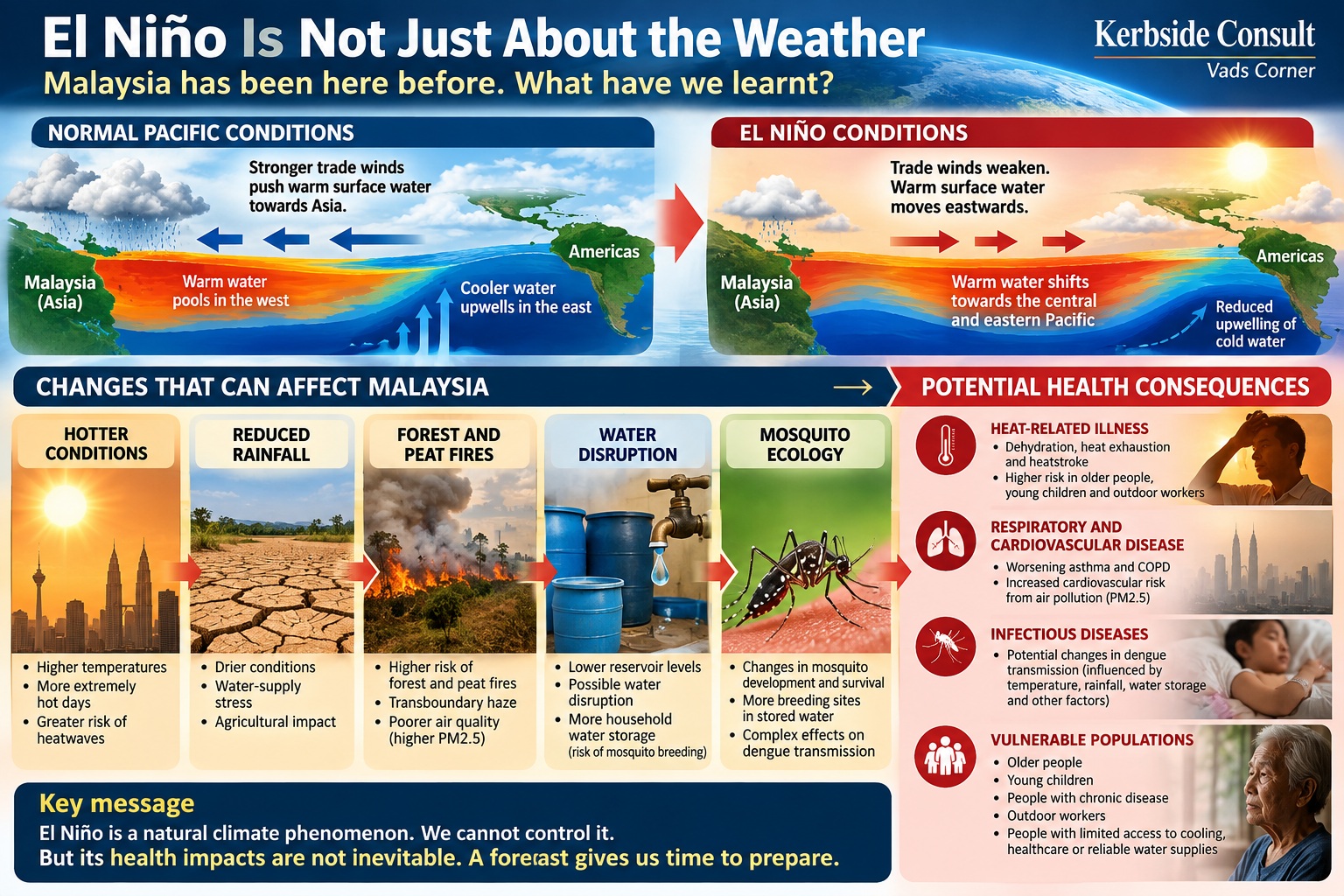
Normally, easterly trade winds push warm surface water westwards across the equatorial Pacific towards Asia. Colder, nutrient-rich water rises from deeper in the eastern Pacific.
During El Niño, those trade winds weaken. Warm surface water shifts eastwards, cold-water upwelling is reduced, and atmospheric circulation and rainfall patterns change.
The ocean and atmosphere influence each other. Changes in sea-surface temperature alter winds and rainfall; altered winds, in turn, redistribute warm water.
El Niño events occur irregularly, typically every few years, and no two behave exactly alike.
For Malaysia, moderate and strong El Niño events are generally associated with reduced rainfall, although the effect varies according to geography and season.
El Niño changes probabilities. It does not determine tomorrow’s weather.
Did we cause El Niño?
No.
El Niño is part of the Earth’s natural climate variability and occurred long before modern industrialisation.
Climate change therefore does not cause El Niño.
But there is an important distinction.
El Niño today occurs against a warmer background climate. WMO says there is currently no evidence that climate change is increasing the frequency or intensity of El Niño events, although a warmer ocean and atmosphere can amplify some associated impacts.
So the two should not be confused.
El Niño is natural climate variability. Climate change alters the world in which El Niño now occurs.
1997: when the air became the problem
The 1997–98 El Niño was exceptionally strong.
Malaysians probably remember something else more vividly:
The haze.
Forest and peat fires in Indonesia produced enormous quantities of smoke that spread across Southeast Asia. El Niño-associated dry conditions helped vegetation and peat become easier to burn and fires more difficult to control.
But El Niño did not light the fires.
By September 1997, visibility had deteriorated and air pollution reached hazardous levels. Sarawak experienced an air-pollution emergency.
That was the environment in which I wrote HAZEDOUS.
At the time, we were asking basic questions. What was causing the haze? What was in the air? What were its health effects? Where were the fires? And where could people obtain reliable information?
Subsequent research provided some answers.
Researchers examining admissions to seven hospitals around Kuching during the 1997 Southeast Asian forest fires found significant increases in respiratory hospitalisations, particularly for asthma and chronic obstructive pulmonary disease (COPD). Older patients with previous respiratory or cardiorespiratory admissions were particularly vulnerable to readmission.
What we were watching on satellite images eventually appeared in epidemiological data.
The haze wasn’t merely unpleasant. It was making people sick.
2016: when the heat became the problem
Almost two decades later came another very strong El Niño.
Malaysia’s annual mean temperature in 2016 reached 27.66°C, then the highest recorded for the country and 0.78°C above the 1981–2010 normal.
Between 1 and 22 March 2016, Ministry of Health facilities recorded 35 heat-related illnesses: 5 cases of heat cramps, 25 of heat exhaustion and 5 of heatstroke.
One death was reported.
Heatstroke is only the dramatic end of a broader problem.
Prolonged heat increases water loss and the risk of dehydration. The cardiovascular system works harder to dissipate heat, renal perfusion can fall, and existing heart, lung and kidney disease may become more difficult to manage.
Those particularly vulnerable include older people, young children, outdoor workers and people with chronic disease.
The patient at risk may be an older person living alone in a poorly ventilated house, a construction worker unable to escape the afternoon heat, or someone with heart failure taking a diuretic.
Sometimes the weather becomes part of the medical history we need to take.
Haze: climate does not light fires
A dry El Niño can create conditions in which vegetation and peat burn more readily.
But haze is not an unavoidable natural consequence of El Niño.
Fire requires ignition.
That distinction matters. Otherwise, a substantially preventable environmental problem begins to sound inevitable.
Once smoke develops, the health consequences of particulate pollution are well established. Asthma and COPD can worsen, and respiratory and cardiovascular risks increase, particularly among susceptible people.
PM2.5 can penetrate deep into the lungs; the smallest particles can enter the circulation, and particulate exposure can trigger systemic inflammation.
A grey sky is therefore not merely an inconvenience that stops us playing golf or hanging washing outdoors.
It is an exposure.
What about dengue?
Here the relationship becomes more complicated.
It is tempting to write:
El Niño → hotter weather → more mosquitoes → more dengue.
The evidence does not justify such a simple equation.
Temperature affects mosquito development, survival, biting behaviour and viral replication. Rainfall influences breeding opportunities. Drought can paradoxically encourage household water storage, potentially creating additional breeding sites.
Humidity, population immunity, urbanisation, human behaviour and vector control also matter.
Malaysian research has found associations between dengue and temperature, rainfall and wind. More recent modelling in Central Malaysia has also identified associations with ENSO-related Niño indices. These relationships may help early-warning models, but they do not make El Niño a simple predictor of local dengue outbreaks.
El Niño cannot reliably tell us whether dengue cases will rise or fall in a particular Malaysian community.
A more defensible conclusion is:
Climate alters the ecological conditions in which dengue transmission occurs.
That alone is sufficient reason to maintain surveillance and vector control rather than wait for cases to rise.
Water is part of the story too
Reduced rainfall can lower reservoir levels and put pressure on water supplies.
Water disruption affects hygiene, food preparation and household behaviour. Families may begin storing water, potentially creating mosquito breeding sites if containers are not properly managed.
Drought and heat can also affect agriculture and food production.
El Niño therefore creates interconnected risks extending beyond temperature alone.
How large could the health impact be?
A recent Climate Impact Lab analysis illustrates the possible scale.
Using seasonal temperature forecasts together with temperature–mortality relationships, Climate Impact Lab researchers modelled approximately 451,000 additional heat-related deaths worldwide between June 2026 and February 2027, compared with corresponding months in an average 1996–2025 year.
This figure requires an important qualification.
It is a modelled projection, not a count of deaths that have occurred.
The report itself has not yet completed full peer-reviewed publication, and the eventual health impact will depend on how temperatures evolve and how effectively communities adapt.
The value of the estimate is therefore not its precision.
It is the warning that extreme heat can carry a very large health burden—and that preparation matters.
And now, 2026
As of 10 September 2026, NOAA reported that El Niño was strengthening, with a greater than 90% chance of a very strong event during the Northern Hemisphere autumn and winter of 2026–27.
NOAA also cautions that even an El Niño of this magnitude does not guarantee particular regional effects.
Malaysia nevertheless has reason to prepare.
METMalaysia warned in June that the developing El Niño could bring hotter and drier than usual conditions, reduced rainfall in some areas, pressure on water supplies, forest and peat fires, and haze.
WHO has also issued a Global Public Health Situation Analysis – El Niño 2026, specifically encouraging anticipatory action, protection of vulnerable populations and health-system readiness.
For once, medicine has something it does not always receive:
advance warning.
We cannot control El Niño. We can control what happens next.
We cannot switch El Niño off, cool the Pacific Ocean or make the trade winds behave.
But El Niño does not decide whether a forest is set alight.
It does not decide whether an outdoor worker receives shade, water and adequate rest.
It does not decide whether an older person living alone is checked during prolonged extreme heat.
It does not determine whether stored water becomes a mosquito nursery.
And it does not decide whether our health services prepare before patients begin arriving.
The climate hazard may be natural. The size of the health disaster is not predetermined.
What can we do?
For individuals and families, much of the advice is straightforward.
Maintain adequate hydration. People prescribed fluid restriction for heart or kidney disease should follow an individual plan agreed with their clinician. Reduce strenuous outdoor activity during extreme heat. Recognise warning symptoms such as dizziness, unusual weakness, confusion and reduced urine output.
Confusion, collapse or suspected heatstroke requires emergency help and immediate cooling.
Never leave children or dependent adults in parked vehicles.
People with chronic disease should have a plan for exceptionally hot periods. Medication should not simply be stopped because the weather is hot, but people susceptible to dehydration should know when to seek medical advice.
Those with asthma or COPD should ensure their treatment is available and know what to do if symptoms worsen during haze.
Follow reliable weather and air-quality information.
Continue mosquito control even during dry periods, particularly where water is being stored.
And check on older relatives, neighbours and people living alone.
For outdoor workers, access to water, shade, adequate rest and sensible work scheduling matter.
“Drink more water” is not an occupational heat policy.
Healthcare professionals should also recognise environmental exposure as part of the clinical history. During prolonged hot weather, hydration, renal function, cardiovascular disease and relevant medications may deserve particular attention.
Public-health surveillance can use meteorological information as an early warning rather than waiting for patients to provide the first signal.
Government preparedness crosses traditional departmental boundaries: meteorology, water management, prevention of forest and peat fires, air-quality surveillance, occupational health, vector control, healthcare and public communication all need to work together.
An El Niño forecast therefore gives us something valuable.
It gives us time.
Twenty-nine years later
In 1997, Cybermed carried a simple phrase:
“El Nino and its impact.”
Today we understand considerably more about that impact.
We can forecast ENSO months ahead, monitor fires from satellites, measure air pollution continuously and check PM2.5 on our phones.
Technology has changed enormously.
Human physiology has not.
An older person can still become dehydrated. A child can still develop heat illness. A patient with asthma can still deteriorate when the air fills with smoke. An outdoor worker still cannot escape extreme heat simply because an app says the temperature is dangerous.
Perhaps that is the lesson from 1997.
The value of predicting El Niño is not simply knowing what the Pacific Ocean will do. It is using the warning before its consequences reach us.
El Niño begins thousands of kilometres away.
Eventually, it can arrive in the clinic.