Hair loss may affect confidence and quality of life, but it is not always a condition requiring surgery. Modern transplantation can deliver natural-looking results, while attractive overseas packages and social-media photographs may obscure questions about diagnosis, surgeon credentials, long-term outcomes and complications.
The central question is not simply whether hair grows after surgery, but whether the result remains safe and satisfactory years later.
1. What causes hair loss?
Androgenetic alopecia is the commonest reason for hair transplantation. Genetically susceptible follicles gradually miniaturise, resulting in patterned thinning. Alopecia areata, active inflammatory or scarring alopecia, telogen effluvium, thyroid disease and nutritional disorders require different evaluation. A careful clinical diagnosis, scalp examination and selective investigations should precede a surgical recommendation.
Patient selection matters. Very young patients with rapidly evolving hair loss, those with inadequate donor reserves, active scalp inflammation or scarring disease, and patients expecting restoration of their teenage hairline may be poor candidates. Surgery should be deferred until the diagnosis and likely progression are understood. A dermatologist may be needed when the cause is uncertain. [11, 12]
2. When should surgery be avoided or postponed?
Surgery is generally inappropriate when the diagnosis is unclear, hair loss is actively inflammatory or rapidly progressing, donor supply is insufficient, or expectations cannot realistically be met. Uncontrolled medical problems, active scalp infection and inability to follow postoperative care also require assessment before proceeding. [11]
Psychological distress about hair loss deserves sensitive evaluation, but surgery is not automatically the best response.
3. What actually happens during transplantation?
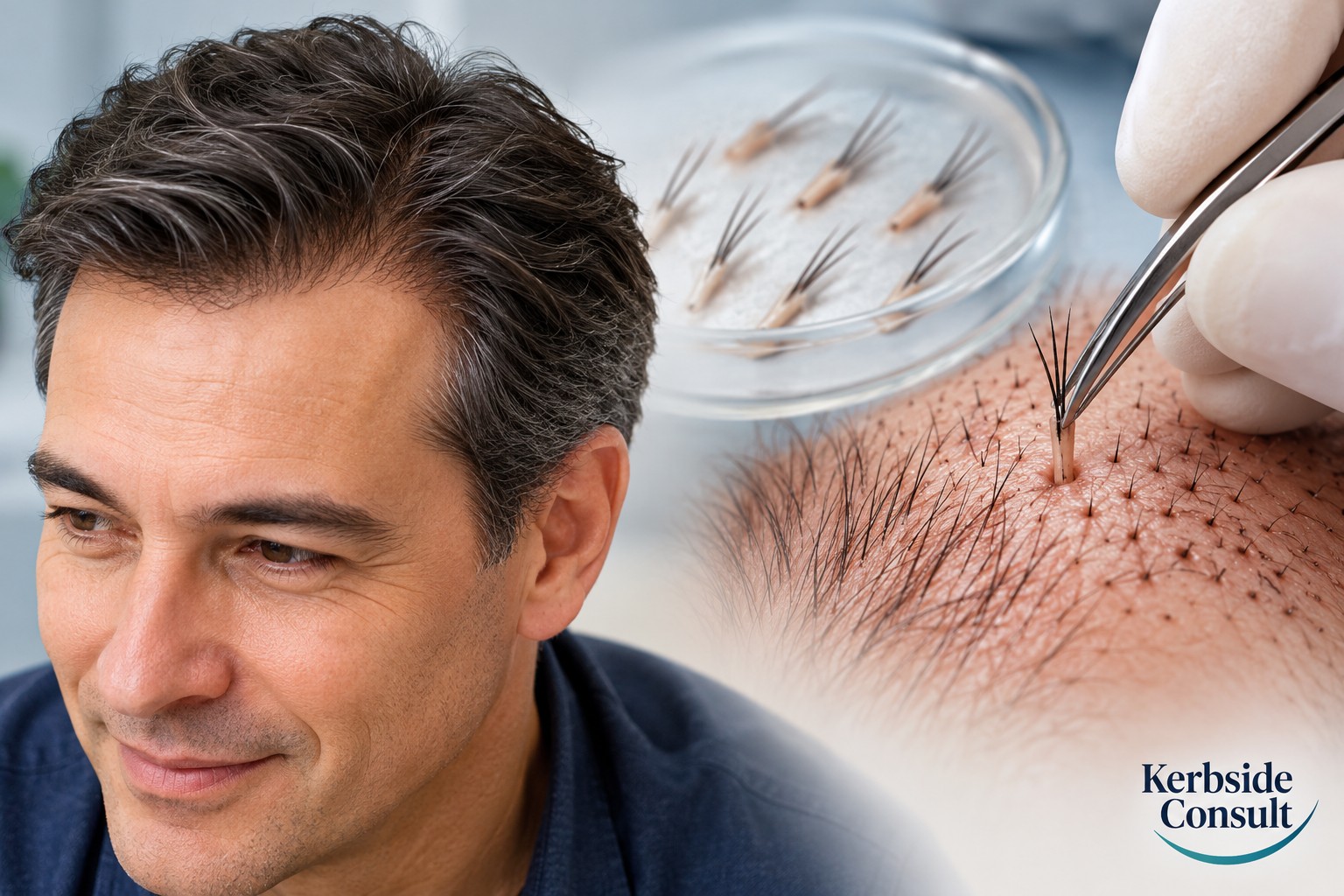
Follicular unit transplantation (FUT) removes a donor strip, which is dissected into grafts; follicular unit excision/extraction (FUE) removes follicular units individually. Both transplant existing follicles and both produce scars, although their patterns differ.
Direct hair implantation (DHI) describes an implantation method, not a fundamentally different source of hair. Marketing labels such as “sapphire” do not by themselves establish better outcomes. Donor follicles are finite: excessive harvesting can permanently reduce coverage at the back and sides of the scalp.
4. Success rates: what do the numbers mean?
The 2025 ISHRS census reported an average of 1.5 surgical procedures per patient to achieve the desired result among responding physicians (median 1; two-thirds reported an average of one). This is a practice survey statistic, not a graft-survival percentage or a prediction for an individual patient. [2]
There is no reliable universal success percentage for all patients, surgeons and procedures. Clinics may advertise very high “success” rates, but often do not specify whether this means graft survival, visible hair growth, photographic density, or patient satisfaction. These outcomes are not interchangeable. [13] Graft survival may be influenced by extraction injury, handling, implantation, vascular supply, smoking, underlying scalp disease and operator skill. Patients should request a clinic’s documented results, definition of success, follow-up duration and complication audit. A technically successful procedure can still produce an unsatisfactory hairline or inadequate density.
Kerbside reality check: an advertised “success rate” means little until the clinic says what was measured, in whom, and for how long.
Published graft-survival figures cannot be treated as a universal patient-level success rate. Ask whether results were assessed by hair counts, standardised photographs or patient-reported outcomes, and how many patients completed follow-up. [1]
5. How long does it last?
Transplanted follicles from relatively androgen-resistant donor regions may continue producing hair for many years or decades, but this is not a lifetime guarantee. Native hair around the grafts can continue to miniaturise, and transplanted follicles can also change with ageing or disease. Many patients need continuing medical therapy and some may eventually consider further surgery.
During the first two weeks, grafts need careful protection and crusting or swelling may occur. Transplanted hair shafts commonly shed after several weeks; new growth generally becomes apparent around four months. The NHS advises that full cosmetic results may take 10–18 months. Long-term outcome studies with consistent ten- or twenty-year follow-up remain limited. [1]
A one-year photograph demonstrates early cosmetic appearance, not lifetime durability. Continued loss of non-transplanted hair can alter the result, and long-term planning should preserve donor follicles for future needs. [1]
6. Side effects and complications
Expected short-term effects include soreness, swelling, tightness, scabbing, itching and temporary sensory changes. Shock loss is temporary shedding of transplanted or neighbouring hair and may be more persistent in vulnerable native follicles. Recognised complications include bleeding, infection, anaesthetic reactions, folliculitis, visible FUT or FUE scarring, unnatural hairline design, poor graft growth and donor-area depletion. Rare serious complications include tissue necrosis.
Exact frequencies vary by technique, case selection and reporting definitions; quoting a single overall complication percentage would be misleading. Increasing pain, fever, spreading redness, pus, heavy bleeding or darkened skin warrant urgent assessment.
A failed or disappointing transplant may leave patchy growth, an unnatural hairline, conspicuous scars or an overharvested donor area. Revision surgery can sometimes improve the appearance, but it cannot reliably replace donor follicles already lost. A second opinion from an appropriately qualified independent specialist is preferable before committing to corrective surgery.
7. Medical tourism: Turkey and beyond
Turkey, especially Istanbul, is widely promoted for hair restoration packages combining surgery, accommodation and transfers. India, Thailand, South Korea, Malaysia and Mexico are also relevant markets. A lower package price does not establish inferior care, just as a higher price does not guarantee quality. The critical issue is who personally performs surgical steps, how many cases the team undertakes, how consent is obtained and how complications are managed after the patient returns home.
The ISHRS 2025 member survey (247 responses from 946 physicians invited; a 26% response rate) reported that 59.4% of responding physicians had black-market clinics in their cities, and that repairs of previous black-market procedures made up, on average, 10% of members’ cases (median 5%). These are physician-reported survey measures, not country-level complication rates or an estimate of risk for an individual patient. Avoid unverified claims about annual Turkish procedure totals or comparative national success rates. [2, 3]
The ISHRS advises patients to ask who will be involved in the surgery, what role each person will play, and whether each is licensed, including for graft harvesting and recipient-site creation. [7]
Advertising may feature celebrity endorsements, dramatic before-and-after photographs, limited-time discounts or promises of a fixed number of grafts. None substitutes for an individual assessment, documented informed consent and clarity about who performs each critical surgical step. Ask whether the clinic has a plan for complications after travel and whether photographs represent comparable lighting, hair length and follow-up intervals.
8. Malaysia: check the procedure, practitioner and premises
In Malaysia, the Ministry of Health explicitly lists hair transplantation as an invasive aesthetic procedure. Its public-facing 3P framework asks patients to check the procedure, the practitioner and the premises. Registration with the Malaysian Medical Council, a current practising certificate, relevant credentialing and privileging (including procedure-specific authorisation), and the suitability and approval of the operating premises should be verified independently. An LCP or a clinic advertising aesthetic services does not, on its own, prove that a particular practitioner may undertake hair transplantation at that location. [4–6]
A Malaysian patient’s verification checklist
Before paying a deposit:
- Check the doctor’s registration and current practising status through the Malaysian Medical Council.
- Check the MOH aesthetic-practitioner registry and ask for written evidence of the practitioner’s specific hair-transplant privileges.
- Check that the facility is registered or licensed and approved for the proposed procedure.
- Establish who performs the surgical steps and who will manage complications.
- Request a written quotation, consent information and follow-up plan.
Where public registries do not establish a procedure-specific privilege, ask the MOH Medical Practice Division or the facility for confirmation. Consult the MOH 3P guidance on checking the procedure, practitioner and premises. [4–6, 8–10]
9. Can medication help?
Appropriate patients may benefit from topical minoxidil and finasteride, before or after transplantation. Oral minoxidil and dutasteride are used off-label in some jurisdictions; suitability, monitoring, adverse effects and local approvals require clinician review. Finasteride and dutasteride may cause sexual adverse effects and have pregnancy-related precautions; oral minoxidil can cause oedema, palpitations and cardiovascular effects.
Platelet-rich plasma and light-based therapies have heterogeneous evidence. Exosome and stem-cell claims should be treated as investigational unless supported by convincing clinical trials and applicable regulatory authorisation. Surgery should not displace diagnosis or evidence-based medical management.
Medical treatment is often considered before surgery to stabilise ongoing loss and may remain important afterwards to preserve non-transplanted hair. [11, 12] Benefits and risks differ by sex, age, pregnancy potential and comorbidities. Patients should not start prescription or off-label treatment solely on a clinic advertisement.
10. Ten questions before paying
- What diagnosis explains my hair loss?
- Is the condition stable and am I a suitable candidate?
- Who will perform extraction, recipient-site creation and implantation?
- What are the operator’s qualifications and privileges?
- How many grafts are planned, and what donor supply will remain?
- What outcome is realistic at 12–18 months?
- What audited complications and revision rates can the clinic provide?
- Will I need ongoing medication or another procedure?
- Who will manage problems after I return home?
- What is the total cost, including revisions and follow-up?
Take home message
Hair transplantation can provide meaningful, durable cosmetic improvement, but it does not create new follicles or cure progressive baldness. Long-term planning, an accurate diagnosis, realistic expectations, qualified operators and reliable follow-up matter more than a fashionable technique or an inexpensive travel package.
The most useful measure of success is not the photograph taken at twelve months, but how naturally and safely the result serves the patient over time.
Sources
- NHS. Hair transplant. NHS; 2023. Source
- International Society of Hair Restoration Surgery. 2025 practice census results. ISHRS; 2025. Source
- International Society of Hair Restoration Surgery. New survey finds younger adults, more women seeking treatment for hair loss. ISHRS; 2025. Source
- Ministry of Health Malaysia, Medical Practice Division. Aesthetic medical practice: procedure, practitioner, premises (3P). Source
- Ministry of Health Malaysia, Medical Practice Division. Invasive aesthetic procedures. Source
- Ministry of Health Malaysia. Guidelines on aesthetic medical practice for registered medical practitioners. 2nd ed. Putrajaya: MOH; 2020. Source
- International Society of Hair Restoration Surgery. Consumer advocacy. Source
- Malaysian Medical Council. MeRITS: search for registered doctor. Official website
- Ministry of Health Malaysia. National registry of registered medical practitioners practising aesthetic medical practice. Official website
- Ministry of Health Malaysia. Medical Practice Division. Official website
- True RH. Is every patient of hair loss a candidate for hair transplant? Deciding surgical candidacy in pattern hair loss. Indian J Plast Surg. 2021;54(4):435–440. DOI 10.1055/s-0041-1739247. Source
- Vañó-Galván S, Bisanga CN, Bouhanna P, et al. An international expert consensus statement focusing on pre and post hair transplantation care. J Dermatolog Treat. 2023;34(1):2232065. DOI 10.1080/09546634.2023.2232065. Source
- Jin M, Zhang J, Jin Z, Pi L, Diao Y. Long-hair follicular unit excision enhances the cosmetic results of hairline restoration: a retrospective study in Chinese recipients. J Cosmet Dermatol. 2024;23(4):1344–1350. DOI 10.1111/jocd.16136. Source