An alert 80-year-old may drive competently while a younger driver impaired by poor sleep or sedating medicines may not. The question is how we recognise the difference — and what happens when a driver becomes unsafe.
Contents
1. What the numbers say
On 16 July 2026 the Deputy Transport Minister, Datuk Hasbi Habibollah, told the Dewan Rakyat in reply to Mohd Nazri Abu Hassan (Merbok) that the ministry does not currently require a health check as an extra condition for private licence renewal from the age of 70[1]. A MIROS study, he said, with international analysis, found no conclusive evidence that mandatory age-based checks significantly reduce accidents. In 2025, he added, 3.5% of all road accidents involved people aged 70 and above, against 69.4% involving people aged 16 to 40 (3% and 65.2% in 2024). To his credit, he gave the caveat himself: the figures include drivers, riders, passengers and victims, and do not show that age alone is the cause. Pressed, he said drivers aged 70 and over in crashes were very few. These figures are from the unrevised Hansard.[2]
None of this is a rate. The Hansard counts accidents involving anyone aged 70 and over, in whatever role, and divides neither by the number of licence holders in that age group nor by how far they drive. A small share of crashes could still hide a high risk per kilometre, and the young may simply account for most crashes because so many of them drive.[2]
I have no commercial relationship with any party mentioned in this piece.
2. What the law asks today
Malaysia sets no upper age for a private driving licence. According to Malay Mail, applicants at renewal need only declare any medical condition or disability[3] that could affect safe driving, under Section 30(3) of the Road Transport Act 1987, and from 60 a licence can be renewed for up to ten years. In December 2024, Bernama reported, the Road Transport Department dismissed a rumour[4] that seniors would face health checks from the new year.
Yet we already believe in function where the stakes are plain. A medical examination (form JPJL8/JPJL8A) is mandatory for every new and renewed vocational licence[5], goods vehicle or public service vehicle, at any age. We ask the question of the man who drives a lorry for a living. We do not ask it of anyone else.
3. Why age is a poor lever
Older drivers are more likely to die when a crash occurs. A US analysis by Li and colleagues[6] found that death rates per mile driven were around 13 times higher at age 80 and over than at 30–59. Much of that difference reflected physical fragility rather than a greater tendency to crash. It is a reason to improve vehicle protection and trauma care, not to assume that every older driver is unsafe.
Age-triggered tests have not clearly reduced harm. A controlled analysis of Utah’s vision-test requirement from age 65 found no evidence of lower injury or fatality rates[7] compared with people aged 45–64. And the Salisbury Eye Evaluation[8] linked crashes to poor glare sensitivity, visual fields and visual attention, but not visual acuity. Testing the wrong thing may offer false reassurance.
No quick test can settle the question. In the DASH study[9] of 525 older drivers, only one of seven off-road screening approaches predicted self-reported crashes. An on-road assessment was more informative. A medical examination can identify concerns, but identifying risk is not the same as proving that a screening programme prevents crashes.
Stopping driving has a cost. A systematic review[10] linked driving cessation with nearly twice the odds of depressive symptoms. These observational findings do not prove that stopping causes depression: deteriorating health may contribute to both. Nor can we rely entirely on self-restraint. Some drivers reduce their journeys when they notice difficulty, yet higher-risk drivers can still have more subsequent at-fault crashes[11]. Mobility and safety both matter.
4. What function looks like in the consulting room
Vision
A 2023 systematic review[12] found limited evidence linking visual-field loss, poor contrast sensitivity and reduced acuity with crashes. Cataract surgery may help: a prospective US cohort[13] reported roughly half the crash rate among patients who underwent surgery, while Australian linked data[14] also suggested improvement after surgery. Both designs have limitations and cannot establish a precise causal benefit. For the consulting room, ask about glare, night driving and peripheral vision; assess further when indicated, and treat remediable disease. Routine visual-field or contrast testing of every driver is not established by these studies.
Thinking
A scoping review[15] found no single psychometric test sufficiently reliable to determine driving competence in older adults with cognitive impairment. Moderate or severe dementia raises major safety concerns, but a diagnosis or a birthday alone cannot replace an individual assessment of function, insight and driving ability. The difficulty is that someone losing insight may be least able to recognise the change.
Sugar and sleep
Hypoglycaemia and excessive sleepiness deserve attention. A study using in-car recorders[16] found more hard-braking events among older drivers with diabetes treated with insulin, but hard braking is not a crash and the study does not establish that insulin caused the difference. A meta-analysis associated obstructive sleep apnoea with more road accidents, although much of the evidence was self-reported and not specific to older drivers. A US evidence review found no convincing crash reduction in the treatment trials it assessed. Ask about low sugars, sleepiness and treatment; do not mistake a risk marker for a licensing verdict.[17], [18]
Medicines
Medicines matter at every age. I would ask particularly about sedating antihistamines, sleeping tablets, benzodiazepines, opioids, certain anti-epileptics and psychotropic medicines, as well as insulin or sulfonylureas that can cause hypoglycaemia. Dizziness after a change in blood-pressure treatment is another warning. A new prescription, a higher dose, a combination of medicines or alcohol may change a person’s ability to drive. This is practical clinical advice; this article has not undertaken a systematic review of medicine-related crash risk.[19]
Ask, then act
These are prompts for relevant consultations, not a validated universal screening programme. They matter particularly when a patient reports a near miss, develops a neurological or visual condition, or starts a medicine that may impair alertness.
- Eyes: any trouble with glare, night driving or the edges of vision? Has the cataract been treated?
- Sleep: do you feel sleepy at the wheel? Does anyone say you snore or stop breathing? Shift work?
- Sugar: are you on insulin or a sulfonylurea? Any low sugar in the past year?
- Medicines: anything that makes you drowsy or slow, such as an antihistamine, a sleeping tablet, an anti-epileptic or a strong painkiller? Anything new or changed lately?
- Events: a recent stroke, seizure, blackout or new memory trouble?
I should be plain about the limits. I found no study showing that asking every driver reduces crashes, and the apnoea review is a warning that finding a problem is not the same as preventing a crash. So this is good history-taking and a duty of care, not a proven screening programme.
5. And then, who do you tell?
Recognising an unsafe driver is one thing. Knowing what to do when that driver refuses advice is another.
The Malaysian Medical Council’s confidentiality guideline states that confidentiality is not absolute: disclosure may be justified in the public interest, subject to safeguards, proportionality and documentation. Its Code of Professional Conduct must be read alongside those guidelines. Neither document establishes a dedicated JPJ reporting procedure. [20], [21]
The Personal Data Protection Act 2010 provides particular grounds for disclosure without consent, but those provisions should not be treated as a blanket permission to report a patient. The Ministry of Health’s 2026 consent guideline also describes public-interest and inter-agency grounds for certain uses of data in MOH facilities. How these provisions apply to an individual driving-risk report requires legal and institutional clarification. I am describing a professional dilemma, not giving legal advice.[22], [23], [24]
In the public guidance I reviewed, I could not identify a clear JPJ route for a doctor to report a patient believed medically unfit to drive — a form, named officer or dedicated address. That does not prove that no route exists. Singapore’s Traffic Police has published a voluntary reporting contact for doctors[25]. Malaysia should make its own pathway clear, with safeguards for patients and clinicians.
6. The strongest argument against me
The strongest argument for an age threshold is simplicity. A birthday is objective, inexpensive to check and does not rely on someone volunteering a problem. My approach depends on clinical time, honest answers and insight — precisely what a driver with emerging cognitive impairment may lack.
Singapore uses age as a trigger and function as the test: drivers from 65 must be certified fit every three years[26]. That is a defensible model, although I found no published crash-outcome evaluation that would allow me to claim it works. The Utah experience reminds us that a requirement to test is not proof of benefit. What matters is whether assessment identifies meaningful impairment and leads to proportionate action.
Thailand has also debated medical certification and retesting older licence holders. Its experience illustrates how easily an age threshold becomes the debate, rather than what a useful assessment should measure. Malaysia should avoid that trap.[27], [28]
7. What I would do
- Ask when it matters. At consultations involving new sedating medicines, visual or neurological symptoms, sleepiness, hypoglycaemia or near misses, ask briefly about driving. This is clinical care, not a universal licensing test.
- Measure the problem properly. Publish crash rates by licensed-driver population and distance driven, separating drivers from passengers and riders and distinguishing crash severity. A headline percentage is not a risk rate.
- Treat what can be treated. Review medicines, correct remediable visual problems, address hypoglycaemia and assess sleep disorders. Then reconsider fitness to drive.
- Make assessment and mobility support available. Offer individual driving assessment where concerns persist, and practical transport alternatives when driving must stop. Independence matters.
- Require fitness-to-drive review after defined events. Stroke, seizure, dementia and severe hypoglycaemia should trigger an appropriately tailored review, not automatic permanent disqualification. Establish a clear, fair route for clinicians to raise serious concerns with JPJ.
The Deputy Minister was right that age alone proves nothing. It does not follow that nothing needs doing.
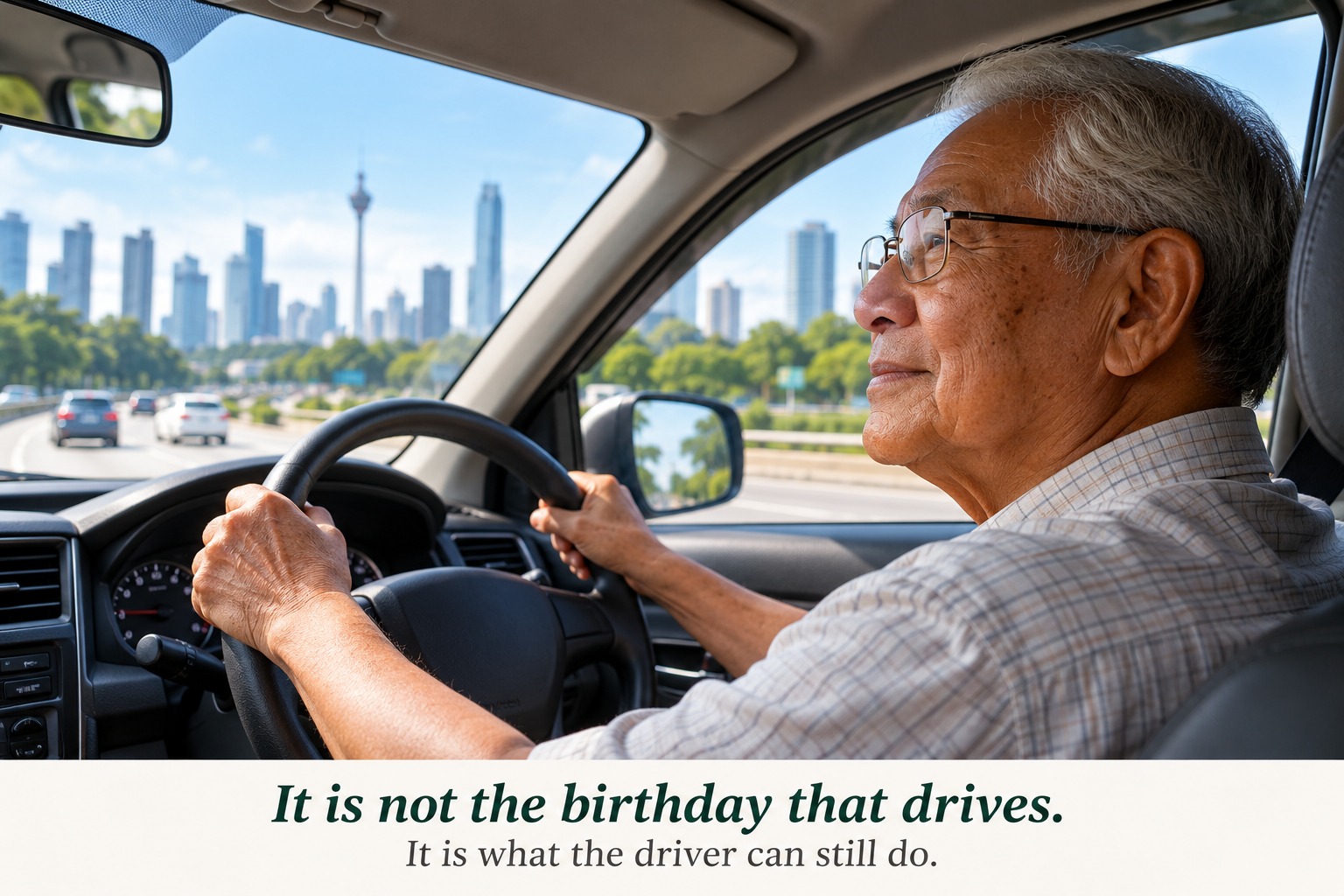
The question is not how old you are. It is whether you can still do it, and who will tell you when you cannot.
Sources & further reading
- NST (16 Jul 2026). Govt rules out age-based health checks for drivers aged 70 and above. Journalistic. Source
- Dewan Rakyat. Penyata Rasmi (Hansard), 16 July 2026, Bil. 36, oral question 9 (Mohd Nazri Abu Hassan, Merbok), pp. 44-46. Unrevised copy ("Naskhah belum disemak"); Malay original. Source
- Malay Mail (11 Jun 2026). Is Malaysia ready for an era of ageing drivers? Journalistic; Section 30(3) and 10-year renewal. Source
- Bernama (18 Dec 2024). No additional conditions for senior citizens' LMM renewal. Source
- Malay Mail / Bernama (16 Jul 2026). Nearly 70pc of road accident victims last year were aged 16 to 40, says deputy minister. Journalistic. Also the source for the JPJL8/JPJL8A vocational medical. Source
- Li G, Braver ER, Chen LH. Fragility versus excessive crash involvement as determinants of high death rates per vehicle-mile of travel among older drivers. Accid Anal Prev 2003;35(2):227-35. doi:10.1016/s0001-4575(01)00107-5. Source
- Pan Y, Evans A, Benedetti MH, Zhu M. Mandatory vision test for driver license renewal in association with traffic fatality and injury among older road users in Utah. J Appl Gerontol 2024;43(2):215-23. doi:10.1177/07334648231204789. Source
- Rubin GS, Ng ESW, Bandeen-Roche K, et al. A prospective, population-based study of the role of visual impairment in motor vehicle crashes among older drivers: the SEE study. Invest Ophthalmol Vis Sci 2007;48(4):1483-91. doi:10.1167/iovs.06-0474. Source
- Attuquayefio T, Huque MH, Kiely KM, et al. The use of driver screening tools to predict self-reported crashes and incidents in older drivers. Accid Anal Prev 2023;191:107193. doi:10.1016/j.aap.2023.107193. Source
- Chihuri S, Mielenz TJ, DiMaggio CJ, et al. Driving cessation and health outcomes in older adults. J Am Geriatr Soc 2016;64(2):332-41. doi:10.1111/jgs.13931. Source
- Ross LA, Clay OJ, Edwards JD, et al. Do older drivers at-risk for crashes modify their driving over time? J Gerontol B Psychol Sci Soc Sci 2009;64(2):163-70. doi:10.1093/geronb/gbn034. Source
- Nguyen H, Di Tanna GL, Coxon K, et al. Associations between vision impairment and vision-related interventions on crash risk and driving cessation: systematic review and meta-analysis. BMJ Open 2023;13(8):e065210. doi:10.1136/bmjopen-2022-065210. Source
- Owsley C, McGwin G, Sloane M, et al. Impact of cataract surgery on motor vehicle crash involvement by older adults. JAMA 2002;288(7):841-9. doi:10.1001/jama.288.7.841. Source
- Meuleners LB, Brameld K, Fraser ML, Chow K. The impact of first- and second-eye cataract surgery on motor vehicle crashes and associated costs. Age Ageing 2019;48(1):128-33. doi:10.1093/ageing/afy156. Source
- de Almeida WM, Quintas JL, Trindade IOA, et al. Diagnosis of Alzheimer's dementia and vehicle driving restriction: a scoping review. Psychogeriatrics 2024;24(1):138-44. doi:10.1111/psyg.13049. Source
- Liu D, Chihuri S, Andrews HF, et al. Diabetes mellitus and hard braking events in older adult drivers. Inj Epidemiol 2024;11(1):22. doi:10.1186/s40621-024-00508-2. Source
- Luzzi V, Mazur M, Guaragna M, et al. Correlations of obstructive sleep apnea syndrome and daytime sleepiness with the risk of car accidents in adult working population. J Clin Med 2022;11(14):3971. doi:10.3390/jcm11143971. Source
- Feltner C, Wallace IF, Aymes S, et al. Screening for obstructive sleep apnea in adults: evidence report and systematic review for the US Preventive Services Task Force. JAMA 2022;328(19):1951-71. doi:10.1001/jama.2022.18357. Source
- The Star (24 Jul 2026). Miros: Doctors can help decide who should drive. Journalistic. Source
- Malaysian Medical Council. Confidentiality. Guidelines approved 11 October 2011; paras 3–4, 34–38. Source
- Malaysian Medical Council. Code of Professional Conduct 2019. Effective 23 February 2021; sections 1.5 and 2.2.2. Source
- Malaysia. Personal Data Protection Act 2010 (Act 709), as amended; see especially section 39. Source
- Malaysia. Personal Data Protection (Amendment) Act 2024 (Act A1727). Source
- Ministry of Health Malaysia. Guidelines on Consent for Health Data Processing at Ministry of Health Malaysia Health Facilities. 1st ed. 2026; section 6.2.1. Source
- Singapore Medical Association. SMA's letter (14 November 2017) and MOH's reply (March 2018) on doctors' duty to report unfit-to-drive cases. SMA News, August 2018, p. 11. Source
- Singapore Ministry of Home Affairs (7 Jul 2026). Criteria for assessing fitness of elderly individuals to retain driving licences. Parliamentary reply. Source
- Bangkok Post (13 Feb 2021). Tougher time for drivers. Journalistic; announcement of a new requirement as of 2021. Source
- Napatanapong C, Pattarapisan N. Retest senior drivers for road safety. TDRI Insight, 27 Jan 2021 (first published in the Bangkok Post). Commentary by researchers who favour a retest for lifetime-licence holders. Source