Mpox made international headlines in 2022. It has since slipped from public attention, but it has not disappeared.
In early November, Thailand reported 470 cases and three deaths for the year so far. Among its confirmed cases this year, clade Ib has come to outnumber clade II, a change from previous years.
What does continued transmission in our region mean for Malaysia?
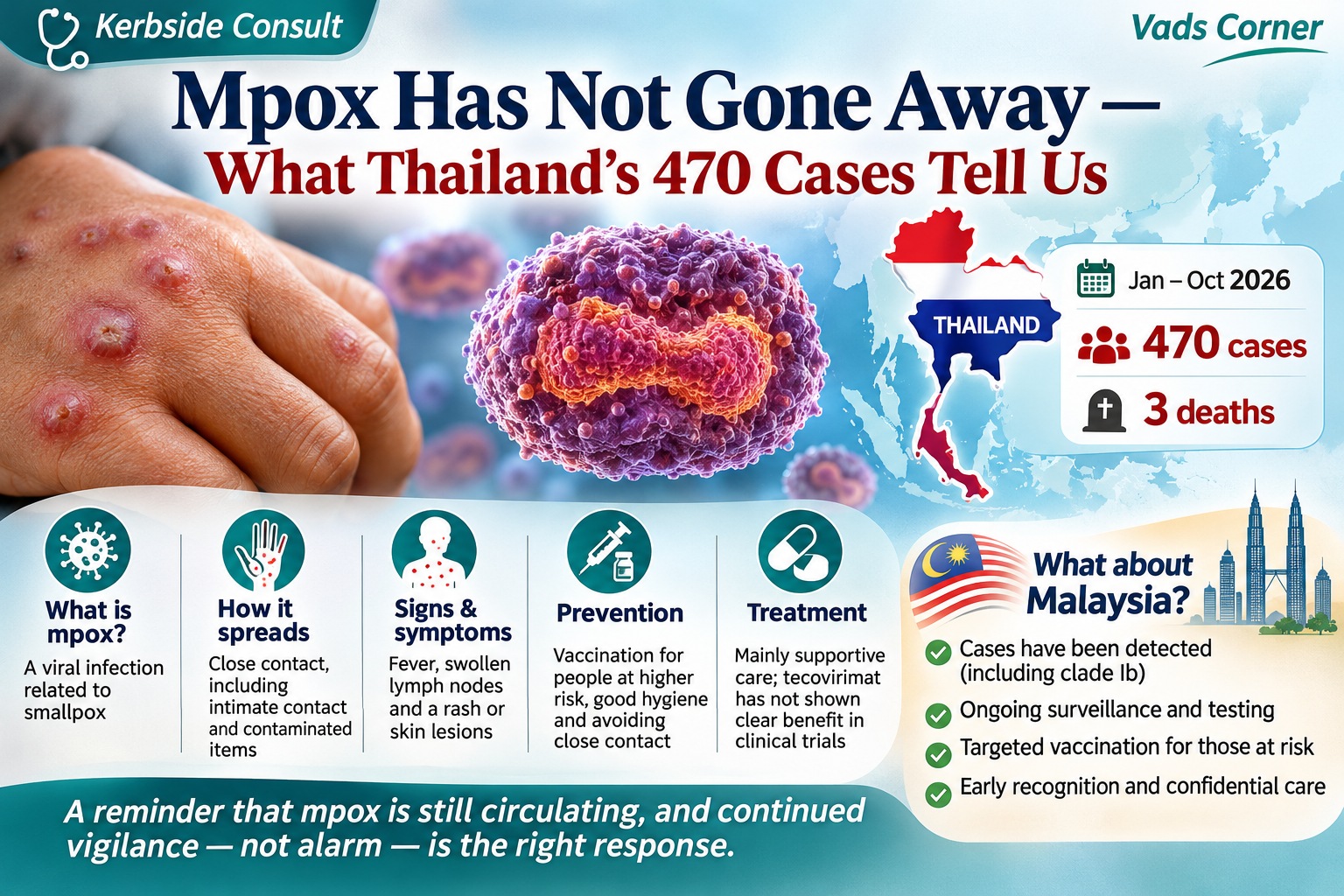 AI-generated illustration
Contents
Why Thailand’s figures matter
Thailand reported 470 cumulative mpox cases and three deaths between January and October 2026. Its Department of Disease Control gave the figures on 3 November and urged people with unexplained rashes or sores to seek medical attention.[1] The statement does not say whether every case was laboratory-confirmed, although the department’s earlier update, on 2 September, described its 2026 series as confirmed cases.[2]
WHO ended the mpox public health emergency of international concern on 5 September 2025, but it still treats the outbreak as a graded emergency, rated the global risk as moderate in its August 2026 assessment, and has extended its standing recommendations to August 2027.[3], [4]
What is mpox, and how does it spread?
Mpox, formerly called monkeypox, is caused by a virus related to the smallpox virus. First discovered in laboratory monkeys in 1958, it circulated in parts of Africa long before the international outbreak of 2022.[5]
Transmission occurs mainly through close physical contact, particularly contact with infected skin lesions. Intimate or sexual contact, contaminated bedding or clothing, and some close face-to-face exposures can also spread infection. Mpox is not exclusively a sexually transmitted infection.[5]
Most patients recover without specific treatment.[1] Severe illness is more likely in people with substantially weakened immunity and can also occur in young children or during pregnancy.[5]
Recognising the rash
Fever, headache, muscle aches and swollen lymph nodes may precede a rash, but not always. Lesions can develop into blisters and pustules before crusting over. They may appear on the face, hands, trunk, genitals or around the anus; some patients have only one or a few lesions.[5]

Selected references: 5.
How is the diagnosis confirmed?
Mpox can resemble chickenpox, herpes or syphilis. Doctors assess the symptoms, rash and possible exposure, but appearance alone cannot establish the diagnosis.[5] The preferred laboratory test is PCR on material swabbed from a skin lesion, and antibody tests are not a substitute because they cannot distinguish between orthopoxviruses.[5], [6] Clinicians are advised to take two swabs per lesion so that clade-specific testing can be done if needed.[6]
Clades: branches of the same family
A clade is simply a branch of a virus family tree. As viruses multiply, small genetic changes accumulate. Mpox has two main branches: clade I (including Ia and Ib) and clade II (including IIb). Clade IIb drove much of the 2022 international outbreak.[5]
Knowing the clade helps public-health teams follow transmission. It does not, by itself, predict how sick an individual patient will become. Thailand’s 3 November statement gave no clade breakdown.[1] However, the department reported on 2 September that clade Ib accounted for 193 of 254 confirmed cases between 1 January and 23 August, with 58 clade II and three awaiting sub-clade classification. It said cases had been rising since June, at a higher level than a year earlier, and that clade Ib now outnumbers clade II, which is a change from previous years.[2] WHO’s South-East Asia bulletin adds that 90 cases were notified between January and June and 164 between 1 July and 23 August, and that 150 of those 164 were clade Ib.[7] That is a notable regional shift. It still cannot be translated into an individual risk.
Clade Ib emerged in the mining region of Kamituga, in eastern Democratic Republic of the Congo, in 2023. Investigators found genomic evidence of sustained human-to-human transmission and a potential role for sexual transmission, since 29% of confirmed cases were sex workers.[8] Separately, an earlier clade I cluster in Kwango province, also in 2023, was linked to sexual contact, showing that this route is not limited to clade II.[9]
WHO now reports community transmission of clade Ib in several European countries, including within sexual networks of men who have sex with men and sex workers.[4] The three Thai deaths cannot be attributed to any clade from the published information.
Mpox in our neighbourhood
Regional reporting is uneven, and national updates cover different periods, so they cannot be compared directly with Thailand’s January–October figures. For 1 January to 21 March 2026, the ASEAN table in Malaysia’s Epidemiology Bulletin lists 22 cases in Thailand, 16 in Malaysia and 6 in Singapore, and none in Indonesia or the Philippines.[10] On 2 April, Singapore’s Communicable Diseases Agency confirmed its first two locally transmitted clade Ib infections, both in men and both likely acquired through sexual contact.[11]
Malaysia’s Ministry of Health reported 41 confirmed cases from January 2023 to 28 March 2026, including 17 that year. Among the cumulative cases, 34 were identified as clade IIb and two as clade Ib.[10] These are the latest published Malaysian figures I could find, not November totals.
Most of Malaysia’s confirmed cases to March 2026 were in men (37 of 41), aged 20–39 (34), and were reported from Kuala Lumpur (25) and Selangor (8). The main reported risk factor was sex between men (32 cases, 78%); six cases were in heterosexual people with multiple partners, and 31 infections (76%) were acquired locally.[10] The Ministry has accordingly folded mpox prevention into the existing HIV and sexually transmitted infection teams at district and state level, and is targeting key populations with risk communication.[10] Mpox is nevertheless spread by close contact, not by identity, and anyone with an unexplained rash should be assessed.
Prevention and vaccination
WHO and Thailand’s Department of Disease Control advise prompt assessment and testing and avoiding close contact during illness.[1], [5] WHO also advises monitoring exposed contacts for symptoms for 21 days.[5] People with confirmed mpox should avoid close physical contact until all lesions have healed, scabs have fallen off and new skin has formed.[1] Local MOH instructions take precedence for Malaysian patients.
Vaccination is targeted at people at increased risk, not the general population. The non-replicating MVA-BN vaccine (Jynneos/Imvanex/Imvamune) is generally given in two doses four weeks apart; real-world studies suggest better protection after two doses, although breakthrough infections occur.[12] LC16m8 is another option, while ACAM2000 has additional safety restrictions.[13]
For eligible close contacts, vaccination is best given less than four days after exposure and may be offered up to 14 days if symptoms have not appeared.[5] BioNTech’s BNT166a mRNA vaccine is being studied, but it has not yet been shown to prevent mpox in clinical practice.[13], [14]
What about treatment?
Most patients need supportive care: pain relief, fluids, care of lesions and treatment of complications. Eye involvement, severe pain, dehydration or worsening illness warrant urgent assessment.[1]
Tecovirimat (TPOXX) initially appeared promising, but the randomised PALM007 and STOMP trials did not show faster lesion resolution in the populations studied. Its role in severe disease or profound immunosuppression remains uncertain.[15], [16], [17]
Cidofovir and brincidofovir may be considered in selected severe cases, usually alongside tecovirimat, and antibody-based treatments and drug combinations are used in similar circumstances. Their benefit against human mpox has not been established, and some carry important toxicity risks.[18] A drug that inhibits a virus in the laboratory does not necessarily help patients recover.
What should Malaysia do?
Malaysia needs clinicians who recognise suspicious lesions, accessible PCR testing, timely contact tracing and clear pathways for targeted vaccination. Clinicians and the public also need to know where vaccination is available and who is eligible.
Confidentiality matters as much as laboratory capacity. People who fear discrimination or disclosure may delay seeking help. Surveillance and care must be accessible without stigma.
At the kerbside
Thailand’s three deaths among 470 reported cases give a crude reported case-fatality ratio of about 0.64%. This is a surveillance figure, not an individual risk estimate. What the numbers do show is that reported cases have climbed steeply through 2026, to 470 by the end of October.[1] We need vigilance without alarm—and preparedness that continues after the headlines move on.
The end of an emergency is not necessarily the end of an infection.