A reported reversal by Malaysia's Poisons Board has revived a controversy that should concern more than smokers, vapers or the medical profession. At issue is a drug capable of creating dependence, a regulatory framework that has changed, and an expert recommendation whose scientific reasoning, as far as published reports show, has not been made public.
On 2 November 2026, CodeBlue reported that the Poisons Board had backed the Health Minister's proposal to exempt liquid nicotine used in vaping products from the Poisons List. According to the Malaysian Pharmacists Society president, Prof Amrahi Buang, the Board decided by secret ballot, and members are bound not to share information.[1] Let me be clear about what this is. It is a reported Board recommendation. It is not yet an order, and as of the reports I reviewed none had been gazetted.
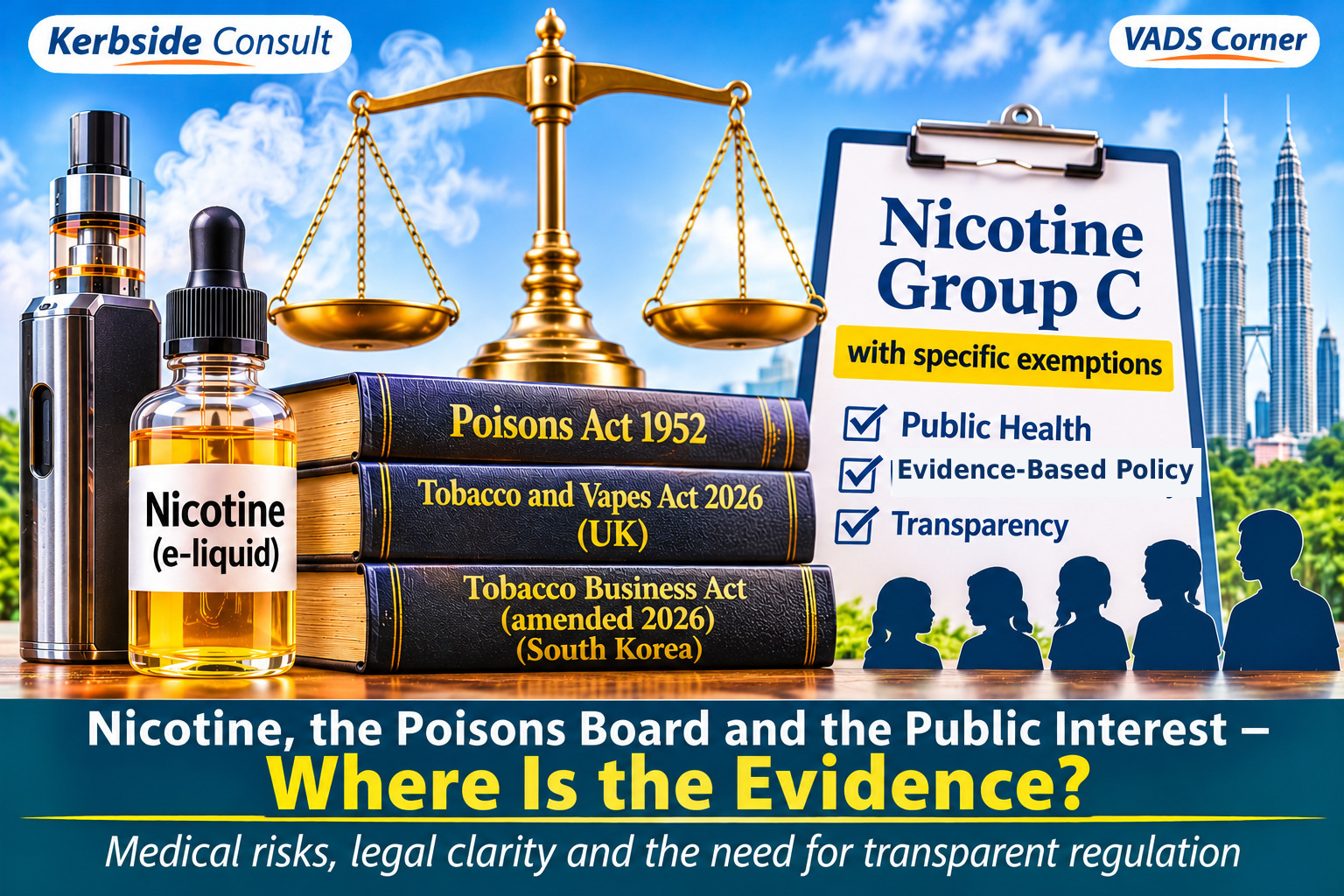 AI-generated illustration
Contents
- Why nicotine matters medically
- Vaping is not simply inhaling water vapour
- What have other countries done?
- Malaysia: what changed between 2023 and 2026?
- A secret ballot is not a secret justification
- The medical profession and civil society respond
- Should MMA withdraw from the Poisons Board?
- At the kerbside
- Sources & further reading
Legal-status note (7 November 2026): As I read it, the Board's reported endorsement is a recommendation, not an order. CodeBlue said on 2 November that no exemption order had yet been published on the Attorney-General's Chambers legislation portal.[1] The Poisons List on the Ministry of Health website, which cites P.U.(A) 460/2025, still carries the e-cigarette liquid exemption.[24] That fits the High Court result, which was a declaration and not a quashing order.[14] Please check the gazette before relying on any of this.
Why nicotine matters medically
Nicotine is not an innocuous flavouring. It is a pharmacologically active substance that binds to nicotinic acetylcholine receptors and acts on the brain's reward pathways. Repeated exposure can produce dependence. When nicotine is withdrawn, cravings, irritability, anxiety, disturbed sleep and difficulty concentrating may follow. These effects make quitting hard, even for people who want to stop.[2], [3], [4]
The Ministry of Health itself calls nicotine highly addictive in its Nicotine Dependence Management Pharmacy Service Protocol (third edition, 2026).[27] On numbers, I would be careful. The WHO's Global Adult Tobacco Survey (GATS) 2023 puts current e-cigarette use among Malaysians aged 15 and above at 5.8%.[29] That age band includes some teenagers. The Ministry's protocol quotes the same 5.8%, up from 0.8% in 2011, and 8.6% among those aged 15–24, but labels them as NHMS findings.[27] They are GATS figures. The GATS Malaysia 2023 technical report confirms 0.8% in 2011 and 5.8% in 2023 for all adults, and 1.1% to 8.6% among those aged 15–24.[30] NHMS 2023, a separate survey, gives 5.0%.[31] Different surveys, different age bands. None of them is a new 2026 estimate.
Children and adolescents deserve particular protection. The brain keeps developing into early adulthood, and nicotine exposure in adolescence raises concerns about attention, learning, impulse control and dependence. Animal and mechanistic studies support this, but the size of the long-term effect in humans is hard to separate from other influences. That uncertainty is not a licence to expose young people to an addictive drug.[2], [3], [4]
The heart and blood vessels also respond to nicotine. It stimulates the sympathetic nervous system, raising heart rate and blood pressure, and can affect vascular function. The acute effects are established. Pinning long-term heart attacks or strokes on nicotine alone is harder, because smoking and vaping come with other exposures. We should separate what is known from what is not.[3], [4]
During pregnancy , recreational vaping should not be considered safe.[2], [4] For a pregnant person who smokes, nicotine replacement therapy is a supervised, case-by-case call. Australian guidelines recommend it for pregnant women who cannot quit unassisted, while ACOG says its safety and efficacy have not been sufficiently evaluated.[36]
Accidental poisoning is another immediate danger. Liquid nicotine can be toxic if swallowed, especially by young children, and significant exposure can cause vomiting, seizures and life-threatening toxicity. Concentration limits, child-resistant packaging, clear warnings and safe storage are practical public-health protections, not administrative niceties.[3], [4], [17]
Vaping is not simply inhaling water vapour
E-cigarettes heat a liquid to make an aerosol. Depending on the device, the liquid and how it is used, that aerosol may contain nicotine, fine particles, carbonyl compounds and metals. Respiratory irritation has been reported, and the long-term consequences of the many different products remain poorly characterised. It would be wrong to say vaping is harmless. It would also be wrong to equate it with the much heavier toxic burden of burning cigarettes.[2], [3]
This matters for smoking cessation, and here the evidence is better than the shouting on either side suggests. The 2025 Cochrane review (104 studies, 30,366 participants) found high-certainty evidence that nicotine e-cigarettes help more people quit than nicotine replacement therapy: roughly three more quitters per 100. It found moderate-certainty evidence that they beat nicotine-free e-cigarettes, and less certain evidence of benefit against behavioural support or no support. It did not detect serious harm, but said longer, larger trials are needed.[28] The caveat that matters most for us: the trials tested regulated nicotine products. Illicit products, or those containing other active substances, may have different harm profiles.[28]
The policy statements are more cautious than the trial result. The CDC warns against e-cigarette use by young people, pregnant people and non-smokers while recognising that complete substitution may help some adult smokers.[2] The World Medical Association and the WHO urge tight controls.[4], [5] So the benefit to an established smoker who switches completely is not the same as continuing to smoke while vaping. And it is certainly no argument for a teenager who has never smoked to start on nicotine. Approved nicotine patches, gums and other cessation treatments have an established role.[2], [3], [4], [5]
Public-health policy has to hold two populations in view at once: adults who smoke and may benefit from quitting combustible tobacco, and children or non-smokers who may acquire a dependence they would otherwise never have had.
What have other countries done?
There is no single international model. Countries have chosen differently, shaped by their public-health priorities and legal systems. The table describes broad approaches. It does not mean outcomes are identical, or that any model can be lifted into Malaysia unchanged.
How other countries regulate vaping
| Country | Broad approach |
|---|---|
| Australia | Therapeutic vapes are supplied only through participating pharmacies. Adults 18+ may obtain nicotine vapes of 20 mg/mL or less without a prescription, subject to conditions and state law; stronger products need a prescription. No vaping product was registered in the ARTG in the TGA guidance updated November 2025.[16] |
| Singapore | Possession, use, importation and supply of vaporisers are prohibited. The Tobacco and Vaporisers Control Act took effect under its new name on 1 May 2026. From the same date, etomidate and its analogues are listed as specified psychoactive substances. Since 1 September 2025, etomidate offenders and repeat vaporiser users must also attend rehabilitation.[17] |
| United Kingdom | Regulated adult vaping remains permitted. Single-use vapes have been banned since 1 June 2025.[34] The Tobacco and Vapes Act 2026 (enacted 29 April 2026) adds powers over marketing, retail licensing and product standards, with commencement set provision by provision.[20], [21] |
| United States | FDA had authorised 48 e-cigarette products as of 28 August 2026. Marketing authorisation is not FDA approval, and not a finding that the product is safe.[18] |
| Japan | Nicotine-containing e-cigarettes are treated as unapproved medicinal products: domestic sale and advertising are prohibited, and personal importation is allowed only within a ceiling and conditions.[23] At a press conference on 24 July 2026, the Minister said no further regulation was being considered.[22] |
| South Korea | Since 24 April 2026, amendments to the Tobacco Business Act bring synthetic-nicotine liquid e-cigarettes under tobacco rules: licensing, tax and health warnings, with online sales and sales to minors banned.[19] |
I took each row from the regulator's own page, not from press coverage.[16], [17], [18], [19], [20], [21], [22], [23], [34] One caution on the UK: the Act is on the statute book, but individual provisions start on the dates set under section 175, so please don't read it as already fully in force.[20]
The WHO's 2025 position is the one I would underline. Where governments prohibit these products, they should enforce the prohibition. Where they allow commercial sale, they should regulate tightly, covering flavours, nicotine concentrations, advertising, sales to minors and online distribution. WHO also urges that health policy be protected from industry interests.[5] Its 2023 call to action says the same of nicotine e-cigarettes: highly addictive, harmful to health, and not to be sold to children.[8] The same document cites WHO trends data: over 15 million children aged 13–15 now use e-cigarettes, and on average they are nine times more likely than adults to do so.[5]
The World Medical Association recommends effective controls on electronic nicotine delivery systems, including youth protection, labelling and product safety.[4] The Australian Medical Association supported stronger vaping controls in its 2024 submission.[6] The Royal College of Physicians in the UK takes a more explicit harm-reduction line for adult smokers, coupled with strong youth safeguards.[7] These differ in emphasis. None says nicotine is non-addictive.
The youth side is worth a look too. The Royal College of Paediatrics and Child Health's 2026 report notes that in England in 2023, 27% of girls and 22% of boys aged 11–15 had ever used an e-cigarette, up from 25% and 19% in 2021. It also reports emerging surveillance data that vapes seized from English secondary schools contained significant quantities of toxins, including synthetic cannabinoids.[35] That is a UK finding, not a Malaysian one. But it is exactly the sort of risk that a nicotine-only debate leaves out.
Malaysia: what changed between 2023 and 2026?
What was exempted? The exemption came through the Poisons (Amendment of Poisons List) Order 2023, P.U.(A) 93/2023, made on 31 March 2023 and effective 1 April 2023.[9], [14] The consolidated Poisons List (P.U.(A) 306/2023) keeps nicotine in Group C but exempts preparations of a kind used for smoking through electronic cigarettes or electric vaporising devices, in liquid or gel form. It separately exempts tobacco and specified registered cessation patches and gums.[25] So “removing nicotine from the Poisons List” is imprecise. The legal issue is the exemption of defined preparations from Poisons Act controls.
What did the Act say about the Board? Section 6 of the Poisons Act lets the Minister amend the Poisons List “after consultation with the Poisons Board.”[26] CodeBlue puts it plainly: the Act requires consultation, not the Board's approval.[1] The Minister is not bound by the Board, but the High Court said the Minister must seek its views and give them due consideration.[14]
What did the High Court decide? The Board unanimously rejected the proposed exemption at its 97th meeting on 29 March 2023.[9], [14] The next day, with no meeting between the Minister and the Board and no reasons given, then Health Minister Dr Zaliha Mustafa decided to make the order.[14] In May 2026, Justice Aliza Sulaiman of the Kuala Lumpur High Court granted declarations on two prayers (A and B). The exemption part of the order was irrational, and it was inserted without proper or adequate consultation with the Poisons Board.[14] The written grounds, delivered on 24 July 2026, say the decision was motivated primarily by economic reasons of tax benefits and revenue collection. The Minister took irrelevant considerations into account, disregarded relevant ones, and breached her duty to protect public health, including under the CRC and the WHO FCTC.[14] The judgment also records that the exemption was made to enable excise duties on e-cigarettes.[14] MMA's application to be appointed amicus curiae was allowed on 6 December 2023, and the decision was given on 15 May 2026.[14]
Two points to keep straight. First, the court granted declarations only. It did not quash the order.[14] What that means in law today is not clear. MCTC noted that neither the Health Ministry nor the Finance Ministry has said whether the sale of nicotine vapes is now illegal under the Poisons Act, or whether more than RM354 million in excise duty collected on nicotine e-liquids has been invalidated.[32] Second, the government withdrew its appeal in August.[1], [32]
The regulatory landscape is now different. Malaysia has enacted the Control of Smoking Products for Public Health Act 2024 (Act 852), which came into force on 1 October 2024. Immediate enforcement covered the prohibition of advertising, promotion and sponsorship; sales in educational institutions, online platforms, vending machines and retail markets; and packaging that resembles toys or food. The ban on selling smoking products to minors followed on 1 April 2025, and packaging and labelling rules on 1 October 2025.[15] CodeBlue's anonymous source argued that the court ruling left a conflict: without an exemption, liquid nicotine is restricted under the Poisons Act to dispensing by pharmacists or doctors, while Act 852 permits sale of nicotine vapes to adults. The source said the decision was “not a commercial decision” and that the Board wants stronger enforcement of Act 852.[1]
That explanation deserves consideration. A legal inconsistency may genuinely need resolving. But it remains an anonymous account , not a published Board assessment. More important, a regulatory conflict does not tell us whether an exemption is the best way out, whether Act 852 protects children adequately, or whether another legislative route would serve public health better.
The properties of nicotine have not changed since 2023. The law has. If that is the reason for the Board's reported reversal, the Ministry should say so clearly and show why the replacement safeguards are enough.
A secret ballot is not a secret justification
There may be legitimate reasons to keep individual contributions to an advisory board confidential. Members should be able to debate difficult questions without intimidation, and a secret ballot can sometimes protect independence. But the secrecy of a vote is a different thing from secrecy of the evidence behind a collective recommendation.
What do we actually know? Prof Amrahi told CodeBlue that the Board held a secret ballot and that members are under oath not to share information.[1] Scoop reported that members are bound by confidentiality requirements.[33] Section 5(1) of the Poisons Act lets the Board regulate its own procedure, so a secret ballot is not unlawful on its face.[26] What the reports do not say is whether the ballot took place at a meeting or as a written resolution without a meeting under section 4A, which needs the agreement of all members.[26] CodeBlue itself says it is unclear when the Board met, who attended, and how anyone voted.[1] I have found nothing that says the whole body of scientific evidence, the options considered and the Board's collective reasons must be withheld. If there is such a rule, someone should name it.
The public does not necessarily need a list of who voted for and against. It does need to know what evidence was examined, how the Board weighed the risks to children and to adult smokers, whether alternatives were compared, and why the recommendation reportedly differs from 2023.
What should be made public?
At minimum, a reasoned statement should identify: the scientific studies and Malaysian surveillance data considered; the risk assessment for youth dependence, poisoning and exposure; the comparative legal analysis of the Poisons Act and Act 852; options such as continued scheduling, restricted supply, legislative amendment or prohibition; anticipated enforcement consequences; and how public-health, administrative and economic factors were weighed. Any conflicts of interest should be declared and managed, with genuinely confidential material protected.
These requests do not require publishing personal information, protected commercial secrets or verbatim deliberations. They require an account of the collective basis for a recommendation with national consequences. Without that account, independent scientists and professional bodies cannot judge whether the conclusion follows from the evidence.
If the scientific evidence has changed, show us the evidence. If the legal framework has changed, explain the consequences. If economic or administrative considerations were decisive, say so. A secret ballot may protect the voter. It should not conceal the reasons for the vote.
Transparency also protects the Board itself. A published rationale would cut speculation about improper influence, let the Ministry defend a sound decision, and show up weaknesses that may need correcting. Secrecy does not prove commercial interference. Nor does it inspire confidence while important questions stay unanswered.
The medical profession and civil society respond
The calls came from several directions, and each is on the record. MMA president Dr Sivanaesan Letchumanan asked the Minister to explain the public-health justification, reaffirm the government's commitment to a nationwide vape ban and give a timeline. MMA's own position is that vape products should be banned nationwide.[10], [11], [33] The Addiction Medicine Association of Malaysia and the Federation of Private Medical Practitioners' Associations Malaysia jointly asked for gazettement to be deferred and for the scientific, legal and public-health considerations to be disclosed.[10] The Malaysian Paediatric Association asked for any new evidence behind the Board's changed position to be published and scrutinised.[13] MyWATCH asked for risk assessments, wider consultation and a clear timeline for restricting recreational vaping.[12] Aliran echoed the MMA and the MPA and warned that children could pay the price for a tax windfall.[13]
One more worry. MMA pointed to the Home Ministry's disclosure in July that 718.43kg of vape products suspected of containing prohibited substances were seized between 2023 and June 2026, with 585 arrests in 400 cases.[11], [33] That is the Home Ministry's figure as cited by MMA, and it concerns a different problem from nicotine liquid. I mention it because the Cochrane trials did not test illicit or drug-laced products, so their reassurance does not stretch to them.[28]
These are the reported positions of the organisations concerned, not proof of misconduct. They share one demand: a major decision about an addictive substance must be justified by evidence that can be examined.
It is also a question of policy coherence. The Minister had said a vape ban was no longer a question of “if” but “when”. If a nationwide ban is still the objective, how does another nicotine exemption advance it? If policy has changed, the public deserves to be told, rather than having to infer it from regulatory orders.[10], [11]
Should MMA withdraw from the Poisons Board?
The question is not mine alone. CodeBlue raises it. Under the Board's consensus decision-making, every member is taken to uphold the proposed exemption, however they voted or whether they attended, unless they resign in protest. MMA and the Malaysian Pharmacists Society have both repeatedly urged a vape ban, and both have a representative on the Board. If they stay, CodeBlue suggests, they may have to pivot to pressing for stronger enforcement of Act 852.[1]
Disclosure: I am a Life Member of the Malaysian Medical Association and have contributed to its newsletter, Berita MMA, where my Cybermed column appeared.
My view is that MMA should stay. The Board's work goes far beyond nicotine, and an association that walks out gives up an independent medical voice on every future decision about medicines, patients and professional independence. Staying is also the only way to keep demanding, from inside, the published reasons this article asks for. The case for leaving is real. Resignation sends a powerful signal, and under consensus decision-making staying can look like owning a decision the association says it objects to. But a signal is not a safeguard. If MMA stays, it must keep saying in public what it opposes and why, and press for a reasoned statement from the Board. Staying quietly would be the worst of both.
A word on numbers. The Poisons Act sets out more seats than the 11 members CodeBlue listed from the Ministry's website.[1], [26] I have not reconciled the two, and the reader should not assume the list is complete. Nor should anyone presume how the current MMA representative voted. Without an authorised disclosure, that remains unknown. What MMA can explain publicly is its policy position, the evidence behind it and the reforms it wants in the Board's decision-making.
At the kerbside
Nicotine dependence is not disputed. The risks to young people, the possibility of acute poisoning and the extra exposures from vaping give ample reason for robust safeguards. Adult smoking cessation raises a legitimate question of relative risk, and the Cochrane evidence is real, but it does not justify an unrestricted market in an addictive product.
Act 852 sets up a separate framework for smoking products. Whether it gives protection equivalent to Poisons Act controls needs a provision-by-provision assessment, including product standards and enforcement. We cannot fairly judge the Board's reported recommendation without seeing the analysis behind it.
The Minister may have the authority to make the decision. The public has every reason to ask for its scientific and legal justification. That is not an attack on the Poisons Board. It is the standard of accountability that should accompany expert advice on matters affecting public health.