Cholesterol treatment usually means taking tablets or returning for injections for years. Could one intravenous infusion instead change the liver’s instructions and keep LDL cholesterol lower long after the medicine has disappeared?
Gene editing has reached human trials, but it has not established a cholesterol cure. Its appeal and its central safety challenge are the same: a change made today may persist for years.
1. The cholesterol story has already changed
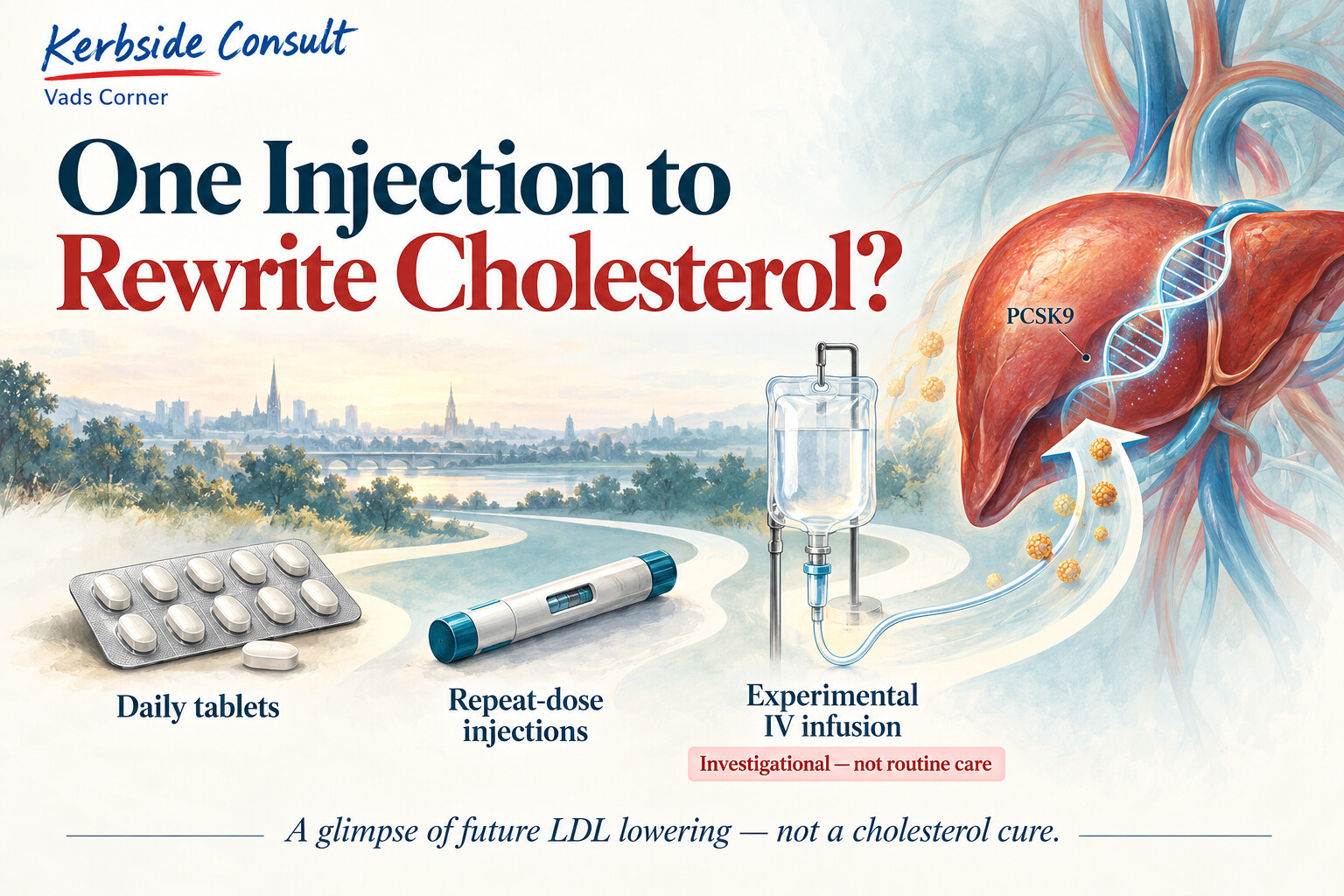
Statins and ezetimibe are established oral treatments. PCSK9 antibodies offer an injectable option, while inclisiran is given initially, at three months, then every six months. Gene editing takes the next step in duration: the intended effect outlasts the treatment itself. Longer lasting, however, does not automatically mean better. [1]
2. Nature supplied the clue
Human genetics supplied the clue. In a 2006 study, Black participants carrying particular PCSK9 loss-of-function variants had mean LDL levels 28% lower and coronary risk 88% lower over 15 years. This association in a genetic subgroup is not a treatment effect that can be promised to someone receiving an editor. [2]
PCSK9 directs LDL receptors towards destruction. Less PCSK9 leaves more receptors to clear LDL from blood. Editing aims to reproduce part of this protective biology; it does not recreate a lifelong inherited state or correct every cause of familial hypercholesterolaemia.
3. Silencing is different from editing
Inclisiran reduces the RNA message used to make PCSK9 protein. It does not change DNA and requires repeat treatment. [1]
VERVE-102 instead targets DNA in liver cells. The editing machinery is temporary, but the intended change remains. Long-acting treatment and permanent editing are different propositions. [3,4]
4. How can one treatment edit the liver
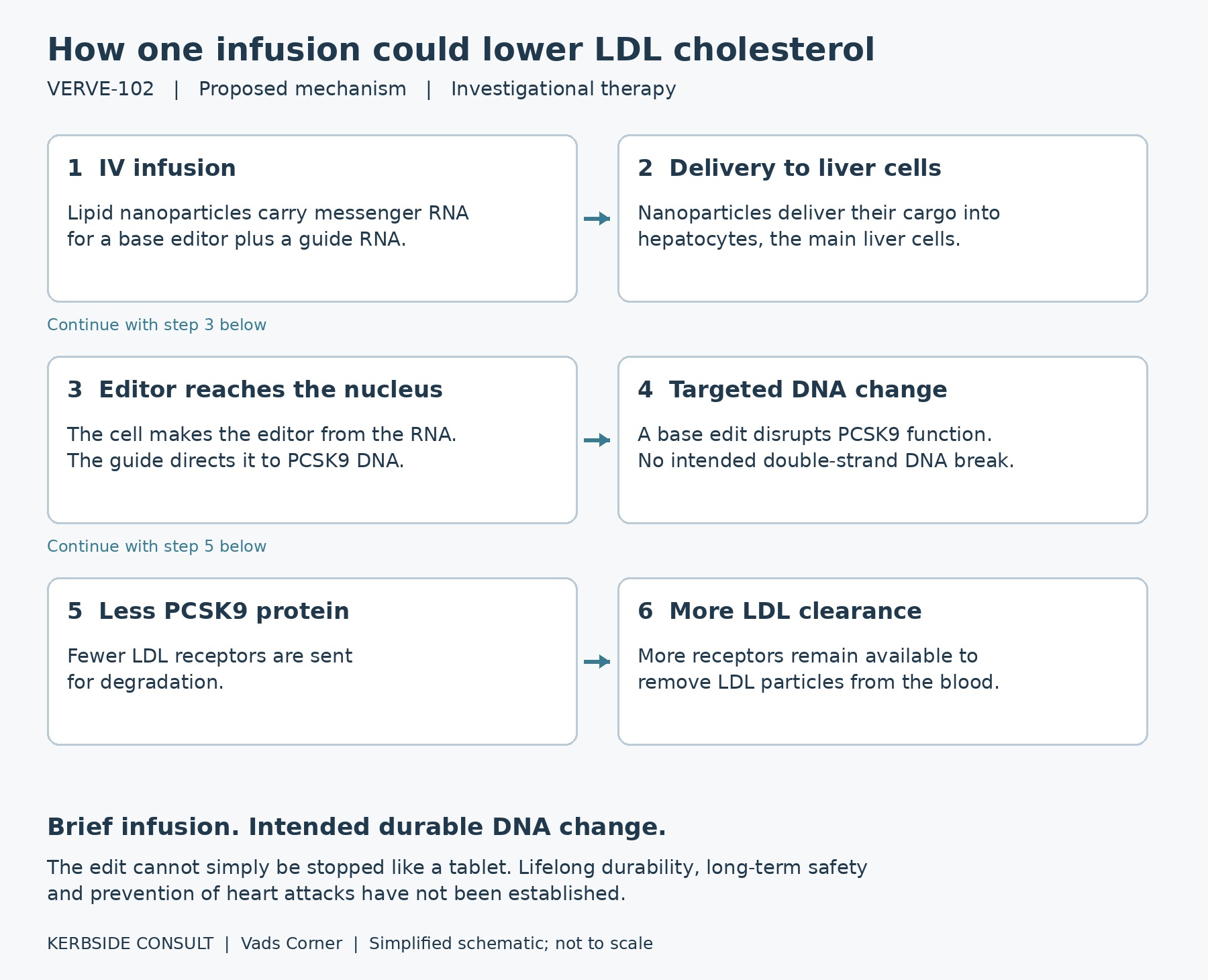
“Injection” is shorthand: VERVE-102 was given as an intravenous infusion lasting up to approximately four hours. Lipid nanoparticles carry messenger RNA encoding an adenine base editor and a guide RNA into liver cells. [3]
Inside the cell, the messenger RNA produces the editor; the guide directs it to the DNA target. Base editing changes a DNA letter without an intended double-strand break. This does not eliminate the possibility of unintended changes. [3,5]
5. What has actually happened in humans
The 2026 NEJM report describes an open-label Phase 1 trial in 35 adults with heterozygous familial hypercholesterolaemia or premature coronary artery disease, across six dose cohorts. There was no placebo group. Verve Therapeutics, a Lilly subsidiary, funded and designed the trial; an independent board monitored safety. [3]
Time-averaged mean PCSK9 reductions ranged from 51% to 88% and LDL-C reductions from 9% to 62%, measured from day 28 to each participant’s last follow-up. At the highest dose, seven participants had a mean LDL-C reduction of 62%, or 78 mg/dL (approximately 2.0 mmol/L). LDL reductions did not increase at every successive dose. [3]
Median follow-up was nine months (28 days to 18 months); 15 participants had reached one year. This nonprespecified interim analysis had no formal statistical testing. Small cohorts and unequal follow-up limit comparisons, and a cohort mean does not predict an individual response. [3]
Safety findings in context
There were no deaths or dose-limiting toxic effects. Seven participants (20%) had grade 1 or 2 infusion reactions, with one temporary infusion interruption. Three had asymptomatic ALT elevations of 2.0–2.4 times the upper limit of normal, peaking on day 3 or 4 and falling below twice that limit by day 8. [3]
Overall, 26 participants (74%) reported adverse events; 11 (31%) had events assessed as treatment-related. One participant with reflux disease and a hiatal hernia developed grade 3 aspiration pneumonitis on day 16, requiring an overnight hospital stay and resolving by day 40. The site investigator assessed this serious event as unrelated to treatment. [3,10]
Kerbside reality check: these results show biological activity. They cannot establish lifelong durability, uncommon or delayed harms, or fewer heart attacks and deaths.
The predominantly White study population limits generalisation, including to Malaysian patients. Off-target screening also relied largely on cells from White donors; assessment across genetic variation remains necessary. [3,5]
HEART-3 is registered as a randomized, double-blind, placebo-controlled Phase 2 trial with an estimated 175 participants. The registry, last updated on 24 September and checked in October 2026, lists it as not yet recruiting. Its primary endpoint is LDL-C change at day 90, rather than cardiovascular events. [6]
| Question | Current answer |
|---|---|
| Human LDL lowering | Observed in an early Phase 1 trial |
| Lifelong effect | Intended, not demonstrated |
| Heart attack prevention | Not established for VERVE-102 |
| Reversing the edit | No established clinical reversal |
| Routine treatment | Investigational |
6. Why durability could matter
A prescription has to survive ordinary life: forgotten doses, costs, interrupted supplies and stopping when one feels well. An effective one-time treatment could reduce dependence on repeated dosing and lower cumulative LDL exposure.
It would not remove the need for follow-up or, for some patients, additional lipid medicines. Smoking, blood pressure and diabetes would still need attention.
7. Safety begins with irreversibility
A tablet can be withheld; a long-acting drug gradually wears off. A DNA edit has no established clinical reversal. That raises the threshold for evidence and informed consent.
Risks include infusion reactions, liver injury, unintended changes at the target or elsewhere in DNA, and delayed consequences. These are risks to investigate, not claims that all occurred in this trial. [5]
Preclinical testing was reassuring within its scope and detection limits, but cannot establish long-term human safety. The evidence note below gives the details. [10]
Delivery matters too. VERVE-101 enrolment was paused in April 2024 after a participant developed marked ALT elevation and low platelets. VERVE-102 uses a different nanoparticle system; that change requires its own safety assessment. [7]
The intended edit is somatic, targeting liver cells rather than eggs, sperm or embryos. Animal findings support this approach but do not prove zero human reproductive risk or liver-exclusive delivery. Reproductive precautions remain necessary. [5,10]
FDA guidance recommends risk-based long-term follow-up, potentially up to 15 years for genome-editing products; Heart-2 participants are expected to undergo 15 years of follow-up in total. Monitoring may detect late problems, but cannot guarantee that none will emerge. [3,8]
8. Who should be studied first?
The strongest initial case is research in people at high cardiovascular risk despite appropriate care, rather than otherwise healthy people with modest LDL elevation. Heart-2 participants had stable disease, received steroid and antihistamine premedication, and were observed in hospital for at least two days. Thirty-two of 35 were taking statins: the trial does not show that editing replaces them. [3]
Consent must distinguish intended effects from observed benefits and unresolved risks. Convenience alone is insufficient: editing must show a favourable balance of benefit and harm against effective alternatives.
The 2026 ACC scientific statement also identifies long-term safety, comparison with existing treatment, cost and equitable access as central challenges. [9]
9. The Malaysian question
Malaysia’s immediate challenge is making effective cholesterol care work in everyday practice. NHMS 2023 found high cholesterol in 33.3% of adults—about 7.6 million people—with approximately half unaware. This demonstrates a detection gap; it does not measure treatment adherence or LDL target attainment. [11] DOSM recorded 17,421 ischaemic heart-disease deaths in 2024, or 13% of medically certified deaths. [13]
After detection, priorities are understanding cardiovascular risk, continuing prescribed treatment, checking lipids and reaching the LDL target appropriate to that risk. Patients need support with concerns, adverse effects and access; clinicians need to review results and intensify treatment when indicated. Malaysia’s 2023 guideline recommends ezetimibe when maximally tolerated statin treatment does not achieve target, and consideration of PCSK9 inhibitors for very high-risk patients still above target despite that combination. [12]
For readers still becoming familiar with cholesterol injections, gene editing is a future possibility distinct from today’s repeat-dose treatments. Experimental progress is no reason to stop prescribed lipid treatment.
10. From prescription to programming
PCSK9 is a starting point, not proof for every target. The sponsor also reports an early ANGPTL3 editing programme; safety and effectiveness cannot be transferred from one target or product to another. [4]
The decisive question is when proven benefit would justify an irreversible genetic change. The answer will depend on the patient’s cardiovascular risk, available alternatives and long-term evidence.
Take home message
Gene editing may eventually reduce repeated dosing. Today, the priority remains taking effective treatment and reaching risk-based LDL targets. The experimental approach still has to prove that patients live longer or live better.
Preclinical evidence note
What did the off-target tests show? The appendix reports screening of 6,081 candidate DNA sites in cultured human liver cells. Confirmatory sequencing of a subset of nominated sites found no off-target editing above a 0.2% frequency threshold at the dose producing 90% of maximal on-target editing. A separate structural-variant screen found no treatment-related rearrangements in two liver-cell donor lots. The threshold describes assay sensitivity, not a measured frequency of unintended editing in patients. These are reassuring preclinical findings within the assays’ scope and sensitivity; they do not rule out every rare unintended edit or establish long-term safety in patients. [10]
The appendix found no transmitted edit in 962 offspring of mice treated with a mouse-adapted editor. This supports the intended somatic approach but is not proof of zero human reproductive risk. In four treated monkeys, delivery was concentrated in the liver, with lower editing in the adrenal glands and spleen. “Liver-targeted” therefore should not be read as “liver-exclusive”. [10]
Sources
- FDA. LEQVIO prescribing information, July 2025. RNA interference mechanism and dosing. Source
- Cohen JC et al. Sequence variations in PCSK9, low LDL, and protection against coronary heart disease. NEJM 2006. DOI 10.1056/NEJMoa054013. Source
- Vafai SB et al. In Vivo Base Editing of PCSK9 with VERVE-102 for Hypercholesterolemia. N Engl J Med. 2026;395(7):648–659. DOI 10.1056/NEJMoa2601283. Source
- Eli Lilly. Heart-2 results and delivery mechanism, 25 May 2026. Sponsor disclosure; supporting source, not independent appraisal. Source
- FDA. Human Gene Therapy Products Incorporating Human Genome Editing. Final guidance, January 2024. Source
- ClinicalTrials.gov. HEART-3, NCT07839936. Updated 24 September 2026; checked October 2026. ClinicalTrials.gov. HEART-3, NCT07839936. Record updated 24 September 2026; checked 13 October 2026; status and primary endpoint corroborated by the export supplied 19 October 2026. Source
- Verve Therapeutics. Updates on its PCSK9 programme, 2 April 2024. Sponsor report of VERVE-101 safety event. Source
- FDA. Long Term Follow-up After Administration of Human Gene Therapy Products. January 2020. Source
- Ambardekar AV et al. Gene Editing Therapy in Cardiovascular Disease: 2026 ACC Scientific Statement. JACC. DOI 10.1016/j.jacc.2026.02.5092. Source
- Vafai SB et al. Supplementary Appendix to NEJMoa2601283. Nonclinical testing, serious-event narrative and additional adverse-event data. Source
- Institute for Public Health. NHMS 2023 Key Findings. Adult high cholesterol prevalence and awareness. Source
- Ministry of Health Malaysia. Management of Dyslipidaemia, 6th edition, 2023. Risk-based LDL targets and treatment intensification. Source
- Department of Statistics Malaysia. Statistics on Causes of Death, Malaysia, 2025. Ischaemic heart-disease deaths in 2024. Source