Optogenetics gave neuroscience a light switch. Whether it becomes a treatment is a different question.
This article came about after I read about the 2026 Nobel Prize in Physiology or Medicine and the award for work on optogenetics.
Optogenetics.
I understood the words — optics, light; genetics, genes. But beyond that, my own tube light did not quite go on!
So I started reading.
And what I found was a fascinating story. It begins with a tiny single-celled green alga that responds to light, leads to the discovery of light-sensitive proteins called channelrhodopsins, and eventually gives scientists something that once sounded like science fiction: the ability to control selected nerve cells using light.
But once my own tube light finally went on, another question occurred to me.
If scientists can control neurons with light, could we eventually use light to treat disease?
That is what this article is about.
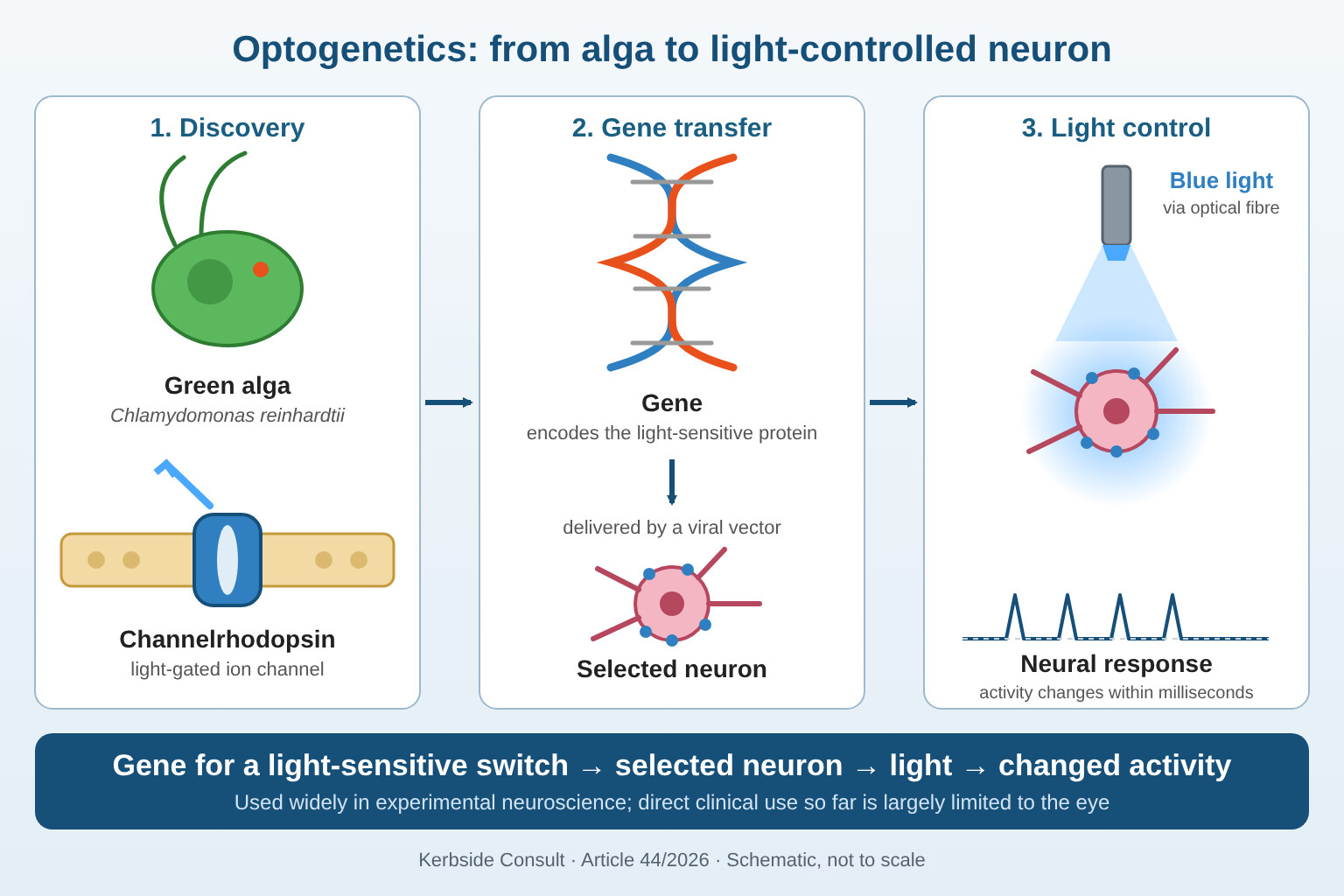
1. The Nobel Prize That Began With an Alga
The 2026 Nobel Prize in Physiology or Medicine was awarded to Karl Deisseroth, Peter Hegemann and Georg Nagel for discoveries concerning light-gated ion channels and optogenetics.[1]
The origins of optogenetics are remarkably humble. Hegemann and Nagel studied how microorganisms, including the green alga Chlamydomonas reinhardtii, respond to light. Their work helped establish the role of channelrhodopsins — proteins that respond directly to light.
In 2002, Nagel and colleagues described Channelrhodopsin-1, a light-gated proton channel from the alga.[2] In 2003, Nagel and colleagues described Channelrhodopsin-2 as a directly light-gated, cation-selective membrane channel.[3]
But what did that have to do with the brain?
What if the gene for this light-sensitive protein could be put into a neuron?
In 2005, Edward Boyden, Feng Zhang, Ernst Bamberg, Georg Nagel and Karl Deisseroth showed that Channelrhodopsin-2 could be introduced into cultured rat hippocampal neurons using a lentiviral vector, allowing neuronal firing to be controlled with millisecond-timescale precision.[4]
Suddenly, something that helped microorganisms respond to light had become a tool for controlling nerve cells. That changed neuroscience — earlier tools for controlling neurons generally lacked this combination of cell-type specificity and speed.
2. So What Exactly Is Optogenetics?
This was where my tube light needed some help.
Put the gene for a light-sensitive switch into a selected neuron. The neuron makes that switch. Shine the right light on it — and you can change what that neuron does.
The “opto” is the light. The “genetics” is what makes the selected cell produce the light-sensitive protein. The protein — an opsin — sits in the cell membrane. When illuminated with the appropriate wavelength, it changes ion movement across that membrane. Depending on the system, neuronal activity can be increased or decreased.
Light-sensitive gene → selected neuron → light-sensitive protein → light → change in neuronal activity.
Of course, the underlying molecular biology is considerably more complicated. But that is enough to make my tube light go on.
3. Why Did This Change Neuroscience?
The brain contains billions of neurons organised into extraordinarily complicated networks. A small region can contain different types of neurons performing different functions. Electrical stimulation remains extremely useful, but it does not necessarily tell us which particular population of cells produced an effect.
Optogenetics offered something different. Researchers could increasingly target particular populations of cells and control their activity with extraordinary timing.
The question changed from “Which part of the brain becomes active when this happens?” to “What happens if I switch these particular neurons on — or off — at this particular moment?”
That helped move neuroscience from observing associations towards testing cause and effect.[6]
4. What Has It Taught Us?
Optogenetics has become one of the most influential tools in experimental neuroscience. Researchers have used it to study circuits involved in movement, memory, fear, reward, addiction, sleep, pain and seizures, among many other processes.
It has also helped scientists investigate circuits relevant to Parkinson's disease, epilepsy and several psychiatric and neurological disorders. But there is an important distinction: using optogenetics to understand a disease is not the same as treating a patient with optogenetics.[6]
5. Has It Actually Been Used in Humans?
Yes. And perhaps surprisingly, the best-known human proof-of-concept comes not from deep inside the brain but from the eye.
In 2021, researchers reported in Nature Medicine partial recovery of visual function in a patient with advanced retinitis pigmentosa after optogenetic therapy.[5]
Researchers used an adeno-associated viral vector to deliver a gene encoding the light-sensitive protein ChrimsonR into surviving retinal ganglion cells. Special goggles detected changes in the visual environment and projected appropriate light pulses onto the retina.
With the treated eye and the goggles, the patient could perceive, locate, count and touch some objects. The patient had late-stage retinitis pigmentosa, and no such responses were detected before treatment or without the goggles.[5]
The treatment did not restore normal sight. It was partial functional recovery in one patient — an important proof-of-concept rather than an established treatment. Further patients have since been treated and other trials exist, but this remains experimental.[6] (The 2021 study was funded by GenSight Biologics, which developed the therapy.)
6. Why Did the Eye Come First?
The eye is meant to receive light.
The retina is neural tissue, but unlike most of the brain it is relatively accessible to optical stimulation. Getting light to a neuron buried deep within the human brain is another matter entirely.
That helps explain why retinal disease has become the clearest example of direct clinical translation of optogenetics so far. Even here, challenges include light sensitivity, gene delivery, immune responses, durability and meaningful measures of visual improvement. Optogenetic therapy remains experimental.[6]
7. Where Could It Eventually Be Used?
This is where the possibilities become exciting — and where we have to be careful not to get ahead of the science.
Potential applications being investigated include blindness, Parkinson's disease, epilepsy, chronic pain and hearing loss, mostly in animal models or early-stage research. Research using optogenetics is also helping scientists understand circuits involved in addiction, anxiety, depression and other neuropsychiatric conditions. Experimental work extends beyond the nervous system as well, for example in studies of heart rhythm in mice.
Showing that light can alter a disease-related circuit in an experimental model is not the same as showing that optogenetics can safely treat that disease in humans.
For most of these conditions, we are still talking about potential rather than established therapy.[6]
8. Why Is Treating the Brain Much Harder?
Imagine wanting to control a particular population of neurons several centimetres inside the human brain. The correct gene has to reach the correct cells. Those cells must express enough light-sensitive protein. Sufficient light then has to reach them — in mice, some noninvasive approaches are being explored, but translating them to the much larger human brain is far from straightforward — and the whole system must work safely for years.
Direct clinical optogenetics may therefore require several technologies to work together:
gene delivery + precise cellular targeting + light-sensitive protein + light-delivery device + long-term safety
There are biological, engineering and ethical questions: immune responses, safe light delivery, long-term implants, unintended circuit effects and, particularly for circuits involved in mood, reward, memory and behaviour, questions of autonomy and appropriate use.[6]
9. The Bigger Legacy
There is another possibility that I find particularly interesting.
Optogenetics may change medicine even if most patients are never directly treated with optogenetics.
Once scientists identify a disease-related circuit, doctors do not necessarily need light to target it. That knowledge might guide drugs, deep-brain stimulation, transcranial magnetic or electrical stimulation, focused ultrasound or other forms of neuromodulation — without introducing genes or light.
The 2025 Nature Neuroscience roadmap (a review article, co-authored by Deisseroth and Sahel) describes this distinction between direct translation, where optogenetics itself is used in a patient, and indirect translation, where discoveries made with optogenetics guide other treatments.[6]
Optogenetics does not necessarily have to become the treatment to change the treatment.
10. So, Can We Control the Brain With Light?
In experimental neuroscience, remarkably, the answer is yes.
In humans, the answer requires more caution. We have proof-of-concept that optogenetic manipulation of neural tissue can produce functional benefit, particularly in the retina.[5] But using light routinely to treat Parkinson's disease, epilepsy, depression or other disorders deep within the human brain remains a much more difficult challenge.
And perhaps that is what I initially missed when I first encountered the word optogenetics.
It isn't simply light + genetics. It is a way of giving selected cells a light-sensitive switch — and then using that switch to discover what those cells actually do.
The journey itself is extraordinary enough without exaggerating where we are. It began with scientists studying how microorganisms respond to light. It eventually gave neuroscience a way of switching selected neurons on and off. And in 2026, that journey was recognised with the Nobel Prize in Physiology or Medicine.
Whether optogenetics itself becomes a widely used treatment remains to be seen. But it has already changed the way we understand the brain.
My tube light finally went on.
Sources and further reading
A. Nobel Prize
- The Nobel Prize in Physiology or Medicine 2026 — Press release. Official Nobel Prize website. Official press-release PDF.
B. Primary research papers
- Nagel G, Ollig D, Fuhrmann M, et al. Channelrhodopsin-1: a light-gated proton channel in green algae. Science. 2002;296(5577):2395–2398. doi:10.1126/science.1072068.
- Nagel G, Szellas T, Huhn W, et al. Channelrhodopsin-2, a directly light-gated cation-selective membrane channel. PNAS. 2003;100(24):13940–13945. doi:10.1073/pnas.1936192100.
- Boyden ES, Zhang F, Bamberg E, Nagel G, Deisseroth K. Millisecond-timescale, genetically targeted optical control of neural activity. Nature Neuroscience. 2005;8:1263–1268. doi:10.1038/nn1525.
- Sahel JA, Boulanger-Scemama E, Pagot C, et al. Partial recovery of visual function in a blind patient after optogenetic therapy. Nature Medicine. 2021;27:1223–1229. doi:10.1038/s41591-021-01351-4.
C. Review article (roadmap)
- Lüscher C, Emiliani V, Farahany N, et al. Roadmap for direct and indirect translation of optogenetics into discoveries and therapies for humans. Nature Neuroscience. 2025;28:2415–2431. doi:10.1038/s41593-025-02097-9.