Preamble
For years, aesthetic medicine largely worked by adding, removing, tightening or relaxing.
Fillers replaced lost volume. Botulinum toxin relaxed muscles. Lasers removed or remodelled damaged tissue. Surgery lifted and repositioned what ageing had changed.
Now the language is different.
We are being offered treatments that promise not merely to hide ageing, but to persuade our tissues to repair themselves.
PRP. PRF. Polynucleotides. PDRN. Exosomes. Secretomes. Growth factors. Stem cells.
They are gathered under an attractive term: regenerative aesthetics.
The idea is compelling. Why not stimulate the skin to repair itself?
Some of the biology is established. Some treatments have encouraging human evidence. Others remain experimental. And sometimes the marketing has travelled considerably faster than the science.
So, can we really make ageing skin younger? Or have we found a younger name for aesthetic medicine?
1. What happens when our skin ages?
Skin ageing is much more complicated than developing wrinkles.
Collagen and elastin change. Fibroblasts function differently. The extracellular matrix becomes altered. Pigmentation, blood vessels and the skin barrier change. Ultraviolet exposure, smoking and pollution add to chronological ageing. [1]
Another process attracts particular interest: cellular senescence. Some cells remain alive but stop dividing and develop altered inflammatory and signalling behaviour. Senescence is implicated in skin ageing; it is not its only explanation. [1]
The face also changes beneath the skin, as fat compartments and bone remodel.
If we say regeneration, what exactly are we claiming to regenerate?
2. What does “regenerative” actually mean?
Looking younger is an outcome. Becoming biologically younger is a much larger claim.
A filler can replace volume. Botulinum toxin can reduce dynamic wrinkles. A laser can improve pigmentation and stimulate tissue remodelling.
These can produce genuine improvement. They do not demonstrate that a 65-year-old skin cell has become biologically 35 again.
Regeneration usually implies restoring or replacing damaged tissue and function. In aesthetic practice, however, the word is often used more broadly for treatments intended to stimulate repair.
That broader usage needs explaining. A better photograph is not a measurement of reversed cellular ageing.
3. PRP — repair signals from our own blood
Platelet-rich plasma, or PRP, is the easiest place to begin.
The patient’s blood is collected and processed to concentrate platelets in a plasma fraction. Platelets release molecules involved in wound healing and tissue repair. [2][3]
Blood → processing → platelet-rich fraction → local tissue response.
The attraction is obvious. The starting material comes from you.
But PRP is not one standardised treatment. Preparation systems, platelet concentrations, leukocyte content, activation and injection protocols vary. [2]
Two clinics offering PRP may therefore deliver different preparations. Autologous also does not remove the need for sterile handling and safe technique.
4. PRF — the next generation of PRP?
Platelet-rich fibrin, or PRF, belongs to the same broad family. Conventional PRF forms a fibrin scaffold containing platelets and other blood components; injectable variants remain fluid initially before clot formation. [4]
The scaffold may influence the release of signalling molecules. That is a plausible advantage, rather than proof of superior clinical results.
Preparation and centrifugation protocols still vary. Human aesthetic studies are relatively limited. [4]
Newer does not automatically mean better.
5. Does PRP actually rejuvenate skin?
There is human evidence, but the results deserve more detail than “it works”.
A randomised split-face trial enrolled 27 people, with 19 included in the analysis. At six months, participants reported greater improvement in texture and wrinkles on the PRP-treated side than on the saline-treated side. The masked dermatologists’ photoageing scores showed no statistically significant difference between the sides. [3]
A 2025 review covering 20 PRP/PRF studies and 514 patients found the strongest signals for skin thickness and elasticity, with less consistent findings for other outcomes. Those studies were not all randomised trials. [2]
Patient satisfaction matters. So do independent assessment, clinically meaningful effect size and durability.
Platelet-based treatments may improve selected aesthetic outcomes. That is a more defensible claim than reversing skin ageing.
6. Polynucleotides and PDRN — the “salmon DNA” phenomenon
Polynucleotides (PN) and polydeoxyribonucleotides (PDRN) have entered the skin-booster conversation quickly.
Both involve DNA-derived materials, commonly from salmonid sources. But molecular size, processing, formulation and biological behaviour differ. PN and PDRN should not be treated as interchangeable names for one product. [5][6]
Some formulations also contain hyaluronic acid or other ingredients. Any benefit may reflect several components.
Research explores hydration, tissue repair and signalling effects. Clinical evidence is encouraging but still developing. In a randomised split-face trial of 27 people, PN was compared with non-crosslinked hyaluronic acid around the eyes. Overall aesthetic scores did not differ significantly between groups, although some measured skin outcomes favoured PN. That is evidence for a particular preparation and protocol, rather than every product sold as “salmon DNA”. [6]
The 2025 PN review included nine studies involving 219 patients and rated their quality as low to moderate. A 2026 review of PN/PDRN randomised trials covered 183 participants across skin rejuvenation, scar prevention and wound healing. Results from a wound cannot automatically be transferred to healthy ageing facial skin. [5][7]
Ask which preparation, for which problem, with which evidence.
7. Exosomes — cells talking to cells
Cells release membrane-bound particles called extracellular vesicles, or EVs. These can carry proteins, lipids and nucleic acids and participate in communication between cells. [8]
Think of them, very simply, as biological parcels.
Exosomes are a subtype defined by their endosomal origin. Small size alone does not prove that a particle is an exosome; accepted guidance recommends EV terminology when its origin has not been demonstrated. [8]
The possibility of influencing repair, inflammation and tissue behaviour is scientifically interesting.
But an interesting message does not tell us whether the right message reaches the right cell, at the right dose, in a patient.
8. An exosome is not simply an exosome
“Exosome” is not the name of one standardised medicine.
Was the material obtained from human, animal or plant cells? What were the culture conditions? How was it isolated? What else came along during purification?
How many vesicles are present? What do they contain? Is there a meaningful potency test? Are the preparation and its handling appropriate for the proposed route?
The manufacturing process helps define the product. Evidence for one preparation cannot simply be borrowed by another. [8]
Plant-derived vesicles, human cell-derived EVs and a cosmetic blend advertised with exosome terminology are not equivalent treatments.
The word on the vial may be much simpler than the biology inside it.
9. Secretomes and conditioned media
The secretome is the collection of substances released by cells. Conditioned medium is the culture medium after cells have grown in it; it may contain secreted proteins, EVs and other materials. [9]
A purified EV preparation is different from the mixture in conditioned medium. Either may subsequently be processed into a commercial formulation.
These terms describe related materials, not interchangeable products. Their composition depends on the cells, culture conditions and processing. [9]
None of them, by itself, means the patient is receiving living stem cells.
10. What about stem cells?
“Stem cell” is a powerful scientific phrase. It is also a powerful marketing phrase.
A living cell, something secreted by that cell and a cosmetic referring to stem-cell technology are different things.
Actual cell therapy raises questions about identity, viability, contamination, biological behaviour and the applicable regulatory pathway. Malaysia’s CGTP framework addresses cell and gene therapy products within its scope. [10]
We should not let the reputation of one branch of medicine automatically validate another product through its name.
11. The delivery problem
The skin is a barrier.
Putting a substance on its surface does not demonstrate that an effective dose reaches the tissue it is meant to influence.
That helps explain protocols combining biological preparations with laser treatment or microneedling. But a disrupted barrier changes the exposure and safety questions.
Topical application, application after laser, microneedling and injection are different routes or treatment contexts.
A cosmetic notification cannot be interpreted as permission to inject that formulation. NPRA’s cosmetic definition concerns external contact and specified oral surfaces, rather than injectable treatment. [11]
12. Who actually deserves the credit?
Suppose fractional laser is followed by an EV preparation and the skin improves.
Was it the laser? The added preparation? Or the combination?
A controlled study can address that. A 2020 randomised split-face trial involving 25 patients used fractional CO₂ laser on both sides of the face over three treatment sessions. Afterwards, one side received an adipose-cell-derived exosome gel and the other a control gel. The exosome-treated side showed greater improvement in acne-scar scores over 12 weeks. [12]
That is useful human evidence. It concerns acne scars, one preparation and one protocol. It does not establish that every exosome-labelled serum rejuvenates ageing skin, or that injection produces the same result.
Testimonials and before-and-after photographs cannot make those distinctions reliably.
13. The evidence ladder — with two guardrails
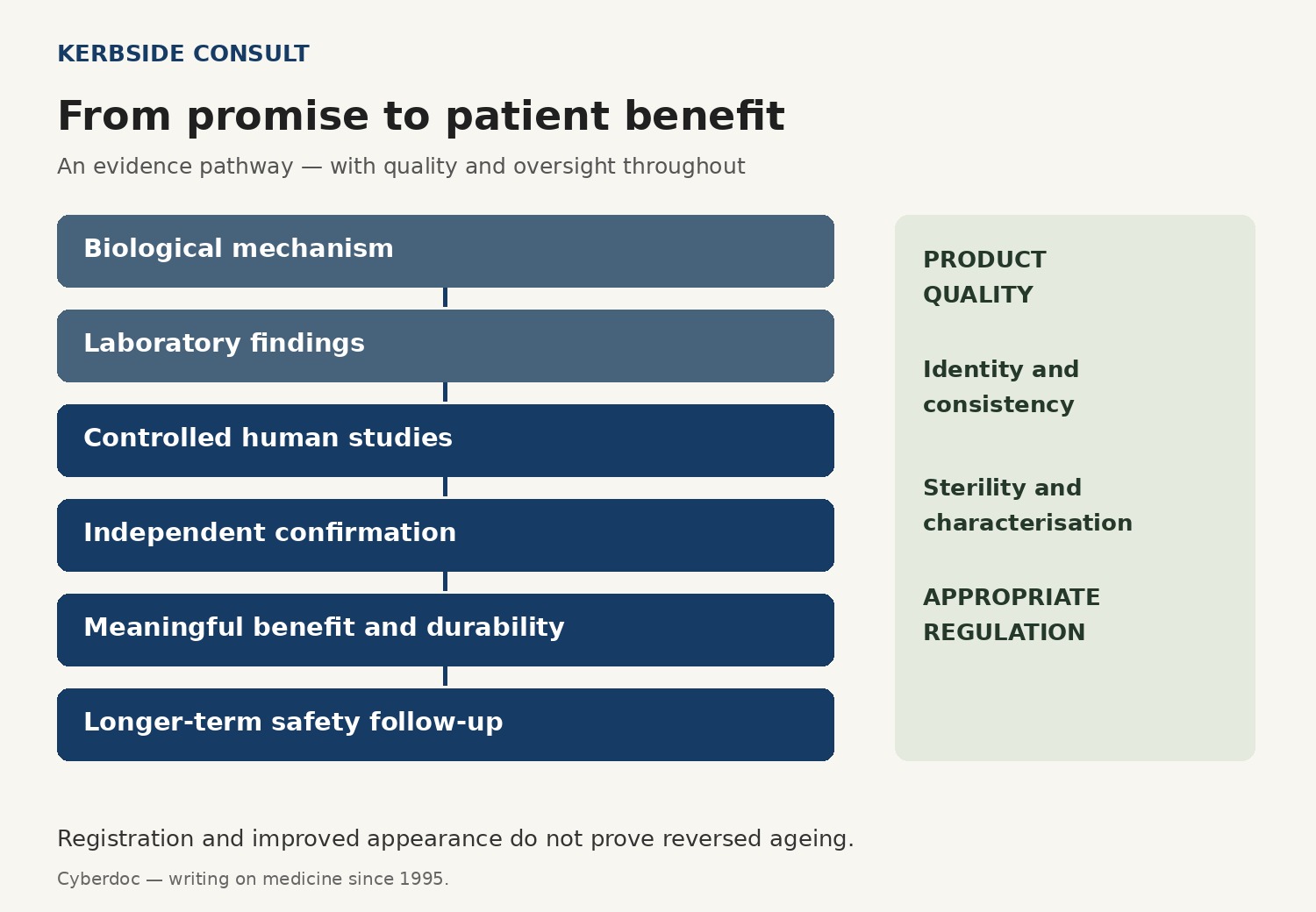
An attractive mechanism starts a research programme. It does not finish one.
Laboratory findings need translation into human studies, appropriate comparators, independent confirmation and benefits that patients can notice. Follow-up must also address durability and safety.
There are two guardrails throughout: product quality and appropriate regulatory oversight.
Manufacturing consistency, sterility and characterisation cannot wait until after clinical success. Nor is registration the final scientific proof that a product reverses ageing.
Marketing may present these questions as settled long before the evidence does.
14. Regenerative aesthetics in Malaysia
This is already a Malaysian conversation. Official device records identify PN injectables, while clinic treatment pages advertise options described as exosome therapies. [13][15]
But sharing a treatment menu does not make them one regulatory family.
MOH’s aesthetic-practice framework and LCP registry concern practitioners and their scope of practice. MDA registers medical devices. NPRA regulates medicinal products and the cosmetic notification system. [11][14][15]
The appropriate pathway depends on the actual product and its intended use.
The framework exists. The difficulty is knowing which framework applies to what is actually being used.
An appropriately credentialed doctor does not automatically validate every product, route or promotional claim.
15. What is actually being offered in Malaysia?
PRP begins with the patient’s own blood. NPRA’s September 2025 CGTP circular lists fresh blood components, including PRP, outside that framework. [10]
PN injectables are regulated as medical devices, and registrations can be looked up in MDA’s public register. The exact model, formulation and registered intended use still matter. A brand-family entry should not be extended to every similarly named product. [15]
EVs and secretomes are explicitly excluded from NPRA’s current CGTP scope. This does not establish approval through another pathway. The circular also restricts general-wellbeing and aesthetic/rejuvenation indications within its framework unless medicinally intended and supported by clinical evidence. [10]
That restriction should not be turned into a blanket statement that every exosome cosmetic is banned or approved.
Some Malaysian clinics advertise exosome products. Those pages establish only what is advertised; regulatory status must be checked separately, and a product described overseas may differ in version or formulation from one used locally. The exact product and its intended route still need checking. [13]
Some exosome-labelled products on the Malaysian market are listed in NPRA’s QUEST3+ system. The precise description is “notified as cosmetics”. Cosmetic notification is valid for two years, with renewal to be completed no later than one month before expiry. The existing number is retained when renewed before expiry, so an older number does not by itself mean that notification has lapsed. [18] Notification status and dates should be checked on QUEST3+ for the exact product. Notification does not establish approval for injection, suitability for use through disrupted skin, or clinical proof of regeneration. The formulation, label instructions and intended route must match the treatment being offered. [11]
MDA’s advertising guidance also prohibits suggestions that a device controls, delays or reverses physiological ageing. Product registration and an anti-ageing advertising claim are separate questions. [16]
16. What could go wrong?
Risks depend on the preparation, route, technique and patient.
Blood collection and injections can cause pain, bruising and swelling. Procedures that breach the skin introduce infection risks. An externally manufactured preparation adds questions about contamination, impurities, traceability and storage.
Vascular and tissue injury are injection-related concerns; their likelihood varies across products and techniques. Poorly characterised biological mixtures may also produce unexpected inflammatory or immune reactions. [17]
Small studies with short follow-up cannot exclude uncommon or delayed harm.
The FDA has issued safety information about unapproved regenerative products, including those marketed as exosomes. That concerns the United States; it does not determine Malaysian legal status. [17]
Natural and regenerative are descriptions, not safety guarantees.
17. Before somebody injects “regeneration” into your skin
Perhaps we should ask a few questions before asking the price.
What exactly is the product? Ask to see the packaging, manufacturer, batch and expiry date.
What does it contain, and where did it come from? Your own blood, purified DNA-derived material, human-cell EVs, plant material or a mixed formulation?
What is its Malaysian status? Ask for the applicable registration or notification identifier and check that it matches the exact product: cosmetics and medicines can be searched on QUEST3+, and medical devices on MDA’s register. [11][15]
What route is intended? Topical use does not establish suitability for injection or use through a disrupted barrier.
Is there evidence for this product, this method and my problem? Ask about expected benefit, duration, alternatives and uncertainty.
Is the practitioner appropriately credentialed for the procedure? Check the relevant LCP listing. [14]
And finally: Who will manage a complication?
18. So, does regenerative aesthetics work?
The answer depends on the treatment and the outcome.
PRP and PRF have human evidence for selected improvements, with considerable variation in protocols and results. [2][3][4]
PN/PDRN preparations have encouraging clinical findings, but formulation and indication matter. [5][6][7]
EV preparations have emerging human evidence, including controlled combination-treatment research. That cannot be generalised across the whole commercial category. [8][12]
Secretomes and conditioned media remain heterogeneous materials. Actual cell therapy belongs in a separate discussion. [9][10]
Improving an aesthetic outcome is credible in some settings. Reversing biological ageing is a much less established claim.
19. Where are we heading?
It would be wrong to dismiss the entire field as empty science.
More consistent platelet preparations, better characterised PN formulations and carefully manufactured EV products may improve the quality of future trials. Research may identify which patients and indications benefit most.
But the future needs more than another before-and-after photograph. It needs reproducible products, meaningful comparators, longer follow-up and transparent adverse-event reporting.
Meanwhile, sun protection and avoiding smoking deserve attention even when a treatment menu is more exciting.
Persuading tissue to repair itself is an important ambition. Demonstrating that we have made ageing skin biologically younger remains a different task.
20. What exactly are we calling regenerative?
There is a difference between a biological possibility, a laboratory result, a measurable clinical benefit and a product offered in a clinic today.
Malaysia illustrates that complexity well.
A doctor may be appropriately credentialed. A product may have a legitimate regulatory status. A mechanism may be plausible. A patient may look better afterwards.
None of those facts alone proves that ageing tissue has been regenerated.
The question is therefore more useful when it becomes specific.
Which product? Which route? Which outcome? Which evidence?
For now, perhaps the most useful question is:
“What exactly are you calling regenerative?”
Acknowledgment
I am grateful to Dr Kamaruzaman Bin Saleh, Former Director of the National Pharmaceutical Regulatory Agency (NPRA), Ministry of Health, Malaysia, for his review of this piece and his critical feedback. The judgements and any errors remain mine.
Sources worth your time
Skin ageing and biological terminology
PRP and PRF
- 2. Qin et al. Systematic Review of Platelet-Rich Plasma and Platelet-Rich Fibrin in Facial Rejuvenation. 2025.
- 3. Alam et al. Effect of Platelet-Rich Plasma Injection for Rejuvenation of Photoaged Facial Skin: A Randomized Clinical Trial. 2018.
- 4. Effectiveness of Injectable Platelet-Rich Fibrin Therapy in Alopecia and Facial Rejuvenation: A Systematic Review. 2024.
Polynucleotides and PDRN
- 5. The Effectiveness of Polynucleotides in Esthetic Medicine: A Systematic Review. 2025.
- 6. Lee et al. Comparison of the effects of polynucleotide and hyaluronic acid fillers on periocular rejuvenation: a randomized, double-blind, split-face trial. 2022.
- 7. Polynucleotides and Polydeoxyribonucleotides for Skin Rejuvenation, Postoperative Scar Prevention, and Wound Healing: A Systematic Review of Randomized Clinical Trials. 2026.
Extracellular vesicles and secretomes
- 8. Welsh et al. Minimal information for studies of extracellular vesicles (MISEV2023): From basic to advanced approaches. 2024.
- 9. Fadilah et al. Cell secretomes for wound healing and tissue regeneration. 2022.
- 12. Combination Treatment with Human Adipose Tissue Stem Cell-derived Exosomes and Fractional CO2 Laser for Acne Scars: A 12-week Prospective, Double-blind, Randomized, Split-face Study. 2020.
Malaysia — regulation and product status
- 10. NPRA. Circular on the second-edition CGTP registration guidance, 11 September 2025. Appendix A, scope and exclusions.
- 11. NPRA. Cosmetic Main Page: definition, notification and regulatory requirements.
- 14. MOH. National Registry of Registered Medical Practitioners Practising Aesthetic Medical Practice.
- 15. MDA. Malaysian Medical Device Register public search.
- 16. MDA. Code of Advertisement, Second Edition, March 2021.
- 18. NPRA. Cosmetic Notification, Sections 2.7 and 2.10: two-year validity, renewal timing and retention of notification numbers. Product search via NPRA consumer guidance; direct product search: QUEST3+ Product Search.
Commercial market examples — not evidence of approval or efficacy
- 13. Malaysian aesthetic-clinic treatment pages advertising exosome therapies, reviewed 11 October 2026; copies retained by the author. Clinic advertising, not evidence of approval or efficacy.