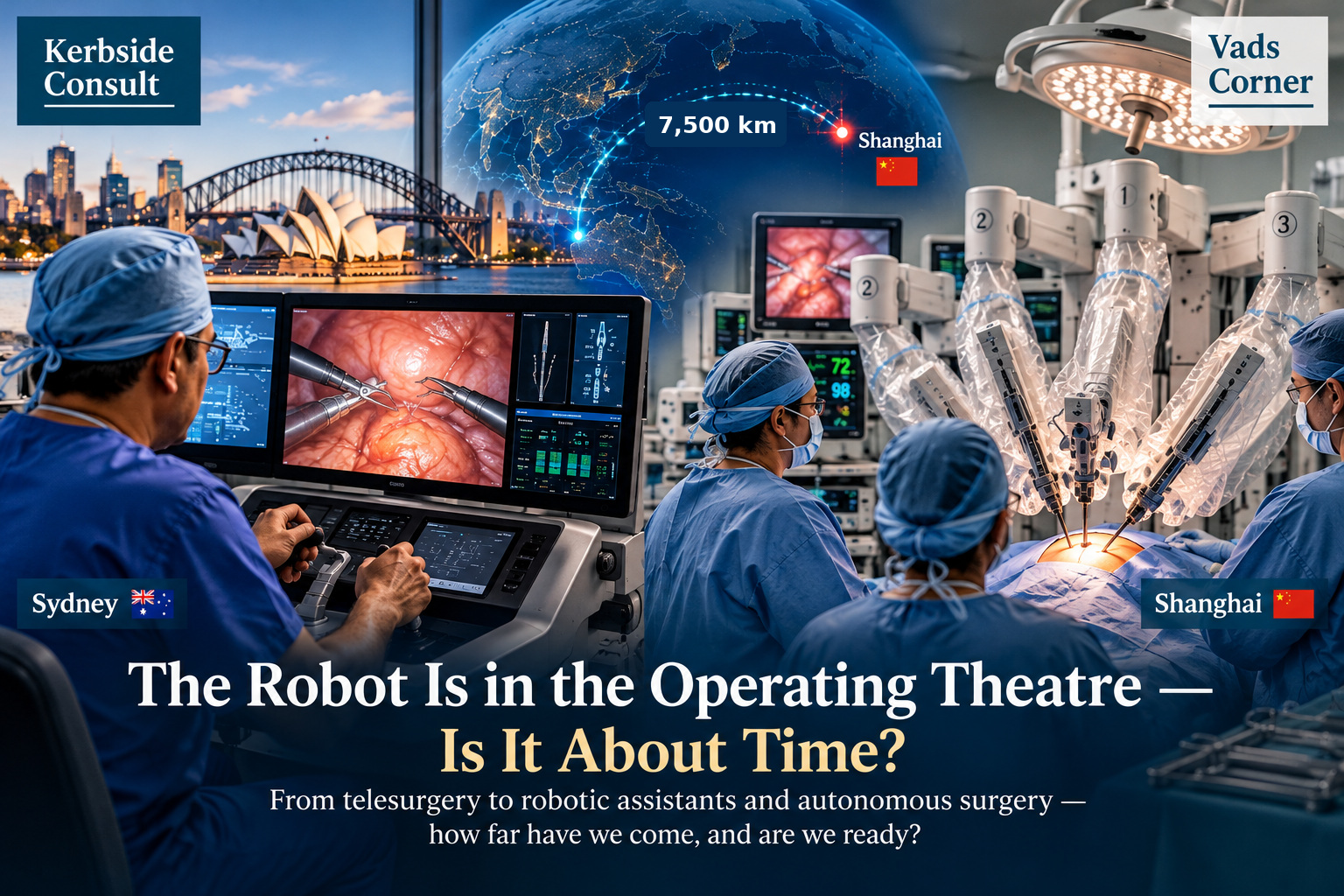
In October 2026, Associate Professor Ruban Thanigasalam sat at a console at Chris O’Brien Lifehouse in Sydney and controlled a Toumai surgical robot approximately 7,500 kilometres away in Shanghai. Its instruments cut and stitched a demonstration kidney. No patient was involved. The reported delay was 150 milliseconds. The demonstration raised an intriguing question: if a surgeon can operate instruments from another country, who will be beside the patient when something goes wrong?[1]
Remote surgery is no longer science fiction. Surgeons have operated on patients across continents. Researchers have also demonstrated humanoid robots working side by side during experimental surgery, while other systems can perform selected surgical tasks without continuous human control.
Does the future belong to surgeons operating remotely, robots assisting surgeons, or machines eventually operating independently? Perhaps the more important question is whether these technologies can make surgery safer, more accessible and more affordable. And regardless of who controls the instruments, someone must remain responsible for the patient.
Contents
- The surgeon moves away
- The robot joins the surgical team
- When the robot begins to act independently
- What does the evidence actually show?
- Malaysia — where are we?
- When something goes wrong
- Who is responsible?
- Better surgery, or simply more expensive surgery?
- The surgeon of tomorrow
- Sources & further reading
1. The surgeon moves away
In September 2001, Professor Jacques Marescaux and colleagues performed a laparoscopic cholecystectomy on a patient in Strasbourg while operating from New York. Operation Lindbergh demonstrated the feasibility of transatlantic telesurgery[2]. Yet remote operations did not become routine: communications, equipment, cost and clinical governance remained substantial barriers.
The 2026 Sydney–Shanghai demonstration highlights the remaining barriers to routine telesurgery: dependable communications, hospital governance, indemnity arrangements and a local team capable of intervening. Its reported latency is not an independently validated technical measurement[1].
A multicentre randomised trial published in The BMJ in 2026 provides more relevant human evidence. Seventy-two patients at five Chinese hospitals were randomised to telesurgery or local robot-assisted surgery for selected urological procedures. Telesurgery met the investigators’ predefined non-inferiority criterion for procedural success, but follow-up was short, the sample was small and a local surgeon and backup console were available[3]. The surgeon may have been far away; the hospital team was not.
2. The robot joins the surgical team
Must the next step be a robot that replaces the surgeon? Or might a robot that assists the surgeon be more useful?
A 2026 Nature study evaluated teleoperated humanoid robots using conventional laparoscopic instruments in living pigs. In one experimental gallbladder operation a robot worked with a human assistant; in another, two robots worked side by side. Human surgeons controlled the robots. They were not autonomous[4].
The attraction of humanoid platforms is versatility: a future assistant might hold a camera, maintain retraction, position instruments or help with selected repetitive tasks. These proposed uses should not be confused with capabilities already clinically validated. The experimental systems needed adjustments and did not establish human safety, efficiency or cost savings.
A reliable robotic assistant performing a limited range of useful tasks may offer more immediate clinical value than a machine attempting to replace the surgeon altogether.
3. When the robot begins to act independently
An assistant follows instructions. An autonomous system begins to determine how those instructions should be carried out.
In 2022, the Smart Tissue Autonomous Robot (STAR) demonstrated autonomous elements of intestinal anastomosis in living pigs, with human involvement in the experimental workflow[5].
In 2025, researchers reported SRT-H, a hierarchical system combining language-based task planning with lower-level robotic movements. In experiments on eight excised pig gallbladders, it completed the evaluated surgical steps successfully in all eight cases without human intervention[6]. That 100% result is noteworthy, but it concerns eight ex vivo experiments—not surgery on human patients. The system did not have to manage active bleeding or a patient's physiological response.
Performing selected steps is different from independently managing an entire operation. Surgical judgement also requires recognising uncertainty, unexpected anatomy and when to stop.
4. What does the evidence actually show?
The evidence is not equally mature. Conventional robot-assisted surgery has substantial human clinical experience. Telesurgery now has selected human clinical studies, including a randomised trial. Humanoid surgical assistance and autonomous surgical tasks remain largely preclinical[3], [4], [5], [6].
The BMJ trial measured a predefined procedural outcome, not equivalence in long-term patient outcomes; its non-inferiority margin and short follow-up warrant caution[3]. The humanoid study showed feasibility in living pigs, while SRT-H demonstrated step-level autonomy on excised tissue[4], [6].
These findings should not be combined into a story suggesting that surgeon-free operations are imminent. Technical feasibility is not the same as clinical effectiveness; clinical effectiveness does not automatically establish value for money.
5. Malaysia — where are we?
Malaysia has experience with robot-assisted surgery, but local robotic surgery, remote education and true telesurgery must be distinguished.
At University Malaya Medical Centre, a 2026 feasibility study described a 40-minute 5G-enabled extended-reality broadcast of transoral robotic surgery to 20 participants in seven countries. The surgeon controlled the instruments locally. The reported latency was platform-derived rather than independently measured end to end. This was remote surgical education, not telesurgery[7].
At the IJN–UTM Research Convention in October 2025, researchers showcased TROSTE, a teleoperated robotic system for echocardiography. The institutional report documents a research innovation, not routine clinical deployment or patient outcomes[8]. It is not a surgical robot.
In August 2025, the World Health Organization (WHO) and the Society of Robotic Surgery announced an initiative on virtual care and telesurgery, including affordability, remote mentoring, training and the development of safe and equitable implementation guidance[9]. This initiative is not a WHO endorsement of routine telesurgery.
We have not established independently verified evidence of a Malaysian hospital performing long-distance, remotely controlled robotic surgery on a human patient. That is not proof that none has occurred. Malaysia's wider telemedicine regulatory issues were discussed in my earlier Kerbside Consult article, ‘Still Not in Force’ (6/2026)[10].
6. When something goes wrong
Imagine a surgeon in Kuala Lumpur operating remotely on a patient in Sarawak. Unexpected bleeding begins just as the communications connection becomes unstable. The answer cannot be to wait for the remote surgeon to reconnect.
The patient’s hospital needs an appropriately trained local team, anaesthesia, emergency equipment and a workable plan for immediate takeover. Depending on the procedure, a local surgeon capable of intervening may be essential. A backup internet connection is not the same as a backup surgeon. Average communications latency alone does not capture interruptions, video degradation, equipment malfunction or cybersecurity risks.
An autonomous system likewise needs clear operating limits and effective human intervention when circumstances change. The technology may change who holds the instruments. It does not change what happens when the patient begins to bleed.
7. Who is responsible?
Telesurgery raises questions of credentialling, licensing, consent, indemnity, cybersecurity and responsibility across institutions and borders. Autonomous systems add questions about how clinicians, hospitals and manufacturers share responsibility when a machine makes a consequential error. Existing law and professional obligations still apply; the precise arrangements need case-specific regulatory clarification.
WHO's 2021 guidance provides six principles intended to ensure AI works for the public interest in all countries[11]. Although not written specifically for surgical robots, they offer a valuable framework:
| WHO principle | Application to surgical robotics |
|---|---|
| Protecting human autonomy | Patients provide informed consent; clinicians retain meaningful authority and intervention capability. |
| Promoting human well-being and safety and the public interest | Validate safety and effectiveness for each intended clinical use. |
| Ensuring transparency, explainability and intelligibility | Teams understand capabilities, limitations and significant AI-supported decisions. |
| Fostering responsibility and accountability | Define the roles of clinicians, hospitals, developers and manufacturers. |
| Ensuring inclusiveness and equity | Avoid widening gaps between tertiary centres and underserved communities. |
| Promoting AI that is responsive and sustainable | Continuously evaluate performance, workforce impact, affordability and sustainability. |
These general WHO principles are not a clinical endorsement of autonomous surgery. For Malaysia, equity and sustainability are especially relevant.
8. Better surgery, or simply more expensive surgery?
Robotic systems require capital expenditure, maintenance, instruments, training and technical support. Telesurgery adds secure communications, redundancy and local backup. A versatile humanoid assistant is not necessarily a cheaper one.
For Malaysia, remote mentoring, carefully selected robotic assistance and advanced telesurgery address different needs. A regional hospital without adequate anaesthesia, nursing and emergency surgery cannot become safe merely by acquiring a robot. Nor should robots be used to justify cutting essential theatre staff.
Any investment should be compared with alternatives: training more surgeons, visiting specialist services, tele-mentoring and transferring patients to established centres. The objective should be better care, not simply more technology.
9. The surgeon of tomorrow
A realistic near-term direction is more robotic assistance and supervised automation—not a timetable for surgeon-free operations. Robots may improve camera control, retraction, instrument positioning and selected repetitive steps; AI may support planning and anatomical recognition. Each application requires procedure-specific clinical validation.
Operation Lindbergh established that surgery could be performed across the Atlantic. Recent clinical trials and experimental robotic systems have broadened the possibilities. But surgery remains more than a sequence of movements: it demands judgement, anticipation and decisions about when to change course or stop.
Perhaps the most useful surgical robot of the future will not be the one that replaces the surgeon, but the one that makes a good surgeon better.
Whatever the technology, the patient must remain at the centre of the operating theatre.
Sources & further reading
- Bureau Report. Sydney surgeon Ruban Thanigasalam operates robotic instruments in China from 7,500km away in Australian-first demonstration. The Australia Today, 27 Oct 2026. Journalistic. Source
- Marescaux J, Leroy J, Gagner M, et al. Transatlantic robot-assisted telesurgery. Nature 2001;413:379–380. doi:10.1038/35096636. Source
- Wang Y, Xia D, Xu W, Rexiati M, Zhao W, Huang Q, et al. Reliability of urological telesurgery compared with local surgery: multicentre randomised controlled trial. BMJ 2026;392:e083588. doi:10.1136/bmj-2024-083588. Source
- Liang Z, Thareja N, Zhang P, et al. In vivo feasibility study of humanoid robots in surgery. Nature 2026;657:236–244. doi:10.1038/s41586-026-10796-x. Source
- Saeidi H, Opfermann JD, Kam M, et al. Autonomous robotic laparoscopic surgery for intestinal anastomosis. Sci Robot 2022;7:eabj2908. doi:10.1126/scirobotics.abj2908. Source
- Kim JW, Chen JT, Hansen P, Shi LX, Goldenberg A, Schmidgall S, et al. SRT-H: A hierarchical framework for autonomous surgery via language-conditioned imitation learning. Sci Robot 2025;10(104):eadt5254. doi:10.1126/scirobotics.adt5254. Source
- Goh LC, Ong HY, Abu Bakar MZ. 5G-enabled XR live broadcasting of transoral robotic surgery (TORS): a feasibility study of an indoor small-cell architecture. J Robot Surg 2026;20:238. doi:10.1007/s11701-026-03191-1. Source
- IJN–UTM Cardiovascular Engineering Centre. IJN–UTM Research Convention 2025. Universiti Teknologi Malaysia; 2025. Institutional report. Source
- World Health Organization. WHO and Society of Robotic Surgery launch health innovation initiative to expand access to virtual care and telesurgery. WHO, 8 Aug 2025. Source
- Vadivale M. Still Not in Force. Kerbside Consult, 31 Aug 2026; 6/2026. Source
- World Health Organization. WHO issues first global report on artificial intelligence in health and six guiding principles for its design and use. WHO, 28 Jun 2021. Source