Preamble
On 4 February, health officers in Kota Tinggi had screened 804 close contacts of a tuberculosis cluster. Thirty-three were positive.[1] Within days the Ministry of Health reported 2,571 cases for the first five weeks of 2026 — 229 more than the same weeks of 2025, a rise of 9.8%.[2] By the seventh week the weekly count was lower than a year earlier, and no new clusters had been reported.[3]
Rising or falling? Both headlines were accurate. Neither tells us much.
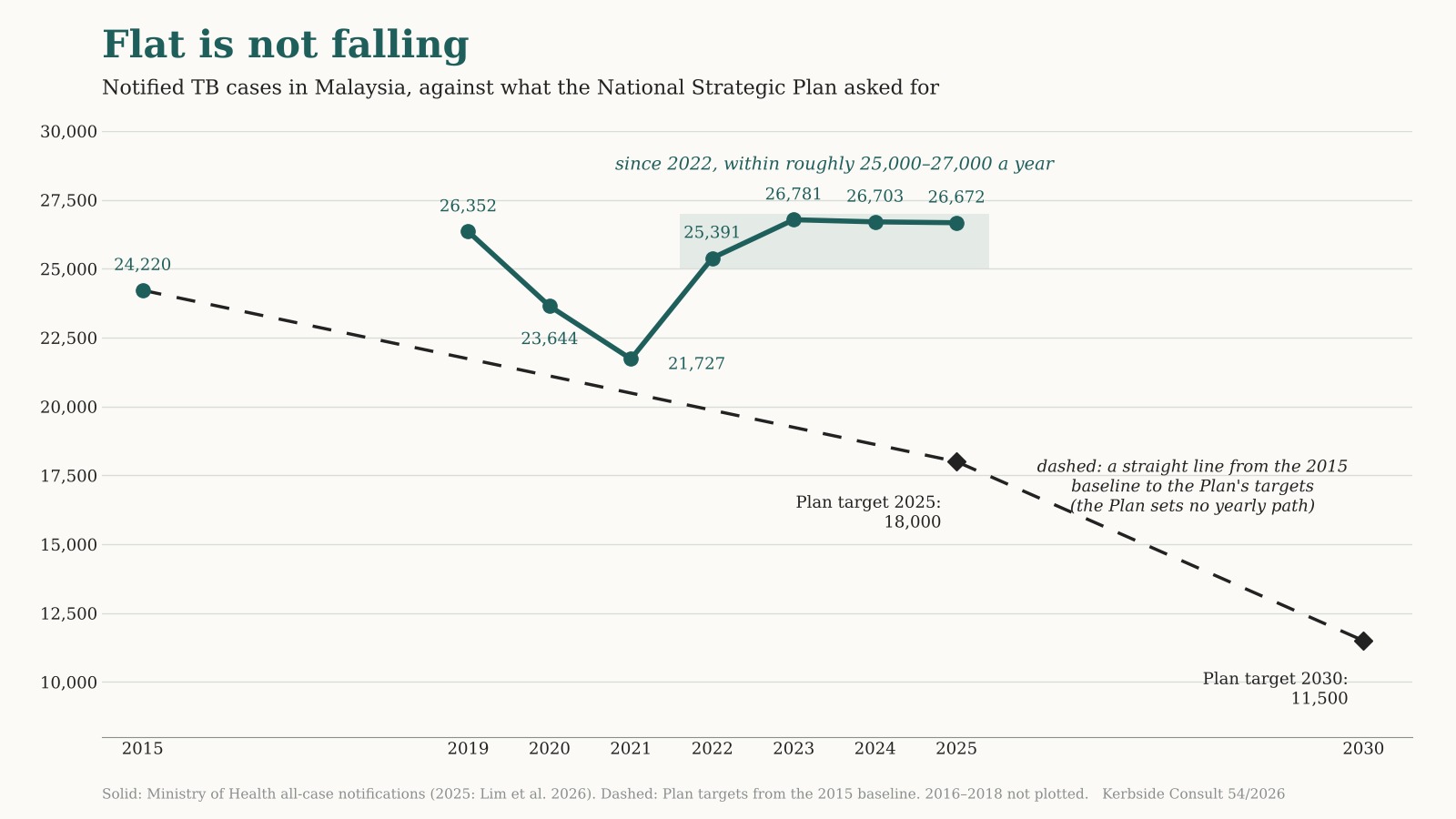
The better question is whether Malaysia’s tuberculosis line is moving at all. In the sources I could find, it is not: about 25,000 to 27,000 notified cases a year since 2022, and no sign of a fall. (By “the line” I mean notified cases, not WHO’s modelled estimate of incidence, which comes later.) The targets Malaysia has signed up to need a steep one.
A flat line is stability only if nobody promised it would fall.
A man has had a cough for three weeks. It is not much. He has mentioned it at work and put off the clinic until the queue is shorter.
A cough that lasts more than two weeks, fever and night sweats are what the Ministry asks people to act on.[2][1] Everything in this article — the clusters, the weekly counts, the targets — begins with someone deciding whether to go.
1. A cluster, two headlines
The Kota Tinggi cluster was confirmed on 25 January. By 4 February, 804 close contacts had been screened and 33 tested positive. One death in the cluster was reported; the Health Minister said it was not caused by TB.[1] By 7 February the Johor cluster stood at 37 cases.[2]
That week’s national statement gave 2,571 cases from 1 January to 7 February, 503 of them new that week, and a rise of 229 cases (9.8%) over the same period of 2025.[2][4] The statement of 21 February, for the sixth week, gave 596 new cases and 3,161 so far, with Sabah (755), Selangor (596) and Sarawak (332) leading and a rate per 100,000 for each state. It did not compare with 2025. Two numbers do not reconcile, and I cannot explain either: 3,161 less 2,571 is 590, not 596, and Selangor’s cumulative 596 equals the national count of new cases that week.[28]
Three weeks on, 417 new cases were reported for the seventh week, 65 fewer than the 482 of the same week in 2025, and the minister said no new clusters had been identified. Malay Mail took the figures from a New Straits Times report, so this is secondhand.[3]
A third description comes from the International Federation of Red Cross and Red Crescent Societies, whose field report of 24 February files the event under “Epidemic” and speaks of a sharp rise in cases. Its figures are the Ministry’s (3,161 cases, with the same state table),[5] so it is secondary; and against the Ministry’s own 9.8% above the same weeks of 2025, “sharp” is a judgement, not a measurement.
I would not build a trend on either. A week’s count reflects what was notified that week. A cluster response that screens 804 people will also find cases that would otherwise have surfaced later, or not at all, so notifications can rise because of detection and not only because of transmission. The weekly numbers cannot separate the two.
2. The line that has not moved
Annual counts depend on whom you ask, and at first sight the sources do not agree.
| Year | Ministry: all notified cases | WHO: new and relapse cases | Lim et al. 2026: observed cases |
|---|---|---|---|
| 2015 | 24,220 [6] | 23,565 [7] | — |
| 2019 | 26,352 [6] | 25,565 [7] | — |
| 2020 | 23,644 [6] | 22,973 [7] | — |
| 2021 | 21,727 [8] | 21,186 [7] | — |
| 2022 | 25,391 [8] | 24,795 [7] | — |
| 2023 | 26,781 [9] | 26,149 [7] | — |
| 2024 | 26,703 [10] | 26,183 [7] | 26,703 [11] |
| 2025 | — | not yet published | 26,672 [11] |
Counts as published by each source; dashes mean I found no figure. Lim et al. do not state their case definition in the passages I read.
The disagreement appears to be mostly one of definition. In every year where both exist, the Ministry’s all-case figure is 2.0% to 3.1% above WHO’s count of new and relapse cases. The 26,149 (2023) and 26,183 (2024) quoted in the press and in a Dewan Negara reply are WHO’s new-and-relapse counts to the case.[7][12][13] WHO’s 2024 country profile lists both 2024 figures, 26,183 new and relapse and 26,703 all notified, the latter the figure Lim et al. report.[10] That confirms the definition for 2024; for earlier years it remains my inference from the steady gap.
Whichever series is used, the picture is the same. Cases have stayed within a band of roughly 25,000 to 27,000 since 2022, and 2025 ended within 31 cases of 2024 in the one source that gives both.[11] On WHO’s series, notified cases were 23,565 in 2015 and 26,183 in 2024: 11% more, by my arithmetic.
A 2025 review in the Malaysian Journal of Pathology says incidence rose steadily after 2011 and that Malaysia is now an endemic country.[14] Its rates for 2021 and 2022 (97 and 113 per 100,000) come from an older WHO series; WHO’s current estimate for both years is 98.[7] The Ministry-affiliated modelling paper calls the burden largely stable across 2013–2025.[11] The safest wording is that it has not fallen.
3. Who is being diagnosed
Most people notified with TB in Malaysia are Malaysians. In 2024 the Ministry told the Dewan Negara that 21,959 of 26,183 cases involved Malaysians and 4,224 involved foreigners; between 2019 and 2024 non-citizens accounted for 13.2% to 16.1% of cases.[13][16] The National Strategic Plan put the non-Malaysian share at 12% to 15% in 2015–2020.[6]
WHO’s regional analysis counts 4,285 foreign-born people among Malaysia’s notified cases in 2024, the largest number in the Western Pacific Region; in Australia and New Zealand they account for about 90% of notifications, and in Singapore 56%.[15] The Ministry’s 4,224 “foreigners” and WHO’s foreign-born count use different definitions and should not be merged. Both say migrants are a real part of Malaysia’s TB picture, and not the main part.
Where cases are notified is uneven. The 21 February statement also gave rates per 100,000, and they change the order of the counts above: Sabah 20.08, Labuan 17.84 (on 18 cases), Sarawak 13.12 and Kuala Lumpur with Putrajaya 11.12, against 8.05 for Selangor.[28] The statement does not say what period the rates cover; Sabah’s 755 cases at 20.08 implies a population of about 3.8 million, so they look like six-week rates, not annual ones. The pattern is not new: a 2025 review puts Sabah at 11% of the population but about 14.78% of the national incidence rate in 2018–2022, with Kota Kinabalu, Semporna and Pitas as hotspots.[14]
Deaths show a clearer gradient. In the Minister’s Dewan Negara reply of 13 March 2025, as reported by CodeBlue, national TB mortality was 7.58 per 100,000 in 2024, against 12.07 in Sarawak, 11.84 in Sabah and 9.32 in Kuala Lumpur.[16] The Ministry recorded 2,623 TB deaths in 2023. These are reported deaths, a different series from WHO’s modelled estimate of TB deaths.[9]
4. How many are we missing?
Notifications count people who were diagnosed and reported. They do not count people who were not. WHO estimates the gap.
WHO’s current series puts the 2024 estimate at 34,000 new cases (range 28,000–41,000), or 96 per 100,000 (78–116), against 26,183 notified. That is a treatment coverage of 77% (64–94%).[10][7] Put plainly: WHO’s central estimate leaves a gap of about one case in four between estimated incident TB and notified new and relapse cases, with a wide range around it — from roughly one in sixteen to a little over one in three, taking WHO’s coverage range of 94% to 64%. The gap may reflect people not diagnosed, cases not reported, and uncertainty in the model itself. The Plan’s target for treatment coverage, the same measure, was 90% by 2025; its own baseline was 87% in 2015 and 2020, on WHO estimates from before the revisions described next.[6]
Estimates are revised, sometimes a lot. WHO’s 2022 country profile gave 38,000 cases, 113 per 100,000 and a coverage of 65% for 2022;[17] the current series gives 34,000, 98 and 73% for the same year.[7] So the useful reading is the range and the direction, not any single number.
The pandemic years show how easily a gap opens. A WHO analysis found Malaysia’s 2021 notifications 21% below the level predicted from the 2015–2019 trend (95% CI, 16% to 25% below); the authors judged reduced detection the more likely main driver but could not say how much was missed diagnosis and how much a real fall.[18] A shortfall is not the same as missed cases: it is the distance between what was reported and what a trend line predicted.
5. “TB-free by 2035” — what the target actually says
The National Strategic Plan to End TB (2021–2030) states its vision as “Malaysia free of TB by year 2035”. Its measurable targets are narrower. By 2030 it asks for a notification rate of 30 per 100,000 (11,500 cases) and a 50% fall in deaths; for 2025 it asks for fewer than 50 per 100,000 (18,000 cases) and fewer than 1,272 deaths. Its 2015 baseline is 79 per 100,000 (24,220 cases) and 1,696 deaths.[6] Against those, 26,672 cases were notified in 2025,[11] and the latest death figure I found is 2,623 for 2023.[9] If the Ministry counted deaths the same way throughout, the 2025 targets have not been met. Treatment success for new and relapse cases was 82% in WHO’s 2023 cohort of 25,632 patients, against the Plan’s target of 90%.[10]
The WHO milestones are different again. The End TB Strategy asks for a 90% fall in the incidence rate by 2035 compared with 2015, and 50% by 2025.[6][19] Globally the net fall by 2024 was 12%; in the Western Pacific Region the rate was 1.7% higher than in 2015.[19] For Malaysia, WHO’s current series gives 104 per 100,000 in 2015 and 96 in 2024, a fall of 7.8%, with estimated total TB deaths 37% higher against a 75% fall asked for by 2025 (the range is wide).[10][7] WHO’s 2025 report moves Malaysia from the “endemic” band (100–299 per 100,000) in 2015 to “upper moderate” (50–99) in 2024.[19] Whichever 2015 baseline is used, 79 notified or 104 estimated, a 90% fall means about 8 to 10 per 100,000. That is not “TB-free”. There are, then, three yardsticks — WHO’s milestones, the Plan’s targets and the 2035 vision — and they should not be mixed.
What would it take? The Ministry-affiliated paper models it. Its calibrated model puts the reproduction number at 1.09 (95% CI, 1.01–1.27): transmission that sustains itself, just above the threshold.[11] With no change, simulated incidence in 2035 is 78.9 per 100,000 — within 1% of the 2015 rate. The most intensive intervention scenario cuts incidence by 66.2% relative to 2015. None of the scenarios reaches 90%.[11]
A model is not a forecast. The authors call the scenarios exploratory, assume people mix at random, and say their calibrated values are model-dependent estimates, not direct measurements. They also leave out action on reactivation of long-standing latent infection, which depends on diabetes, smoking, alcohol, nutrition and poverty.[11] Adult diabetes prevalence was 15.6% in the 2023 national survey.[20] Their reading is that current efforts may prevent explosive growth but not produce a substantial, sustained fall; that needs TB-specific control together with action on the wider causes of ill health.[11]
6. After the diagnosis: what treatment looks like
The Ministry’s guideline sets the standard. For drug-susceptible pulmonary TB it is eight weeks of isoniazid, rifampicin, pyrazinamide and ethambutol, then eighteen weeks of isoniazid and rifampicin, as fixed-dose tablets. Treatment should be directly observed; video-observed treatment is an option for selected patients where facilities exist, and self-administered treatment is allowed when neither is possible. For latent infection, once active TB is excluded, the first-line regimens are three months long: isoniazid with rifampicin, or weekly isoniazid with rifapentine.[33][29] WHO’s 2024 list matches these and adds six months of levofloxacin for contacts of rifampicin-resistant TB, which I did not find in the Ministry’s guideline.[39]
WHO has since shortened treatment. Its current guidance is the second edition of Module 4, published on 25 September 2026. For drug-susceptible TB, people aged 12 and over may receive a four-month regimen of isoniazid, rifapentine, moxifloxacin and pyrazinamide (conditional recommendation, moderate certainty), noninferior to six months in a phase 3 trial.[38][32] For rifampicin- or multidrug-resistant TB, six-month BPaLM (bedaquiline, pretomanid, linezolid, moxifloxacin) remains the suggested regimen for most people aged 14 and over, with a six-month BDLLfx/C regimen (bedaquiline, delamanid, linezolid, levofloxacin and clofazimine) for those who cannot take it. New in 2026, for pulmonary pre-extensively drug-resistant TB the choice depends on severity: BPaL if non-severe, BPaLC (with clofazimine) if severe. WHO also now recommends palliative care alongside treatment of resistant TB.[38] The 2022 and 2025 editions set out the earlier versions.[30][31][37]
Is either used in Malaysia? Not that I can document. The Ministry’s fourth edition was issued in 2021, cut off its literature search at 30 June 2021, mentions the rifapentine trial as “recently published” and recommends the standard six months; it was due for review in 2025 and I found no later edition. Its stated obstacle is the drug: rifapentine regimens are marked “not yet available in Malaysia”.[33] A Sabah registry of 895 people given preventive treatment between 2019 and mid-2022 shows the effect: 877 (98.0%) were on six months of isoniazid.[34] A rifapentine product has since appeared in the national register (Rifapex 150 mg dispersible tablets, made by Lupin, with a Malaysian registrant). Its patient and product leaflets list prevention of TB in people at risk as an indication, but the entry and leaflets give no registration date or status, so I cannot say whether it is on the market or whether the Ministry supplies it.[36] For resistant TB the national guideline is a separate first edition from 2016, which pre-dates BPaLM and lists bedaquiline only as an add-on; I found no Malaysian document on whether BPaLM is used.[35]
7. What should happen next?
None of this says the Ministry is doing nothing. Contact screening, daily directly observed therapy and screening in boarding schools, prisons and workers’ hostels are all in place.[21] WHO lists funding for TB prevention, diagnostic and treatment services at US$18 million in 2024, all domestic, excluding inpatient and outpatient care.[10] The question is what would make the line bend.
Publish one national series, with definitions. Notified cases or new and relapse; citizens and non-citizens; the date of each revision. Two sources should not give two answers for the same year.
Report rates by state, not only counts. The 21 February statement showed it can be done, with a rate for every state,[28] but I found no statement giving the same weeks of 2025 by state. Deaths already show Sabah, Sarawak and Kuala Lumpur above the national rate.[16] Matching-week rates would show whether Sabah’s high rate is new.
Replace an estimate with a measurement. Indonesia’s national inventory study found under-reporting had fallen from an estimated 41% in 2017 to 15.6% in 2023.[15] WHO’s estimate for Malaysia carries a wide range. I did not find a Malaysian inventory study in the sources I read; if one exists, it should be public.
Find the missing cases, active and latent. A Ministry health technology assessment (June 2024) found that computer-aided reading of chest X-rays matched radiologists in the studies it reviewed (sensitivity 0.88–0.91, specificity 0.61–0.76) and recommended it to assist early detection in high-risk groups, after technical evaluation of products. The evidence came from other countries, WHO limits use to people aged 15 and over, and the threshold may need local calibration.[8] The report describes a local study of two products, Putralytica and Qure.ai, and a 2025 review mentions a Ministry evaluation of the same two;[8][14] the National Strategic Plan lists ultra-portable X-ray with AI for remote areas and outbreaks.[6] I did not find results of the local evaluations or where the software is in use. For latent infection, the Minister has warned that it is harder to detect,[21] and the Ministry says people with latent infection carry a 5–10% risk of progressing to disease later in life, which preventive treatment can stop.[22] The cascade has been thin. In the National Strategic Plan’s tables, contacts screened at first visit fell from 78.0% in 2015 to 57.9% in 2020 against an 80% target, and preventive treatment reached 12.5% to 19.1% of under-5 contacts in 2018–2020 against a 50% target.[6] WHO estimates that 17% of household contacts of bacteriologically confirmed cases were on preventive treatment in 2024.[10] A 2026 registry study from Selangor (2022–2024) found that of about 3,100 contacts who started preventive treatment, 913 had no recorded outcome; of the 1,832 with one, 77.2% completed (95% CI, 75.2–79.1), and living more than 10 km from a clinic was associated with much lower odds of completing (adjusted odds ratio 0.147; 95% CI, 0.061–0.350).[23] That is one state, cross-sectional, and the missing outcomes could bias it either way. Reporting the whole cascade — contacts identified, tested, started, completed — would show where people are lost.
Think TB, and notify. Persistent cough, fever, night sweats, weight loss, haemoptysis.[1] The Ministry names people with HIV, chronic kidney disease or COPD, smokers and contacts of cases as groups to screen.[9] TB is notifiable under the Prevention and Control of Infectious Diseases Act 1988.[11] Treatment is usually six months and fully subsidised; and the Ministry’s plea is not to stigmatise people with TB.[22]
Do not wait for a vaccine. Nearly 99% of newborns receive BCG, but there is still no TB vaccine for adults, the Minister told the Dewan Rakyat on 10 February 2026.[24] One late-stage candidate, M72/AS01E, showed 49.7% efficacy (95% CI, 2.1–74.2) over three years in HIV-negative adults aged 18–50 with latent infection in a phase 2b trial — 13 cases against 26 on placebo.[25] That is a phase 2b result in a selected group, not evidence of protection across the population. A phase 3 trial began in March 2024 at 54 sites in Indonesia, Kenya, Malawi, South Africa and Zambia, with results anticipated in late 2028.[26] Malaysia is not among the countries named. Whatever it shows, it will not change the next few years’ numbers.
On the evidence here, Malaysia has held tuberculosis steady. It has not yet shown that it can bring it down.
The next number to watch is not this week’s. It is whether the line ever bends.
Sources worth your time
Primary and official
Ministry of Health Malaysia, press statement, 10 February 2026 and 15 February 2026 (in Malay). The primary source for the 2026 counts, state breakdown and clusters. The 21 February statement adds incidence rates for every state.
National Strategic Plan to End TB (2021–2030). The Ministry’s own baseline, targets and contact-screening tables. Read it before reading the press.
WHO Global tuberculosis report 2025 and section 1.1 online. The global baseline, the End TB milestones and Malaysia’s change of band.
WHO Global Health Observatory data for Malaysia. Current WHO estimates and notifications, by year.
Ministry health technology assessment on computer-aided chest X-ray reading, 2024. Evidence, local study and cost model for AI-assisted chest X-ray screening.
Ministry clinical practice guideline, Management of Tuberculosis (Fourth Edition, 2021). The full guideline: evidence, regimens and the rifapentine barrier.
Ministry quick reference to the same guideline. Eight pages: regimens, monitoring, latent-infection treatment, drug reactions.
WHO guidelines, drug-susceptible TB treatment (2022). The four-month regimens.
WHO guidelines, drug-resistant TB treatment (2022 update, now superseded). BPaLM and the nine-month all-oral regimen.
WHO Module 4, drug-resistant TB treatment (2025). Current BPaLM and BDLLfxC recommendations.
WHO Module 4: treatment and care, second edition (2026). The latest edition; adds pre-XDR-TB regimens by severity.
WHO operational handbook, TB preventive treatment regimens. The 2024 regimen list for latent infection.
Ministry guideline, Management of Drug Resistant TB (first edition, 2016). The national guidance for resistant TB; it predates BPaLM.
WHO tuberculosis profile for Malaysia (2022 estimates) — an older series, now revised; the current profile is in WHO’s interactive country profiles. WHO revises its estimates each year, so check the year.
Peer-reviewed
Lim et al., Front Public Health 2026. Ministry-affiliated authors; the model, R0 and the scenarios. The most useful single read.
Oh et al., Lancet Reg Health West Pac 2024. WHO analysts on how far notifications fell below trend during the pandemic.
Western Pacific Region analysis, 2010–2024. Regional context, foreign-born cases and the Indonesian inventory study.
Fadzil, Ramli and Neoh, Malays J Pathol 2025. History of the national programme, lineages and resistance mutations.
Ideris et al., Med J Malaysia 2026. Completion of preventive treatment among contacts, Selangor registry data.
Tait et al., N Engl J Med 2019. The M72/AS01E phase 2b result.
Dorman et al., N Engl J Med 2021. The four-month rifapentine–moxifloxacin trial.
Mohamed et al., PeerJ 2025. Preventive-treatment completion among 895 people in Sabah.
Journalism used here (secondary; each reports a Ministry or ministerial statement)
Bernama (Malay), Malay Mail, The Star, CodeBlue, Malay Mail (Dewan Rakyat), Utusan, IFRC GO. Used where I could not retrieve the primary text; each is described as secondary in the references.
Full references
- 1. Bernama. Satu kluster tibi dikesan di Kota Tinggi, 804 disaring, 33 positif — Dzulkefly. 5 February 2026 (in Malay). Journalistic report of a ministerial statement. https://www.bernama.com/bm/news.php?id=2520241
- 2. Kementerian Kesihatan Malaysia. Kenyataan Media: Situasi Semasa Penyakit Tuberkulosis di Malaysia. 10 February 2026 (in Malay). Primary source. https://www.moh.gov.my/images/kenyataan-media/2026/FEB%202026/Kenyataan%20media%20Tuberkulosis%20KKM%2010%20Feb%202026.pdf
- 3. Malay Mail. Health Ministry: TB cases dip to 417 in seventh week, no new clusters reported. 2 March 2026. Journalistic report of a ministerial statement. https://www.malaymail.com/news/malaysia/2026/03/02/health-ministry-tb-cases-dip-to-417-in-seventh-week-no-new-clusters-reported/210926
- 4. Kementerian Kesihatan Malaysia. Kenyataan Media: Situasi Semasa Penyakit Tuberkulosis di Malaysia (ME 5/2026). 15 February 2026 (in Malay). Primary source. https://www.moh.gov.my/images/kenyataan-media/2026/FEB%202026/Kenyataan%20Media%20Tibi%20KKM%20v2.pdf
- 5. IFRC GO. Malaysia: Epidemic — Tuberculosis (field report 18179; “MYS: Epidemic - 01-2026 - Tuberculosis”). Report date 24 February 2026. Secondary: compiles Ministry of Health figures. https://go.ifrc.org/field-reports/18179
- 6. Ministry of Health Malaysia, Disease Control Division (TB/Leprosy Sector). National Strategic Plan to End TB (2021–2030). Primary source; copy supplied by the author (file name Buku_Garis_Panduan_NSPTB_2021-2023). https://moh.gov.my/moh/resources/Penerbitan/Penerbitan%20Utama/Buku_Garis_Panduan_NSPTB_2021-2023.pdf
- 7. World Health Organization. Global Health Observatory, Malaysia: TB incidence per 100,000 (MDG_0000000020), estimated incident cases (TB_e_inc_num), new and relapse cases notified (TB_c_newinc) and treatment coverage (TB_1). Retrieved 12 October 2026 from the GHO OData API. https://ghoapi.azureedge.net/api/MDG_0000000020?$filter=SpatialDim%20eq%20%27MYS%27
- 8. Syful Azlie MF, Aidatul Azura AR, Sit WL, Roza S, Ku Nurhasni KAR, Izzuna MMG. Computer-aided detection or artificial intelligence for chest X-ray in early detection of tuberculosis. Health Technology Assessment Report 01/2024 (executive summary). Putrajaya: MaHTAS, Ministry of Health Malaysia; 2024. eISBN 978-967-2887-72-0. Endorsed 12 June 2024. https://moh.gov.my/moh/resources/Penerbitan/Penilaian%20Teknologi%20Kesihatan%20(HTA)/ES_COMPUTER_AIDED-DETECTION_OR_ARTIFICIAL_INTELLIGENCE_FOR_CHEST_X-RAY_IN_EARLY_DETECTION_OF_TUBERCULOSIS.pdf
- 9. Bernama. Two pct increase in TB deaths last year — Dzulkefly. 24 March 2024. Journalistic report of the Ministry’s World TB Day statement. https://bernama.com/en/general/news.php?id=2282209
- 10. World Health Organization. Tuberculosis profile: Malaysia (interactive country profile; data last updated 16 February 2026; generated 12 October 2026). Copy of the profile text supplied by the author. https://worldhealthorg.shinyapps.io/tb_profiles/?_inputs_&entity_type=%22country%22&lan=%22EN%22&iso2=%22MY%22
- 11. Lim MC, Mohd Ghazali N, Kamarudin MK, et al. Modelling tuberculosis transmission dynamics in Malaysia. Front Public Health. 2026;14:1843471. doi:10.3389/fpubh.2026.1843471. https://doi.org/10.3389/fpubh.2026.1843471
- 12. Malay Mail. Facts, risks and response: what we know about the tuberculosis outbreak in Johor. 11 February 2026. Journalistic. https://www.malaymail.com/amp/news/malaysia/2026/02/11/facts-risks-and-response-what-we-know-about-the-tuberculosis-outbreak-in-johor/208744
- 13. The Star. Health Ministry committed to minimise tuberculosis cases by 2030. 20 March 2025. Journalistic report of a Ministry written reply to the Dewan Negara (13 March 2025). https://www.thestar.com.my/news/nation/2025/03/20/health-ministry-committed-to-minimise-tuberculosis-cases-by-2030
- 14. Fadzil FA, Ramli SR, Neoh H. Tuberculosis in Malaysia: disease timeline, epidemiology, control initiatives and outlook. Malays J Pathol. 2025;47(1):13–23. PMID 40302472. https://pubmed.ncbi.nlm.nih.gov/40302472/
- 15. Morishita F, Oh KH, Otani M, et al. Tuberculosis epidemiology and programmatic progress in the WHO Western Pacific Region, 2010–2024: an analysis of surveillance data. Trop Med Health. 2026;54(1). doi:10.1186/s41182-026-00971-1. PMID 42581387. https://doi.org/10.1186/s41182-026-00971-1
- 16. CodeBlue. Sarawak’s TB mortality rate hits five-year high despite nationwide decline. 20 March 2025. Journalistic report of Ministry of Health data. https://codeblue.galencentre.org/2025/03/sarawaks-tb-mortality-rate-hits-five-year-high-despite-nationwide-decline/
- 17. World Health Organization. Tuberculosis profile: Malaysia (2022 estimates). Generated 16 December 2023. Copy hosted by AIDSDataHub. https://www.aidsdatahub.org/sites/default/files/resource/malaysia-tb-profile.pdf
- 18. Oh KH, Yanagawa M, Morishita F, Glaziou P, Rahevar K, Yadav RP. Changing epidemic of tuberculosis amidst the COVID-19 pandemic in the Western Pacific Region: analysis of tuberculosis case notifications and treatment outcomes from 2015 to 2022. Lancet Reg Health West Pac. 2024;47:101104. doi:10.1016/j.lanwpc.2024.101104. https://doi.org/10.1016/j.lanwpc.2024.101104
- 19. World Health Organization. Global tuberculosis report 2025. Geneva: WHO; 2025. ISBN 978-92-4-011692-4. Annex 3, Tables A3.2 and A3.3; section 3. https://www.who.int/publications/i/item/9789240116924
- 20. Institute for Public Health, Ministry of Health Malaysia. National Health and Morbidity Survey 2023: fact sheet. https://iku.moh.gov.my/images/nhms2023/fact-sheet-nhms-2023.pdf
- 21. Malay Mail. Thirty-five TB clusters remain active in Malaysia; health minister warns of latent cases. 10 February 2026. Journalistic report of the Health Minister’s reply in the Dewan Rakyat. https://malaymail.com/news/malaysia/2026/02/10/thirty-five-35-tb-clusters-remain-active-in-malaysia-health-minister-warns-of-latent-cases/208713
- 22. The Star. TB cases rise by over 5% last year. 16 February 2024. Journalistic report of a Ministry of Health statement. https://thestar.com.my/news/nation/2024/02/16/tb-cases-rise-by-over-5-last-year
- 23. Ideris I, Selamat MI, Mohamad M, Ilias SH. Prevalence and determinants of tuberculosis preventive treatment (TPT) completion in latent tuberculosis infection (LTBI) among TB contacts in Selangor, from January 2022–December 2024: National TB Registry (NTBR). Med J Malaysia. 2026;81(2):304–312. https://www.e-mjm.org/2026/v81n2/latent-tuberculosis-infection.pdf
- 24. Utusan Malaysia. Tiada vaksin tibi untuk golongan dewasa. February 2026 (in Malay). Journalistic report of the Health Minister’s reply in the Dewan Rakyat, 10 February 2026. https://www.utusan.com.my/nasional/2026/02/tiada-vaksin-tibi-untuk-golongan-dewasa/
- 25. Tait DR, Hatherill M, Van Der Meeren O, et al. Final analysis of a trial of M72/AS01E vaccine to prevent tuberculosis. N Engl J Med. 2019;381(25):2429–39. doi:10.1056/NEJMoa1909953. https://doi.org/10.1056/NEJMoa1909953
- 26. Gates Medical Research Institute. M72/AS01E manufacturing: frequently asked questions. 2026. https://www.gatesmri.org/wp-content/uploads/2026/07/GatesMRI_MFR_FAQ.pdf
- 27. World Health Organization. Global tuberculosis report 2025 — 1.1 TB incidence. Geneva: WHO; 2025. https://www.who.int/teams/global-programme-on-tuberculosis-and-lung-health/tb-reports/global-tuberculosis-report-2025/tb-disease-burden/1-1-tb-incidence
- 28. Ministry of Health Malaysia. Media statement on tuberculosis, 21 February 2026 (596 new cases and 3,161 cumulative to epidemiological week 6, by state, with incidence rates per 100,000). https://www.moh.gov.my/images/kenyataan-media/2026/FEB%202026/KKM%202026-02-21%20-%20Kenyataan%20Media%20Tibi%20ME%206-2026.docx.pdf
- 29. Ministry of Health Malaysia. Management of Tuberculosis (Fourth Edition): Quick Reference for Healthcare Providers. Putrajaya: Malaysian Health Technology Assessment Section; 2022 (file creation date 26 July 2022; edition year not stated in the document). https://www.moh.gov.my/images/04-penerbitan/penerbitan-klinikal/panduan-amalan-klinikal/QR_-_Management_of_Tuberculosis_4th_Edition.pdf
- 30. World Health Organization. WHO consolidated guidelines on tuberculosis: Module 4: treatment: drug-susceptible tuberculosis treatment. Geneva: WHO; 2022 (page dated 24 May 2022). https://www.who.int/publications/i/item/9789240048126
- 31. World Health Organization. WHO consolidated guidelines on tuberculosis: Module 4: treatment: drug-resistant tuberculosis treatment, 2022 update. Geneva: WHO; 15 December 2022. https://www.who.int/publications/i/item/9789240063129
- 32. Dorman SE, Nahid P, Kurbatova EV, et al. Four-month rifapentine regimens with or without moxifloxacin for tuberculosis. N Engl J Med. 2021;384(18):1705–18. doi:10.1056/NEJMoa2033400. PMID 33951360. https://doi.org/10.1056/NEJMoa2033400
- 33. Ministry of Health Malaysia, Malaysian Health Technology Assessment Section. Clinical Practice Guidelines: Management of Tuberculosis (Fourth Edition). Putrajaya: MaHTAS; issued 2021 (text states issued 2021, review due 2025; file created 26 July 2022). https://www.moh.gov.my/images/04-penerbitan/penerbitan-klinikal/panduan-amalan-klinikal/CPG-_Management_of_Tuberculosis_4th_Edition.pdf
- 34. Mohamed AF, Shafei MN, Wan Mohammad WMZ, Teo R, Min Hui AS. Factors associated with incomplete latent tuberculosis infection preventive treatment in Sabah, Malaysia. PeerJ. 2025;13:e19736. Registry data 1 January 2019 to 30 July 2022. PMID 40755793. https://doi.org/10.7717/peerj.19736
- 35. Ministry of Health Malaysia, Disease Control Division. Clinical Practice Guidelines: Management of Drug Resistant Tuberculosis (First Edition). 2016. https://mymahtas2.moh.gov.my/files/CPG%20Management%20of%20Drug%20Resistant%20TB.pdf
- 36. National Pharmaceutical Regulatory Agency (NPRA), Malaysia. Product register (QUEST3+): Rifapex 150mg Dispersible Tablets, registration no. MAL26106013AZ as displayed; holder Pahang Pharmacy Sdn. Bhd.; manufacturer Lupin Limited (India). Retrieved 18 October 2026. https://quest3plus.bpfk.gov.my/pmo2/detail.php?type=product&id=MAL26106013A
- 37. World Health Organization. WHO consolidated guidelines on tuberculosis. Module 4: treatment and care, Chapter 2: Drug-resistant TB treatment. Geneva: WHO; 2025 (NCBI Bookshelf NBK613101). https://www.ncbi.nlm.nih.gov/books/NBK613101/
- 38. World Health Organization. WHO consolidated guidelines on tuberculosis: Module 4: treatment and care, second edition. Geneva: WHO; 25 September 2026. https://www.who.int/publications/i/item/9789240125124
- 39. World Health Organization. WHO consolidated operational handbook on tuberculosis, Module 1: prevention, section 5.1 Recommended TPT regimens (based on the WHO consolidated guidelines on tuberculosis: tuberculosis preventive treatment, second edition, 9 September 2024). https://tbksp.who.int/en/node/1271