The Cell That Could Become Almost Anything
Cyberdoc — writing on medicine since 1995
In 2006, scientists discovered how to take an ordinary adult cell and turn its biological clock backwards.[1]
Twenty years later, cells created from that discovery are being used to make heart muscle, replace dopamine-producing neurons, manufacture platelets and engineer immune cells to attack cancer.[4] [5] [8] [9]
The question is no longer simply whether we can make an iPS cell. It is what we can make from it.
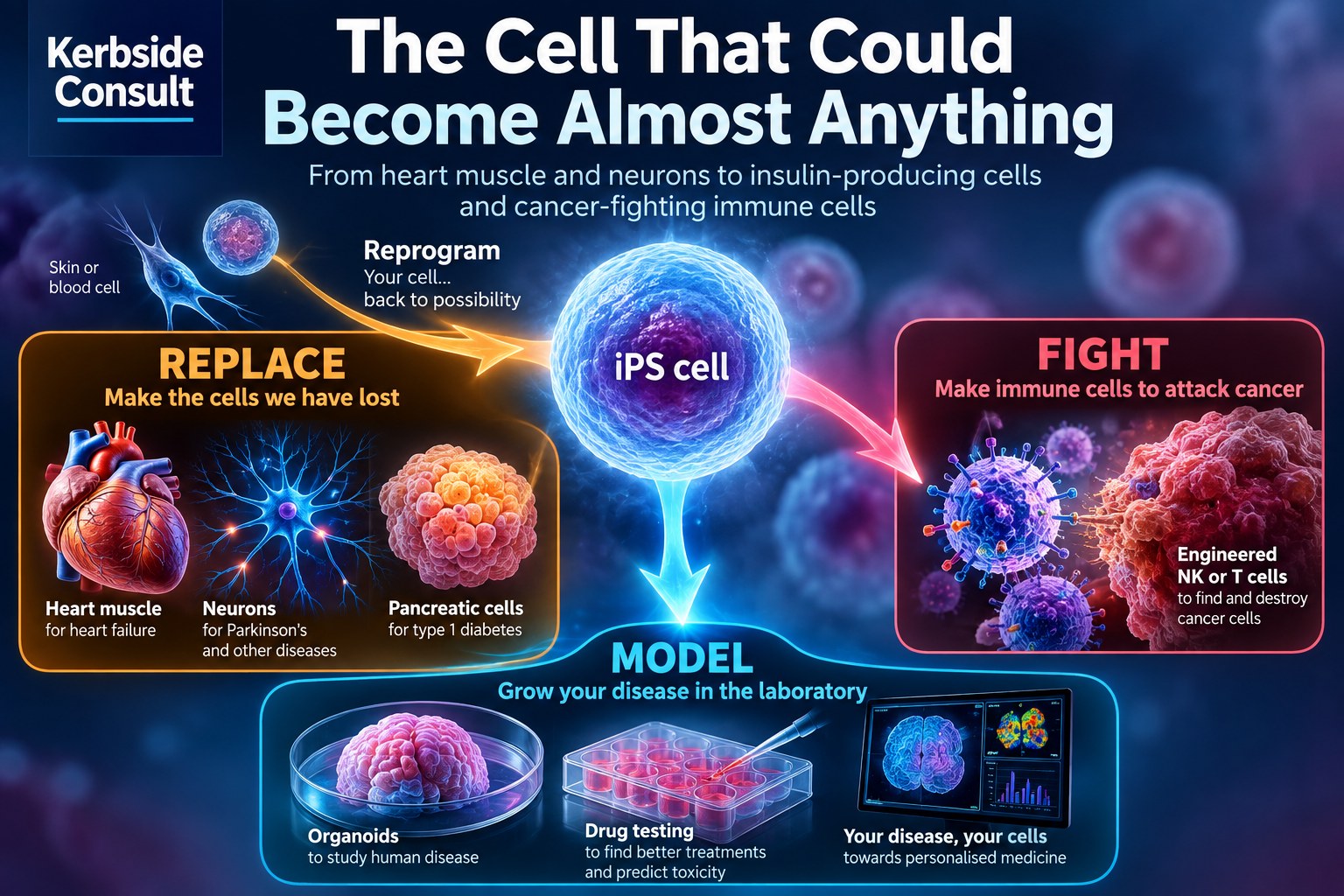
Contents
- Reprogram — turning the biological clock backwards
- Replace — manufacturing cells that have been lost
- Fight — turning cells into cancer medicines
- Model — your disease in a dish
- Edit — when iPS meets gene editing
- Build — a cell is not an organ
- Manufacture — the cell factory
- What is real — and what remains promise?
- The right cell
- Sources
REPROGRAM — Turning the biological clock backwards
In 2006, Kazutoshi Takahashi and Shinya Yamanaka showed that four defined factors — Oct3/4, Sox2, c-Myc and Klf4 — could reprogramme differentiated mouse fibroblasts into cells with pluripotent properties.[1] In 2007, the same group generated iPS cells from adult human fibroblasts.[2] In 2012, Yamanaka and John Gurdon shared the Nobel Prize for the discovery that mature cells can be reprogrammed to become pluripotent.[3] Pluripotent is an important word. iPS cells can generate derivatives of all three embryonic germ layers,[2] but they are not totipotent cells capable of making an entire organism.[3]
An iPS cell is not itself a heart cell, neuron or cancer treatment. It is better thought of as a renewable biological starting material.[2] [9] [10]
REPLACE — Instead of compensating for a lost cell, replace it
Much of medicine compensates for cells that have been lost. We give insulin when beta-cell function is lost, dopaminergic medicines when dopamine-producing neurons disappear, and heart-failure treatment after cardiomyocytes die.
iPS technology asks a different question: why not replace the missing cell?
Heart: RiHEART, developed by Cuorips, is an allogeneic iPS-cell-derived cardiomyocyte patch placed on the surface of the heart. It received conditional and time-limited approval in Japan in March 2026 for severe heart failure due to ischaemic cardiomyopathy that responds inadequately to standard treatment.[4] [14] The product is designed to support damaged myocardium through the effects of secreted cytokines and other factors.[14] A cardiomyocyte that beats in a dish is not a repaired heart; durable clinical benefit and long-term safety still require evaluation.
Parkinson's disease: in a Kyoto University phase I/II study, seven patients received bilateral transplantation of allogeneic iPS-cell-derived dopaminergic progenitors and were followed for 24 months.[5] No serious adverse events were reported; imaging showed no graft overgrowth and biological findings supported graft survival and dopamine production.[5] The study was small and early-stage.[5] Japan subsequently granted conditional and time-limited approval to AMCHEPRY (raguneprocel) on 6 March 2026, for motor symptoms inadequately controlled by existing medicines. Post-marketing clinical study and surveillance are required to support full approval.[13]
Eye: retinal pigment epithelial cells were among the earliest iPS-derived cells transplanted into a patient.[6] In the landmark Japanese report, the graft remained intact at one year, while visual acuity had neither improved nor worsened — technically remarkable, but not a dramatic clinical cure.[6] A subsequent report of the same patient documented continued graft survival at four years, with no adverse events reported; this remained a single-case follow-up.[15]
Diabetes: Japan's OASiS-1 is a phase 1/1b study of OZTx-410, an allogeneic iPS-cell-derived islet-cell sheet.[7] Its registered target sample is only three patients, and the registry lists it as “Not Recruiting” as checked on 3 October 2026.[7] The manufactured cells must regulate insulin appropriately, while the autoimmune process that destroyed the original beta cells may still need to be addressed.
In China, a 2024 Cell report described the first patient in a phase I trial of autologous chemically induced pluripotent stem-cell-derived islets (CiPSC-islets). Cells from her own adipose tissue were chemically reprogrammed, differentiated into islet-like cells and transplanted beneath the abdominal anterior rectus sheath. She became insulin-independent on day 75 and remained so through the one-year follow-up, with improved glucose control.[12]
This was a one-patient preliminary report. She was already receiving immunosuppression for a liver transplant, which continued after the islet transplant. The study therefore could not assess the immune response to an autologous graft without immunosuppression or show that the underlying autoimmunity had been resolved. Longer-term safety and efficacy, and results in more patients, remain to be established.[12]
Blood: Japan's iPLAT1 programme has already taken autologous iPS-derived platelets into a first-in-human trial.[8] The longer-term challenge is scale: transfusion requires enormous numbers of cells.[8]
Biological possibility does not automatically mean industrial practicality.
FIGHT — Turning cells into cancer medicines
Cancer takes the story in a different direction. Conventional CAR-T therapy begins with T cells and genetically equips them with a chimeric antigen receptor that recognises a tumour-associated target.[9]
iPS technology offers another manufacturing route: start with a renewable, characterised master iPS line and produce immune cells from it.[9]
FT596 is an allogeneic iPS-derived CD19-directed CAR-NK product.[9] In a phase 1 first-in-human study, 86 patients with relapsed or refractory B-cell lymphoma received FT596 after conditioning chemotherapy, without or with rituximab; 33 (38%) had previously received CAR-T therapy.[9] The maximum tolerated dose was not reached. Cytokine-release syndrome was uncommon and low grade, and neurotoxicity was not observed. However, common adverse events included neutropenia, anaemia and thrombocytopenia, including grade 3 or higher events. Activity varied by lymphoma subtype.[9] This is meaningful clinical evidence, but it remains phase 1 evidence.[9]
CAR describes how an immune cell is engineered to recognise a target.[9]
iPS describes a potential renewable starting platform from which therapeutic cells can be manufactured.[9]
MODEL — Your disease in a dish
Some of the most important uses of iPS cells may never involve transplantation. A patient's blood or skin cell can be reprogrammed and differentiated into a disease-relevant cell. The resulting cardiomyocytes, neurons or other cells retain that patient's genetic background.[10]
Researchers can investigate mechanisms, compare diseased and corrected cells, and expose cells to candidate medicines. This creates the possibility of living human disease models and, eventually, better-informed treatment selection.[10] But laboratory responses do not reproduce every feature of an adult organ and do not guarantee what will happen in the patient.[10]
Organoids take the concept into three dimensions, reproducing selected features of tissue architecture and function.[10] [11] But an organoid is not a miniature fully functioning organ.[11]
EDIT — What happens when iPS meets gene editing?
Genome editing adds another possibility: a patient's cell can potentially be reprogrammed, genetically corrected or engineered, expanded and differentiated into the required cell type.[10]
For monogenic disease the logic is particularly attractive. But unintended genetic changes, clonal selection and genomic stability matter enormously when edited cells are expanded and potentially implanted into a human being.
BUILD — A cell is not a tissue. A tissue is not an organ.
This may be the most important reality check in the iPS story. Making a cardiomyocyte is difficult. Making functioning myocardium is harder. Making a complete heart — with muscle, vessels, valves, conduction tissue, nerves and three-dimensional architecture — is vastly harder.
Making a neuron ≠ rebuilding a neural circuit.
Making an insulin-producing cell ≠ curing the autoimmunity that destroyed the original beta cell.
This is why iPS biology increasingly converges with tissue engineering, biomaterials, vascular engineering, organoids and bioprinting.
MANUFACTURE — The cell factory
This is where regenerative medicine becomes pharmaceutical medicine. The breakthrough in the laboratory is only the beginning. A cell product must still survive chemistry, manufacturing and controls (CMC), Good Manufacturing Practice (GMP), regulation, logistics and real-world clinical use. A clinical cell product must repeatedly satisfy questions of identity, purity, potency, genetic stability, sterility, viability, consistency, storage, transport and administration.
Then comes long-term surveillance. Where do the cells go? How long do they survive? Do they mature appropriately? Can they form unwanted tissue? Do they provoke immunity?
Autologous: patient → patient's cells → iPS cells → therapeutic cells → same patient.[6] [8]
Allogeneic: selected donor/master iPS-cell bank → therapeutic cells → many patients.[5] [9]
Autologous production offers personalisation but is slow and expensive. Allogeneic manufacturing is more scalable but brings immune compatibility and rejection into sharper focus.
The safety question
The same pluripotency that makes iPS cells attractive creates risk. Residual undifferentiated cells, unwanted differentiation, genetic or epigenetic abnormalities, immune rejection and contamination all matter. Product-specific risks differ: cardiac grafts may cause arrhythmias; neural grafts raise questions about differentiation and integration; engineered immune cells can have unintended immune effects; gene editing adds another layer of potential change.
The question is not only: Did we make the right cell? It is: Did we make only the right cell, consistently, and will it behave predictably for years inside a human being?
What is real — and what remains promise?
| Stage | Examples |
|---|---|
| Established research platform | Disease modelling, differentiation studies, drug discovery and toxicity research[10] |
| Reached patients / early clinical translation | iPS-derived retinal cells, dopaminergic progenitors, cardiomyocytes, platelets and autologous CiPSC-islets[4] [5] [6] [8] [12] |
| Conditionally approved in Japan, 2026 | RiHEART for severe heart failure due to ischaemic cardiomyopathy inadequately responsive to standard treatment; AMCHEPRY for Parkinson's motor symptoms inadequately controlled by existing medicines[13] [14] |
| Early clinical development | iPS-derived islet products and engineered immune-cell therapies[7] [9] |
| Rapidly developing research | Gene-edited iPS cells, organoids and complex tissue engineering[10] [11] |
| Still largely experimental / longer horizon | Manufacturing complete, fully functional replacement human organs[10] [11] |
Japan's 2026 approvals are milestones rather than an endpoint. Their conditional and time-limited status explicitly reflects the need for further evidence after marketing.[4]
The right cell
Twenty years ago, the remarkable achievement was showing that an adult cell could be pushed backwards into pluripotency.[1] Today the question is what we can responsibly manufacture from it.
an immune cell to FIGHT
a disease model to UNDERSTAND
an organoid to TEST
a genetically corrected cell to RESTORE
The possibilities are extraordinary. So are the scientific, manufacturing, regulatory and ethical obstacles.
What if, when the right human cell is missing, we could manufacture it?
We are nowhere near manufacturing every part of the human body. But that question is no longer entirely science fiction.
The future of medicine may not only be about finding the right drug. It may also be about manufacturing the right cell.
Acknowledgments
I am grateful to Dr Alan Teh Kee Hean, Consultant Haematologist at Subang Jaya Medical Centre, for his review of this piece and his critical feedback. The judgements and any errors remain mine.
Sources & further reading
- Takahashi K, Yamanaka S. Induction of pluripotent stem cells from mouse embryonic and adult fibroblast cultures by defined factors. Cell. 2006.
- Takahashi K, et al. Induction of pluripotent stem cells from adult human fibroblasts by defined factors. Cell. 2007.
- Nobel Prize in Physiology or Medicine 2012 — John Gurdon and Shinya Yamanaka.
- Japan Agency for Medical Research and Development (AMED). RiHEART and AMCHEPRY: conditional and time-limited approvals, 6 March 2026.
- Sawamoto N, et al. Phase I/II trial of iPS-cell-derived dopaminergic cells for Parkinson's disease. Nature. 2025.
- Mandai M, et al. Autologous Induced Stem-Cell–Derived Retinal Cells for Macular Degeneration. N Engl J Med. 2017.
- Japan Registry of Clinical Trials. OASiS-1: OZTx-410 allogeneic iPS-cell-derived islet-cell sheet. jRCT2053240146.
- Sugimoto N, et al. iPLAT1: first-in-human clinical trial of iPSC-derived platelets as a phase 1 autologous transfusion study. Blood. 2022.
- Ghobadi A, et al. Induced pluripotent stem-cell-derived CD19-directed chimeric antigen receptor natural killer cells in B-cell lymphoma: a phase 1, first-in-human trial. Lancet. 2025. doi:10.1016/S0140-6736(24)02462-0.
- Rowe RG, Daley GQ. Induced pluripotent stem cells in disease modelling and drug discovery. Nat Rev Genet. 2019.
- Andersson-Rolf A, Clevers H. New developments and applications of human organoids. Nat Rev Mol Cell Biol. 2026.
- Wang S, et al. Transplantation of chemically induced pluripotent stem-cell-derived islets under abdominal anterior rectus sheath in a type 1 diabetes patient. Cell. 2024;187:6152–6164.e12. doi:10.1016/j.cell.2024.09.004.
- Sumitomo Pharma and RACTHERA. AMCHEPRY (raguneprocel): conditional and time-limited approval in Japan and post-marketing commitments. 6 March 2026.
- Cuorips. RiHEART: human allogeneic iPS-cell-derived cardiomyocyte patches; indication, March 2026 conditional approval and intended mechanism. Accessed 3 October 2026.
- Takagi S, et al. Evaluation of Transplanted Autologous Induced Pluripotent Stem Cell-Derived Retinal Pigment Epithelium in Exudative Age-Related Macular Degeneration. Ophthalmol Retina. 2019;3:850–859. doi:10.1016/j.oret.2019.04.021.
Note: This article provides general information and does not replace individual medical advice. The views expressed are the author’s own and do not represent those of any employer or organisation. Regulatory status, trial registrations and clinical data in this field change quickly; follow current official sources.
Published 33/2026 · 3 October 2026 · No corrections to date · Corrections policy