The medicine bag
An elderly gentleman arrives at the clinic carrying a plastic bag filled with medicines. He has diabetes, hypertension, coronary artery disease and osteoarthritis. He also has difficulty sleeping. Over the years, different doctors have prescribed medicines for his various conditions. Some were started during hospital admissions, others by specialists, and a few by his family doctor.
He now takes twelve prescribed medicines every day. Recently, he has been feeling dizzy and tired. His appetite is poor, and he has fallen twice.
His daughter mentions that he also takes fish oil, a multivitamin, a preparation for his joints and something advertised to improve memory. There is an anti-ageing supplement recommended by a friend and a herbal remedy that he believes helps him sleep. None appears on his medical record.
Every product has a story. Some have a sound medical indication. Others have simply accumulated over time. The question is no longer whether another medicine might help him. It is whether he still needs everything he is taking.
Illustrative clinical scenario; not an account of an identifiable patient.
Contents
- How did we get here?
- STOP — Before adding another pill
- LOOK — What is really in the medicine cabinet?
- When good treatment becomes too much treatment
- Deprescribing — A clinical decision, not abandonment
- The Malaysian dimension
- Who should take responsibility?
- GO — Towards a better treatment plan
- The last prescription
- Sources & further reading
How did we get here?
Modern medicine has given us effective treatments for conditions that once shortened lives considerably. Patients with diabetes, hypertension and heart disease are living longer, often because of medicines with demonstrated benefits.
But longer lives also mean more chronic conditions, more specialists and more prescriptions. A cardiologist prescribes medicines to protect the heart. An endocrinologist manages diabetes. An orthopaedic surgeon treats joint pain. Another doctor adds something for gastric symptoms, while someone else prescribes a sleeping tablet. Each decision may be reasonable when considered separately. The difficulty arises when nobody looks at the complete list.
This is polypharmacy, commonly defined as the regular use of five or more medicines. The number itself does not establish inappropriate treatment. A patient may genuinely need ten medicines, while another may be taking three unnecessarily. The issue is whether each continues to provide more benefit than harm.[1]
Selected references: 1.
STOP — Before adding another pill
We are trained to diagnose and treat disease. Prescribing is a familiar part of that process. Stopping a medicine can be more difficult.
A doctor may hesitate to discontinue treatment started by a specialist. The original indication may no longer be clear. A patient may have taken the medicine for years and be reluctant to stop. Occasionally, a medicine is continued simply because it appears on the previous prescription.
There is also the prescribing cascade. A patient develops ankle swelling from a medicine. Instead of recognising an adverse effect, another medicine is prescribed to treat the swelling. That second medicine may produce further complications, leading to yet another prescription.
Before prescribing something new, perhaps we should ask whether an existing treatment is contributing to the patient’s symptoms.
LOOK — What is really in the medicine cabinet?
A medication review should not stop with the hospital prescription or the medicines listed in a clinic record. It should include everything the patient takes.
Prescription medicines and over-the-counter products
Some medicines remain essential for preventing serious complications. Others may have been prescribed for temporary symptoms that have long since resolved. Sleeping tablets, certain painkillers, medicines with anticholinergic effects and long-term acid-suppressing medicines are among those that may warrant reassessment.[2], [3] That does not mean they should automatically be stopped. The indication, expected benefit, adverse effects and consequences of withdrawal must all be considered.[4]
Vitamins and health supplements
There is an important difference between treating a demonstrated nutritional deficiency and taking supplements in the hope of improving general health. Vitamin B12 replacement in someone with a confirmed deficiency, for example, has a clear therapeutic purpose. Taking several multivitamins, additional minerals and other preparations without an established need is different.
More is not necessarily better. Excessive doses can cause harm, ingredients may be duplicated across products, and some supplements interact with prescribed medicines. Even when a supplement is relatively safe, we should ask whether its expected benefit justifies continued use and cost.
Anti-ageing products — The promise of turning back the clock
Products marketed for longevity, cellular rejuvenation, better memory and improved metabolism are increasingly available. Some contain nicotinamide riboside, nicotinamide mononucleotide or other substances intended to influence nicotinamide adenine dinucleotide (NAD⁺) metabolism.
There is genuine scientific interest in the biology of ageing. Laboratory findings, however, do not automatically translate into longer or healthier lives in humans. A 2026 systematic review identified 113 eligible NAD-related intervention studies, including 33 in humans. Oral NAD⁺ precursors consistently changed measurable biomarkers, but improvements in clinically meaningful outcomes were inconsistent or absent. The review found clinical effectiveness for anti-ageing and wellness inconclusive. It identified no eligible outcomes trials of intravenous or intramuscular NAD⁺ itself for these purposes. The review was unregistered, drew mostly on small, short trials, and most of the randomised trials had some risk-of-bias concerns.[5]
We should not dismiss promising research. Neither should we confuse scientific possibility with established clinical benefit. The relevant question is: what evidence shows that this particular product will help this patient?
Selected references: 5.
Herbal and traditional medicines — Natural does not always mean harmless
Traditional medicines occupy an important place in many Malaysian households. Malay, Chinese, Indian and other preparations may be used alongside conventional treatment. Some patients believe natural products must be safer than manufactured medicines. But natural does not necessarily mean harmless.
Herbal preparations may contain pharmacologically active substances. Some can affect liver function, alter blood clotting or interact with prescribed medicines. Composition and concentrations may vary. The evidence for interactions also varies: some are established, while others remain possible or theoretical.[6]
St John’s wort is a particularly clear example. It can weaken the effects of important medicines, including cyclosporine, some HIV and cancer medicines, warfarin and certain contraceptives. Combining it with medicines that affect serotonin may cause serious adverse effects.[7] Ginkgo may increase bleeding risk when combined with anticoagulants, although the strength of evidence varies by product and circumstance.[6]
Contamination or adulteration with undeclared pharmaceutical ingredients is a separate concern.[8], [9] None of this means every herbal preparation is ineffective or dangerous. The same principles should apply to all treatments: evidence of benefit, reliable quality, appropriate dosing and acceptable safety.
Patients should feel comfortable telling their doctors about traditional remedies without fear of being ridiculed. A doctor cannot assess an interaction involving a product whose use has never been disclosed.
When good treatment becomes too much treatment
Older patients may be more vulnerable to adverse effects because of frailty, multiple illnesses and changes in kidney and liver function. Dizziness, confusion, constipation, poor appetite, falls and daytime drowsiness may sometimes be related to treatment rather than a new disease.
A medicine appropriate ten years ago may no longer offer the same balance of benefit and risk. Preventive medicines deserve particular thought: benefits may take years to become apparent, while adverse effects and treatment burdens may be immediate. This does not justify withdrawing effective preventive treatment simply because a patient is old. It calls for an individual assessment of health, prognosis, treatment goals and preferences.
Deprescribing — A clinical decision, not abandonment
Deprescribing is the planned reduction or withdrawal of a medicine when its potential harms outweigh its expected benefits or it no longer fits the patient’s treatment goals. It is not an instruction to stop taking medicines independently. Some medicines must be continued; others require gradual dose reduction, as abrupt withdrawal can be dangerous.
The 2026 Australian deprescribing guideline summary (University of Western Australia–led, endorsed by the RACGP and others) includes 185 consensus-based recommendations and 70 good-practice statements, covering when to deprescribe, ongoing treatment needs, how to deprescribe and monitoring. The authors found no high- or moderate-certainty evidence sufficient for formal evidence-based recommendations under their methodology.[4]
That limitation deserves attention. Reducing unnecessary medication can reduce treatment burden, but removing tablets does not automatically improve every clinical outcome. Decisions should be shared with the patient and relevant clinicians, with monitoring and a plan to reassess if symptoms return.
Selected references: 4.
The Malaysian dimension
In Malaysia, patients may receive treatment from government clinics, private general practitioners, specialist centres and hospitals. Medicines may be purchased from community pharmacies, while supplements and traditional preparations come from shops, friends or online sellers. There may be no single complete record of everything the patient takes.
Medication reconciliation matters especially after hospital discharge or a change of treatment. Consumers can check products through the National Pharmaceutical Regulatory Agency (NPRA) product search. Registered products carry a MAL number and a security hologram; N identifies health supplements and T traditional medicines. Registration does not establish every advertised anti-ageing or therapeutic claim.[10]
Selected references: 10.
Who should take responsibility?
The World Health Organization identifies polypharmacy and changes between care settings as medication-safety priorities. Its Five Moments for Medication Safety encourages questions when starting, taking, adding, reviewing or stopping a medicine.[1], [11] The CDC likewise advises keeping a current list that includes over-the-counter medicines and supplements, particularly because some products increase the risk of falls or driving-related injury.[12], [2]
Ideally, one clinician should maintain an overview of the patient’s complete regimen, supported by pharmacists and relevant specialists. The family doctor is often well placed to coordinate the review, but communication between providers is essential. A patient attending several specialists should not have to decide alone which medicines to continue or discontinue.
A practical review asks five questions: Why am I taking this? Is it still helping? Could it cause harm or interact with something else? Is there a safer or simpler alternative? If it is no longer needed, how can it be reduced or stopped safely?
The answers may lead to fewer medicines. They may equally confirm that the existing treatment is appropriate. Both are useful outcomes.
GO — Towards a better treatment plan
Let us return to our elderly gentleman. A complete review may identify duplication, a product with no clear indication, or a medicine contributing to his dizziness. Some treatments will remain essential. Others may be reduced or discontinued under supervision, with monitoring of symptoms and relevant clinical measurements.
His daughter can help keep an updated list of prescription medicines, over-the-counter products, supplements and herbal remedies, and bring it to every consultation. The CDC offers a practical MyMedications List and MyMedications Action Plan to support that conversation.[13], [14] The objective is not to empty his medicine bag. It is to ensure that everything remaining has a good reason to be there.
The last prescription
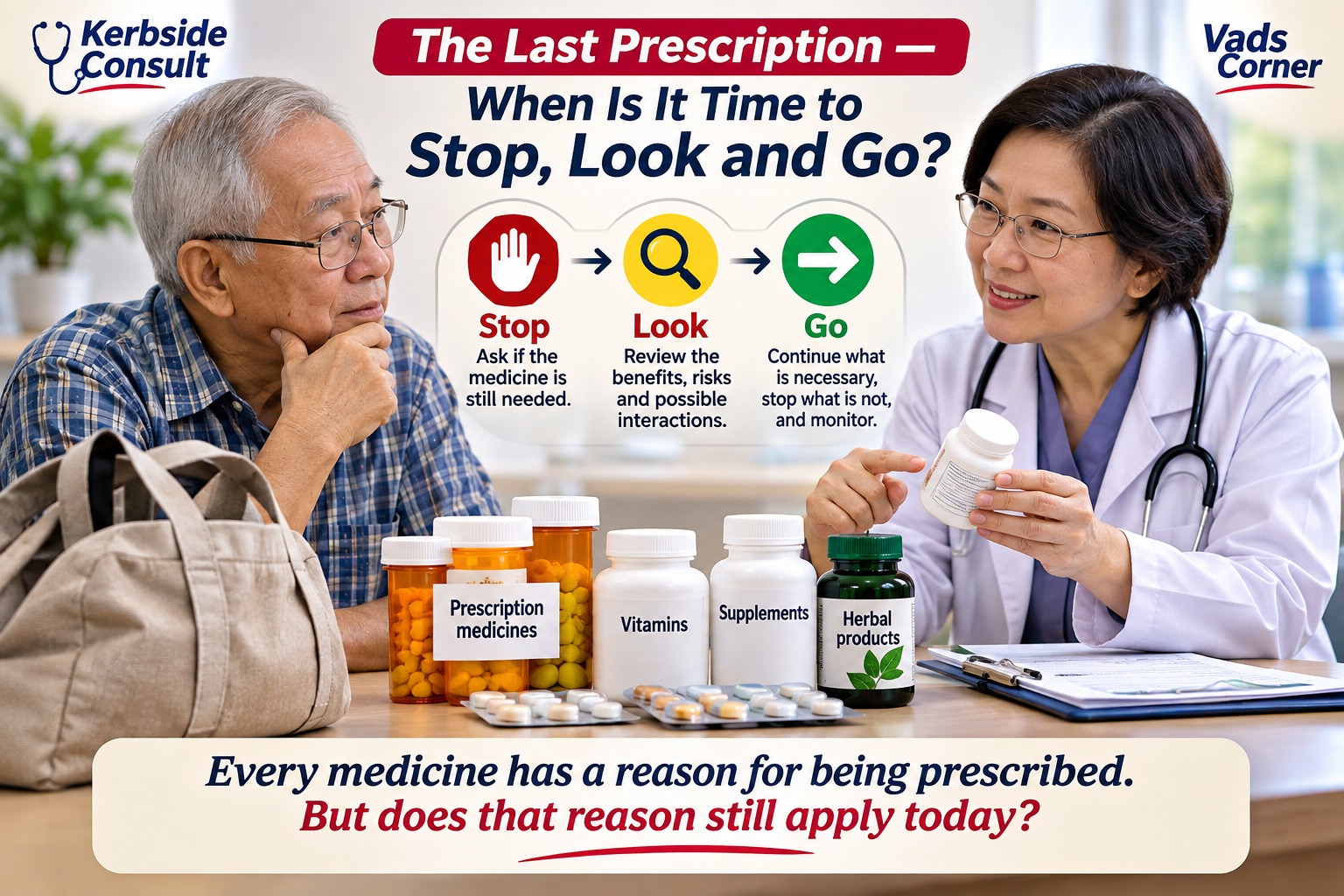
Perhaps it is time we applied a familiar lesson from road safety to the medicine cabinet: Stop, Look and Go.
Stop before adding another medicine. Look carefully at everything the patient is already taking. Then go forward with a treatment plan that reflects what the patient needs today, rather than simply continuing what was prescribed years ago.
Prescribing is a clinical decision. So is deprescribing.
The last prescription may not be the final medicine a patient receives. It may be the first occasion when someone has taken a serious look at whether all the others are still necessary.
Sources & further reading
- World Health Organization. Medication safety in polypharmacy: technical report [Internet]. Geneva: WHO; 2019. WHO/UHC/SDS/2019.11 [cited 2026 Nov 4]. Source
- US Centers for Disease Control and Prevention. Medicines risk fact sheet [Internet]. Atlanta (GA): CDC; page last updated 2024 Dec 30 [cited 2026 Nov 4]. Source Fact sheet: US Centers for Disease Control and Prevention. Medications can be linked to injuries as we age [Internet]. Atlanta (GA): CDC; 2023 [cited 2026 Nov 4].
- Farrell B, Pottie K, Thompson W, Boghossian T, Pizzola L, Rashid FJ, et al. Deprescribing proton pump inhibitors: evidence-based clinical practice guideline. Can Fam Physician. 2017;63(5):354-64. Source
- Quek HW, Reus Perello X, Lee K, et al. Deprescribing in older people: a clinical practice guideline summary. Med J Aust. 2026;224:e70174. doi:10.5694/mja2.70174. Source
- Gallagher C, Emmanuel OO. NAD⁺ supplementation for anti-aging and wellness: a PRISMA-guided systematic review of preclinical and clinical evidence. Ageing Res Rev. 2026;116:103057. doi:10.1016/j.arr.2026.103057. Source
- National Center for Complementary and Integrative Health. Herb-drug interactions: what the science says. NCCIH Clinical Digest [Internet]. Bethesda (MD): NIH; 2024 Dec [cited 2026 Nov 4]. Source
- National Center for Complementary and Integrative Health. St. John’s wort: usefulness and safety [Internet]. Bethesda (MD): NIH; last updated 2025 May [cited 2026 Nov 4]. Source
- National Pharmaceutical Regulatory Agency, Ministry of Health Malaysia. Traditional product Nan Bao (capsule) contain sildenafil, a scheduled poison [press release] [Internet]. 2019 Mar 18 [cited 2026 Nov 4]. Source
- Ariffin SH, Wahab IA, Hassan Y, Abd Wahab MS. Adulterated traditional-herbal medicinal products and its safety signals in Malaysia. Drug Healthc Patient Saf. 2021;13:133-40. doi:10.2147/DHPS.S305953. Source
- National Pharmaceutical Regulatory Agency. FAQ: Traditional and natural products and health supplements [Internet]. Ministry of Health Malaysia [cited 2026 Nov 4]. Official NPRA guidance; QUEST3+ verification instructions.
- World Health Organization. 5 moments for medication safety [Internet]. Geneva: WHO; 2019. WHO/HIS/SDS/2019.4 [cited 2026 Nov 4]. Source
- US Centers for Disease Control and Prevention. Medication safety and your health [Internet]. Atlanta (GA): CDC; 2024 Nov 18 [cited 2026 Nov 4]. Source
- US Centers for Disease Control and Prevention. MyMedications List [Internet]. Atlanta (GA): CDC; 2023 [cited 2026 Nov 4]. Source
- US Centers for Disease Control and Prevention. MyMedications Action Plan [Internet]. Atlanta (GA): CDC; 2023 [cited 2026 Nov 4]. Source