This is not my usual Kerbside Consult article. It is not about medicine, healthcare or scientific discovery. It is about a man whose extraordinary determination to fulfil a personal ambition has left me deeply impressed.
When Karl Bushby set out from the southern tip of South America in 1998, he established two fundamental rules: he would not use mechanical transport to advance his journey, and he would not return home until he had completed it. What began as an ambitious undertaking became a commitment that would consume 28 years of his life.
What fascinates me is not simply the distance he covered, but his singularity of purpose. Through financial hardship, bureaucratic obstacles, physical danger, broken relationships and years of uncertainty, he remained committed to the principles he had set for himself. The mindset and perseverance required to pursue one goal for so long, at such enormous personal cost, are astounding.
His story also reminds us that even the most determined individual cannot accomplish everything alone. Along the way, Bushby encountered people whose kindness, generosity and companionship helped him continue when the journey might otherwise have ended.
That, to me, is what makes his story worth telling. It is about the strength of the human spirit, the price of unwavering determination and the remarkable humanity of the people he met along the way.
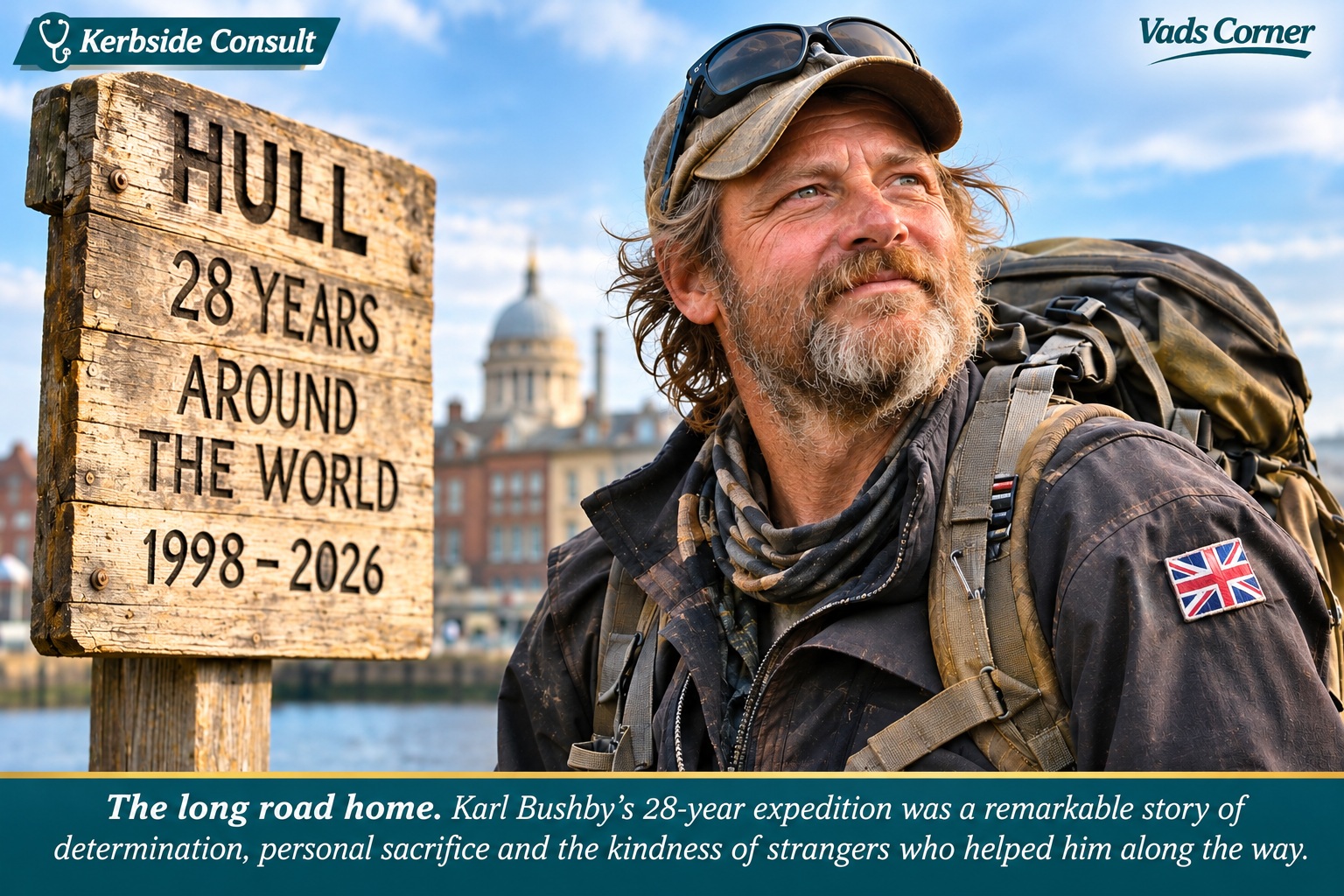 AI-generated illustration
- Route map credited to Bushby (ExplorersWeb, 2025)
- Official Goliath Expedition route and chronology
- Before: Bushby during the expedition (photograph from 2000)
- After: Bushby’s homecoming in Hull (November 2026)
The 2025 route map predates the final leg. The photograph links open publishers’ pages; their images are not reproduced here.
Contents
A promise that lasted 28 years
Bushby had been a British paratrooper. The idea for the expedition took shape after his father described an argument about whether it would be possible to walk between Britain and North America via the Bering Strait. Bushby drew a line on a map and extended it to the southern tip of South America. The plan was audacious, but his rules were uncomplicated: he would not use transport to advance his journey, and he would not go home until he had arrived on foot.[1]
What was meant to take considerably less time stretched across nearly three decades. Geography was only part of the problem. He faced restrictions on borders and visas, periods of imprisonment after unauthorised crossings, shortages of money and the interruption of the COVID-19 pandemic. Walking was often the straightforward part; getting permission to continue was not.[1], [2]
When the walking stopped, the journey continued
Bushby did not walk continuously for 28 years. Russian visa restrictions and Siberia's narrow seasonal windows repeatedly stopped him. When the financial crisis cost him sponsorship, he spent roughly two years in Mexico, which became a temporary base where he could live cheaply while looking for a way to resume the expedition.[4], [5]
In 2012, denied another Russian visa, he undertook a protest walk from Los Angeles towards the Russian embassy in Washington, DC. Later, the COVID-19 pandemic stranded him in Mexico for several more years. Plans through Iran and Russia collapsed amid sanctions, closed borders and war. His September 2026 interview described how world events could stop one man from taking his next step.[2], [6]
He sometimes flew to Mexico or the United States during these pauses, but he could not use transport to advance along the expedition route: each time he returned to the place where he had stopped. He also kept his promise not to return home to England until the journey was complete. Waiting, and beginning again, demanded a different kind of endurance.[1], [2]
Who paid for the journey?
Walking may be one of the simplest ways to travel, but walking around the world for 28 years is another matter. Bushby set off in 1998 with about US$500 and no sponsors. His early progress depended on stretching scarce funds and accepting the practical help of strangers.[1]
As the expedition attracted attention, a publishing advance helped finance the equipment and preparation required for the Bering Strait. Sponsorship offered further support, but it was never guaranteed. The financial crisis of 2008 cost him important backing, and the journey stalled. During his time in Mexico, he worked as a waiter and helped run a boat-racing school to get by.[8]
In 2010, screenwriter Beau Willimon became involved, and he and producer Jordan Tappis subsequently supported the expedition through their production venture. Bushby also received help from his parents, who organised grassroots fundraising, and from people who provided meals, accommodation and care along the way.[8]
There is no comprehensive public accounting of what the expedition cost or precisely how much each source contributed. But the larger point is clear: a journey described as one man’s walk depended on an evolving network of family, backers, colleagues and strangers. His feet carried him forward; others repeatedly made the next step possible.[8]
Three difficult crossings
The Bering Strait, 2006
With fellow adventurer Dimitri Kieffer, Bushby negotiated roughly 90 kilometres of shifting sea ice between Alaska and Russia in about two weeks. Ice cracked and drifted, freezing water posed a constant danger, and earlier efforts had required rescue from drifting ice. Once ashore in Russia, the pair were detained over border formalities. The crossing required partnership as much as resolve.[1], [7]
The Caspian Sea, 2024
Unable to proceed by land through Iran or Russia, Bushby crossed approximately 288 kilometres of the Caspian Sea from Kazakhstan to Azerbaijan. Over 31 days he spent more than 130 hours in the water, accompanied by explorer Angela Maxwell, Azerbaijani swimmers Anastasia Boborykina and Abdurrahman Rustamov, and maritime support crews. They swam in stages and rested aboard support vessels. This was not an uninterrupted solo swim.[1], [5]
The English Channel, 2026
Unable to walk through the Channel Tunnel, Bushby crossed the Channel with flotation equipment and support, spending about 20 hours in the water over three days. He called his unconventional method “floatimming”. On 5 October 2026 he landed at Shakespeare Beach near Dover, leaving the final walk to Hull.[1], [5]
Each crossing was his to complete, but none was truly solitary. Companions, local expertise and support teams helped carry the expedition forward.
The people who opened their doors
It is tempting to tell such a story as the triumph of one exceptionally determined man. Bushby's own recollections suggest a more generous interpretation.
He has described being welcomed into modest homes, sharing simple meals with families who had little to spare, and receiving help when he was ill or exhausted. During his passage through Peru, a doctor's family nursed him through a severe stomach illness. The value of that assistance cannot be measured in miles. It allowed him to recover and continue.[2]
Many of those who helped him would never appear in an expedition record. They were not sponsors or professional guides. Some simply encountered a weary stranger on the road and chose to help. Bushby later emphasised that generosity had come from people across countries, cultures and economic circumstances.[1], [2]
The price of a long ambition
There is another side to the story. Twenty-eight years is not simply a long expedition. It is a substantial part of an adult life.
During his absence, his son grew into adulthood. His family aged. Ordinary celebrations, reunions and the small rituals of being together could not be recovered later. At his homecoming, Bushby was reunited with his mother and his adult son and met a granddaughter whom he had not previously seen.[2]
We can admire his perseverance without pretending that such devotion comes without cost. Great personal ambitions can demand sacrifices not only from those who pursue them but also from the people who love them. Bushby's story is richer, and more human, when we acknowledge both sides.
His marriage had ended before the expedition. His son Adam grew up during his absence, and the two later discussed what those years apart meant. Bushby also spoke of a seven-year relationship with a Colombian woman and a three-year relationship with a Japanese woman. Both ended. He acknowledged that putting the mission first was no easy basis for lasting relationships. His determination deserves admiration, but the sacrifices were shared by others.[2], [5]
What it means to come home
After swimming the English Channel, Bushby reached British soil near Dover on 5 October 2026. He still had hundreds of kilometres to walk. On 2 November, the journey ended in Hull, where supporters gathered to welcome him.[1], [2]
There is an obvious satisfaction in a promise kept. But returning home after so many years must also involve adjustment. For almost three decades, each day had a direction and a destination. Now the journey is complete. Bushby has spoken publicly about the challenge of returning to ordinary life; it would be wrong to speculate beyond his own words about how he will experience that transition.[2]
A lesson beyond the expedition
Why does this belong in Kerbside Consult? Not because walking 50,000 kilometres offers a sensible exercise prescription. Nor because we can infer anything definite about Bushby's physical or mental health from the scale of his achievement.
It belongs here because care and trust are at the heart of medicine, too. A patient who enters a clinic or hospital often places considerable faith in someone they have never met. The clinician may come from a different language, culture or background. Yet a few minutes of attention, kindness and competence can matter enormously.
Bushby's journey reminds us that the people who make a difference are not always the people whose names are remembered. They may be a family offering a meal, a doctor treating a traveller, a companion sharing a dangerous crossing, or a stranger who stops to ask whether help is needed.
He walked the miles himself. But he did not make the journey alone.
Perhaps that is the most enduring achievement of the man who walked for 28 years: not simply that he found his way home, but that, across so much of the world, he found people willing to help him get there.
Sources & further reading
The expedition and the homecoming
- Bushby K. The Goliath Expedition: The Longest Journey Home [Internet] [cited 2026 Nov 3]. Source
- Associated Press. Karl Bushby embraces emotional mother as he completes his 28-year, 31,000-mile walk around world [Internet]. 2026 Nov 2 [cited 2026 Nov 3]. Source
- Bushby K. Giant steps: the remarkable story of the Goliath Expedition. London: Little, Brown; 2012 [cited 2026 Nov 3]. Source (publisher’s page; further reading)
Features and interviews
- The Guardian. Karl Bushby’s incredible 28-year walk home [Internet]. 2026 Oct 13 [cited 2026 Nov 3]. Source
- Associated Press. In 28 years of walking, Karl Bushby has overcome jungle, desert and red tape [Internet]. 2026 [cited 2026 Nov 3]. Source
- Outdoor Magazyn. Interview with Karl Bushby: 28-year walk home [Internet]. 2026 Oct 5 [cited 2026 Nov 3]. Source