As children, we lose our baby teeth knowing that another set will take their place. But lose a permanent tooth at 40, 60 or 80, and there is no replacement waiting underneath. Could that ever change?
Researchers in Japan are investigating whether a medicine could encourage the body to grow another tooth. Their work has progressed from animal experiments[1], [2] to early human trials.[3] The idea is fascinating, but the treatment is still experimental, and its first target is children born without some of their permanent teeth, not an adult who has lost a molar.
I wrote this because the posts I kept seeing on Facebook said “regrow”, while the papers and registry entries said something far more careful. This is a walk from one to the other.
What is the idea? How far has it got? And what should we tell patients who ask?
Contents
- Why do we stop growing teeth?
- The discovery in Japan
- Who could benefit first?
- The human trials so far
- Would the new tooth work normally?
- When might treatment be available?
- Another approach — rebuilding tooth enamel
- Stem cells, 3D printing and implants
- What the posts said, and what the record says
- At the kerbside
- Sources & further reading
Why do we stop growing teeth?
Humans normally develop two sets of teeth: 20 baby teeth and up to 32 permanent teeth. Specialised cells receive chemical signals that guide where and how teeth form. Some signals encourage growth; others restrain it.
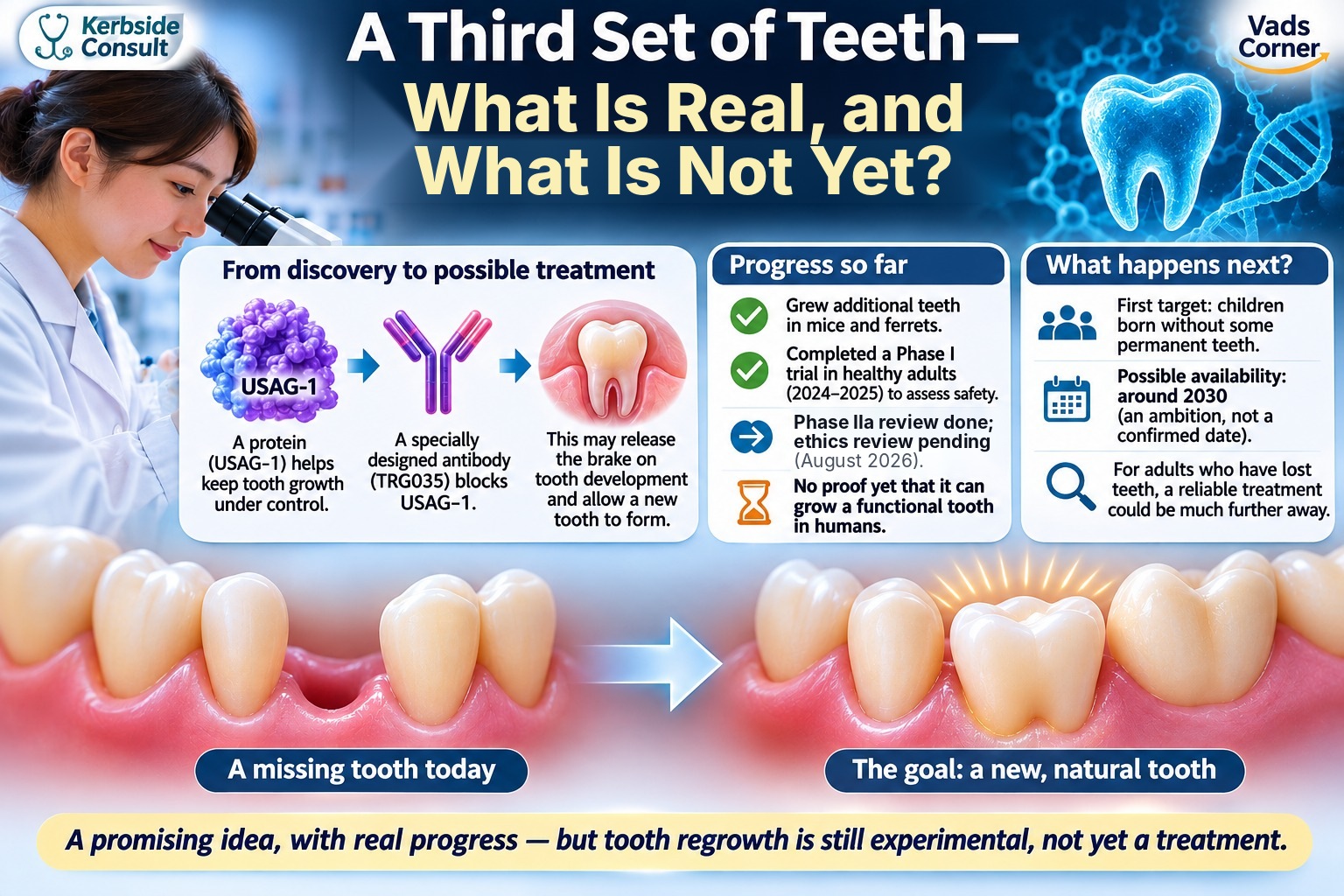
One protein, called USAG-1, helps regulate this process. Think of it as one of the brakes on tooth formation. Japanese scientists found that blocking USAG-1 could, under certain conditions, allow additional teeth to develop. The aim is not to manufacture a tooth but to influence the body’s existing developmental machinery.[1], [2]
The discovery in Japan
In 2021, a Kyoto University and University of Fukui team including Dr Katsu Takahashi reported in Science Advances that a single systemic dose of an antibody against USAG-1 restored missing teeth in mouse models of congenital tooth agenesis. In ferrets, which, like humans, have baby and permanent teeth, an extra incisor formed, like a third dentition. But it took a five-times higher concentration, three administrations and immunosuppression.[1] The authors added that the antibody did not cure every form of agenesis, that further studies in non-rodent animals such as dogs or pigs were needed, and that future use should focus on congenital agenesis with specific causative gene mutations.[1]
It was a significant laboratory finding. But animal experiments do not prove that an adult human can regrow a tooth lost years earlier.
Who could benefit first?
The initial focus is on children born without some of their permanent teeth, a condition called congenital tooth agenesis. Missing teeth can affect chewing, speech, appearance and jaw development. Encouraging these teeth to develop could change their treatment. Japan’s health ministry designated the medicine an orphan drug for severe congenital partial anodontia (six or more permanent teeth missing) in September 2025.[4]
But there is an important distinction. A child whose tooth never formed may retain developmental potential that differs from that of an older adult whose molar was lost to decay, gum disease or injury. Success in one group would not automatically mean that everyone could grow a third set of teeth. The 2021 paper itself suggested that future use should focus on congenital agenesis with specific causative gene mutations, which might serve as markers for choosing patients.[1] The company describes acquired tooth loss as a later ambition, not a current programme.[5]
The human trials so far
Phase I (completed). The medicine, now called TRG035 and developed by Toregem BioPharma, entered a Phase I study at Kyoto University Hospital in October 2024. It was randomised, double-blind and placebo-controlled, with single intravenous doses escalated across five levels. The 30 participants were healthy men aged 30 to 64, each missing at least one molar. The primary endpoint was safety; drug levels and antibodies against the drug were secondary. The registry lists the study as complete, and in November 2025 the company stated that Phase I was finished and the drug’s safety confirmed. Detailed results have not yet been published, and the study was never designed to show that a tooth would grow.[3], [6]
Phase IIa (planned). On 17 August 2026 the company announced that Japan’s regulator, the PMDA, had completed its investigation of the clinical trial notification for a Phase IIa study (protocol TR-002).[7] By the company’s description it is an open-label, non-comparative, multicentre dose-finding trial in 24 children with severe congenital partial anodontia. The company says it will enrol subjects after review by the clinical site’s ethics committee (IRB); no start date has been announced.[5], [7] Completing the notification review is not marketing approval, and not evidence of tooth regrowth in humans.
Regulators and investors have taken the programme seriously: the company also reported the US FDA’s response to a pre-IND meeting in November 2025,[6] and raised US$5.3 million in May 2026 to support Phase II trials.[5] These are steps in a development plan, not results.
Key milestones in the USAG-1 antibody programme
| Period | Milestone |
|---|---|
| 2021 | Anti-USAG-1 antibody restores missing teeth in mouse models of tooth agenesis; in ferrets an extra incisor forms, but only with higher and repeated dosing plus immunosuppression.[1], [2] |
| Oct 2024 | Phase I study of TRG035 registered and begun at Kyoto University Hospital: 30 healthy men, single intravenous dose, safety primary.[3] |
| Sep 2025 | Orphan drug designation for severe congenital partial anodontia.[4] |
| Nov 2025 | Company reports Phase I completed and safety confirmed; receives the FDA’s pre-IND meeting response.[6] |
| Feb 2026 | Company reports passing the interim AMED stage-gate evaluation, citing completion of the domestic Phase 1 trial and a pre-IND meeting with regulators.[8] |
| May 2026 | US$5.3 million raised to support Phase II trials in Japan.[5] |
| Aug 2026 | PMDA completes its review of the Phase IIa clinical trial notification; ethics review still pending.[7] |
| About 2030 | Developers’ stated ambition for treating congenital tooth absence; not a confirmed date.[5] |
Would the new tooth work normally?
A useful new tooth must appear in the right place, have the appropriate shape and roots, connect properly with supporting tissues and withstand years of chewing. Researchers must also examine unintended effects, since the signalling pathways involved in tooth development have other roles in the body. This was visible in the 2021 mouse work: antibodies that also blocked USAG-1’s interaction with Wnt co-receptors were associated with low birth and survival rates in treated pregnant mice, whereas the antibody that worked best acted on the BMP pathway only.[1], [2]
A tooth appearing on an X-ray would be encouraging. A safe, durable, functional tooth is a much higher standard.
When might treatment be available?
The developers have discussed approximately 2030 as an ambition for treatment of congenital tooth absence. It is not a confirmed launch date. Phase II efficacy data, further regulatory review and approval must come first, and the next stage is focused on severe congenital hypodontia, not on adult tooth loss from periodontal disease, injury or decay.[5]
For people who lost teeth through ordinary dental disease, any reliable regrowth treatment could be much further away.
Another approach — rebuilding tooth enamel
A different question is whether a lost surface layer can be rebuilt, rather than a whole tooth grown. Researchers at the University of Nottingham have engineered a protein-based coating (an elastin-like recombinamer, or ELR) that guides minerals into an enamel-like layer on damaged tooth surfaces. Enamel is the hard outer covering of a tooth. Although early mineral loss can be repaired through remineralisation, substantial enamel loss does not naturally grow back.[9]
In a Nature Communications paper published on 4 November 2025, the coating guided organised mineral crystals to grow on extracted human teeth, in layers up to about 10 micrometres thick, even down to bare dentine. In the laboratory, remineralised enamel regained its stiffness and hardness (Young’s modulus 76.3 ± 18.7 GPa and hardness 3.1 ± 0.8 GPa, against 80.7 ± 18.3 and 3.4 ± 0.9 for native enamel), and fracture toughness rose from 0.7 to 1.1 against 1.2 MPa·m0.5 for healthy enamel. The layer grown on dentine was softer (hardness 1.4 ± 0.3 GPa). The samples withstood simulated toothbrushing equivalent to about a year and simulated chewing and grinding equivalent to about 3.5 years.[9]
Two caveats matter. First, the coating goes on in minutes, but the mineral layer grew over about 10 days in laboratory mineralising solutions at body temperature, and over 14 days in natural human saliva. That is not yet a chairside procedure. Second, everything was done on extracted teeth. The authors state that confirming enamel regeneration needs in vivo validation, which they plan as future work. This is enamel repair, not the growth of a new tooth, and effectiveness and durability in patients remain to be demonstrated. A university spin-out company, Mintech-Bio, is working towards products; two of the authors are its co-founders and hold equity in it, as the paper discloses. I have found no published patient data.[9]
Selected references: 9.
Stem cells, 3D printing and implants
Other researchers are investigating stem cells, tissue engineering and 3D printing to repair dental tissues. These methods differ from the USAG-1 approach, which uses an antibody to influence tooth development.[5]
Dental implants, bridges and dentures will remain important. Unlike experimental regeneration, they already have established clinical uses. A natural replacement tooth might someday offer advantages, but those benefits still need to be demonstrated in patients.
Selected references: 5.
What the posts said, and what the record says
I looked at three public Facebook posts about the Japanese antibody, dated 23 April, 24 October and 26 October 2026. I have left out the page names; the pattern matters more than the publisher. None linked to the registry entry or the paper. One cited only “Kyoto University Hospital and Toregem”, with a year and no link. The caveats were often present somewhere in the text, but under a headline or an image that told a bigger story.
Three posts against the record
| What the post said | What the record says |
|---|---|
| Post 1. An image headline saying scientists “begin” human trials for the world’s first tooth regrowth drug, over a vial labelled “Tooth Regrowth Drug”. The caption itself said the first trial was completed and the drug is not available. The post carried an “AI content” label. | Phase I is complete.[6], [8] Phase IIa has not started.[7] I found no product label like the one pictured in any source I read. The caption was sound; the picture contradicted it. |
| Post 2. The drug works by “switching off a gene called USAG-1”; treated mice and ferrets “grew complete new teeth”; a single injection restarts the body’s “tooth factory”; the new tooth has root, enamel and nerve; a third set at any age. | The drug is an antibody that blocks the USAG-1 protein, not a gene switch.[1] In ferrets the result was an extra incisor, and it needed a five-times higher dose, three administrations and immunosuppression.[1] Phase I gave single intravenous doses to 30 healthy men to test safety.[3] The first target is children born without some permanent teeth.[4], [7] I found no support for “nerve” in the sources cited here. The idea of dormant tooth buds has a basis; whether the antibody wakes them in people is the unanswered question. |
| Post 3. Kyoto University “began human trials in 2026”; the drug awakens dormant tooth development “in adults”; “available by 2030”. An image headline said adults may soon replace lost teeth. | Phase I began in October 2024 and was a safety study in healthy men.[3] The children’s study is the first step towards benefit.[7] 2030 is the developers’ ambition, not a date.[5] The text did say “focus on safety” and “if successful”; the headline dropped both. |
I hold myself to the same test. The Phase I and Phase IIa status in this article rests on company releases and a registry entry, not on published trial results, and I have said so each time.
At the kerbside
Tooth loss is not a rare problem in Malaysia. In the National Oral Health Survey of Adults 2020 (16,734 adults), the average Malaysian adult had 24.4 natural teeth, 48.4% needed some form of dental prosthesis, and 28.9% of dentate adults needed an extraction.[10] Interest in “growing teeth back” is therefore understandable.
The tooth story is a small case of a larger habit worth keeping: go back to the source. Four questions do most of the work. Who is saying it: a peer-reviewed paper, a registry entry, a company release, or someone re-sharing a picture? In what: a mouse, a ferret, an extracted tooth, a healthy volunteer, or a patient? At what stage: safety in volunteers, or benefit in the people who need it? And can I click through to the source? Asked of the posts above, these questions take most of the hype out and leave facts that are interesting enough. The caveat is usually there somewhere. It simply does not travel with the share.
The real risk is the gap between headline and clinic. No tooth-regrowth method is publicly available anywhere.[5] The first patient to ask about it in a Malaysian clinic will be asking a fair question. The second may be responding to an advertisement.
We already have rules. Under the Medicines (Advertisement and Sale) Act 1956, an advertisement promoting an article as a medicine or remedy needs the approval of the Medicine Advertisements Board, and breaches are criminal offences (up to RM3,000 or a year’s imprisonment for a first offence).[11] For medical devices, which would cover an enamel material, Section 44(2) of the Medical Device Act 2012 forbids misleading or fraudulent claims in advertisements.[12] For dentists, the Malaysian Dental Council’s guidelines (in force since 1 July 2022) require public information to be factually accurate and capable of being substantiated, forbid any claim that cannot be substantiated, and make breaches subject to disciplinary action.[13] My view is that no new rule is needed. For a product claim, two of those questions matter most: where is the registration, and where are the patient data? At present neither exists for either technology in this article.
What would I tell a patient today? That no tooth-regrowth medicine or enamel-regrowing gel is available to the public, and that anyone claiming otherwise deserves caution. Implants, bridges and dentures remain the established choices, and prevention remains cheaper and more reliable than any future cure. What would I watch for? Publication of the Phase I data; ethics clearance and a start date for the children’s Phase IIa study; and, above all, the first evidence that a functional tooth erupts in a patient. For the enamel gel, the milestone is a first controlled study in people’s mouths.
Perhaps one day, losing a permanent tooth will no longer mean losing it forever. For now, caring for the teeth we have remains the more reliable option.