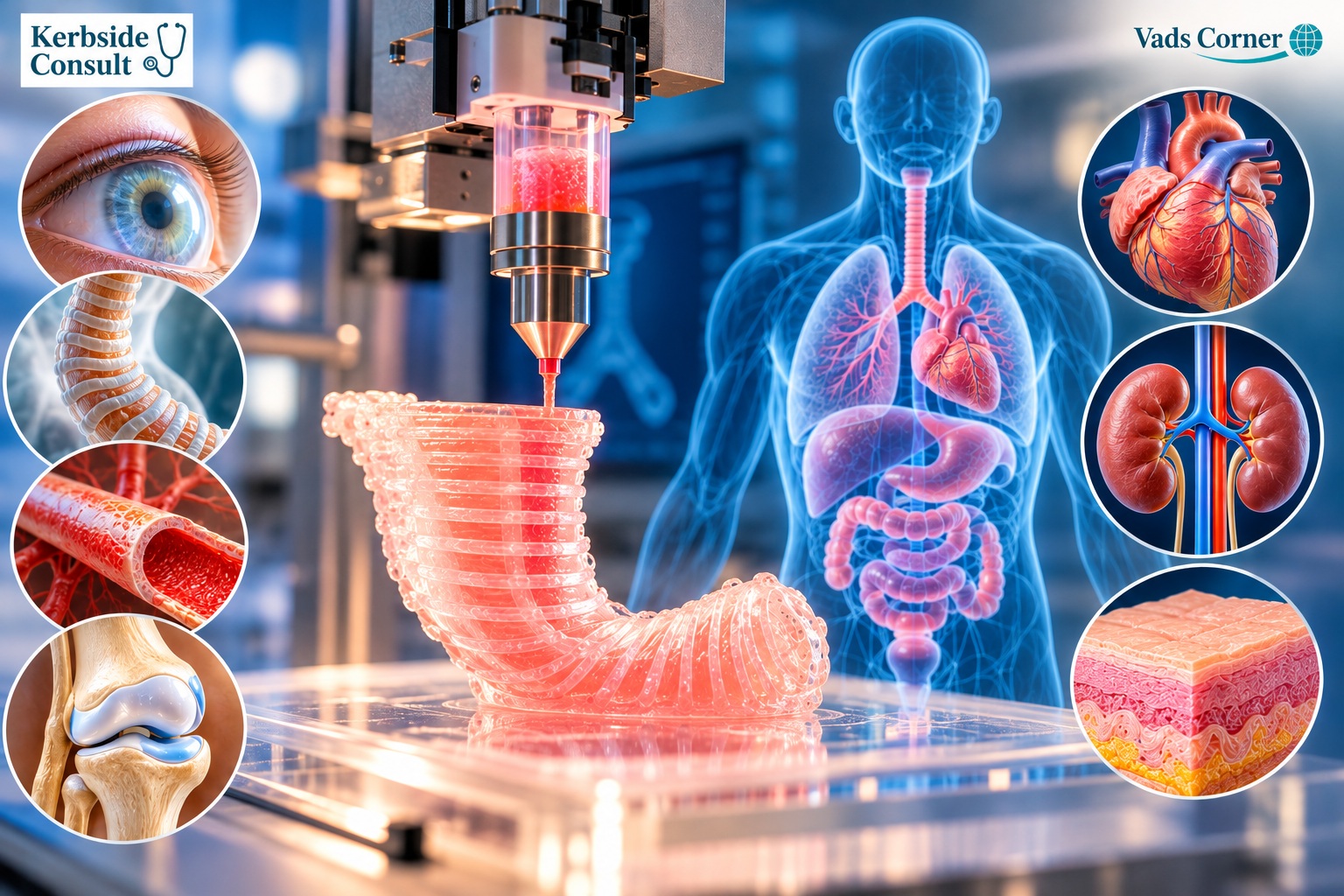
In August 2023, a woman in her fifties underwent an unusual operation in South Korea. Following damage to her windpipe during treatment for thyroid cancer, surgeons implanted a customised tracheal structure made using 3D bioprinting technology. It combined a biodegradable framework with donor-derived cells. At six months, the team reported encouraging healing and blood vessel formation. These details come from the hospital’s announcement as reported in the press in March 2024; I could not find a peer-reviewed paper.[1]
Could a replacement body part be manufactured rather than donated? The question is compelling, but the longer-term outcome of this particular implant has not been established in the publicly available clinical literature reviewed for this article. That is not evidence of failure; it is a reminder that early technical success and durable clinical benefit are different things.
We can already manufacture structures that resemble parts of the human body. Making them function safely inside a living person for years is a much greater challenge.
Contents
- Printing, Engineering and Growing — What Is the Difference?
- Sometimes, a Little Support Is Enough
- When Engineered Tissues Really Work
- A New Window on the World — Rebuilding the Cornea
- Can We Grow a Replacement Windpipe?
- Why Printing a Whole Organ Is So Difficult
- When Innovation Moves Faster Than Evidence
- The Kerbside View
- Sources & further reading
Printing, Engineering and Growing — What Is the Difference?
Medicine has long replaced damaged body parts. Artificial hips, heart valves and pacemakers save lives, but they are not living tissues that grow and repair themselves.
Three approaches are often confused. Conventional 3D printing produces customised implants, models and supporting devices, generally without living cells. Tissue engineering combines cells and supporting materials to repair or replace tissue; in some products the cells are removed before implantation. Three-dimensional bioprinting uses printers to arrange living cells and biological materials in deliberate patterns.
The approaches overlap, but they are not interchangeable. A printed splint may support a weakened airway. An engineered vessel may replace an injured artery. A bioprinter may attempt to manufacture living tissue.
A printer can reproduce the shape of an organ. Reproducing its biological functions is another matter.
Sometimes, a Little Support Is Enough
In Australia, surgeons reported treating a 21-month-old boy with severe tracheobronchomalacia: his windpipe and major airway could collapse during breathing. Two customised biodegradable splints were placed around the outside of the weakened airway. He was extubated five days later and subsequently discharged, with reported clinical improvement.[2]
This was an Australian first, but not the world's first such operation. American surgeons described an early case in 2013 and later reported experience with 29 splints in 15 children. Outcomes were encouraging in several patients, although these were highly selected, critically ill children. Three of the 15 children died, one possibly related to the device.[3], [4]
The surgeons had not grown a new windpipe. They supported the child's existing airway. Sometimes that is precisely what the patient needs.
But what happens when the damaged tissue itself must be replaced?
When Engineered Tissues Really Work
Blood vessels. Replacing a damaged blood vessel is not new. For decades, vascular surgeons have used synthetic Dacron (polyester) grafts to replace diseased sections of the aorta, including during aneurysm repair. These grafts replace the vessel mechanically; they are not living tissue.
In December 2024, the US Food and Drug Administration approved Symvess, an acellular tissue-engineered vascular conduit for adults with severe extremity arterial injuries when urgent revascularisation is needed and a suitable vein graft is unavailable.[5] Human cells are used during manufacturing to produce the supporting tissue; the cells are then removed. It is a regulatory milestone, but graft rupture, thrombosis and other complications remain important risks. Symvess is neither a living printed artery nor a general substitute for conventional vascular surgery.
Cartilage. In Europe, Spherox uses a patient's own cartilage cells, grown into small spheroids, to treat selected cartilage defects in the knee. It received European marketing authorisation in 2017.[6] It repairs tissue; it does not manufacture a new joint.
Skin in Malaysia. Universiti Kebangsaan Malaysia developed MyDerm, a tissue-engineered skin substitute investigated for burns and wounds. UKM reports completion of early Phase I/IIa clinical development in 2016.[7] This is a Malaysian contribution, not evidence of routine commercial availability. Malaysia's regulatory guidance for cell and gene therapy products provides a framework for evaluating relevant products.[8]
For now, repairing a defined tissue may be more achievable than recreating an entire organ.
A New Window on the World — Rebuilding the Cornea
The cornea is the transparent window at the front of the eye. Damage to its surface or supporting tissue can severely impair vision, and donor corneas are not always available.
India has helped pioneer limbal stem-cell approaches to repairing the corneal surface. In simple limbal epithelial transplantation, small pieces of healthy limbal tissue are placed onto the injured eye to help restore its surface. In a study of 47 patients, all with limbal stem-cell deficiency in one eye after a chemical burn and treated with their own tissue (autologous transplantation), 32 (68%) had a successful corneal epithelial outcome five to twelve years after surgery. This was a single long-term assessment, not continuous monitoring, and the result should not be extended to donor-tissue transplants or to immune-mediated conditions such as Stevens-Johnson syndrome.[9]
A different approach was tested in India and Iran. Researchers inserted transparent implants made from purified pig-derived collagen into the existing corneas of 20 patients with advanced keratoconus. All completed two-year follow-up; the study reported substantial improvements in corneal thickness and vision, including restoration of useful vision among participants classified as blind before surgery.[10] This was a small, uncontrolled feasibility study. The implant reinforced the existing cornea; it did not replace it.
In Japan, researchers transplanted corneal epithelial sheets derived from induced pluripotent stem cells into four patients with severe limbal stem-cell deficiency. The early findings were promising, but the treatment remains investigational.[11] Europe has approved Holoclar, a cultivated limbal stem-cell therapy for selected patients with corneal surface damage.[12]
Restoring the right cells, or strengthening existing tissue, may be more useful than replacing the whole structure.
Can We Grow a Replacement Windpipe?
The Korean patient’s six-month results were reported as encouraging, but peer-reviewed and long-term outcomes remain unpublished, as far as I could find.[1] Other teams have tried different approaches to airway reconstruction.
In a Chinese series published in 2026, seven patients underwent tissue-engineered reconstruction of tracheal or bronchial defects using biological material, mechanical support and techniques intended to encourage tissue regeneration in the body.[13] Two patients died after severe vascular complications; three later died after cancer recurrence; two were alive at the reported final follow-up. In some patients, an airway lining regenerated, but normal supporting cartilage did not. This was not proof of a complete, self-supporting regenerated windpipe.
The comparison matters. The Australian and American splints supported an existing airway. The Korean procedure attempted implantation of a bioprinted structure containing cells. The Chinese work explored tissue reconstruction within the patient. Each is a different technology with a different level of evidence.
Successful implantation is an achievement. Durable replacement of a functioning organ is a much higher standard.
Why Printing a Whole Organ Is So Difficult
Consider the kidney. Each contains roughly a million microscopic filtering units that must connect to blood vessels and drainage pathways. The organ must filter waste, regulate electrolytes and fluid balance, and participate in blood-pressure control. Printing its outline does none of these things.
Thick living tissues need a reliable blood supply. Multiple cell types must communicate correctly, integrate with surrounding tissues and remain functional over years. Manufacturing must be consistent, contamination controlled and failures anticipated.
In the United Kingdom, researchers reported engineered oesophageal tissue that restored important functions in an animal study in 2026. It was a promising preclinical achievement, not a proven human treatment.[14] Japan has also advanced therapies using induced pluripotent stem cells, including cardiac applications. We explored the heart-specific challenges in an earlier Kerbside Consult article, Can We Repair a Broken Heart?[15]
The remaining questions are not solely scientific. Who will manufacture these tissues? How will regulators assess them? Who will monitor recipients for years? And will patients in Malaysia be able to afford them?
The challenge is biological function, not appearance.
When Innovation Moves Faster Than Evidence
The history of synthetic tracheal transplantation offers a warning. Paolo Macchiarini's operations were initially hailed as breakthroughs. Three patients who underwent synthetic tracheal transplantation at Karolinska University Hospital later died. Investigations exposed grave shortcomings in clinical practice and oversight; a Swedish appellate court convicted Macchiarini of aggravated assault in 2023.[16]
Patients with life-threatening disease may accept uncertainty when established treatments have failed. That does not remove the duty to provide a sound scientific rationale, meaningful consent, independent scrutiny and transparent long-term follow-up.
The lesson is not to stop innovating. It is to avoid confusing a dramatic operation with a demonstrated treatment.
A technically successful operation is not necessarily a successful treatment.
Selected references: 16.
The Kerbside View
The South Korean tracheal implant captures the promise of regenerative medicine. Its early results, however, cannot replace long-term evidence.
For defined indications, engineered vascular conduits, cartilage treatments and corneal stem-cell therapies are already in clinical use. Printed splints can support weakened airways. Malaysia, too, has contributed to tissue-engineering research.
None of this means that a fully functional human kidney, liver or heart can be bioprinted for routine transplantation today.
The science deserves excitement. Patients deserve evidence.
We may already be able to print something that looks like an organ. The greater achievement will be making it work like one.
Sources & further reading
Airway: bioprinted implant and printed splints
- Bae JS (sponsor). Patient-customized bioprinting technology for practical regeneration of the respiratory tract (trachea) [Internet]. ClinicalTrials.gov identifier NCT06051747. Seoul St. Mary's Hospital; last update posted 2023 Sep 25 [cited 2026 Oct 31]. Source Press reports of the case: Kim Y. Catholic Medical Center succeeds in transplanting allogeneic adult stem cell-based 3D-printed trachea. Korea Biomedical Review [Internet]. 2024 Mar 7 [cited 2026 Oct 31]; Leach N. Woman given a new 3D-printed windpipe in a world-first. BBC Science Focus [Internet]. 2024 Mar 7 [cited 2026 Oct 31]; 3Dnatives. World’s first 3D printed trachea transplanted in South Korea [Internet]. 2024 Mar 20 [cited 2026 Oct 31].
- Ha JF, Ohye R, Green GE, Nicholson I, Skowno J, Murfin D, et al. Management of severe tracheobronchomalacia with 3D printed resorbable airway splints: an Australian first. Int J Pediatr Otorhinolaryngol. 2025;198:112564. doi:10.1016/j.ijporl.2025.112564. Source
- Zopf DA, Hollister SJ, Nelson ME, Ohye RG, Green GE. Bioresorbable airway splint created with a three-dimensional printer [letter]. N Engl J Med. 2013;368(21):2043-5. doi:10.1056/NEJMc1206319. Source
- Les AS, Ohye RG, Filbrun AG, Ghadimi Mahani M, Flanagan CL, Daniels RC, et al. 3D-printed, externally-implanted, bioresorbable airway splints for severe tracheobronchomalacia. Laryngoscope. 2019;129(8):1763-71. doi:10.1002/lary.27863. Source
Engineered vessels, cartilage and skin (including Malaysia)
- US Food and Drug Administration, Center for Biologics Evaluation and Research. SYMVESS (acellular tissue engineered vessel-tyod), STN 125812 [Internet]. Silver Spring (MD): FDA; approved 2024 Dec 19; content current as of 2025 Feb 25 [cited 2026 Oct 31]. Source
- European Medicines Agency. Spherox (spheroids of human autologous matrix-associated chondrocytes): European public assessment report, EMEA/H/C/002736 [Internet]. Amsterdam: EMA; marketing authorisation issued 2017 Jul 10; page updated 2025 Mar 3 [cited 2026 Oct 31]. Source
- Universiti Kebangsaan Malaysia, Department of Tissue Engineering and Regenerative Medicine. Our success story [Internet]. Kuala Lumpur: UKM [cited 2026 Oct 31]. Source
- National Pharmaceutical Regulatory Agency (NPRA), Ministry of Health Malaysia. Guidance document and guidelines for registration of cell and gene therapy products (CGTPs) in Malaysia. 2nd ed. [Internet]. NPRA; 2025 Sep [cited 2026 Oct 31]. Source
Cornea
- Shanbhag SS, Kate A, Ganguly S, Jakati S, Deshmukh R, Basu S. Five- to twelve-year outcomes of autologous simple limbal epithelial transplantation: long-term corneal epithelial imaging and phenotypic analysis. Am J Ophthalmol. 2025;273:107-18. doi:10.1016/j.ajo.2025.02.003. Source
- Rafat M, Jabbarvand M, Sharma N, Xeroudaki M, Tabe S, Omrani R, et al. Bioengineered corneal tissue for minimally invasive vision restoration in advanced keratoconus in two clinical cohorts. Nat Biotechnol. 2023;41(1):70-81. doi:10.1038/s41587-022-01408-w. Source
- Soma T, Oie Y, Takayanagi H, Matsubara S, Yamada T, Nomura M, et al. Induced pluripotent stem-cell-derived corneal epithelium for transplant surgery: a single-arm, open-label, first-in-human interventional study in Japan. Lancet. 2024;404(10466):1929-39. doi:10.1016/S0140-6736(24)01764-1. Source
- European Medicines Agency. Holoclar (ex vivo expanded autologous human corneal epithelial cells containing stem cells): European public assessment report, EMEA/H/C/002450 [Internet]. Amsterdam: EMA; marketing authorisation issued 2015 Feb 17; page updated 2025 Jul 8 [cited 2026 Oct 31]. Source
Tissue-engineered airway, oesophagus and cautionary history
- Wang Z, Xu Y, Huang J, Wang N, Mao F, Wang Z, et al. Feasibility of tissue-engineered tracheal and bronchial reconstruction using an in vivo bioreactor technique. JTCVS Tech. 2026;38:102391. doi:10.1016/j.xjtc.2026.102391. Source
- Durkin N, Hall GT, Lutman R, Scuglia M, Xenakis T, Patera G, et al. Functional integration of an autologous engineered oesophagus in a large-animal model. Nat Biotechnol. 2026 Mar 20. doi:10.1038/s41587-026-03043-1. Source See also the press release: UCL News. Engineered tissue offers hope for babies born with missing food pipe section [Internet]. London: University College London; 2026 Mar 20 [cited 2026 Oct 31].
- Vadivale M. Can we repair a broken heart? Kerbside Consult, article 58/2026 [Internet]. Kuala Lumpur; 2026 Oct 21 [cited 2026 Oct 31]. Source
- The Local Sweden. Sweden jails disgraced Italian star surgeon Paolo Macchiarini [Internet]. 2023 Jun 21 [cited 2026 Oct 31]. Source