On 29 September 2026, surgeons in Japan transplanted an iPS-cell-derived cardiomyocyte sheet in a patient with severe heart failure — the first such procedure after the treatment entered Japan's national health-insurance system.[14]
I found this announcement fascinating. Could we really be approaching the day when damaged heart muscle can be repaired rather than simply managed? Curious to learn more, I began looking into the Japanese development and related research around the world.
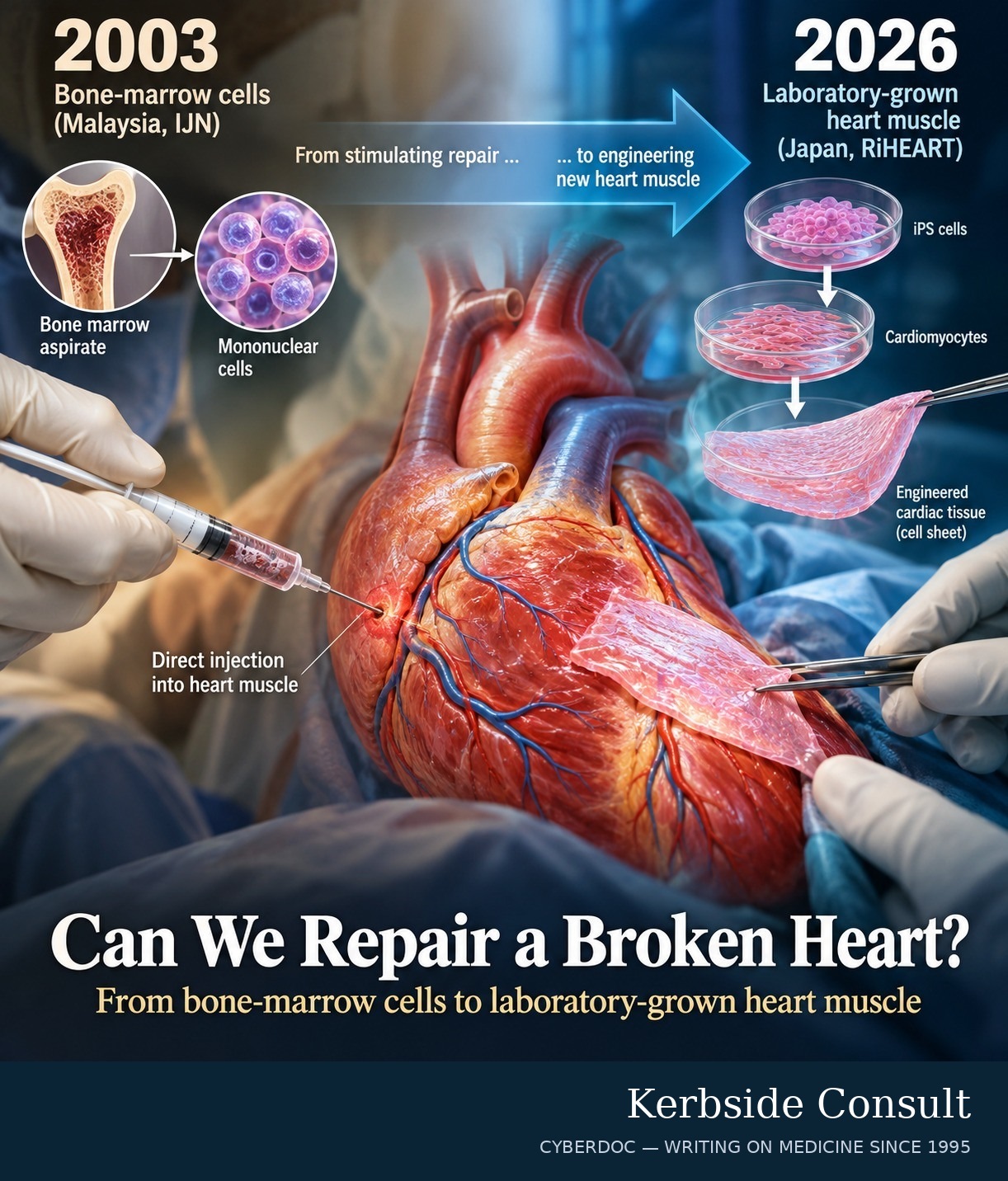
What emerged was a story spanning more than 25 years — from early bone-marrow cell experiments, including work at Malaysia’s National Heart Institute (IJN), to attempts to grow and transplant heart muscle. But can these advances produce lasting benefits for patients with heart failure? That is what this article explores.
Contents
- The heart heals with a scar
- The first idea: put regenerative cells into the heart
- Malaysia was there too
- Twenty-five years in a glance
- The early promise meets reality
- Perhaps we were using the wrong cell
- Japan had another idea: don't inject the cells
- RiHEART: when an experiment becomes a product
- Japan is not alone
- Three generations of cardiac regeneration
- Does the new tissue really become heart?
- Where would this fit in heart-failure treatment?
- A word of caution about “stem-cell treatment”
- Malaysia: what happened after 2003?
- The heart we could not replace
- Sources & further reading
The heart heals with a scar
When a coronary artery is suddenly blocked, cardiomyocytes deprived of oxygen begin to die. Reopening the artery quickly can save threatened myocardium, but muscle already lost is largely replaced by scar tissue.
The adult human heart has only limited capacity to regenerate substantial amounts of myocardium.
Modern cardiology has become remarkably good at protecting what remains. We reopen arteries with angioplasty or bypass surgery. ACE inhibitors or ARNI, beta-blockers, mineralocorticoid antagonists and SGLT2 inhibitors reduce heart-failure morbidity and mortality. ICDs and cardiac resynchronisation therapy help selected patients. At the extreme, mechanical circulatory support and transplantation can replace some or all of the failing heart's function.
Protecting surviving myocardium is not the same as replacing myocardium that has already died.
That is the problem regenerative cardiology has been trying to solve.
The first idea: put regenerative cells into the heart
In the late 1990s and early 2000s, experimental studies generated considerable excitement about stem and progenitor cells. Perhaps cells obtained from bone marrow could stimulate angiogenesis or improve the biological environment surrounding injured myocardium. The more ambitious hope was that some might even contribute to new cardiac tissue.
Japan moved particularly early into human studies. At Yamaguchi University, Kimikazu Hamano and colleagues began a clinical trial in 1999. Five patients undergoing coronary bypass surgery received autologous bone-marrow cells implanted into myocardial regions that could not be bypassed. Three subsequently demonstrated improved perfusion on cardiac scintigraphy. The investigators appropriately described their findings as preliminary and framed the approach primarily as therapeutic angiogenesis.[1]
Other countries quickly entered the field. In France, Philippe Menasché and colleagues reported skeletal-myoblast transplantation in 2001, in a single patient with severe ischaemic heart failure, during bypass surgery.[2] Germany became another important centre, with early intracoronary bone-marrow and circulating progenitor-cell studies, including the nonrandomised TOPCARE-AMI.[3]
A new field had emerged. And Malaysia was there remarkably early.
Malaysia was there too
In 2003, doctors at Institut Jantung Negara (IJN) began exploring autologous bone-marrow-cell therapy in patients with severe ischaemic heart disease.[8], [9]
The work was subsequently published in 2006 by Isham Jaafar, Reiji Hattori, Azhari Yakub, Jeswant Dillon, Hassan Ariff and colleagues as Transplant of autologous bone marrow stem cells in ischemic heart disease.[8]
Four symptomatic patients whose ischaemic disease was not amenable to conventional revascularisation were treated. Bone marrow was harvested from the patients themselves and processed; the resulting cells were delivered through multiple direct intramyocardial injections into areas of ischaemic myocardium.
An important feature was that this was being investigated as cell therapy itself, rather than simply adding cells to a simultaneous coronary revascularisation procedure. The authors described changes in symptoms, myocardial perfusion and ventricular function.
But there were only four patients and no randomised control group. The study demonstrated feasibility and generated a hypothesis; a series of this size could not show that the treatment works, let alone that the cells reduced hospitalisation, prevented heart failure or prolonged life.
More than twenty years ago, Malaysia was already participating in the international experiment of human cardiac regeneration.
Twenty-five years in a glance
| Year | Milestone |
|---|---|
| 1999 | Japan: Yamaguchi University begins a human trial of autologous bone-marrow-cell implantation. [1] |
| 2001 | France: skeletal-myoblast transplantation is reported in severe ischaemic heart failure. [2] |
| 2001–02 | Germany: early intracoronary bone-marrow/progenitor-cell programmes emerge, including TOPCARE-AMI. [3] |
| 2003 | Malaysia: IJN uses autologous bone-marrow cells as direct intramyocardial therapy in severe ischaemic heart disease. [8] |
| 2004 onward | Randomised trials test whether early functional signals translate into reproducible clinical benefit. [4], [5], [6] |
| 2006 | Japan: cell-sheet technology advances clinically using skeletal myoblasts. [12] (Osaka University retrospective) |
| 2008 onward | Japan: Osaka programme develops iPS-derived cardiomyocytes for cardiac repair. [12] |
| 2010s | Bone-marrow-cell evidence accumulates; a 2024 Cochrane review finds no significant effect on mortality and only a small gain in ejection fraction. Attention shifts toward cardiac-specific cells and engineered tissue. [7] |
| 2020 | Japan: first human transplantation in Osaka's iPS-derived cardiomyocyte-sheet clinical programme. [12] |
| 2025–26 | Germany: iPS-derived engineered heart muscle moves into human clinical investigation. [17], [18] |
| March 2026 | Japan: RiHEART receives conditional and time-limited approval. [13] |
| September 2026 | Japan: RiHEART enters clinical use following approval and insurance coverage. [14], [15] |
The early promise meets reality
Early studies justified larger trials. BOOST reported an initial improvement in left-ventricular function after bone-marrow-cell transfer.[4] REPAIR-AMI, a placebo-controlled trial of 204 patients, found a modest improvement in ejection fraction at four months (a gain of 5.5 versus 3.0 percentage points with placebo; P=0.01).[5]
But later studies were inconsistent. The ambitious BAMI programme attempted to answer a more important question: could bone-marrow-cell therapy reduce mortality after myocardial infarction? Recruitment and event rates were lower than anticipated, leaving the trial unable to provide the definitive mortality answer it had been designed to deliver. Of 375 patients randomised, 6 in the cell group and 7 in the control group had died by two years; the authors state that the numbers preclude any meaningful group comparison.[6]
A 2024 Cochrane review of stem-cell therapy after myocardial infarction found no significant effect on all-cause mortality (high-certainty evidence) and a small improvement in long-term MRI-measured ejection fraction of 1.85 percentage points (95% CI 0.13 to 3.56).[7]
As evidence accumulated, the original biological story itself became less convincing. Bone-marrow cells did not simply settle inside damaged myocardium and reliably transform into large quantities of functioning heart muscle. Experimental work suggested that many transplanted cells did not persist. Other experiments suggested that potential effects might instead result from signalling molecules, angiogenesis, modulation of inflammation and other paracrine effects.
Putting stem cells into a heart is not the same as growing new heart muscle.
Perhaps we were using the wrong cell
A myocardial infarction destroys cardiomyocytes. If the ultimate objective is to replace lost myocardium, the logical replacement is therefore a cardiomyocyte.
The challenge was obtaining enough suitable human cardiomyocytes. Induced pluripotent stem (iPS) cells changed what was conceivable.
In simple terms: Scientists can take an ordinary adult cell, such as a skin or blood cell, and reprogramme it into a versatile, stem-cell-like state—as though turning back its biological clock. This is an induced pluripotent stem (iPS) cell. Under carefully controlled laboratory conditions, iPS cells can then be guided to develop into heart muscle cells, called cardiomyocytes. Researchers can assemble these into cell sheets or engineered tissue. The hope is to replace damaged heart muscle, although lasting clinical benefit and safe integration with the patient’s heart have yet to be established.
adult cell → iPS cell → cardiomyocyte → millions of cardiomyocytes → engineered cardiac tissue
This is fundamentally different from taking bone-marrow cells and hoping they will somehow repair myocardium. Scientists can now attempt to manufacture the cell the heart actually lost.
Japan had another idea: don't inject the cells
Yoshiki Sawa's Osaka group had been developing another important technology: cell sheets. Injecting individual cells through a needle has disadvantages; many fail to remain where they are placed and many do not survive. A cultured sheet can instead be placed directly over damaged myocardium.
The Osaka programme initially explored this using skeletal myoblasts. From around 2008, the programme developed large numbers of cardiomyocytes from human iPS cells and tested cardiomyocyte sheets preclinically.
In January 2020, Professor Yoshiki Sawa and colleagues at Osaka University performed the first human transplantation of an iPS-cell-derived cardiomyocyte sheet in a patient with severe ischaemic cardiomyopathy. It formed part of an investigator-initiated clinical trial supported by AMED. By December 2020, three patients had received the treatment. The trial was designed to assess safety and potential efficacy, not to establish definitive clinical benefit.
This is an important historical point: the September 2026 operation was not the world's first transplantation of an iPS-derived cardiomyocyte sheet. Its importance lies elsewhere.
Selected references: 12.
RiHEART: when an experiment becomes a product
On 6 March 2026, Japan granted RiHEART conditional and time-limited marketing approval. AMED describes it as an iPS-cell-derived cardiomyocyte transplantation therapy for ischaemic cardiomyopathy and described the 2026 approvals as the world's first practical application of iPS-cell-based therapeutic products.
These are not undifferentiated stem cells injected into a patient's heart. They have already been deliberately differentiated into cardiomyocytes and manufactured into sheets.
The proposed benefit may involve paracrine signalling—a form of communication in which transplanted cells release chemical messengers that influence nearby cells. In everyday terms, the cells may help create better conditions for healing rather than directly replace lost heart muscle. Possible effects include encouraging blood-vessel growth and modifying inflammation; these mechanisms do not, by themselves, prove that the treatment improves patient outcomes.
RiHEART became eligible for Japanese national health-insurance coverage on 1 September 2026. On 29 September 2026, the first transplantation following that coverage was performed at Osaka Keisatsu Hospital. Regenerative cardiology had crossed an important boundary:
laboratory science → clinical trial → manufactured product → regulated clinical use
But conditional approval is not the same as definitive proof of clinical benefit. Under Japan's conditional and time-limited pathway, safety must be confirmed and efficacy reasonably predicted from clinical-trial results, with efficacy and safety further evaluated after marketing. Whether RiHEART reduces heart-failure hospitalisation, improves durable quality of life or prolongs survival remains to be established.
Japan is not alone
France moved from skeletal myoblasts toward cardiac progenitor cells derived from embryonic stem cells, reporting a first clinical case in 2015.[16] Germany has taken another route: engineered heart muscle composed of cardiomyocytes and stromal cells derived from allogeneic iPS cells.
In 2026, investigators reported interim results from the BioVAT-HF phase 1–2 programme in the New England Journal of Medicine. Twenty patients with advanced heart failure were treated. Of 16 recipients of the highest dose, 12 completed the prespecified three-month interim assessment. The estimated increase in target-wall thickness was 4.5 mm (90% CI 3.7–5.4); LVEF increased by 3.9 percentage points (90% CI 0.9–6.8; P=0.04); and the Kansas City Cardiomyopathy Questionnaire overall summary score increased by 6.7 points (90% CI 1.0–12.5; P=0.06). All patients experienced at least one adverse event. Three patients died (one each from vasoplegia, COVID-19 and aortic dissection), one underwent heart transplantation, and immunosuppression was discontinued in four patients. The open-label, uncontrolled design, small sample and short interim follow-up mean that durable clinical benefit and genuine functional remuscularisation remain unproven.[18]
The findings are intriguing, not definitive; neither improved survival nor fewer heart-failure admissions has been established. Longer follow-up is required, and correspondence published in the same journal, with a reply from the authors, has since discussed how the findings should be interpreted.[19]
That discussion is important. It illustrates how much remains to be learned even when engineered cardiac tissue can be implanted successfully.
Three generations of cardiac regeneration
Generation 1 — Stimulate repair
Bone-marrow and other progenitor cells were placed into damaged myocardium. The hoped-for benefits included angiogenesis, paracrine signalling and myocardial recovery. IJN's 2003 work belongs principally here.
Generation 2 — Move closer to cardiac cells
Skeletal myoblasts and cardiovascular progenitors were investigated while researchers developed better delivery systems, including scaffolds, patches and cell sheets.
Generation 3 — Manufacture myocardium
Pluripotent stem cells can be deliberately differentiated into cardiomyocytes and organised into sheets or engineered tissue.
We are moving from cell therapy toward tissue engineering.
Does the new tissue really become heart?
The distinction is between supporting repair through cellular signals and true remuscularisation: transplanted cardiomyocytes surviving, developing a blood supply and contributing functioning contractile tissue.
That is also where the major challenges lie. The cells must survive, acquire a blood supply, withstand mechanical forces and ideally integrate electrically without producing dangerous arrhythmias.[17] Allogeneic cells may trigger immune rejection and require immunosuppression;[18] residual pluripotent cells raise concerns about unwanted tissue formation;[17] and manufacturing large numbers of consistent, viable cardiomyocytes is itself a major pharmaceutical challenge.
A new cardiomyocyte does not merely need to beat. It needs to beat with the heart.
Durability and cost remain unanswered questions. A therapy can be scientifically extraordinary and still have little public-health impact if its benefits do not persist or health systems cannot afford it.
Where would this fit in heart-failure treatment?
For now, regenerative therapy belongs near the experimental end of the pathway. Patients still require contemporary guideline-directed heart-failure therapy. Revascularisation remains important when appropriate. ICDs, CRT and other devices retain established roles. Patients with advanced disease may require mechanical circulatory support or transplantation.
Where would engineered myocardium eventually fit? Perhaps before LVAD or transplantation. Perhaps in selected patients before severe remodelling occurs. Perhaps somewhere we have not yet considered.
A word of caution about “stem-cell treatment”
Legitimate regenerative medicine should not inadvertently lend credibility to inadequately proven commercial “stem-cell treatments”. RiHEART did not emerge because someone obtained some stem cells and injected them into a patient. It followed years of cell biology, differentiation research, manufacturing development, animal experiments, human trials and regulatory assessment.
The term stem cell alone tells us almost nothing about whether a treatment works. We need to ask: Which cell? How was it produced? What is it supposed to become? Where is it delivered? What clinical evidence supports it? And, most importantly, does it help patients live longer or live better?
Malaysia: what happened after 2003?
The IJN experiment raises an interesting question. Malaysia was involved in human cardiac cell therapy remarkably early. What happened next?
I have not found a published clinical follow-up to the 2006 report. IJN clinicians did later take part in laboratory research on cardiac-resident mesenchymal stem cells,[11] and Malaysia now has a formal regulatory framework for cell and gene therapy products through the National Pharmaceutical Regulatory Agency.[10]
The next step need not be to manufacture a cardiac graft immediately. Malaysia could build on its clinical-trial experience through carefully selected multicentre studies, long-term patient registries, partnerships in cell manufacturing and quality control, and regulatory expertise in cell and gene therapy products. The test would be whether these investments generate reliable evidence and, ultimately, measurable patient benefit.
It is not simply: “When will regenerative cardiology come to Malaysia?” In one form, it was already here more than twenty years ago.
The heart we could not replace
For generations, doctors could reopen blocked arteries and support a failing heart, but could not replace the muscle already lost.
Today, scientists can manufacture cardiomyocytes from pluripotent stem cells and organise them into sheets or engineered tissue. Japan has taken one such product into conditionally approved clinical use; Germany is testing another form of engineered heart muscle.
Neither proves that we can reliably rebuild a failing human heart. Patient numbers remain small and the outcomes that matter most — durable function, fewer hospitalisations, better quality of life and longer survival — still need to be established.
But something fundamental has changed.
Twenty-five years ago we were asking whether stem cells might encourage a damaged heart to repair itself. Today we are asking whether we can manufacture the myocardium that the patient has lost.
That is not yet a regenerated heart.
But neither is it science fiction anymore.
Malaysia was there during the early days of this journey.
Will we be there for the next generation?
Sources & further reading
Early clinical cardiac cell therapy
- Hamano K, Nishida M, Hirata K, Mikamo A, Li TS, Harada M, et al. Local implantation of autologous bone marrow cells for therapeutic angiogenesis in patients with ischemic heart disease: clinical trial and preliminary results. Jpn Circ J. 2001;65(9):845-7. doi:10.1253/jcj.65.845. Source
- Menasché P, Hagège AA, Scorsin M, Pouzet B, Desnos M, Duboc D, et al. Myoblast transplantation for heart failure [letter]. Lancet. 2001;357(9252):279-80. doi:10.1016/S0140-6736(00)03617-5. Source
- Assmus B, Schächinger V, Teupe C, Britten M, Lehmann R, Döbert N, et al. Transplantation of progenitor cells and regeneration enhancement in acute myocardial infarction (TOPCARE-AMI). Circulation. 2002;106(24):3009-17. doi:10.1161/01.cir.0000043246.74879.cd. Source
- Wollert KC, Meyer GP, Lotz J, Ringes-Lichtenberg S, Lippolt P, Breidenbach C, et al. Intracoronary autologous bone-marrow cell transfer after myocardial infarction: the BOOST randomised controlled clinical trial. Lancet. 2004;364(9429):141-8. doi:10.1016/S0140-6736(04)16626-9. Source
- Schächinger V, Erbs S, Elsässer A, Haberbosch W, Hambrecht R, Hölschermann H, et al. Intracoronary bone marrow-derived progenitor cells in acute myocardial infarction. N Engl J Med. 2006;355(12):1210-21. doi:10.1056/NEJMoa060186. Source
- Mathur A, Fernández-Avilés F, Bartunek J, Belmans A, Crea F, Dowlut S, et al. The effect of intracoronary infusion of bone marrow-derived mononuclear cells on all-cause mortality in acute myocardial infarction: the BAMI trial. Eur Heart J. 2020;41(38):3702-10. doi:10.1093/eurheartj/ehaa651. Source
- Zwetsloot PP, van der Naald M, Jones D, Reid A, Chamuleau S, Mathur A. Stem cell treatment for acute myocardial infarction. Cochrane Database Syst Rev. 2024;(8):CD006536. doi:10.1002/14651858.CD006536.pub5. Source
Malaysia
- Jaafar I, Hattori R, Yakub A, Dillon J, Ariff H, Ali R, et al. Transplant of autologous bone marrow stem cells in ischemic heart disease. Brunei Darussalam J Health. 2006;1:22-9. Source
- Hattori R, Matsubara H. Therapeutic angiogenesis for severe ischemic heart diseases by autologous bone marrow cells transplantation. Mol Cell Biochem. 2004;264(1-2):151-5. doi:10.1023/b:mcbi.0000044384.39422.e0. Source
- National Pharmaceutical Regulatory Agency (NPRA), Ministry of Health Malaysia. Guidance document and guidelines for registration of cell and gene therapy products (CGTPs) in Malaysia. 2nd ed. [Internet]. NPRA; 2025 Sep [cited 2026 Oct 20]. Source
- Subramani B, Subbannagounder S, Palanivel S, Ramanathanpullai C, Sivalingam S, Yakub A, et al. Generation and characterization of human cardiac resident and non-resident mesenchymal stem cell. Cytotechnology. 2016;68(5):2061-73. doi:10.1007/s10616-016-9946-5. Source
iPS cardiomyocytes and engineered myocardium
- Japan Agency for Medical Research and Development (AMED). Investigator-initiated clinical trial of cardiomyocyte sheets generated from iPS cells - treatment of severe cardiomyopathy [Internet]. Tokyo: AMED; 2020 Jan 27 [cited 2026 Oct 20]. Source
See also: Osaka University Graduate School of Medicine. Clinical trial on cardiomyocyte sheets made from iPS cells to treat heart failure [Internet]. Osaka University; undated [cited 2026 Oct 20]. Osaka University Graduate School of Medicine. Clinical trial on cardiomyocyte sheets made from iPS cells to treat heart failure - latest status of clinical trials [Internet]. Osaka University; status as of 2020 Dec [cited 2026 Oct 20]. Osaka University Graduate School of Medicine. iPS cell-based therapy for heart disease: clinical application of iPS cell-derived cardiomyocytes [Internet]. Osaka University; undated [cited 2026 Oct 20]. - Japan Agency for Medical Research and Development (AMED). Japan's R&D and application practices toward the realization of induced pluripotent stem cell (iPS cell) therapy [Internet]. Tokyo: AMED; [updated 2026 Mar 23; cited 2026 Oct 20]. Source
- Osaka Keisatsu Hospital. Successful transplantation of iPS cell-derived cardiomyocyte patches for severe heart failure [Internet] (in Japanese). Osaka Keisatsu Hospital; 2026 Sep 29 [cited 2026 Oct 20]. Source
- Cuorips Inc. Notice regarding the first transplantation of regenerative medicine product "RiHEART®" [Internet]. Cuorips Inc.; 2026 Oct 1 [cited 2026 Oct 20]. Source
- Menasché P, Vanneaux V, Hagège A, Bel A, Cholley B, Cacciapuoti I, et al. Human embryonic stem cell-derived cardiac progenitors for severe heart failure treatment: first clinical case report. Eur Heart J. 2015;36(30):2011-7. doi:10.1093/eurheartj/ehv189. Source
- Jebran AF, Seidler T, Tiburcy M, Daskalaki M, Kutschka I, Fujita B, et al. Engineered heart muscle allografts for heart repair in primates and humans. Nature. 2025;639(8054):503-11. doi:10.1038/s41586-024-08463-0. Source
- Zimmermann WH, Ensminger S, Kutschka I, Paitazoglou C, Seidler T, Brandenburg S, et al. Stem-cell-derived biologic ventricular assist tissue in heart failure. N Engl J Med. 2026;394(20):1991-2001. doi:10.1056/NEJMoa2513525. Source
- Lal S. Biologic ventricular assist tissue in heart failure [letter]. N Engl J Med. 2026;395(8):827; Emmert MY, Schoenrath F, Falk V. Biologic ventricular assist tissue in heart failure [letter]. N Engl J Med. 2026;395(8):827-8; Zimmermann WH, Ensminger S, Kutschka I. Biologic ventricular assist tissue in heart failure [reply]. N Engl J Med. 2026;395(8):828-9. doi:10.1056/NEJMc2608577. Source