1. Before Googling Became a Verb
Before we could search for medical information, we had to get online. That was already a task: obtaining an Internet account, setting up a modem, configuring the software and connecting through a telephone line. Having a computer did not mean you were connected.
My first Cybermed column, Internet for Doctors — Getting Started, began with those practical steps. It discussed computers, modems, telephone lines, service providers and browsers. I suggested a Pentium processor, at least 16 MB of RAM and more than a gigabyte of hard disk space. JARING and TMnet were among the routes online. [4]
Today, those specifications read almost like a museum label. At the time, they were practical advice.
Before sharing useful medical resources, I had to help readers reach them. The early medical Internet was about access as much as information. A working link could take a colleague to a resource previously beyond easy reach. That was enough reason to write.
2. Vads Corner — A One-Stop Site for Medical Resources
Medical information was not readily available online in the way it is today. Finding a useful source took time, and finding enough reliable material on an unfamiliar disease or an unfolding outbreak was harder still.
I conceived Vads Corner as a one-stop site for medical resources. I searched for resources, assessed what I found and organised the material so that doctors and other readers had somewhere to begin. Each useful link saved a reader some of that effort.
During outbreaks, the task became more urgent. Information emerged in fragments across reports, institutions and publications. Bringing those fragments together helped readers follow what was known—and recognise what remained uncertain.
Vads Corner later became the home of the Cybermed archive and Kerbside Consult. Its contribution therefore includes both the articles I wrote and the medical resources I assembled. [1]
It is tempting to describe all three as separate projects. I see them as parts of the same habit: finding something useful, asking what it means, and making it available to someone else.
The website is the home of the writing. It is also a body of work in its own right.
3. Cybermed — Medicine Meets the Internet
Cybermed took that work to a wider audience. From March 1997, the column appeared in Berita MMA, the Malaysian Medical Association’s monthly newsletter. Doctors could read it in print even if they had not yet connected to the Internet. [2]
The printed column introduced useful medical resources and explained how to reach them. Vads Corner provided the online links and supporting material. Print and the Web worked together: one brought the information to colleagues; the other gave them somewhere to explore further.
The column continued into 2006, becoming intermittent in the later years. The archive also hosts editorials by Dr David Quek, interviews and other contributions. Those belong to the wider record, but should not automatically be counted as my columns. [2]
There were occasional detours. Wine appeared in June 2001; golf followed in July. Those interests have survived rather better than the modem specifications. [10] [11]
4. Some Articles Aged Better Than Others
An archive should not become a collection of occasions on which the author believes he was right.
Some advice has plainly expired. Some links lead nowhere. Institutional names have changed. A page may retain an original date while also carrying later additions, so it cannot always be treated as an untouched record of that first day.
The 2000 Human Genome column is a useful example. It reproduced the then-current estimate of 50,000–100,000 human genes. That estimate is part of the history of the subject, not a number to carry uncritically into a current explanation. [9]
The lesson is not that old science was foolish. It is that scientific knowledge changes. A retrospective should give yesterday’s uncertainty the same respect we ask for today’s.
There is value in being able to say: this is what we knew then, this is what we thought, and this is where the record now needs qualification.
5. From Cybermed to Kerbside Consult
Cybermed helped readers find information. Kerbside Consult spends more time asking what to do with it.
A directory of useful websites once served an immediate purpose. Today, a reader may arrive with a search result, a social-media claim or an answer generated by AI. Access is easier. Assessing the answer remains difficult.
That changes the task of medical writing. What was measured? In whom? How reliable is the source? Does a promising laboratory result establish benefit for a patient? Does a national policy reach the consultation room?
A link can begin the enquiry. It cannot finish it.
6. The Conversation Changes
Kerbside Consult began on 26 August 2026. Its name borrows from the informal exchange between colleagues: a question, some experience, an honest assessment and an attempt to make sense of the problem. [3]
The articles are longer because the explanation often needs room. They connect evidence with everyday decisions and return, where relevant, to Malaysia.
I want the reader to be able to follow the argument and check the sources. Where evidence is incomplete, that incompleteness belongs in the article. A tidy ending is not worth a claim the evidence cannot support.
Nor does every subject require a long essay. Sometimes a short practical guide is the more useful piece of writing.
7. What Have I Written About?
The recurring subjects are easier to see when the archive is read across the years. The table below is a thematic guide, rather than a statistical classification: one article can belong to several themes.
| Recurring theme | Examples across the writing |
|---|---|
| Outbreaks and infectious disease | Enterovirus, Nipah, influenza, HIV, dengue and other emerging threats |
| Environment and health | Haze, air-quality information and the practical meaning of exposure |
| Clinical research and evidence | GCP, research priorities and judging claims about treatment |
| Technology and communication | Getting online, medical websites and the use of AI |
| Health systems and everyday care | Access, ageing, the consultation and what happens after a policy is announced |
| Genetics and biotechnology | The Human Genome Project and later questions about DNA and new therapies |
| Life beyond medicine | Wine, golf and personal reflections |
These interests are broad. The question underneath them is often quite specific: what does this development mean for the person who has to live with it?
8. What Does This Mean for Malaysia?
Whether I write about an overseas outbreak, a new treatment or a change in healthcare, I keep returning to the same questions: what does this mean for Malaysia, and what could we do better?
In 2006, Medical Research and 9th MP in Malaysia considered research priorities and the use of findings in health policy and practice. The question of how evidence reaches people was already there. [8]
The Kerbside Consult articles make that approach clearer. The haze pieces ask whether the information we publish helps people protect their health. The antimicrobial-resistance article asks whether national plans reach the consultation room and pharmacy counter. The dengue-vaccine article examines access alongside the evidence. [12] [13] [14]
The ageing articles bring the discussion into Malaysian homes: hearing-aid costs, caregiver support and the practical choices families face. The recent article on doctors’ postings asks what would make service in Sabah and Sarawak worth accepting—and worth staying for. [15] [16] [17]
International developments also prompt local questions. West Nile raises the issue of connecting animal, mosquito and human surveillance. The latest influenza article asks whether Malaysia’s surveillance systems can recognise an emerging threat quickly enough. [18] [19]
The purpose has been to bring evidence home: understand how it applies to Malaysia, identify what is missing, and ask how we can improve.
9. When Yesterday’s Article Becomes History
The May 1999 Nipah column preserves concern about deaths, culling, livelihoods and the emerging evidence about the virus’s origin. It includes provisional reports and questions being raised while events were unfolding. [5]
Those details give the page its historical value. They also mean it should be read as a contemporary record, rather than as current clinical guidance.
With hindsight, an outbreak can become a neat sequence: a mystery, a discovery, a response. The old pages remind us that people were making decisions before the sequence was clear.
The haze archive offers another kind of continuity: a resource begun in 1997, repeatedly revisited as the problem returned. [6]
Preserving such material means keeping its context visible. Updating a current resource and preserving a historical account are both worthwhile, but readers should know which they are looking at.
10. From the Mouse to Generative AI
Some of the old columns ended with an invitation to let the mouse or keyboard do the talking, followed by “Happy Surfing”. [7]
Today, the computer can produce a plausible answer before the reader has opened a source.
I use AI assistance in researching and preparing these articles. It can help organise material, compare documents and expose gaps in an argument. It can also make an unsupported statement sound convincing. [3]
That makes the old habit of linking sources more important. The reader should be able to follow the evidence and challenge the article without having to take the author’s confidence on trust.
11. The Numbers — And What They Count
As at 4 October 2026, the Cybermed index contains 68 entries explicitly labelled “Cybermed Article”. Its final entry appears under the September 2006 issue, with an October update in the title. Counting those columns and the distinct pieces in the Kerbside Consult index gives the following totals. [2] [3]
| Category | Count | Basis |
|---|---|---|
| Cybermed columns | 68 | Entries explicitly labelled Cybermed Article |
| Main Kerbside series | 37 | Articles 1/2026 through 37/2026 |
| Main series combined | 105 | 68 + 37 |
| Additional Kerbside pieces | 5 | Two measles companions, one insurance-claims guide and two unnumbered reflections |
| All Kerbside pieces indexed | 42 | 37 + 5 |
| Entries across both indexes | 110 | 68 + 42; excludes this retrospective |
The additional pieces are What to Do If You Think It’s Measles, Before You Travel: Measles and the MMR, What to Do If Your Claim Is Denied, Was It Worth It? and Thirty Years of Someone Writing Back.
Neither 105 nor 110 is a complete lifetime bibliography. Standalone Vads Corner resources and other writing have not been comprehensively inventoried. Counting every hosted page would also risk including contributed work or counting the same material again.
These are indexed columns and pieces, including wine and golf—not a count of research publications.
Vads Corner will mark its 31st anniversary on 12 October 2026. The publication dates below come from the site’s own record; they should not be confused with the dates of later revisions. [1]
| When | Milestone |
|---|---|
| 12 October 1995 | Vads Corner goes online |
| March 1997 | Cybermed begins in Berita MMA |
| 1997 | Enterovirus, haze and H5N1 resource pages |
| 1999 | Nipah and West Nile resource pages |
| 2003 | SARS resource page |
| 2006 | Final Cybermed entry in the preserved index |
| 2009 and 2020 | H1N1 and COVID-19 resources |
| 26 August 2026 | Kerbside Consult begins |
| 4 October 2026 | Main Kerbside series reaches Article 37 |
12. What Has Changed — And What Hasn’t?
Yet access does not settle every problem. A person may know what prevention requires and still struggle to act. A clinician may have a guideline and lack the time, resources or support to implement it.
Reading the archive has made me less interested in celebrating the arrival of a new tool than in asking what happens after it arrives.
Does it reach people? Does it improve decisions? Can they afford it? What remains uncertain?
Those questions are worth repeating, provided each article brings evidence rather than simply another expression of frustration.
13. Why Am I Still Writing?
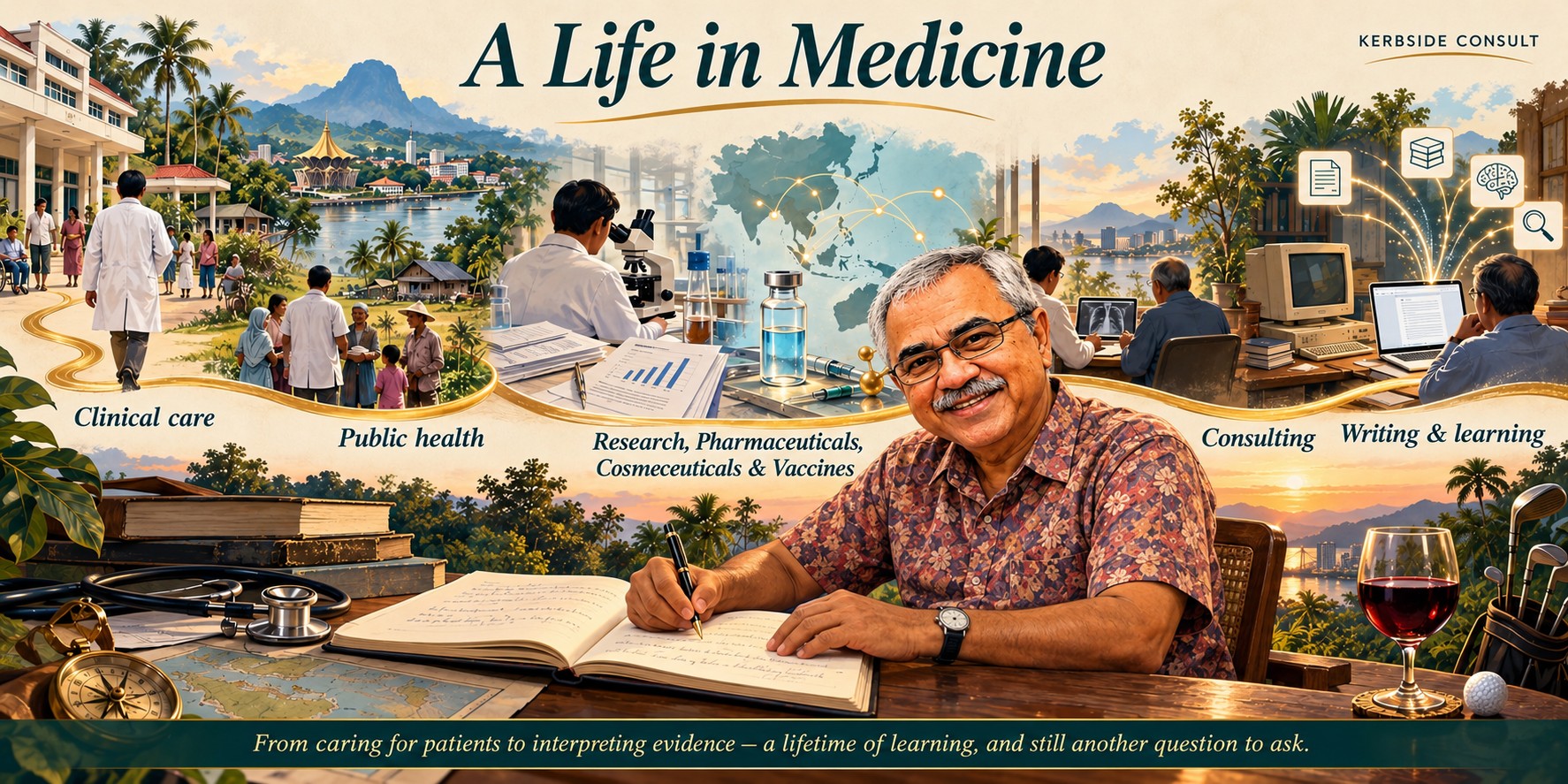
I will soon be 68. My working life began with housemanship in India and in Kuching, Sarawak. Government service took me to Seremban and the districts, where I worked as a medical officer in charge and a medical officer of health in Kuala Pilah and Kuala Pilah/Jempol.
The pharmaceutical industry followed, with country, multicountry and regional responsibilities (Servier, Sanofi, Celgene, BMS and Novavax), culminating in my role as Vice President, Head of Medical Affairs Asia-Pacific at Novavax. I now work as a consultant. The interest in understanding medicine has remained. [23] [25]
Along the way, my work has covered clinical medicine, public health, occupational medicine and pharmaceutical medicine. Within the industry, it has ranged across medicines, vaccines and cosmeceuticals, research and development, clinical trials, pharmacovigilance, medical affairs and medical information. That breadth helps explain why the articles do not stay within one specialty.
Writing has been part of that work throughout: study protocols, case report forms, statistical analyses and publications, alongside numerous presentations at meetings and congresses and papers in peer-reviewed journals. Each requires attention to what the evidence says and how clearly it can be explained. My ORCID profile provides a record of listed publications. [24]
That experience shapes Kerbside Consult. A treatment raises questions about its evidence, safety, public-health implications and access. Having worked across those settings, I find it hard to stop at just one part of the question.
The guestbook gave me a reason to keep writing. A reader worried about her husband travelling to Taiwan during the enterovirus outbreak and what it might mean for their children. A doctor arrived through Berita MMA while still learning to use the Internet. Both found information they needed. [20]
As I reflected in Thirty Years of Someone Writing Back and Was It Worth It?, the correspondence revealed a gap: people needed understandable information to help them make decisions. [21] [22]
Today, AI can produce an answer in seconds. Readers still need to understand what it means, how well it is supported and whether it applies to their circumstances. A simple explanation should make the evidence easier to understand without making it sound more certain than it is.
That is what I hope Kerbside Consult offers: clear interpretation, sources the reader can check, and an honest account of what we do not yet know. Trust has to be earned through that work, including correcting mistakes when they are found.
Keeping that work useful means continuing to learn. At almost 68, I am still adapting to tools very different from those I used in 1995.
With AI, you can fear it or embrace it. I have chosen to embrace it—but there is a learning curve. Structured courses, including certification courses where available, can help. The certificate is a milestone; the learning continues through practice.
Embracing AI also means questioning it. Does the answer make sense? Is the source real, and does it support the claim? A confident answer can still be wrong. Experience helps me judge it; checking the original evidence remains necessary. The responsibility for what I publish is mine.
Writing gives me a reason to keep learning. It makes me read more carefully and explain what I think I understand. Sometimes it forces me to change my mind.
I still enjoy wine and golf. Apparently, I also still enjoy finding another question that needs an article.
14. The Next Article
I did not set out in 1995 to preserve a record stretching into 2026. The next useful page was enough.
Looking back, the archive is less a record of answers than a record of attention: what seemed important, what required explanation and what remained unresolved.
There will be errors to correct and old assumptions to reconsider. There will also be developments that deserve neither enthusiasm nor dismissal until the evidence is clearer.
That leaves plenty of work.
The technology will keep changing. I hope the curiosity lasts long enough to make use of it.
There is probably another article in that.