We all grow older. Our hair turns grey, our skin loses its elasticity, wounds take longer to heal, and organs gradually become less efficient. We have long accepted these changes as part of the natural ageing process.
But what if an ageing cell could be persuaded to behave like a younger one — not replaced, and not turned into a different cell, but encouraged to recover some of the functions it has lost?
A discovery made in Japan twenty years ago has brought that question into serious scientific investigation. In 2026, the first patients began receiving an experimental treatment based on the idea. Can we reverse some cellular changes associated with ageing without creating more problems than we solve?
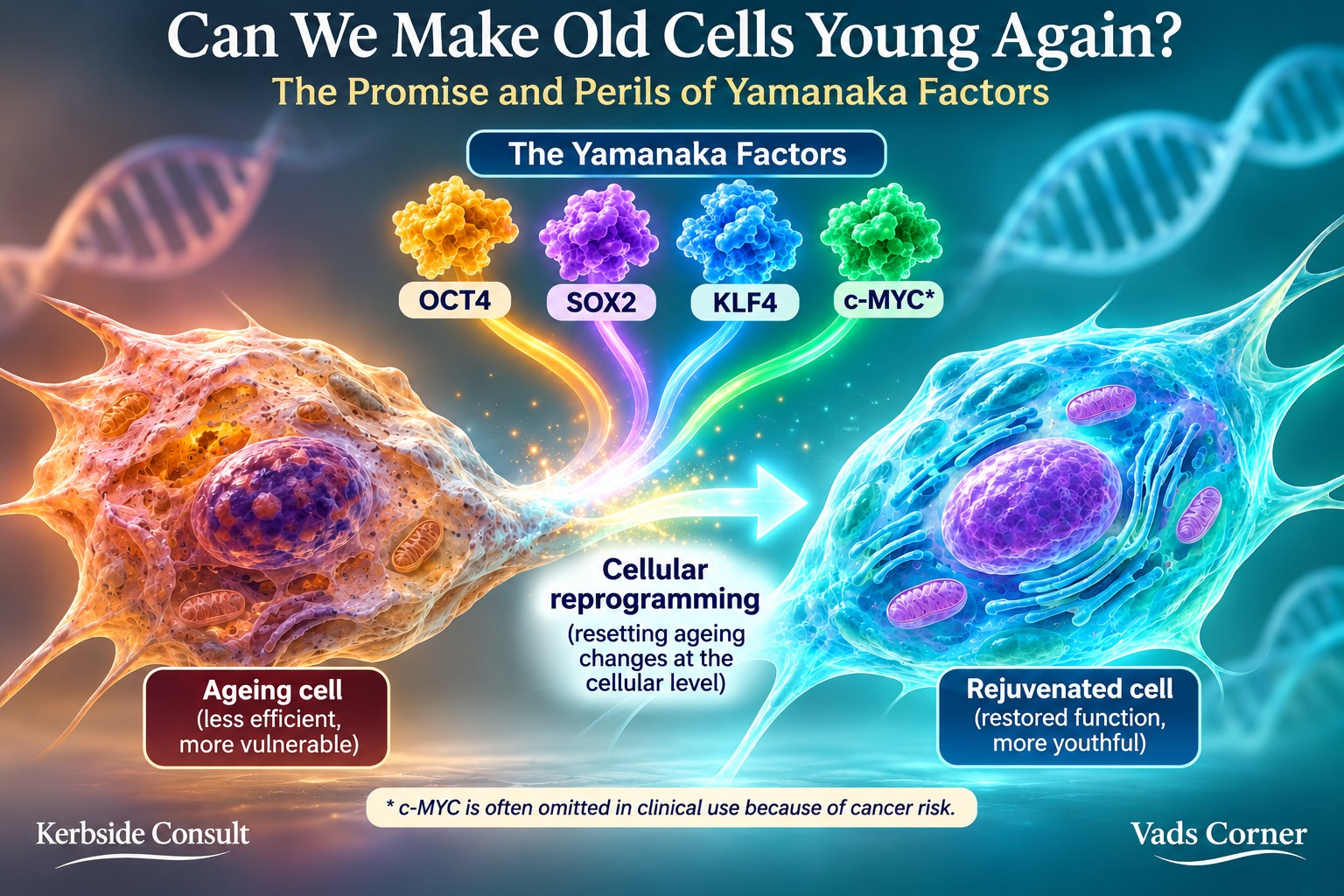 AI-generated illustration
Contents
- A discovery that changed biology
- What does reprogramming mean?
- Partial reprogramming — a different ambition
- What have experiments shown?
- The first patients — why the eye?
- Could the heart, brain or skin benefit?
- What could go wrong?
- A younger cell is not necessarily a younger person
- Treating ageing, or treating disease?
- Beyond the original four factors
- At the kerbside
- Sources & further reading
A discovery that changed biology
In 2006, Kazutoshi Takahashi and Shinya Yamanaka showed that four factors could reprogramme mature mouse cells into induced pluripotent stem cells (iPSCs). In 2007, they achieved a similar result with human cells. This overturned the assumption that a specialised cell’s identity was permanently fixed. Yamanaka and Sir John Gurdon shared the 2012 Nobel Prize in Physiology or Medicine for work establishing that mature cells can be reprogrammed.[1], [2], [3]
The original four factors are OCT4, SOX2, KLF4 and c-MYC. They are transcription factors: proteins that influence which genes are switched on or off. Full reprogramming produces cells that can subsequently be guided towards many specialised cell types. That approach, and its uses in cell replacement, are discussed in my earlier Kerbside Consult article, The Cell That Could Become Almost Anything (33/2026, 3 October 2026). Here, the question is different: can we refresh an existing cell without replacing it?
What does reprogramming mean?
Nearly every cell carries essentially the same genetic instruction book, but a skin cell and a nerve cell read different chapters. Part of the machinery controlling which instructions are read is called the epigenome. Reprogramming changes patterns of gene activity without requiring a deliberate rewrite of the underlying DNA sequence.
That distinction does not mean the process is risk-free. Changing gene activity can also change what a cell does, how it grows and whether it retains its identity.
Partial reprogramming — a different ambition
With full reprogramming, a mature cell is returned to a pluripotent state. With partial reprogramming, researchers try to activate reprogramming factors for a limited period, reversing some ageing-related changes while preserving the cell’s specialised identity.
Think of refreshing an ageing computer without wiping its operating system. The analogy is imperfect, but it captures the objective. Too little reprogramming may achieve nothing; too much may erase essential cellular functions or encourage abnormal growth.[4], [5]
What have experiments shown?
In 2016, Ocampo and colleagues reported that short-term, cyclic expression of all four factors improved several ageing-related characteristics and prolonged lifespan in a mouse model of premature ageing. The same approach also improved recovery from metabolic disease and muscle injury in older, otherwise normal mice. In 2022, Browder and colleagues applied long-term partial reprogramming, again with all four factors, to naturally ageing mice. They reported rejuvenating effects in tissues such as the kidney and skin, reversal of an epigenetic clock, and reduced expression of genes involved in inflammation, senescence and stress responses; the longer the treatment, the greater the effect.[4], [6]
These findings are promising, but molecular changes in mouse tissues do not establish that humans can be made younger, live longer or recover lost function. Those claims require direct clinical evidence.
The first patients — why the eye?
In 2026, Life Biosciences began human testing of ER-100 in optic neuropathies, including open-angle glaucoma and non-arteritic anterior ischaemic optic neuropathy (NAION). The experimental treatment uses a modified adeno-associated virus (AAV) vector, injected into the vitreous of the eye, to deliver three factors — OCT4, SOX2 and KLF4 (OSK). Oral doxycycline switches their expression on for eight weeks (56 days), and an oral prednisolone taper is given to limit inflammation from the immune response to the vector. The original fourth factor, c-MYC, is omitted, although that does not eliminate every risk.[5], [7], [8], [9]
The eye provides a localised target and measurable visual outcomes. A key piece of preclinical evidence comes from mice: OSK expression in retinal ganglion cells restored youthful DNA methylation patterns, promoted axon regeneration after injury, and reversed vision loss in a mouse model of glaucoma and in aged mice.[10] The registered early-phase study is designed primarily to assess safety and tolerability. It is open-label and non-randomised, and plans to enrol up to 18 participants: 12 with open-angle glaucoma and 6 with NAION.[8]
On 8 October 2026, the sponsor reported interim observations in three patients with open-angle glaucoma through Day 56, all treated at the lowest dose level (2×10¹¹ vector genomes). It reported no dose-limiting toxicities, adverse events of special interest or serious adverse events; the adverse events that did occur were attributed by the sponsor to the injection procedure, the steroid or pre-existing conditions. It also reported preliminary visual-field improvements at Day 56 in two of the three participants, with at least 28% of tested points improving by more than 4 dB in each. The data safety monitoring board recommended escalation to the next dose level (6×10¹¹ vector genomes).[9]
These are company-reported, uncontrolled findings, not proof that ER-100 restores sight or reverses human ageing. Visual-field tests can vary, and three patients followed for 56 days cannot establish long-term safety or effectiveness. At the time of writing, the registry record (last updated 19 May 2026) has no results posted.[8]
Could the heart, brain or skin benefit?
Researchers are exploring whether partial reprogramming might eventually help ageing or damaged tissues, including nerves, muscles and other organs. Yet an effect in the eye cannot be assumed to occur elsewhere. Different tissues may respond differently, and the delivery method itself can create risks.
The meaningful outcome is not a younger-looking cell on a laboratory test. It is better sight, mobility, recovery or independence in a patient.
What could go wrong?
The concerns include loss of cell identity, abnormal growth or tumours, immune reactions to delivery systems and difficulty controlling exactly where and for how long reprogramming occurs. c-MYC has oncogenic activity, and it can be omitted from in vivo partial reprogramming without apparent loss of the rejuvenating effect, but removing it does not guarantee safety.[5]
In mice, continuous induction of all four factors led to liver and intestinal dysfunction, weight loss and premature death within one week; the authors reduced this toxicity by avoiding expression in the liver and intestine. Timing, duration and location of expression clearly matter.[11]
Long-term follow-up is especially important. A short-lived favourable result cannot exclude delayed complications, and molecular signs of benefit are not a substitute for clinical safety data. The registered protocol plans follow-up for up to five years, and it excludes people who have had cancer in the previous five years (other than basal cell skin cancer).[8]
A younger cell is not necessarily a younger person
Epigenetic clocks estimate aspects of biological ageing from patterns such as DNA methylation. A shift towards a younger reading is scientifically interesting, but it is not equivalent to adding years of healthy life.
Ageing also involves DNA damage, mitochondrial dysfunction, cellular senescence, inflammation and changes across entire organs. I discussed the wider questions of biological clocks, lifespan and healthspan in my earlier article, How Long Do You Want to Live? (28/2026, 25 September 2026). The narrower question here is whether reprogramming can produce a measurable clinical benefit.
Treating ageing, or treating disease?
ER-100 is being investigated for defined eye diseases, not as a general anti-ageing treatment. If controlled trials eventually show a meaningful and lasting improvement in vision, that would be valuable even without any claim of extending lifespan.
Improving the years we remain healthy and independent may ultimately matter more than changing a number on a biological clock.
Beyond the original four factors
Scientists are exploring more precise ways to control partial reprogramming, including temporary RNA instructions, chemical compounds and delivery targeted to individual organs. The aim is to influence ageing-related cellular changes without allowing cells to lose their normal identity. These approaches are largely experimental, and none has established safe, lasting whole-body rejuvenation in humans. The technology deserves a separate article; the clinical question here is whether any method can improve patients’ health without unacceptable risks.
At the kerbside
Twenty years after Yamanaka’s discovery, carefully controlled cellular reprogramming is being tested in patients. That is a remarkable progression, but we are still far from safely reversing ageing throughout the human body.
Perhaps the real achievement will not be making a 70-year-old biologically 30 again. It may be helping that person retain eyesight, mobility, independence and quality of life. That would be progress worth celebrating.
The next step is controlled evidence: larger trials with longer follow-up that show whether any visual gain is real, lasting and safe.
Reprogramming has entered the clinic; whether it can safely give patients back lost function remains to be shown.