The King of Fruits on Trial: What the Evidence Actually Says About Durian and Your Health
Cyberdoc — writing on medicine since 1995
Every durian season in Malaysia, the same ritual plays out across the clinic desk. A patient with hypertension, diabetes or high cholesterol leans forward and asks the question he already dreads the answer to: “Doctor, can I eat durian?”
Durian is too often cast as the villain, a decadent, artery-clogging indulgence to be banned along with the deep-fried snacks. I went back to the original studies rather than the headlines. The picture is more nuanced than the folklore, and in one or two places less comfortable than the usual “durian is perfectly fine” reassurance.
My view is modest. Durian is not junk food, and it does not deserve its reputation as a cardiovascular time bomb. It is a rich, energy-dense treat, and for most people how much they eat matters more than the fruit's reputation.
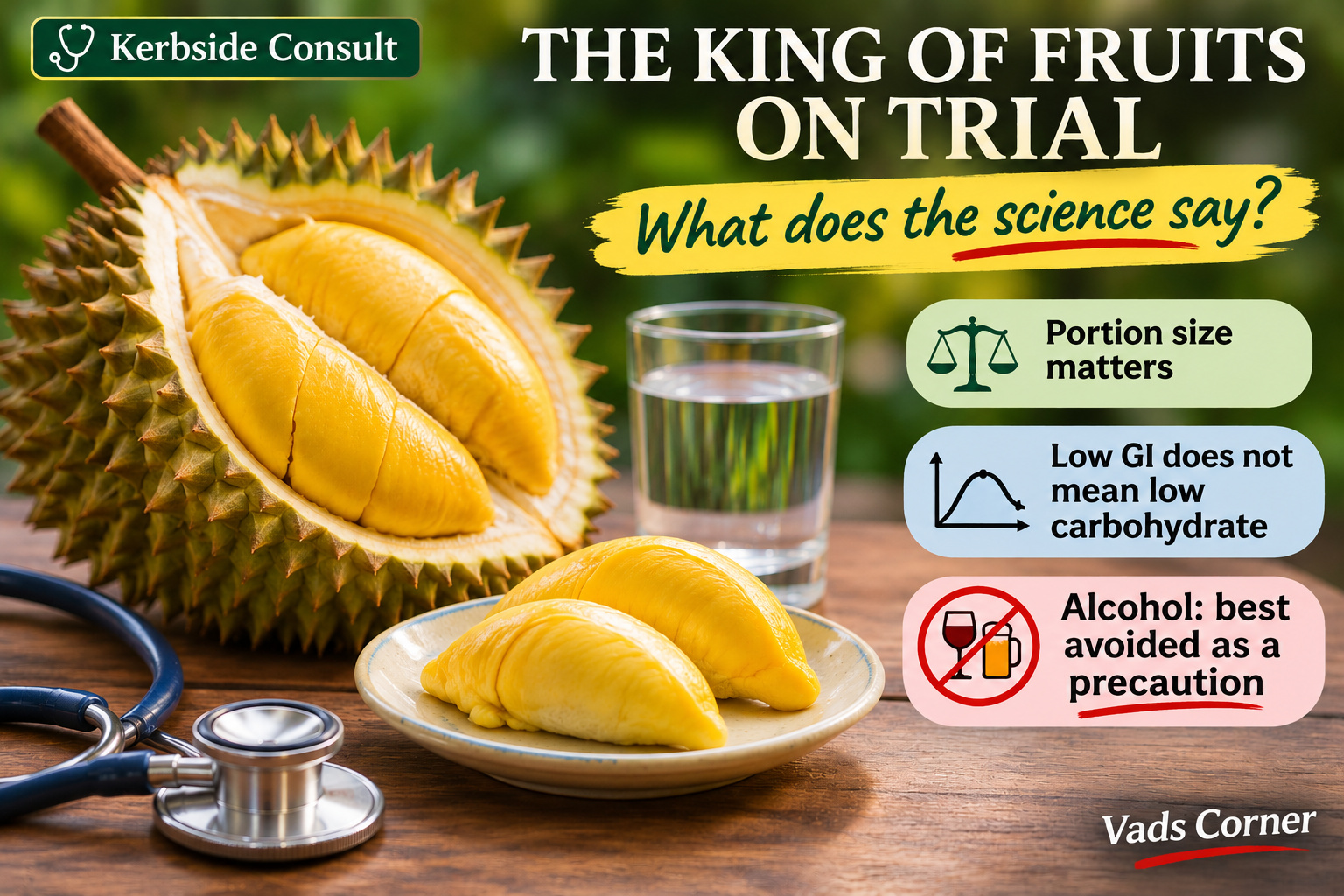
The image is inspired by the subject. It is AI-generated, is not a photograph, and does not show real people.
1. Not your average fruit: what a pulp actually delivers
Most tropical fruits are water, sugar and a modest dose of vitamins. Durian is built differently. The USDA entry for raw or frozen durian gives, per 100 g of flesh, 147 kcal, 27.1 g carbohydrate, 5.3 g fat, 3.8 g dietary fibre and about 436 mg potassium, with no cholesterol. [1] Durian flesh is also a source of vitamin C, thiamine and vitamin B6, and of carotenoids and polyphenols. [2]
Two cautions on those numbers. First, they are for one database entry. Across published analyses of different varieties, energy runs from roughly 84 to 185 kcal per 100 g, and fat from about 1.6 g to 5.4 g, so your Musang King and your neighbour's D24 will not match the table exactly. The Malaysian composition data cited in the same review give 153 kcal, 27.9 g carbohydrate and 3.4 g fat per 100 g. [2] Second, nobody eats grams; we eat pulps, the segments of flesh around each seed (ulas in Malay). In the UKM blood pressure trial, five de-seeded pulps weighed 250 g, so I use about 50 g of flesh per pulp as a working figure. [3]
| Measure | Per 100 g | Per pulp (about 50 g) | Five pulps (250 g) |
|---|---|---|---|
| Energy | 147 kcal | about 74 kcal | about 368 kcal |
| Carbohydrate | 27.1 g | about 13.5 g | about 68 g |
| Fat | 5.3 g | about 2.7 g | about 13 g |
| Potassium | 436 mg | about 218 mg | about 1,090 mg |
Per-pulp and 250 g figures are my arithmetic from the USDA per-100 g values [1], using the 50 g per pulp working figure [3]. Real pulps vary by variety and size.
That table settles the calorie question. Three to four medium pulps come to roughly 220 to 295 kcal, a snack-plus rather than a snack. A big sitting is another matter. The UKM trial's top dose of 500 g (ten pulps) comes to about 735 kcal on the USDA figure, a full meal and then some. [1] [3] Make a habit of sittings like that, on top of your usual meals, and the calories add up quickly.
2. Cholesterol, triglycerides and the fat in durian
Durian contains no dietary cholesterol. [1] That is true, and it is where most of the reassurance stops, because it is not where the question ends.
The popular line that durian fat is “like avocado”, predominantly monounsaturated, is only partly right. In Thai analyses, oleic acid is the main monounsaturated fat and palmitic acid the main saturated one. Three of four varieties in one study had more monounsaturated than saturated fat, but Monthong had the reverse. [4] Across 17 indigenous Thai varieties, oleic acid made up roughly 28% to 52% of fatty acids and palmitic acid roughly 36% to 48%. [5] I could not find a fatty acid profile for Malaysian D24 or Musang King, so for the fruit on your table the honest answer is “a mixture, and it depends on the variety”.
What happens in the body was tested in a small Singapore crossover trial published in 2025. Sixteen healthy Chinese adults ate an isocaloric portion (367.5 kcal) of durian and of banana on separate days. Over the next three hours, triglycerides rose after durian but not after banana. [6] The authors themselves advise moderation because of durian's sugar and fat content. [6]
So the folklore has a kernel of truth, with the mechanism misplaced. The fruit is not delivering cholesterol. It is delivering fat and sugar in a concentrated package, and that shows up in triglycerides. I found no trial of what regular durian eating does to fasting lipids over weeks or months. A temporary rise in triglycerides after a meal containing fat is not unexpected and does not by itself show harm; whether regular durian affects fasting triglycerides, LDL cholesterol or cardiovascular risk is unknown. Animal data in a 2019 review suggest a lipid-lowering effect, but that is a hypothesis for human trials, not an advertisement. [2]
3. The blood sugar paradox: low GI, high load
Patients with diabetes are often told to avoid durian altogether. Yet when researchers at Universiti Sains Malaysia measured the glycaemic index of four common local fruits, durian had the lowest value: GI 49, against watermelon 55, papaya 58 and pineapple 82. [7] Strictly, only pineapple stood apart. The differences among durian, watermelon and papaya were not statistically significant, and the authors classed durian and watermelon as low GI. [7] It is a useful anchor, with limits worth knowing. Durian was tested in only eight volunteers, the test portion was 207 g (about four pulps) supplying 50 g of available carbohydrate, and portions were set from food-table values, not from analysis of the fruit used. [7] The authors suggest fat and fibre as the reason, though their own data showed no link between fibre content and GI across the four fruits. [7]
A low glycaemic index does not mean a low carbohydrate intake. GI compares the glucose response to the same amount of carbohydrate; it says nothing about how many grams are on your plate.
The Singapore trial makes the point. Although the durian portion contained far fewer carbohydrates than the isocaloric banana, the postprandial rise in blood glucose was comparable. [6] Put the two together and the practical message is clear: GI says how each gram of carbohydrate behaves, and load adds up the grams. Two pulps carry roughly 27 g of carbohydrate. Half a fruit carries several times that. Durian for a person with diabetes is a portion-control exercise, not an automatic ban. Both trials above were in healthy volunteers, so your own glucometer is the better judge.
| Portion | Flesh | Available carbohydrate | Estimated glycaemic load |
|---|---|---|---|
| 1 pulp | 50 g | about 11.6 g | about 6 |
| 2 pulps | 100 g | about 23.3 g | about 11 |
| 3 pulps | 150 g | about 34.9 g | about 17 |
| 5 pulps | 250 g | about 58.2 g | about 29 |
My arithmetic, not a measured result: glycaemic load = GI 49 [7] × available carbohydrate (USDA carbohydrate less fibre, 27.1 − 3.8 = 23.3 g per 100 g [1]) ÷ 100, at 50 g per pulp [3]. The GI came from eight volunteers, so treat the loads as rough. By the usual convention, below 10 is low, 11 to 19 medium and 20 or more high.
4. Blood pressure and heart rate
The belief that durian “shoots up the blood pressure” is deeply rooted in Southeast Asia. Researchers at Universiti Kebangsaan Malaysia (UKM) tested it in a randomised, single-dose, non-blinded study. Thirty-two healthy young men, eight to a group, received 250 g of D24 flesh, 500 g, a sugar placebo matched to the sugar in 250 g, or nothing. Blood pressure was followed for up to 24 hours. [3] Neither dose raised blood pressure, whereas the sugar-only placebo produced a small but significant rise in systolic pressure at two hours. Heart rate did rise significantly in the 500 g group, between 30 minutes and two hours, but stayed within the normal 60 to 100 beats per minute range. [3] The authors put the heart rate rise down to the sugar load and the steady blood pressure to durian's potassium, though neither explanation was tested. [3] The doses were not arbitrary: in a quick survey of 40 people in Segamat, the average daily intake was five pulps and the maximum ten. [3]
The Singapore crossover trial went further and found that blood pressure fell over three hours after 250 g of durian, with no change after banana. [6] The same trial found a higher and longer-lasting thermic effect with durian in most participants, which may loosely echo its “heaty” reputation, though the two ideas are not the same thing. [6]
Hypertensive animals were less forgiving. In spontaneously hypertensive rats, a high dose of durian raised blood pressure significantly an hour after dosing, on the first day only, while a low dose did not. [8]
Here is the honest limit. Every human blood pressure study I found enrolled healthy young volunteers, and the UKM authors themselves called for work in people with prehypertension or hypertension. [3] Rats are not patients. My advice to hypertensive readers, modest portions and no half-kilo binges, is clinical common sense extrapolated from this evidence, not a result from it.
5. Durian and alcohol: folklore with a biochemical footprint
Not all durian lore is a myth. The belief that durian and alcohol do not mix is, by the Tsukuba authors' account, more than 250 years old, and it comes with flushing, palpitations, vomiting and, in anecdote, cardiac episodes and deaths. [9] Is there anything behind it? Some, though the evidence sits low on the ladder.
Rung one is a test-tube study from the University of Tsukuba. Durian extract inhibited yeast aldehyde dehydrogenase (ALDH) in a dose-dependent way, by up to 70% at a very low extract concentration, and the sulphur-rich fractions were the most active. [9] It was yeast enzyme, not human, and a solvent extract, not fruit as eaten. Diethyl disulphide, a sulphur compound reported among durian's volatiles [2], was used in the assay as a reference standard. [9] The authors themselves described it as the first attempt to test the enzyme link, and noted that earlier in vivo studies from 1969 to 1986 had vaguely disproved the interaction. [9] I have read the oldest of them, below, but not the others.
Rung two is the same group's rat study. Rats given durian and then an alcohol challenge developed unpleasant, disulfiram-like reactions that control animals did not, with slower clearance of blood acetaldehyde and a fall in body temperature after the first challenge. Rats given cabbage did similarly, a reminder that durian is not the only sulphur-rich food. [10]
The oldest experiment points the other way. In 1969 Ogle and Teh at the University of Singapore gave mice durian homogenate (about 0.8 g of flesh per mouse) and 10% alcohol, either together or alcohol 2, 4 or 6 hours after the durian. They saw no interaction. In the alcohol-after-durian groups, 4 of 60, 7 of 50 and 6 of 50 mice fell asleep, against 9 of 60 given alcohol alone, and the differences were not significant (smallest P 0.3). [11] The authors found only one clinical report, a 1941 case of fatal haemorrhagic pancreatitis after durian and alcohol, and concluded that their results gave no basis for the belief, while noting that mice and purified alcohol are not people. [11] Two cautions of mine. Sleeping time is a crude endpoint that does not measure acetaldehyde, and the later rat work used a different species and different measures, so the two sets of findings do not cleanly cancel out.
I found no recent controlled human study. The proposed mechanism is plausible, though the animal evidence is mixed, since ALDH is the enzyme that clears acetaldehyde, the toxic by-product of alcohol, and disulfiram (Antabuse) works by blocking it. But a human reaction “like Antabuse” is a hypothesis supported by yeast and rats, not a measured finding. There is insufficient clinical evidence to say that eating durian with alcohol kills people; the deaths remain anecdote. There is also no data on how long to wait between durian and a drink, so there is no human evidence on a safe interval to offer; the 1969 mouse study tried 2, 4 and 6 hours and saw nothing, but mice are not people. The cost of caution is a missed drink; the cost of being wrong, on the anecdotal reports, could be a cardiac scare. On that asymmetry, the safer course is to keep alcohol out of the picture altogether while durian is on the table, for everyone, whatever your health, and not only for those with heart or liver problems.
6. Who actually needs to be careful?
Healthy adults can enjoy durian without guilt. Four groups need a firmer boundary.
- Chronic kidney disease (CKD). Durian is potassium-dense: about 1.1 g in a 250 g sitting, over a third of the 3 g a day limit usually advised for people with reduced kidney function who tend to develop hyperkalaemia, including those on drugs that act on the angiotensin pathway. [1] [12] The picture is not a blanket ban, though. KDIGO 2024 does not endorse restricting naturally potassium-rich foods such as fruit in early CKD. It advises an individualised approach, with limits on bioavailable potassium for people with CKD stages G3 to G5 who have a history of hyperkalaemia or are going through a period of risk, guided by a renal dietitian. [13] No one has measured how much of durian's potassium is absorbed. The risk is not confined to chronic disease. A 2021 Sabah case report describes a 79-year-old woman, with kidney function previously normal, who ate a large amount of durian over several days despite repeated watery diarrhoea. She arrived dehydrated with acute kidney injury (eGFR 18.7), a potassium of 8.1 mmol/L and a heart rate of 40 beats per minute with the ECG changes of hyperkalaemia, and recovered within three days without dialysis. [14] It is one patient, the amount of durian was not measured, and the dehydration and kidney injury did the rest, but the practical lesson stands: no durian binges while you are losing fluid to diarrhoea or vomiting. If you have CKD, ask your kidney team before the season starts, not after the third pulp.
- Diabetes. A low GI does not neutralise a high carbohydrate load. Stick to small, measured portions and check your post-meal readings. [6] [7]
- Weight and triglyceride management. Five pulps is about 370 kcal, with a measurable triglyceride rise in healthy volunteers. [1] [6] For anyone watching weight or lipids, count durian towards your day's calories and carbohydrate rather than treating it as an extra after a full meal.
- Hypertension or heart disease. Modest portions did nothing to blood pressure in healthy men, but large sittings raised heart rate, and the rat data urge caution. [3] [8] Studies in actual hypertensive patients are missing, so keep to small portions and avoid the half-kilo binge.
And for anyone, whatever your condition, keep alcohol out of the picture while the durian is on the table.
7. At the kerbside
If you remember one point: durian is a rich, nutrient-dense treat, not a light fruit snack, and not a cardiovascular time bomb either.
Enjoy the season, respect the pulp count, and keep the alcohol for another day.
For most healthy adults, my rule of thumb is two to three medium pulps per sitting (roughly 100 to 150 g, or about 150 to 220 kcal), eaten slowly, with plain water. That is a clinical rule of thumb, not a trial result, and it is more cautious than real life: the average respondent in the UKM survey ate five pulps a day. [3] If you live with kidney disease, diabetes, high blood pressure or a lipid problem, treat it as a starting point and take your own team's advice.
Sources & further reading
- U.S. Department of Agriculture, Agricultural Research Service. FoodData Central: Durian, raw or frozen (SR Legacy, FDC ID 168192; NDB 9422; per 100 g). [Source] Same USDA values tabulated in the open-access review: [Aziz & Mhd Jalil 2019, Table 1]
- Aziz NA, Mhd Jalil AM. Bioactive compounds, nutritional value, and potential health benefits of indigenous durian (Durio zibethinus Murr.): a review. Foods. 2019;8(3):96. [Free full text] [PubMed] [DOI]
- Kumolosasi E, Teh SG, Mansor AH, Bakry MM, Azmi N, Jasamai M. Effects of durian intake on blood pressure and heart rate in healthy individuals. Int J Food Prop. 2016;19(7):1483–1488. [DOI] [Abstract, FAO AGRIS]
- Charoenkiatkul S, Thiyajai P, Judprasong K. Nutrients and bioactive compounds in popular and indigenous durian (Durio zibethinus Murr.). Food Chem. 2016;193:181–186. [Source]
- Thiyajai P, Charoenkiatkul S, Kulpradit K, Swangpol S, Sridonpai P, Judprasong K. Nutritional composition of indigenous durian varieties. Malays J Nutr. 2020;26(1):93–99. doi:10.31246/MJN-2019-0083. [Source]
- Ling CY, Yeo MTY, Kang Y, Ng SM, Bi X, Henry CJ. Comparative effects of durian and banana consumption on thermic effect of food and metabolic responses in healthy adults. J Am Nutr Assoc. 2025;44(4):283–291. [Source] [DOI]
- Robert SD, Ismail AA, Winn T, Wolever TMS. Glycemic index of common Malaysian fruits. Asia Pac J Clin Nutr. 2008;17(1):35–39. [Source] [PDF]
- Jasamai M, Samsudin NH, Azmi N, Kumolosasi E. Effects of durian fruit on blood pressure of spontaneously hypertensive rats. Sains Malaysiana. 2018;47(6):1221–1226. [Source]
- Maninang JS, Lizada MCC, Gemma H. Inhibition of aldehyde dehydrogenase enzyme by durian (Durio zibethinus Murray) fruit extract. Food Chem. 2009;117(2):352–355. [Source] Corrigendum (affiliations only): Food Chem. 2010;120(4):1122, [DOI]
- Maninang JS, Lopido-Sese LRC, Lizada MCC, Gemma H. The influence of durian (Durio zibethinus Murray cv. Monthong) on conditioned taste aversion to ethanol. Food Chem. 2012;131(2):705–712. [Source]
- Ogle CW, Teh YF. Durian and alcohol: a preliminary report. Singapore Med J. 1969;10(4):288–290. [Source]
- Cupisti A, Kovesdy CP, D'Alessandro C, Kalantar-Zadeh K. Dietary approach to recurrent or chronic hyperkalaemia in patients with decreased kidney function. Nutrients. 2018;10(3):261. [Source]
- KDIGO CKD Work Group. KDIGO 2024 clinical practice guideline for the evaluation and management of chronic kidney disease. Kidney Int. 2024;105(4S):S117–S314. [Source]
- Payus AO, Ahmedy F, Syed Abdul Rahim SS, Sumpat D. An uncommon side effect from the ‘king of fruit’: a case report on life-threatening hyperkalaemia after eating durian fruit. SAGE Open Med Case Rep. 2021;9:2050313X211063195. [Free full text] [DOI]
Published 89/2026 · 26 November 2026 · No corrections to date · Corrections policy