Ebola brings back memories of the devastating West African epidemic of 2014–2016. Many readers may assume that the vaccines and treatments developed since then will work whenever Ebola returns. Unfortunately, Ebola is not just one virus.
This review sets out what is known, and what is not yet known, about the Bundibugyo virus behind the current outbreak in the Democratic Republic of the Congo, using WHO’s figures as of 20 October 2026.
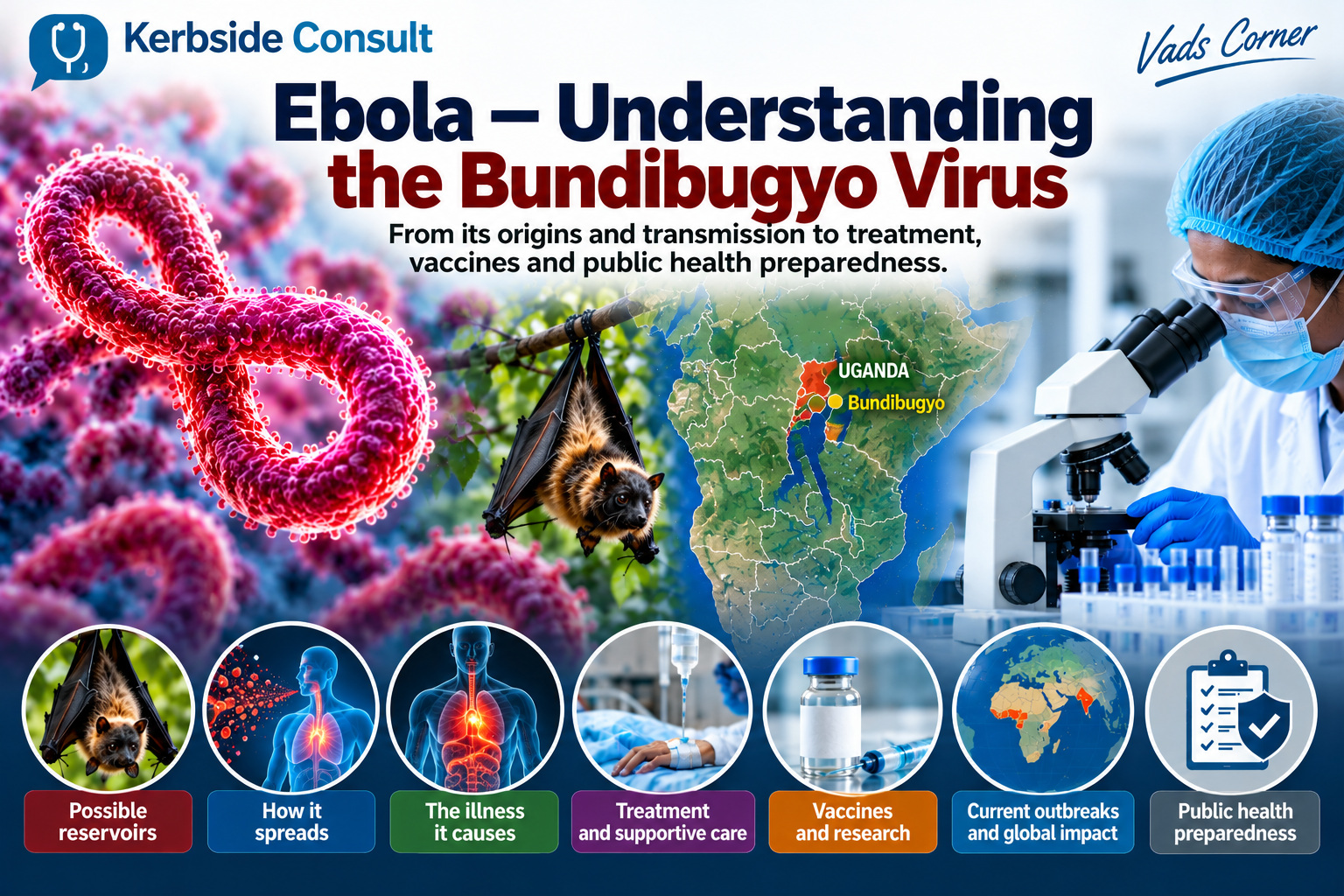
Contents
- The Outbreak at a Glance
- Ebola Is Not Just One Virus
- Where Does Ebola Come From, and How Does It Spread?
- What Are the Signs and Symptoms?
- How Dangerous Is Bundibugyo?
- Can Patients Be Treated Without a Specific Antiviral?
- Why Does the Vaccine Gap Matter for Bundibugyo?
- Why Is a Bundibugyo Vaccine So Difficult to Develop?
- A New Trial Begins
- A Brief Note on Malaysia’s Preparedness
- The Bigger Lesson
- Sources & further reading
1. The Outbreak at a Glance
According to WHO’s 23 October update, the Democratic Republic of the Congo (DRC) had recorded 9,704 confirmed cases and 4,687 deaths as of 20 October 2026, spread across 66 health zones in eight provinces. WHO describes this as the largest Ebola disease outbreak ever recorded in the DRC[1].
WHO’s most recent risk assessment, on 14 August, rated the risk as very high in the DRC, high for countries sharing a land border with it, and low for the rest of the African region and globally. That assessment is now being revised, and WHO advises against travel or trade restrictions on affected countries[1]. In my view there is no cause for alarm in Malaysia, but there is every reason for vigilance.
Since the outbreak was declared on 15 May 2026, cases have been reported in five countries: the DRC, Uganda, France, and more recently Kenya and Nigeria. Uganda reported 20 confirmed cases, including two deaths, and declared its outbreak over on 27 August 2026[2]. Kenya has reported nine cases, including one death. All eight secondary cases trace to a single imported case, and WHO found no evidence of transmission beyond that cluster. Nigeria confirmed one imported case in Abuja on 20 October, with 44 contacts being monitored[1].
2. Ebola Is Not Just One Virus
Several related viruses can cause Ebola disease. The best known is Ebola virus (EBOV), responsible for the major West African epidemic. Sudan virus and Bundibugyo virus are relatives, but they are not identical. Bundibugyo virus was first identified in 2007–2008 in Bundibugyo district, western Uganda[3], [4].
Think of a vaccine as showing the immune system a photograph of a wanted person. If a different person arrives with a similar but not identical face, recognition may be incomplete. Ebola vaccines train immunity against viral proteins; related viruses have different versions of those proteins. This is a simplified analogy, but it explains why a vaccine proven against one Ebola virus cannot automatically be assumed to protect against another.
3. Where Does Ebola Come From, and How Does It Spread?
The first recognised Ebola outbreaks occurred in 1976, in what is now South Sudan and in the DRC[5]. Fruit bats are suspected to be the natural reservoir. Human infection is thought to begin with close contact with the blood or secretions of infected wildlife, such as bats or non-human primates[1].
Among people, it spreads through direct contact with the blood, secretions, organs or other body fluids of an infected person, or through contaminated surfaces and materials. Transmission is amplified in health facilities with inadequate infection prevention and control, and during unsafe burials that involve direct contact with the body[1]. In the 2007–2008 Ugandan outbreak, handling the dead without protection was strongly associated with infection (adjusted odds ratio 3.83, 95% CI 1.78–8.23)[3]. The virus is not ordinarily transmitted through shared air like measles[1], [6]. People are not infectious before symptoms begin[1], [6].
Sexual transmission after recovery is a recognised concern. For Ebola virus disease, WHO notes that transmission through semen has been documented up to 15 months after clinical recovery, and advises male survivors to practise safer sex for 12 months if semen testing is unavailable[6]. That evidence comes from Ebola virus (EBOV) disease; comparable data specific to Bundibugyo are more limited, so the same precautions are prudent.
4. What Are the Signs and Symptoms?
Symptoms may begin 2–21 days after exposure. Early signs are non-specific: sudden fever, fatigue, muscle pain, headache and sore throat. They can look like malaria, dengue or influenza, so a travel and exposure history is vital[1], [6]. In a small observational study of the 2012 Bundibugyo outbreak in Isiro, DRC, malaria was the commonest alternative diagnosis[7].
As the illness progresses, vomiting, diarrhoea and abdominal pain can cause dangerous dehydration. Some patients develop a rash, impaired kidney and liver function, or confusion[6]. Bleeding is less common than people assume and tends to occur later; Ebola is not simply a disease in which everyone bleeds[6], [7].
Someone who develops compatible symptoms within 21 days of possible exposure should telephone a healthcare facility or public health authority for instructions before attending in person, so that safe assessment and isolation can be arranged. Any suspected case should be notified immediately to the public health authorities.
5. How Dangerous Is Bundibugyo?
WHO reports a crude case-fatality ratio of 48.3% in the DRC: 4,687 deaths among 9,704 confirmed cases as of 20 October 2026[1]. That figure needs care. WHO also reports 2,595 recoveries, and the outcome of the remaining cases is not yet recorded. The crude ratio is therefore a moving figure, and it is not an individual’s predicted risk of death.
Many deaths occur outside hospital. Of the 482 deaths added since WHO’s previous update, 307 occurred in the community and 175 in treatment centres, which points to delays in detection and access to care[1]. WHO gives case-fatality ratios of 30% and 50% for the two earlier Bundibugyo outbreaks (Uganda 2007 and DRC 2012)[1]. The original Ugandan investigation reported 34%[3]. Early recognition and good supportive care matter.
6. Can Patients Be Treated Without a Specific Antiviral?
Yes, to a degree. Early intensive supportive care, including rehydration and treatment of specific symptoms, can improve survival[6]. The monoclonal antibodies that WHO recommends (ansuvimab and REGN-EB3) are for Ebola virus (EBOV) disease. For Bundibugyo, WHO states that no therapeutic is approved, although candidate products are under development[6].
7. Why Does the Vaccine Gap Matter for Bundibugyo?
For decades, scientists searched for a way to prevent this dangerous disease. One promising approach used a modified vesicular stomatitis virus (VSV) as a carrier. Researchers engineered it to display a surface protein from Ebola virus (EBOV), training the immune system to recognise that protein without exposing recipients to the complete Ebola virus.
The devastating 2014–2016 West African epidemic accelerated testing. A landmark ring-vaccination trial in Guinea vaccinated contacts, and contacts of contacts, of confirmed patients. Among those randomised, no cases occurred 10 or more days after randomisation in the immediately vaccinated clusters, against 16 cases in the delayed-vaccination clusters. Estimated efficacy was 100% (95% CI 68.9–100.0)[9]. That vaccine, Ervebo, made by Merck (MSD outside the United States and Canada), is now licensed and WHO-prequalified for Ebola virus. WHO states that no licensed vaccine exists for Bundibugyo, Sudan or Taï Forest virus[4], [8].
Two vaccines have been licensed against Ebola virus (EBOV): the single-dose Ervebo, and the two-dose Zabdeno/Mvabea regimen, in which the second dose is given eight weeks after the first. Approval for both is restricted to EBOV[4]. Neither has proven clinical efficacy against Bundibugyo.
What evidence exists on cross-protection is limited. In macaques, a heterologous VSV prime-boost regimen protected all animals against Bundibugyo challenge, whereas a single blended dose performed no better than no vaccine (2 of 3 animals died in each group)[10]. These were small studies in non-human primates. In people, a peer-reviewed study of the Zabdeno/Mvabea regimen found minimal cross-reactivity with other filoviruses, including after natural Bundibugyo infection[11]. Neither line of evidence shows that vaccinated people are protected against Bundibugyo illness.
8. Why Is a Bundibugyo Vaccine So Difficult to Develop?
First, designing a vaccine is not the same as proving it works. Scientists can construct a candidate that prompts an immune response, but they must still show acceptable safety and protection against disease.
Second, Ebola outbreaks are unpredictable. A trial may struggle to enrol enough people at risk before transmission declines. Deliberately infecting healthy volunteers with a potentially fatal virus is not an acceptable shortcut.
Third, some research involving live Ebola viruses requires maximum-containment laboratories. These are specialised and expensive, although much early vaccine research can use safer systems.
Fourth, outbreaks are sporadic, so the commercial incentive to invest in manufacturing and stockpiling may be limited. Public and international funding helps close that gap.
Finally, manufacturers must demonstrate consistent quality, and regulators must assess the evidence. The difficult task is not simply making a vaccine; it is showing that it protects people and having doses ready when they are needed.
9. A New Trial Begins
On 23 October 2026, the first participant was vaccinated in Bunia, DRC, in Tumaini (Swahili for “hope”), a pivotal Phase 2/3 adaptive platform trial (ClinicalTrials.gov NCT07842107). The first candidate is Ervebo, which is licensed for Ebola virus and is now being evaluated against Bundibugyo. Two CEPI-funded Bundibugyo-specific candidates, from Moderna and from Oxford University with the Serum Institute of India, are expected to enter the trial shortly. They had not yet done so at the time of the announcement. Candidates are chosen through an independent WHO prioritisation process, and are assessed by ring vaccination, which targets contacts at high risk of infection[12].
The trial aims to establish safety, immune responses and efficacy. It is not proof that a Bundibugyo vaccine already works. Gavi has committed up to US$40 million to fund manufacturing readiness, so that vaccines are available at scale as soon as they are approved[12].
10. A Brief Note on Malaysia’s Preparedness
In a 20 May 2026 statement (issued in Malay; the summary here is mine), Malaysia’s Ministry of Health described strengthened surveillance at all international entry points, including airports and ports. It also described healthcare isolation and infection-control readiness, PPE stocks and training, and laboratory capacity for viral haemorrhagic fevers through the Institute for Medical Research (IMR) and the National Public Health Laboratory. Travellers from Uganda and the DRC, including those transiting through Dubai, Doha and Singapore, were to be monitored. The Ministry reported no Malaysian cases at that time[13].
These are sensible precautions. Airport temperature checks cannot identify someone still incubating infection, so clinical vigilance and prompt public-health notification remain essential. The statement is five months old and is not an October status update. As of 25 October 2026, I could not find a later statement from the Ministry.
The Bigger Lesson
Ebola is not a single interchangeable vaccine target. Bundibugyo illustrates why recognising the virus, interrupting contact with infectious bodily fluids, providing early supportive care and developing vaccines before outbreaks occur all matter.
Preparedness begins with understanding the disease—not with alarm.
Sources & further reading
- World Health Organization. Ebola disease caused by Bundibugyo virus – Democratic Republic of the Congo, Kenya and Nigeria. Disease Outbreak News. 23 October 2026. Source
- World Health Organization Regional Office for Africa. Uganda ends Ebola outbreak following completion of 42-day countdown. 27 August 2026. Source
- Wamala JF, Lukwago L, Malimbo M, et al. Ebola hemorrhagic fever associated with novel virus strain, Uganda, 2007–2008. Emerg Infect Dis. 2010;16(7):1087–1092. doi:10.3201/eid1607.091525. Source
- Pletschette M, Biedenkopf N. Vaccine preparedness for Bundibugyo virus and lessons learned. npj Vaccines. 2026;11:170. doi:10.1038/s41541-026-01569-8. Source
- Centers for Disease Control and Prevention. History of Ebola disease outbreaks. (accessed 25 October 2026). Source
- World Health Organization. Ebola disease (fact sheet). (accessed 25 October 2026). Source
- Kratz T, Roddy P, Tshomba Oloma A, et al. Ebola virus disease outbreak in Isiro, Democratic Republic of the Congo, 2012: signs and symptoms, management and outcomes. PLoS One. 2015;10(6):e0129333. doi:10.1371/journal.pone.0129333. Source
- World Health Organization. Ebola vaccines: questions and answers. (accessed 25 October 2026). Source
- Henao-Restrepo AM, Camacho A, Longini IM, et al. Efficacy and effectiveness of an rVSV-vectored vaccine in preventing Ebola virus disease: final results from the Guinea ring vaccination, open-label, cluster-randomised trial (Ebola Ça Suffit!). Lancet. 2017;389(10068):505–518. doi:10.1016/S0140-6736(16)32621-6. Source
- Mire CE, Geisbert JB, Marzi A, Agans KN, Feldmann H, Geisbert TW. Vesicular stomatitis virus-based vaccines protect nonhuman primates against Bundibugyo ebolavirus. PLoS Negl Trop Dis. 2013;7(12):e2600. doi:10.1371/journal.pntd.0002600. Source
- Mdluli T, Wollen-Roberts S, Merbah M, et al. Ebola virus vaccination elicits Ebola virus-specific immune responses without substantial cross-reactivity to other filoviruses. Sci Transl Med. 2025;17(792):eadq2496. doi:10.1126/scitranslmed.adq2496. Source
- Coalition for Epidemic Preparedness Innovations. First participant vaccinated in pivotal Phase 2/3 Bundibugyo vaccine trial in DRC. 23 October 2026. Source
- Ministry of Health Malaysia. Kesiapsiagaan Kementerian Kesihatan Malaysia (KKM) dalam menghadapi risiko penyakit Ebola virus Bundibugyo. Media statement (in Malay). 20 May 2026. Source