EBOLA
VADS CORNER — Ebola disease · Bundibugyo virus · Democratic Republic of the Congo, Kenya and Nigeria 2026
First posted 25 October 2026 · Figures and links checked 25 October 2026
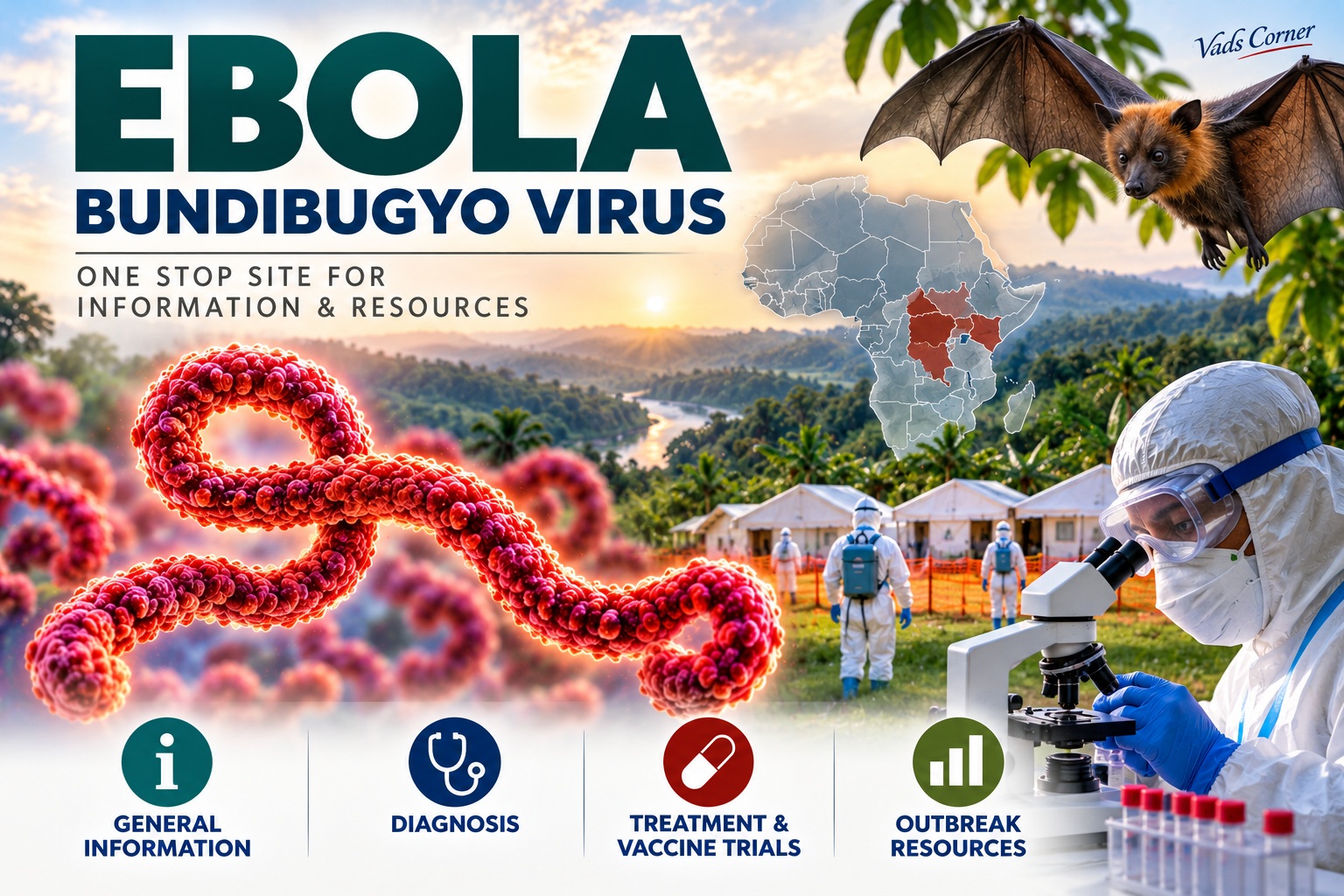
Ebola is back in the news, and this time it is not the virus most of us remember from West Africa in 2014–2016. The outbreak in the Democratic Republic of the Congo (DRC) is caused by Bundibugyo virus, a relative of that Ebola virus, but with no licensed vaccine and no approved treatment. This page is a one-stop reference. It starts with the disease, diagnosis, treatment and vaccines, then gives the outbreak its own section with the dated figures, the official reports, the journal papers and the links. Ebola viruses are not paramyxoviruses. They are filoviruses (family Filoviridae, genus Orthoebolavirus), which is why a vaccine proven against one species cannot be assumed to work against another.
My own writing on Ebola
Ebola — Understanding the Bundibugyo Virus
Kerbside Consult 65/2026, 25 October 2026. A plain-language review of where Bundibugyo virus comes from, how it spreads, why vaccines are difficult, the new Tumaini trial, and Malaysia’s preparedness.
The Serum Institute of India — Vaccinating the World, One Dose at a Time
Related Kerbside Consult. The Oxford–Serum Institute candidate is one of two Bundibugyo-specific vaccines expected to join the Tumaini trial.
SURVEILLANCE SNAPSHOT marks a dated table of figures.
The disease Diagnosis Treatment and trials Vaccines and the Tumaini trial DRC outbreak Other countries Travel and borders Malaysia Journal articles General resources About the figures
Ebola: the disease
Ebola disease is a severe and often fatal illness. According to the WHO fact sheet (version dated 24 April 2025, so it predates this outbreak), three viruses have caused large outbreaks: Ebola virus, Sudan virus and Bundibugyo virus. The average case-fatality rate is around 50%, and it has ranged from 25% to 90% in past outbreaks.
| Virus | Disease | Licensed vaccine | Approved treatment |
|---|---|---|---|
| Ebola virus (EBOV; Orthoebolavirus zairense) | Ebola virus disease | Yes: Ervebo (Merck); Zabdeno with Mvabea (Janssen) | Yes: ansuvimab and REGN-EB3 (WHO strong recommendation) |
| Sudan virus (SUDV) | Sudan virus disease | No. Candidates in development | No. Candidates in development |
| Bundibugyo virus (BDBV; Orthoebolavirus bundibugyoense) | Bundibugyo virus disease (BVD) | No. Tumaini trial under way | No. Trials under way |
Source: WHO fact sheet; CDC Health Alert Network advisory of May 2026 for the species names. Check the ICTV page above for the current taxonomy.
- Origin. Ebola disease first appeared in 1976, in two simultaneous outbreaks: Sudan virus in Nzara (now South Sudan) and Ebola virus at Yambuku (now DRC). Fruit bats are thought to be the natural hosts. People are infected through close contact with the blood, secretions or organs of infected animals, including bats, chimpanzees, gorillas and forest antelope found ill or dead.
- Spread between people. By direct contact, through broken skin or mucous membranes, with the blood or body fluids of a person who is sick with or has died from Ebola, or with contaminated objects and surfaces. WHO says people cannot transmit the disease before they have symptoms. Health workers are often infected when infection control slips, and unsafe burials with direct contact with the body drive further spread. It is not spread through the air like measles.
- Onset. Symptoms begin 2–21 days after infection: sudden fever, fatigue, muscle pain, headache and sore throat, then vomiting, diarrhoea, abdominal pain, rash and signs of kidney and liver impairment. Bleeding is less common than people believe and tends to come later. WHO’s Africa office says it is not very common with Bundibugyo. Confusion, irritability and aggression can occur.
- Look-alikes. The early picture is the same as malaria, typhoid, shigellosis, meningitis and other viral haemorrhagic fevers, so a travel and exposure history matters.
- Survivors. Orthoebolaviruses can persist in immune-privileged sites such as the testes, the eye and the brain. For Ebola virus, transmission through semen has been documented up to 15 months after recovery. Where no semen testing programme exists, WHO advises male survivors to practise safer sex for 12 months. That evidence is for Ebola virus (EBOV), and data specific to Bundibugyo are more limited, so the same precautions are prudent. WHO does not recommend isolating recovered patients whose blood is negative.
Authoritative disease information
- WHO — Ebola disease fact sheet · WHO Ebola health topic · WHO Q&A on Ebola vaccines
- CDC — About Ebola · Signs and symptoms · How it spreads · Outbreak history
- CDC — Clinical guidance for Ebola disease
- WHO guidelines for the clinical management of filovirus disease
- WHO infection prevention and control guideline for Ebola and Marburg disease (17 May 2026)
- Specific to Bundibugyo virus disease: CDC MMWR — Outbreak of Ebola disease caused by Bundibugyo virus, DRC and Uganda, May 2026 · WHO Disease Outbreak News 622 · ECDC — Ebola disease: multi-country outbreak 2026 · CEPI — Ebola Bundibugyo
- WHO — Marburg virus disease fact sheet (a related filovirus)
How deadly is Bundibugyo?
- Earlier outbreaks. The two previous Bundibugyo outbreaks were in Uganda (2007–2008) and in DRC (2012). The published fatality figures differ by source: WHO gives 30% and 50%, CDC gives 25% and 50%, and the original Ugandan investigation (Wamala et al., Emerg Infect Dis 2010) reported 34%. A 2026 reanalysis estimated 31%, declining to 25% after control measures (de Padua and Akhmetzhanov). I have not tried to reconcile them.
- This outbreak. WHO’s crude case-fatality ratio in DRC is 48.3% as of 20 October 2026 (figures below). Many patients die in the community rather than in a treatment centre, which points to late detection and late care.
Diagnosis: laboratory tests
Ebola cannot be told from malaria, typhoid and other fevers on clinical grounds in the early days, so laboratory confirmation is what counts. WHO lists four confirmatory methods: reverse transcriptase PCR (RT-PCR), antibody-capture ELISA, antigen-capture detection tests and virus isolation in cell culture.
- Species coverage is the catch. In this outbreak the first samples were tested with an assay aimed at Ebola virus and were negative. Broader molecular testing and genomic sequencing then identified Bundibugyo virus (CDC; Hassan et al.). WHO’s Africa office notes that Bundibugyo can look like malaria or typhoid and that advanced PCR may be needed.
- First listed test. On 2 July 2026 WHO added the first molecular diagnostic test for Bundibugyo virus to its Emergency Use Listing. WHO and Africa CDC are also setting up a joint validation platform for further products, including near-point-of-care and antigen rapid tests (WHO news release, 2 July 2026, as reproduced by GlobalSecurity.org).
- Biosafety. Samples from patients are an extreme biohazard. WHO advises that testing of non-inactivated samples be done under maximum biological containment, with triple packaging for transport.
- Cross-reactivity of antibody tests. Antibody responses to the licensed Ebola virus vaccine and to natural infection do not cleanly separate the species. See the journal list below, and read the full papers before relying on any serology result.
Laboratory testing: further reading
- WHO — Diagnostic testing for Ebola disease and Marburg virus disease: interim guidance (9 July 2026)
- WHO — Diagnostic testing for Ebola and Marburg diseases (earlier guidance, linked from the fact sheet)
- CDC — Clinical screening and diagnosis for viral haemorrhagic fevers
- WHO — Border health and points of entry for filovirus outbreaks
Treatment and treatment trials
- Supportive care comes first. Early, intensive supportive care, with aggressive rehydration, treatment of symptoms and of co-infections such as malaria, improves survival. WHO’s own guidance calls it optimised supportive care. Seeking care early can be lifesaving.
- No approved treatment for Bundibugyo. The monoclonal antibodies WHO recommends (ansuvimab and REGN-EB3) are for Ebola virus disease only. WHO says no therapeutic is approved for Bundibugyo, and no treatment has been shown to work across all the viruses that cause Ebola disease.
| Trial | What is being tested | Start and place | Source |
|---|---|---|---|
| PARTNERS (Platform Adaptive Randomised Trial for New and Repurposed Filovirus TreatmentS) | MBP134 (a two-antibody cocktail, Mapp Biopharmaceutical) and remdesivir (Gilead), each alone or together, added to standard supportive care. The outcome is mortality 28 days after starting treatment. | Enrolment opened 2 July 2026 at the Evangelical Medical Centre, Bunia, Ituri | ITM Antwerp press release |
| EBO-PEP | Oral obeldesivir (Gilead) as post-exposure prophylaxis in high-risk contacts, randomised against placebo. Led by INRB, ANRS MIE and ALIMA. | Announced 14 July 2026; DRC and Uganda | EBO-PEP press release (PDF) |
Both trials are investigational. Nothing here shows that any of these products works against Bundibugyo in people. Design details come from the sponsors’ announcements; check the WHO and trial-registry records for current protocols.
Treatment and clinical-management references
- WHO — Optimized supportive care for Ebola virus disease (2019)
- WHO — Therapeutics for Ebola virus disease (the recommendations for Ebola virus only)
- WHO — PARTNERS CORE trial protocol · PARTNERS trial website (Oxford)
- WHO — Assessment and management of health and care workers with possible occupational exposures
Vaccines and the Tumaini trial
- Licensed vaccines are for Ebola virus only. Ervebo (single dose) and the Zabdeno and Mvabea regimen are approved for Ebola virus disease. WHO and CDC both say there is no licensed vaccine for Bundibugyo.
- Do not assume cross-protection. CDC’s May 2026 Health Alert Network advisory said that, based on animal studies, Ervebo is not expected to protect against Bundibugyo virus. Whether it does protect people is exactly what Tumaini will test. See my Kerbside Consult article for the animal and antibody data and their limits.
- Tumaini (Swahili for “hope”) is a Phase 2/3 randomised, adaptive platform trial of Bundibugyo vaccine candidates in contacts of cases, using ring vaccination (NCT07842107). The first participant was vaccinated in Bunia on 23 October 2026. The first candidate is Ervebo, which is licensed for Ebola virus. Two CEPI-funded Bundibugyo-specific candidates, from Moderna and from the University of Oxford with the Serum Institute of India, are expected to enter the trial shortly and had not yet done so at the time of the announcement.
- Who runs it. INRB (DRC) and the University of Antwerp are co-sponsors. Candidates are chosen by the WHO Technical Advisory Group on Candidate Vaccine Prioritisation. Eligibility includes pregnant women, children aged 12 and over, and children from one year for Ervebo.
- Manufacturing. Gavi has committed up to US$40 million for manufacturing readiness, so doses are available at scale once a vaccine is approved.
The ClinicalTrials.gov record showed “not yet recruiting” with an estimated start of 20 October 2026 when I last checked. The CEPI announcement reports the first vaccination on 23 October, which is the date used here.
Vaccine and policy references
- Licensed Ebola vaccines (Ebola virus only, not Bundibugyo): FDA — Ervebo · EMA — Zabdeno (Ad26.ZEBOV-GP) · WHO Q&A on Ebola vaccines
- CEPI — First participant vaccinated in pivotal Phase 2/3 Bundibugyo vaccine trial in DRC (23 October 2026)
- WHO — Third TAG-CVP meeting report on Bundibugyo vaccine prioritisation (31 July 2026)
- CDC — Ebola vaccine product information · CDC Health Alert Network advisory, May 2026
- WHO SAGE recommendations on Ebola vaccination (July 2024)
- CEPI — Ebola Bundibugyo · IPPS — tracker of diagnostics, therapeutics and vaccines
Democratic Republic of the Congo
SURVEILLANCE SNAPSHOT Reporting date: 20 October 2026. Source: WHO Disease Outbreak News 622 (23 October 2026).
| Measure | Count | Classification |
|---|---|---|
| Cases | 9,704 | Confirmed |
| Deaths | 4,687 | Among confirmed cases |
| Recoveries | 2,595 | Among confirmed cases |
| Crude case-fatality ratio | 48.3% | WHO calculation; outcomes of the remaining cases not yet recorded |
| Spread | 66 health zones in 8 provinces | 50 of the 66 had a new case in the previous 21 days |
| Latest 24 hours | 67 new confirmed cases | Ituri 37, Nord Kivu 29, Tshopo 1 |
| Since the previous WHO update (8 October) | 976 cases and 482 deaths | 307 of those deaths in the community and 175 in treatment centres |
| Province | Confirmed cases | Deaths |
|---|---|---|
| Ituri (epicentre) | 7,040 | 3,271 |
| Nord Kivu | 2,146 | 1,199 |
| Haut-Uélé | 421 | 183 |
| Tshopo | 76 | 27 |
Bas-Uélé, Sud-Kivu, Sud-Ubangi and Nord-Ubangi also have confirmed cases; WHO does not give their individual totals in this release. Nord Kivu has the highest provincial case-fatality ratio, at 55.9%. Nord-Ubangi is the most recently affected province, with three confirmed cases including one death.
How the figures have moved
Each row is a separate source with its own reporting date. Read across a row, not down a column.
| Source | As of | Confirmed cases | Deaths |
|---|---|---|---|
| Chamla et al., Lancet Infect Dis 2026 | 8 June | 598 | about 115 (case-fatality ratio about 19%) |
| Same paper | 22 June | 1,048 | 267 |
| WHO DON 622 | 20 October | 9,704 | 4,687 |
| CEPI release, citing the INRB epidemic dashboard | 21 October | 9,552 | 4,602 |
| CDC current situation (updated 24 October) | 22 October | 9,816 | 4,757 |
The three October rows are not a daily sequence. They come from different data cuts, and the CEPI figure is lower than WHO’s earlier-dated figure. The 8 June case-fatality figure is the paper’s own: 115 of 598. The paper also notes that the early suspected-case series peaked at 1,077 on 26 May before being revised sharply downwards by laboratory reclassification.
What has happened
- Declaration. DRC declared the outbreak on 15 May 2026, its 17th Ebola outbreak since 1976, in Ituri Province. WHO declared a public health emergency of international concern on 17 May. Africa CDC declared a public health emergency of continental security on 18 May. The outbreak was detected after weeks of unrecognised spread, following unusual deaths northwest of Bunia (WHO PHEIC announcement).
- Size and speed. WHO describes it as the largest Ebola outbreak ever recorded in DRC, irrespective of species. CDC calls it the second-largest on record. CDC reports that it passed 1,000 confirmed cases within 40 days of response activation, against about 235 days for the 2018 outbreak in DRC.
- WHO risk assessment (14 August). Very high for DRC, high for countries sharing a land border with DRC, and low for the rest of the African region and globally. WHO is now revising it. WHO advises against any restriction of travel or trade.
- Contact tracing is short of target. WHO reports 30,130 contacts under follow-up in six provinces, with 79.7% seen in the last 24 hours against a required 95%. Nord Kivu is the weakest, at 73.3%.
- Why it is hard. CDC lists limited health infrastructure, conflict and displacement, violence against health workers and PPE shortages that leave health workers infected, frequent cross-border movement, and mistrust and misinformation.
- Response. Surveillance, laboratory testing, infection prevention and control, clinical care, community engagement and research are being scaled up. The WHO AFRO page below carries the weekly external situation reports.
Official and surveillance sources
- WHO Disease Outbreak News 622: DRC, Kenya and Nigeria (23 October 2026) · DON 619 (8 October) · all WHO DONs for this event
- WHO Regional Office for Africa — outbreak page and weekly situation reports
- CDC — Ebola outbreak: current situation (updated 24 October 2026)
- DRC Ministry of Health — daily situation reports (INSP) · INRB epidemic intelligence dashboard
- WHO Rapid Risk Assessment, version 4 (being revised)
- IHR Emergency Committee, second meeting: temporary recommendations (24 August 2026)
- Africa CDC and WHO — continental preparedness and response plan, June–November 2026
NGO and partner reports
- Médecins Sans Frontières — DRC Ebola outbreaks
- CEPI — Ebola Bundibugyo · IPPS countermeasure tracker
Other countries
SURVEILLANCE SNAPSHOT Cases have been reported in five countries since the outbreak was declared: DRC, Uganda, France, Kenya and Nigeria. Sources: WHO DON 622 (Kenya and Nigeria, to 20 October) and CDC (Uganda and France, to 22 October).
| Country | Confirmed | Deaths | Status |
|---|---|---|---|
| Uganda | 20, plus 1 probable | 2 confirmed, plus 1 probable | Outbreak declared over on 27 August 2026 after the 42-day countdown. The last confirmed case was released from care on 16 July. |
| Kenya | 9 | 1 | One imported case, reported on 6 October, and eight linked cases: four family members and four health and care workers. All were in quarantine at onset. No evidence of transmission outside this cluster. 135 contacts traced and quarantined. |
| Nigeria | 1 | 0 | Imported case confirmed in Abuja on 20 October in a person who travelled from Uganda. Symptoms began on 7 October. 44 contacts are being monitored. Source of exposure under investigation. |
| France | 1 | 0 | The case recovered and was released from care on 4 July 2026. |
The United States has reported no cases from this outbreak (CDC, 24 October). Uganda’s own ministry does not include suspected cases in its official count, and CDC’s Uganda figures include one probable case and one probable death. Kenya had screened 709,093 travellers and tested 461 samples by 22 October, according to WHO.
Country sources
- WHO AFRO — Uganda ends Ebola outbreak following completion of 42-day countdown (27 August 2026)
- WHO AFRO — Nigeria confirms imported case of Ebola Bundibugyo virus disease · Federal Ministry of Health, Nigeria: press statement (PDF)
- Kayiwa et al., Emerg Infect Dis 2026 — early action review of Uganda’s response (7-1-7 framework)
Travel and borders
- WHO advice. WHO advises against any restriction of travel to, or trade with, affected countries. WHO’s Africa office adds that border closures are not supported by scientific evidence and may push movement onto informal and unmonitored crossings.
- United States. CDC says the risk to the American public remains low. US entry for travellers who were recently in DRC is temporarily restricted, travellers from Uganda or South Sudan must enter through designated airports, and from 3 November 2026 all passengers on international flights to the US must attest that they have not been in DRC in the previous 21 days. These rules change, so check the CDC pages below. Other countries have their own measures.
- CDC travel health notices. Level 4 (avoid all travel) for Ituri and Nord-Kivu; Level 3 for Haut-Uélé and Tshopo; Level 2 for the rest of DRC and Uganda; Level 1 for Kenya.
- CDC — Information for travellers returning from Ebola-affected areas · Interim public health travel guidance
- CDC travel health notice, Level 4: Ituri and Nord-Kivu · Kenya, Level 1
Malaysia
- Latest statement I could find. The Ministry of Health Malaysia issued a media statement on 20 May 2026, in Malay. It reported no Ebola case in Malaysia, strengthened surveillance at all international entry points, and monitoring of travellers from Uganda and DRC, including those transiting through hubs such as Dubai, Doha and Singapore. It said there were no direct flights from either country to Malaysia, and described isolation and infection-control readiness, PPE and training, and laboratory capacity through the Institute for Medical Research (IMR) and the National Public Health Laboratory.
- Not a current status report. That statement is five months old, and as of 25 October 2026 I could not find a later one. Check the Ministry’s own site for anything newer.
- What a temperature check cannot do. It cannot identify someone who is still incubating the infection, so clinical vigilance and prompt notification to the public health authorities matter more than airport screening.
- Kementerian Kesihatan Malaysia — Kesiapsiagaan menghadapi risiko penyakit Ebola virus Bundibugyo (20 May 2026, in Malay)
- Ministry of Health Malaysia
Journal articles on the 2026 outbreak
Abstracts read via PubMed (publication dates 2026 unless stated). Figures quoted on this page from papers come from their abstracts; check the full text before quoting them further. Two items have no abstract in PubMed and are listed from their titles and citations only.
Outbreak and epidemiology
- Chamla D, Belizaire MRD, Co IF, et al. Size of the 2026 Ebola outbreak and risk of cross-border spillover from Bundibugyo virus in Ituri Province, DR Congo, and its implications for preparedness: a recalibrated stochastic modelling study. Lancet Infect Dis 2026;26(11):1099–1105. DOI
- Gashema P, Muvunyi CM. Can stochastic modelling predict cross-border spread of the Bundibugyo Ebola virus outbreak in Africa? Lancet Infect Dis 2026;26(11):1088–1089 (comment; no abstract). DOI
- Verheyden JGL, Mudogo CN. Sixteen days undetected: growth dynamics and the case for pre-positioned response capacity in the 2026 Bundibugyo virus disease outbreak, Democratic Republic of the Congo. Int J Infect Dis 2026:109170. DOI
- Kayiwa J, Bbuye M, Atuhaire R, et al. Early action review of detection, notification, and response timeliness during cross-border Bundibugyo virus disease outbreak, Uganda, 2026. Emerg Infect Dis 2026;32(10):1543–1550. DOI
- de Padua B, Akhmetzhanov AR. Estimated transmissibility and case fatality rate of Bundibugyo virus, Uganda, 2007. Emerg Infect Dis 2026;32(10):1762–1764. DOI
- CDC 2026 Ebola Response. Notes from the field: outbreak of Ebola disease caused by Bundibugyo virus — Democratic Republic of the Congo and Uganda, May 2026. MMWR 2026;75(22). MMWR
Clinical care, treatment and prophylaxis
- Uhrig A, Pfäfflin F, Tober-Lau P, et al. A case of Bundibugyo virus disease treated with monoclonal antibodies and remdesivir. Nat Med 2026 (single case report). DOI
- Gaebler C, Le HN, Martin L, et al. Post-exposure prophylaxis with a monoclonal antibody cocktail after Bundibugyo ebolavirus exposure in adults and children. Nat Med 2026;32(10):3606–3611 (five people in one family cluster). DOI
- Kratz T, Roddy P, Tshomba Oloma A, et al. Ebola virus disease outbreak in Isiro, Democratic Republic of the Congo, 2012: signs and symptoms, management and outcomes. PLoS One 2015;10(6):e0129333. DOI
Vaccines and laboratory science
- Pletschette M, Biedenkopf N. Vaccine preparedness for Bundibugyo virus and lessons learned. npj Vaccines 2026;11:170. DOI
- Jain S, Morgan L, Choi M, et al. Cross-neutralisation of authentic Ebola virus and Bundibugyo virus following natural infection or Ervebo vaccination. Lancet Infect Dis 2026 (letter; no abstract in PubMed, so not read). DOI
- Mdluli T, Wollen-Roberts S, Merbah M, et al. Ebola virus vaccination elicits Ebola virus-specific immune responses without substantial cross-reactivity to other filoviruses. Sci Transl Med 2025;17(792):eadq2496. DOI
- Mire CE, Geisbert JB, Marzi A, et al. Vesicular stomatitis virus-based vaccines protect nonhuman primates against Bundibugyo ebolavirus. PLoS Negl Trop Dis 2013;7(12):e2600. DOI
- Henao-Restrepo AM, Camacho A, Longini IM, et al. Efficacy and effectiveness of an rVSV-vectored vaccine in preventing Ebola virus disease: final results from the Guinea ring vaccination, open-label, cluster-randomised trial (Ebola Ça Suffit!). Lancet 2017;389(10068):505–518. DOI — the Ebola virus (Zaire) trial behind Ervebo
- Jain S, Bergeron É, Flint M, et al. Development and characterization of a recombinant Bundibugyo virus expressing a fluorescent reporter protein. Emerg Microbes Infect 2026;15(1):2709847. DOI
- Kupferschmidt K. Vaccine trial is a ray of hope in Congo’s Ebola epidemic. Science 2026;394(6822):364–365 (news, 22 October 2026). DOI
Preparedness and commentary
- Hassan AM, Yusuf AA, Hirsi AM, et al. Species breadth is a preparedness metric: lessons from the 2026 Bundibugyo virus disease outbreak. Emerg Microbes Infect 2026;15(1):2744490. DOI
- Kambale Kahingi J, Mbokolo Bolima C, Belanga Bola J, et al. From Ebola response to adaptable preparedness beyond a single virus. Trop Med Health 2026;54(1) (letter). DOI
- Baker P. Community event-based surveillance as trust infrastructure for Bundibugyo Ebola response. Int J Infect Dis 2026;172:109109. DOI
- Dhillon H, Sasidharan S. The storm we chose: Bundibugyo virus, preparedness injustice, and the pathogens we decline to fight. Dev World Bioeth 2026. DOI
- Wamala JF, Lukwago L, Malimbo M, et al. Ebola hemorrhagic fever associated with novel virus strain, Uganda, 2007–2008. Emerg Infect Dis 2010;16(7):1087–1092. DOI — the original description of Bundibugyo virus
PubMed searches
- Ebola
- Ebola outbreak
- Ebola virus disease
- Bundibugyo
- Bundibugyo 2026 outbreak
- Ebola vaccine
- Ebola treatment
- Ebola monoclonal antibodies
- Ebola survivors
- Sudan virus
- Filovirus
Journals
General resources
- Genus Orthoebolavirus – ICTV Report · International Committee on Taxonomy of Viruses (ICTV)
- World Health Organization · Disease Outbreak News
- CDC — Ebola · Centers for Disease Control and Prevention
- Africa CDC
- Vads Corner — Measles
- Vads Corner — Nipah virus and the Paramyxoviridae
- Vads Corner — Dengue
- PubMed (NLM)
About the figures on this page
The case counts here are a snapshot as of 25 October 2026, drawn from data dated 20–22 October. This page does not update itself, and the outbreak is still moving, so the numbers will be out of date soon after you read them. Each figure is shown with its source, reporting date and case classification so you can check it against the original.
- For the latest figures, go to the WHO Disease Outbreak News for this event, the CDC current situation page, the WHO Africa weekly situation reports and the DRC Ministry of Health daily reports.
- Counts are provisional. Reporting delays, reclassification and data-standardisation work mean totals can be revised, sometimes downwards.
- Compare like with like. Only compare two figures from the same source that cover the same period and use the same definition. A change in a cumulative total is a change in reported cases, not necessarily new cases that day.
- Trials move fast. The status of PARTNERS, EBO-PEP and Tumaini, including which vaccine candidates have entered the trial, can change within days.
This page is revised from time to time as new official reports are published.
First posted 25 October 2026
Disclaimer ·
cyberdoc@vadscorner.com