When COVID-19 arrived, most people had never heard of messenger RNA, or mRNA. Yet within a short time, millions were receiving vaccines built on this technology. The science was not invented during the pandemic: it rested on decades of research.
Now researchers are testing whether the same messenger can help treat cancer. In October 2026, a large melanoma trial reported encouraging results.[4] What exactly is mRNA, and how might it help?
The messenger is not the whole story. What matters is the message it carries, and whether the evidence shows that message works.
A word of transparency: I am now a freelance consultant, and I previously worked at the Ministry of Health, Servier, Sanofi, Celgene, BMS and Novavax.
Contents
- The Body’s Instruction System
- How an mRNA Vaccine Works
- Why Is mRNA Different?
- From Infection to Cancer
- Melanoma: Made for One Patient
- What the Latest Trial Showed
- Beyond Melanoma — Pancreas and Breast
- Not Every mRNA Medicine Is a Vaccine
- Safety and Limitations
- What About Malaysia?
- The Kerbside View
- Sources & further reading
The Body’s Instruction System
Imagine a cell as a factory. DNA is its master instruction book. Messenger RNA is a temporary copy of one recipe, and ribosomes are the workers that read it to manufacture a protein. Our cells make and destroy mRNA every day.
Scientists learned to manufacture a message containing instructions for a chosen protein. Instead of supplying the finished product, they could temporarily tell cells how to make it.[1]
Not the product, but the recipe.
Selected references: 1.
How an mRNA Vaccine Works
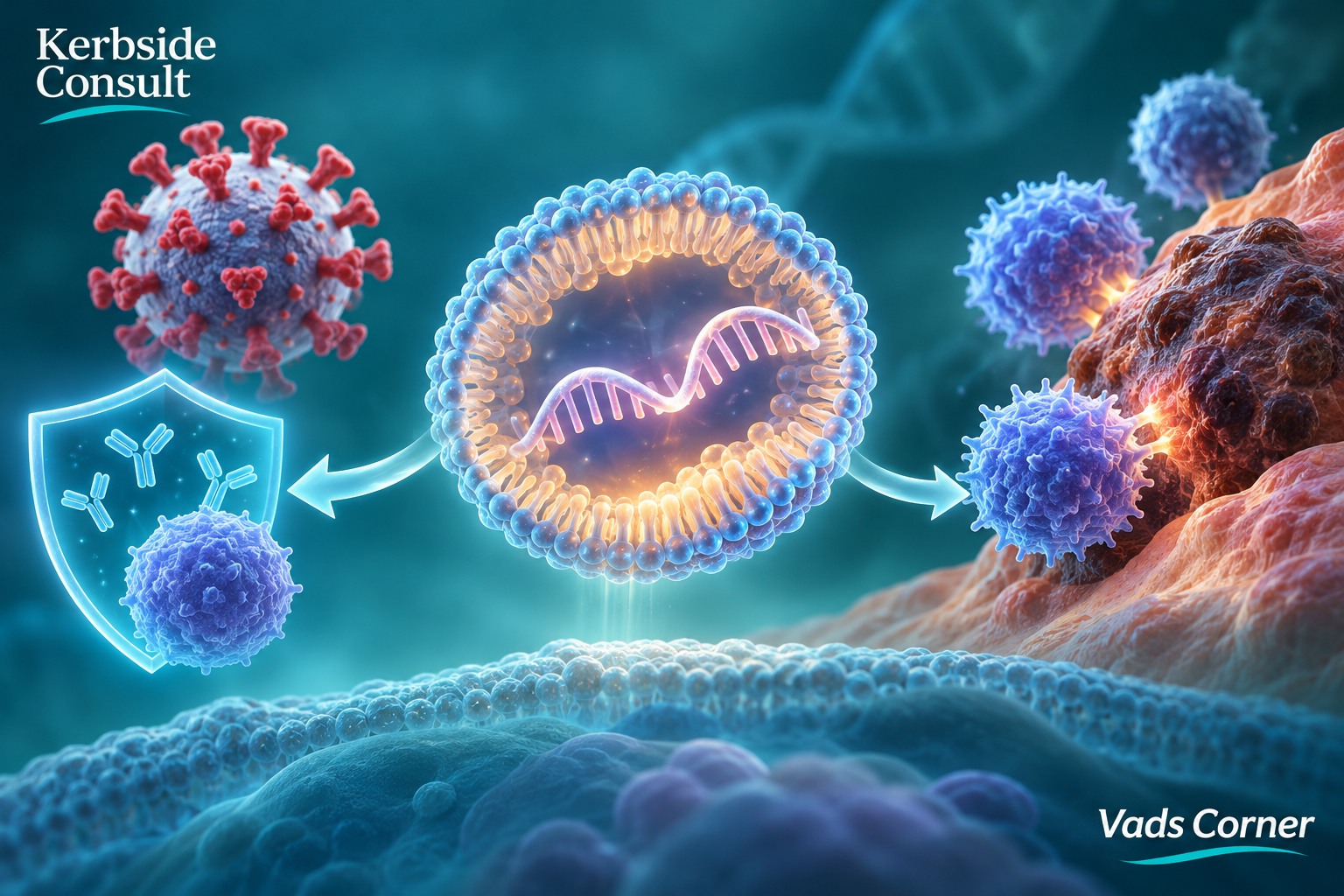
For COVID-19, the message encoded the coronavirus spike protein. Scientists enclosed the fragile mRNA in tiny fatty bubbles (lipid nanoparticles) to protect it and help deliver it into cells. Those cells briefly made the spike protein, which helped the immune system learn to recognise the virus.
The vaccine did not contain a complete infectious coronavirus. The mRNA does not rewrite our DNA; it is short-lived and is broken down after use.[1]
Think of vaccination as a fire drill: the immune system rehearses before meeting the real threat.
Selected references: 1.
Why Is mRNA Different?
Traditional vaccines may deliver a weakened or inactivated pathogen, or a protein made outside the body. An mRNA vaccine delivers the instructions for making an antigen. Once a useful genetic sequence is known, researchers can redesign the message relatively quickly.
COVID-19 was the first large test. Regulators have since approved an mRNA vaccine against respiratory syncytial virus (RSV): in the United States it is licensed for adults aged 60 and over, and for younger adults at increased risk. The platform is no longer a one-disease story.[2]
Even so, speed and flexibility do not remove the need for manufacturing controls, safety evaluation or properly conducted clinical trials. Not every candidate will work.
Selected references: 2.
From Infection to Cancer
An infectious-disease vaccine generally aims to prevent infection, and it is given to people who are well. A therapeutic cancer vaccine is a different animal. It is given to a patient who has, or has had, cancer, and it aims to help the immune system attack the cancer or reduce the risk of its return. The word “vaccine” is borrowed; the purpose is treatment.
Cancer cells arise from our own tissues, so they are harder for the immune system to distinguish from healthy cells. Some develop mutations that produce distinctive targets called neoantigens. An mRNA vaccine can instruct cells to make selected neoantigens, helping train T cells to recognise tumour cells bearing those targets.
The same messenger, but a different job.
Melanoma: Made for One Patient
In a personalised approach, clinicians sample a patient’s melanoma and compare its genetic information with normal tissue. Researchers identify promising mutations, select neoantigens and manufacture a corresponding mRNA treatment. Two patients may therefore receive different instructions.
The treatment can be paired with pembrolizumab, a checkpoint inhibitor that blocks the PD-1 pathway. In simple terms, the vaccine helps identify the target; pembrolizumab helps release a brake on immune attack.
Pembrolizumab is not a newcomer here. After surgery for stage III melanoma, it already lowered the risk of recurrence or death in the 2018 EORTC 1325 (KEYNOTE-054) trial (hazard ratio 0.57).[6] The question for the new treatment is what it adds on top of that standard.
Selected references: 6.
What the Latest Trial Showed
The Phase III INTerpath-001 trial enrolled 1,137 adults whose high-risk melanoma (stage IIB to IV) had been completely removed by surgery. Two out of every three received the personalised mRNA treatment, intismeran autogene, plus pembrolizumab; the rest received pembrolizumab plus a dummy injection. Neither patients nor doctors knew which.[4], [5]
The personalised treatment takes time to make: a median of 64 days before the first dose, although pembrolizumab started straight away. For someone with fast-moving disease, waiting two months is not a small matter.[4], [5]
After two years, 82.2% of patients on the combination were alive and free of recurrence, against 70.0% on pembrolizumab alone. That 12-point difference is what researchers express as a 42% lower risk of recurrence. The two figures describe the same result; it does not mean 42% more patients were cured. Spread to distant organs was also less frequent (88.5% free of spread against 80.2%).[4], [5]
The benefit did not appear at once. For the first six months the two groups looked alike, which is what you would expect while the treatment is being made and the immune system is learning its target.[4]
Side effects were mostly fever, a sore arm and fatigue, much as with other vaccines. Serious side effects were similar in the two groups (17.6% and 15.8%), although more patients on the combination stopped one of the two drugs.[4], [5]
Full numbers, for the technically minded
| Measure | Intismeran + pembrolizumab | Placebo + pembrolizumab | Comparison |
|---|---|---|---|
| Two-year recurrence-free survival (primary endpoint) | 82.2% | 70.0% | HR 0.58 (95% CI 0.45–0.75); p<0.001 |
| Two-year distant metastasis-free survival | 88.5% | 80.2% | HR 0.62 (95% CI 0.45–0.85); p=0.002 |
| Overall survival | Immature | HR 0.77 (95% CI 0.45–1.31); p=0.33, boundary not crossed | |
| Grade 3 or higher adverse events | 23.6% | 20.3% | — |
| Serious adverse events | 17.6% | 15.8% | — |
| Both drugs discontinued together because of an adverse event | 6.5% | 5.3% | — |
| Either drug discontinued because of an adverse event | 16.6% | 9.5% | — |
| Fatal adverse events | 1.1% (8 patients) | None | None judged related to intismeran |
| Fever / injection-site pain / fatigue | 52.2% / 51.0% / 38.5% | 8.2% / 9.5% / 29.7% | Excess mostly low grade and injection-related |
Efficacy: intention-to-treat population (757 vs 380 patients); recurrence assessed by investigators. Safety: as-treated population (755 vs 380). Rates in the abstract are the primary source; overall survival, serious adverse events and “either drug” discontinuation are from the reported presentation.
Two cautions. We do not yet know whether patients live longer; the survival data are still immature. And these are interim results from a trial run by the makers of the treatment. An independent expert commenting for ESMO, Prof. Inge Marie Svane of Copenhagen, called the results convincing, but said clinicians will need guidance on where it fits among other options. The treatment remains investigational. The full paper is due in the New England Journal of Medicine on 11 November 2026, and I will check these figures against it.[5]
A genuine advance, with the best evidence still to come.
Beyond Melanoma — Pancreas and Breast
Melanoma is only one cancer. What about the others?
Pancreatic cancer. In a small Phase I study, 16 patients received an individualised RNA neoantigen vaccine after surgery as part of a treatment programme that also included atezolizumab and chemotherapy. Eight developed measurable vaccine-induced T-cell responses.[7] A 2025 follow-up in Nature reported that these eight responders had a median recurrence-free survival that had not been reached, against 13.4 months in the eight non-responders.[8] That is a comparison between immune responders and non-responders, not between vaccinated and unvaccinated patients. The authors did check whether responders simply had stronger immune systems, and found that both groups mounted equivalent responses to a concurrent COVID-19 mRNA vaccine.[7] That is reassuring, but the study was small, nonrandomised and without an unvaccinated control group. Larger trials must show whether vaccination itself improves outcomes.
Triple-negative breast cancer. In a small study published in Nature in February 2026, 14 patients received individually designed mRNA vaccines after surgery and other standard treatment. Vaccine-induced T-cell responses were detected in nearly all, remained functional for years, and 11 patients stayed free of relapse for up to six years. Three relapsed.[9] Encouraging, certainly, but this was an exploratory, non-comparative study run by the vaccine’s developer, and without a randomised comparison group we cannot conclude that the vaccine prevented those recurrences. Personalisation also takes time: the average turnaround from sample receipt to vaccine release was 69 days (range 34–125), although the aim was to establish the workflow rather than to be fast.
Melanoma is not the only target in the pipeline. Phase 2 and 3 trials of the same personalised approach are examining bladder cancer, lung cancer and kidney cancer.[4] Evidence from one tumour cannot simply be transferred to another.
Not Every mRNA Medicine Is a Vaccine
mRNA is a temporary set of instructions, and its purpose depends on the protein being made. Infectious-disease vaccines train immunity against a pathogen. Therapeutic cancer vaccines aim to train immune cells against tumour targets. Others are not vaccines at all.
Some mRNA medicines are being tested for inherited metabolic diseases. Instead of training immunity, they instruct cells to make an enzyme the patient lacks. Early clinical programmes include methylmalonic acidemia and ornithine transcarbamylase deficiency. Repeated dosing, delivery and lasting clinical benefit remain challenges.[10], [11]
mRNA can also temporarily produce gene-editing machinery, potentially allowing a lasting correction to DNA. Researchers are also exploring ways to programme immune cells inside the body, rather than modifying them in a laboratory, as a possible route to treating cancer and autoimmune disease; much of that in-body work is still in animals. These applications are at different stages of investigation and are not established treatments.[10], [11]
Unlike gene editing, which may be intended to make a lasting change to DNA, ordinary mRNA vaccination leaves DNA alone.[1]
Safety and Limitations
Common mRNA vaccine reactions include injection-site discomfort, fatigue and fever. Some authorised products carry rare but important risks. Myocarditis and pericarditis have been rarely observed after COVID-19 vaccination, most often in adolescent and young adult males within a week of the second dose.[3]
Cancer vaccines may have different risks, especially when combined with immunotherapy. That is why the melanoma safety data matter, and why longer follow-up is essential.[4] Each formulation, dose and patient population needs separate evaluation.
Delivery to the right cells, antigen selection, cost and equitable access remain substantial challenges.
What About Malaysia?
Malaysia’s COVID-19 vaccination experience established public familiarity with mRNA, but making a personalised cancer treatment is another matter. It requires tumour sequencing, bioinformatics, specialised manufacturing, oncology expertise, quality assurance and regulatory oversight working together.
Malaysia could participate in multinational trials and develop capacity, but actual availability, local manufacturing and reimbursement must be verified rather than assumed.
If such treatment is eventually approved, a central question will be whether patients in public hospitals can benefit, not only those who can afford private care.
The Kerbside View
The appeal of mRNA is its flexibility. For one disease, the message may help the immune system recognise a virus; for another, a cancer-specific target; for a genetic disorder, it may supply instructions for a missing protein. The messenger is similar, but the message is different.
We are beginning to ask not only what medicine we can give the body, but what we can instruct the body to make for itself.
The promise is substantial. As always, it must be measured against the evidence.
Sources & further reading
mRNA basics and vaccine safety
- National Institutes of Health, National Human Genome Research Institute. Understanding COVID-19 mRNA vaccines [Internet]. Bethesda (MD): NHGRI; page last updated 2021 Aug 30 [cited 2026 Nov 1]. Source
- US Food and Drug Administration. MRESVIA (respiratory syncytial virus vaccine), STN 125796 [Internet]. Silver Spring (MD): FDA; content current as of 2026 Aug 10 [cited 2026 Nov 1]. Source
- US Centers for Disease Control and Prevention. Safety considerations for COVID-19 vaccines. Interim clinical considerations [Internet]. Atlanta (GA): CDC; 2026 Sep 23 [cited 2026 Nov 1]. Source
Melanoma: the INTerpath-001 trial
- Long GV, Khattak MA, Gogas HJ, Schadendorf D, Arance AM, Carlino MS, et al. INTerpath-001: phase 3 study of the mRNA-based individualized neoantigen therapy (INT) intismeran autogene plus pembrolizumab vs pembrolizumab alone for adjuvant treatment of resected stage IIB–IV melanoma. Abstract LBA1. Presidential Symposium I, ESMO Congress 2026, Madrid; 2026 Oct 24 [cited 2026 Nov 1]. Source (conference abstract) Further figures from the presentation (overall survival, time to first dose, adverse-event detail) are as reported by OncLive Staff. Adjuvant intismeran autogene plus pembrolizumab improves RFS and DMFS in melanoma. OncLive [Internet]. 2026 Oct 24 [cited 2026 Nov 1]. Full publication is scheduled in N Engl J Med on 2026 Nov 11; figures to be rechecked against it.
- European Society for Medical Oncology. First positive phase III trial data for an individualised mRNA-based neoantigen therapy [Internet]. ESMO; 2026 Oct 24 [cited 2026 Nov 1]. Source
- Eggermont AMM, Blank CU, Mandala M, Long GV, Atkinson V, Dalle S, et al. Adjuvant pembrolizumab versus placebo in resected stage III melanoma. N Engl J Med. 2018;378(19):1789-801. doi:10.1056/NEJMoa1802357. Source
Other cancers: pancreas and breast
- Rojas LA, Sethna Z, Soares KC, Olcese C, Pang N, Patterson E, et al. Personalized RNA neoantigen vaccines stimulate T cells in pancreatic cancer. Nature. 2023;618(7963):144-50. Published online 2023 May 10. doi:10.1038/s41586-023-06063-y. Source
- Sethna Z, Guasp P, Reiche C, Milighetti M, Ceglia N, Patterson E, et al. RNA neoantigen vaccines prime long-lived CD8+ T cells in pancreatic cancer. Nature. 2025;639(8056):1042-51. Published online 2025 Feb 19. doi:10.1038/s41586-024-08508-4. Source
- Sahin U, Schmidt M, Derhovanessian E, Cortini A, Vogler I, Omokoko T, et al. Individualized mRNA vaccines evoke durable T cell immunity in adjuvant TNBC. Nature. 2026;651(8107):1088-96. Published online 2026 Feb 18. doi:10.1038/s41586-025-10004-2. Source
mRNA beyond vaccines
- Chien KR, Foo KS, Witman N. Towards mRNA therapeutics 2.0. Nat Rev Drug Discov. 2026;25:757-78. Published online 2026 Jun 3. doi:10.1038/s41573-026-01459-7. Source
- Yang B, Sedano MJ, Perez K, et al. RNA therapeutics: current status and future directions. Signal Transduct Target Ther. 2026;11:409. doi:10.1038/s41392-026-03032-5. Source A broader review of RNA therapeutics, not only mRNA.