Who Will Pay for Malaysia's Health Care? The National Health Fund in Plain Words
Cyberdoc — writing on medicine since 1995
On 16 November the Health Minister told the Dewan Rakyat that the Ministry is targeting the drafting of a National Health Fund Act by 2029. The fund would keep tax-funded care for all citizens and add a separately managed fund of the kind used in social health insurance countries. [1] [2] Very little else was said. This piece explains the terms in everyday language, sets out what we know and do not know, and notes what the Malaysian Medical Association (MMA) has asked for. It is not an endorsement or a criticism of a plan that has not yet been written.
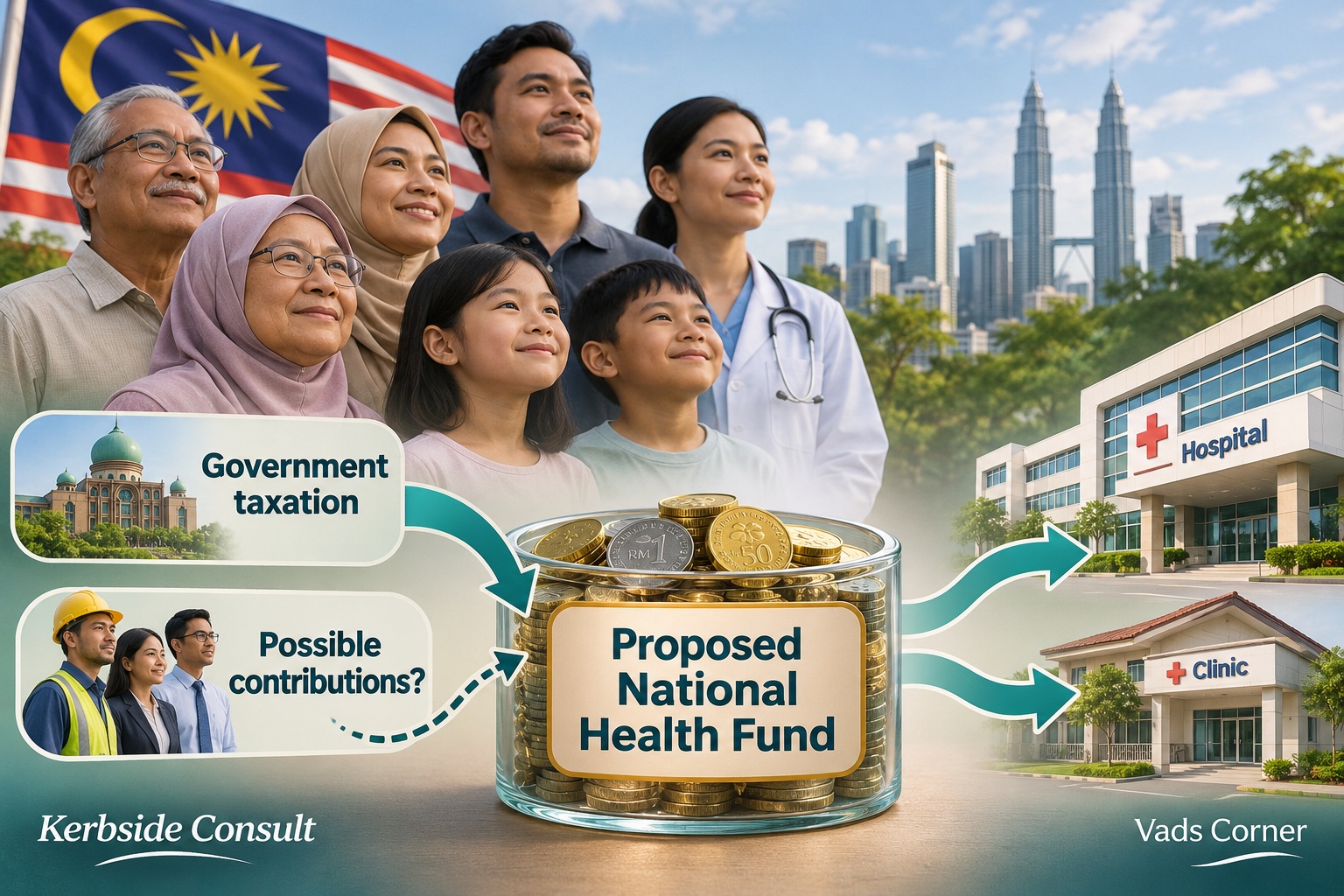
Malaysia’s proposed National Health Fund aims to combine tax-based funding with dedicated healthcare financing. Who contributes, what is covered and how the fund will be governed remain important unanswered questions. The image is AI-generated and is not a photograph of any real people.
1. What was actually said
The Minister was answering Dr Zulkafperi Hanapi (Tanjong Karang), who had asked when the government would introduce a sustainable financing framework to reduce the public system's dependence on annual budget allocations. [1] [2] The reply, as reported, had five parts.
- The target is 2029. The Star quotes the Minister as saying the Ministry targets the drafting of the Act by that year. Bernama also says "drafted", while CodeBlue quotes the Minister as targeting "enactment". The Hansard, still an unrevised draft, has the Minister say the Ministry "menyasarkan penggubalan Akta Dana Kesihatan Nasional menjelang tahun 2029". Penggubalan can be rendered as drafting or enacting, which explains the different English reports. I use "drafting" until the final Hansard. [3] [2] [4] [5]
- The fund would keep the tax-funded base that gives all citizens cover and add features of a dedicated fund managed separately, which would allow more strategic purchasing of services. [2] [6] [7]
- It would need new legislation, federal-state coordination and possibly constitutional changes. [1]
- The Ministry is still studying financing, actuarial modelling, benefit packages, governance and the legal framework. [1]
- The plan builds on the Sihat Bersama 2030 document, the Health White Paper (approved by the Dewan Rakyat in 2023) and the 13th Malaysia Plan. [1] [4]
Note the timing. The 15th Parliament dissolves automatically in December 2027, so the Bill, if there is one, will meet the next government. [5] Either way, 2029 falls to the next government.
2. The terms, in plain words
Health financing sounds technical, but it comes down to three questions: where does the money come from, who holds it, and how is it spent on care? Most of the jargon names an answer to one of these.
- Health financing
- How a country collects money for health, puts it together, and uses it to pay for services. The aim is that people can get services without being pushed into hardship by the cost. [8]
- Pooling
- Putting everyone's contributions into one pot so that money moves from the healthy to the sick and from the better-off to the poorer. A pool raised and held separately, by area or by employer group, can weaken that sharing. [9]
- Beveridge model
- Care is paid for mainly from general taxes, as in the United Kingdom. Malaysia's public system works this way, as the Minister himself noted. [5] [10]
- Bismarck model (social health insurance)
- Named after the German chancellor. Employers and employees pay regular contributions, usually deducted from wages, into a dedicated fund that pays for care. Germany, France and Japan are examples. Tax money often tops it up. [10] [8]
- Hybrid
- A mix of the two. The Minister described tax funding as the base with elements of the Bismarck approach added. [2] WHO frames health financing as three functions, raising revenue, pooling funds and purchasing services, so whatever the label, what counts is how the money is raised, pooled and spent. [8]
- Ring-fenced or earmarked
- Money set aside for health that cannot be spent on something else. The Minister has used "ring-fenced" for the fund. [11]
- Strategic purchasing
- Instead of simply paying hospitals a yearly budget, the fund buys services for the population, choosing what to buy, from whom, and at what price. The Health White Paper proposes a not-for-profit "Strategic Purchaser" for this. [12]
- Out-of-pocket payment
- What you pay yourself at the point of care, such as a private clinic bill. High out-of-pocket spending means less protection.
- Community-rated versus risk-rated
- Under pure community rating, people pay the same premium for equivalent cover regardless of their health risks. Under risk rating, the premium reflects the expected cost of insuring you, so older and sicker people pay more. [13] [14]
- Takaful
- Shariah-compliant insurance, in which participants contribute to a shared pool that pays claims. "MHIT" in the news means medical and health insurance/takaful, and MediAsas is the new name for the government-designed base plan. [15]
- Medical inflation
- Medical costs and insurance premiums rising faster than ordinary prices.
Selected references: [2], [5], [8], [9], [10], [11], [12], [13], [14], [15]
3. Where we stand today
The 2023 Health White Paper described the position using 2019 and 2020 data. Public services provide almost free primary care and heavily subsidised hospital care, funded largely from federal revenue, while the private sector runs mainly on out-of-pocket payments and private insurance. [12]
| Measure | Figure | Source |
|---|---|---|
| Current health spending, 2019 | 4.1% of GDP (upper-middle-income average 7.4%) | Health White Paper, Figure 9 (WHO data) [12] |
| Public share of current health spending, 2019 | 2.2% of GDP (upper-middle-income average 4.4%) | Health White Paper, Figure 9 (WHO data) [12] |
| Share paid out of pocket, 2020 | 34.2% of current health spending | Health White Paper, Figure 6 (national accounts 2020) [12] |
| Total health spending, 2024 | RM89.8 billion, 4.65% of GDP | MOH, Malaysia National Health Accounts 2011-2024 [16] |
| Who paid, 2024 | Public sources 50.7% of total; private sources 49.3%; households out of pocket 38.8%; voluntary private insurance 7.9% | MOH, MNHA 2011-2024 [16]; BNM White Paper gives the same picture [13] |
A caution: the White Paper figures use current health expenditure, while the 2024 figures use total expenditure under the updated MNHA Framework 2.0, which restates earlier years (2023 moves from 4.62% to 4.54% of GDP). Read the table as two snapshots, not a trend. [17] [16]
Two targets are in circulation. The White Paper proposes raising publicly managed health funding to 5% of GDP gradually. [12] The Minister said in February that an upper-middle-income country like ours should be at 5 to 6%, and that revenue as a share of GDP is plateauing, asking instead to be allowed to be "resourceful". [11] The MMA also asks for at least 5%, which it puts at roughly RM70 to 80 billion a year. [18] That gap between where we are and where everyone agrees we should be is the reason a new fund is being discussed. The cost side of the same story, from fixed GP fees to unregulated hospital charges and a strained public system, is in The Floor and the Ceiling and the Doctors Between (7/2026).
4. What "hybrid" is likely to mean
No design has been published, so this is a reading of what the Ministry has said before, not a description of the plan. The White Paper set out the architecture in outline: a benefit package paid for by a dedicated health fund run by a not-for-profit Strategic Purchaser, a "progressive contributory scheme" to be explored, and the Ministry's roles as both purchaser and provider to be gradually devolved to the Purchaser while public facilities remain providers. [12] The Minister's November wording, a tax-funded base plus a separately managed fund that allows strategic purchasing, fits that outline. [7] Buying is the same idea applied to medicines, which I looked at in Buying Medicines Together (60/2026): a large, organised buyer can negotiate better than many small ones.
If so, three things would change. A ring-fenced fund could give health more predictable money, depending on how its own revenue and the government's annual allocation are set. The buyer would be separated from the provider. And contributions might join taxes as a source. The first two are about discipline. The third is about who pays, and that is where the real debate is.
5. The question nobody has answered: who contributes?
In February 2026, at the Forum Ekonomi Malaysia, the Minister listed the sources the fund might draw on: government allocation, a phased contribution described as "targeted employer-employee", industry inputs, trust funds and earmarked "sin" taxes (he has named tobacco, vape, alcohol and sugary drinks). He gave no rates or income bands, and did not say whether contributions would be compulsory. [11] In November, explaining the Bismarck model in the Dewan Rakyat, he described it as built on compulsory contributions from formal-sector workers, with employers and employees both paying in. He said the fund would take the strengths of that model, but not whether it would include such contributions. CodeBlue notes it is unclear whether statutory contributions are involved at all, since he spoke of a "package of benefits". [3] [5] There is also a constitutional wrinkle: a month earlier he had told the Dewan Rakyat that sugary-drink tax revenue is not earmarked for health, because government revenue goes into the federal consolidated fund. So even earmarking may need legal change. [11]
The timetable has also shifted. In February the Minister spoke of having the fund in place within 2026 or 2027; in November the target was 2029 for the Act. A fund and its legislation may be different steps, but the Ministry should say how they fit together. [11] [1]
The Edge adds that, in an earlier parliamentary reply, the Ministry said the fund would pool financing from multiple sources rather than rely entirely on employee contributions or general taxation. [1] That points to a mix, but leaves the share of each open. Contributions, if there are any, are the part ordinary families will feel, so whether the self-employed and informal workers are included is the detail to watch.
6. A second track: MediAsas, the base MHIT plan
Alongside the public fund there is a separate and nearer reform for private cover. In January 2026 the Ministries of Health and Finance and Bank Negara published a White Paper on a voluntary, standardised base medical and health insurance/takaful plan, meant to be value-based, sustainable and easy to understand. [19] [13] The White Paper sets premiums as risk-rated, reflecting age, gender and health status, and says they will be paid by individuals from their own income or savings, with an option to use their EPF Account Sejahtera. [13] [20] [21] The plan is now known as MediAsas. A pilot ran in the Klang Valley from the end of July to October 2026, with six insurers and takaful operators and ten hospitals, open only to staff of selected statutory bodies, government-linked companies and SMEs. [15] The standard version, MediAsas Teras, has an annual limit of RM100,000, rising to RM150,000 from age 60. An optional second version, MediAsas Fleksi, offers RM300,000 with a higher deductible. From January 2027 every licensed life insurer and family takaful operator writing medical business will need to offer Teras. [22] It can be bought up to age 70 and renewed to age 85. Bank Negara's indicative premiums for the standard plan are RM80 to RM120 a month at ages 31 to 35 and RM280 to RM350 at ages 61 to 65. [23] [13] Its MHIT portal gives a wider indicative range of RM60 to RM550 a month for entry ages up to 70. [15] Both are indicative, from different Bank Negara sources; the final premiums come at the January 2027 launch. The reform was prompted by costs: the White Paper recorded about 340,000 policies, 5.2% of the total, surrendered between January 2024 and June 2025 after steep premium rises. [24]
What it does about pre-existing conditions is the crux. The January White Paper promised a standardised underwriting approach that aims to widen access for people whose prior conditions, including mental health conditions, are stable and well managed. It said a no-look-back clause was only being considered. [13] MediAsas is underwritten: applicants declare their health history, and for pre-existing conditions Bank Negara's pilot FAQ says extra medical evidence may be required. [25] The FAQ lists 35 major exclusions, pre-existing conditions among them. Its "no look-back" protection is a seven-year moratorium on contesting claims for non-disclosure or misrepresentation, counted from the start of cover, with two exceptions: non-disclosure that was fraudulent, deliberate or reckless, and claims for a list of Pre-Defined Medical Conditions that existed before, or first appeared within 30 days of, the start date. The list covers all cancers, end-stage organ failure, major heart and neurological conditions, and systemic autoimmune disorders. [25] [26] A Bank Negara spokesperson described the same rule in September, and said some people with stable conditions, such as early-stage cancer in remission, may now be accepted. But acceptance is not cover for the condition, and fully covering pre-existing conditions would raise premiums five to ten times. [27] The seven years do not make pre-existing conditions covered, and the pilot terms may be revised before January 2027, so the final policy terms will decide the protection. [25]
Put the two tracks side by side and the difference is plain. The proposed National Health Fund envisages population-wide risk sharing. MediAsas also pools risk, but only among those who buy it, with premiums that reflect individual risk, and Bank Negara's own portal says it is "not a social insurance/takaful scheme". [15] Both can exist, since one is public and the other voluntary and private. The White Paper explains why it chose risk-rating: full community rating in a voluntary system, it says, lets healthier people delay buying cover until they are sick, so the pool deteriorates and becomes unaffordable. [13] That reasoning is itself an argument for compulsory participation. It is my reading, not the paper's, and automatic enrolment, subsidies and risk adjustment can also ease the problem. It is why the contribution question in section 5 matters so much. Whatever the fund's benefit package turns out to be, it will sit beside a private market that charges older and sicker people more, or leaves their conditions out. I argued in Covered, Until You Need It (8/2026), written before the September briefing, that a base plan which can exclude pre-existing conditions leaves a protection gap that Malaysia has not explicitly chosen.
Singapore shows what the missing layer looks like. Since 2015 MediShield Life has been compulsory national cover for all citizens and permanent residents, with pre-existing conditions covered, and private plans sit above it. Malaysia has no equivalent, so MediAsas and other private plans sit directly above the public system and EPF withdrawals. That comparison comes from Milliman, an actuarial consultancy writing for insurers, which cautions that the countries are not like for like. [22] The Ministry has not said whether the fund is meant to fill that gap. My reading is that a contributory fund would be the nearest thing to it.
MediAsas is also contested. On 18 November the Public Accounts Committee said the pilot drew only 1,600 interested individuals, under 0.1% of the 9.9 million people who rely on private healthcare, and recorded no hospital admissions or claims, so the whole operational chain is still untested. [28]
There is a data side too: insurers that price on risk need information about the people they cover. Who consents, how much of the record travels and who sees it next are the questions in When Your Medical Records Reach the Insurer (62/2026), the second part of a pair that begins with Who Owns Your Medical Records? (61/2026). The White Paper proposes an interoperable electronic medical record system, with patient consent, across network hospitals and participating insurers. [13]
Selected references: [13], [15], [19], [20], [21], [22], [23], [24], [25], [26], [27], [28]
7. What the MMA has said
People have been discussing national health financing in Malaysia for at least a quarter of a century. The question is not new, although the proposed mechanism may be different.
This month. On 17 November the MMA, under president Dr Sivanaesan Letchumanan, said the fund cannot replace adequate government investment in public health care and must not shift the financial burden to the public. It asked whether the fund would pay for workforce needs, including staffing, pay and retention. It called for transparency and accountability and for early involvement of health professionals. It recognised the 2029 timeline but said hospital overcrowding, workforce shortages and staff retention "cannot wait". The statement does not discuss contributions, the private sector or insurance. [29] The scale of the workforce problem is laid out in The Floor and the Ceiling and the Doctors Between (7/2026).
In January. Then-president Datuk Dr R. Thirunavukarasu called the MHIT initiative "the right direction" and the first serious, collective effort on medical inflation and rising premiums. He said about 70% of people rely on the public system, which is overstretched and must be strengthened as the safety net. He wanted MPs to discuss sustainable funding, including social health insurance and national health financing. [18]
The older record. In 2018 the MMA said a scheme aimed at one segment of the population may not be sustainable and proposed compulsory social health insurance for all, run by a not-for-profit National Health Financing Authority answerable to Parliament. It also questioned the Ministry acting as both regulator and provider. [30] [31] In 2001 the MMA and the Citizens Health Initiative backed a non-profit, government-controlled national scheme funded by taxation and compulsory contributions from employers, employees and the self-employed, community-rated, and opposed commercial insurers taking part and risk-rating. [14]
The older statements are decades old and speak for earlier councils. Across them the recurring themes are equity, adequate public funding and accountability. The earlier councils were more explicit in backing compulsory social health insurance than the 2026 statements, which are narrower and focus on money, workforce and governance. I would not claim the MMA has endorsed or opposed the hybrid. It has said what it needs to see.
8. The questions that will decide it
- Who contributes, and how much? Compulsory or voluntary, and from which groups?
- What does it buy? What is in the benefit package, and what is left out?
- Who runs it? What governs the separately managed fund, and to whom does it answer?
- Does it add to government funding or replace part of it? The MMA says the fund cannot substitute for adequate public investment, and the Ministry has framed it as reducing reliance on annual allocations. If people are asked to contribute, they should know whether that means more resources or a different way of paying for the same services. [29] [5]
- Who is protected if they cannot contribute? The White Paper speaks of a progressive contributory model with targeted assistance and subsidies. Pensioners, the unemployed and informal workers are the groups to ask about. [12]
- Who pays for the staff? The MMA's question is a fair one: money for services does not help if there are not enough people to deliver them.
- How do the federal and state governments share the task? The Minister has said federal-state relations, and possibly constitutional matters, are part of the groundwork. [1]
- How does it sit beside private insurance? In particular MediAsas, which prices risk and, by Bank Negara's own description, is not a social insurance scheme.
9. At the kerbside
Nothing changes for patients today. The Ministry's target is 2029 for the Act (reports differ on whether that means drafting or enacting it), and it passes to the next Parliament. The nearer change is MediAsas, the base MHIT plan, expected on sale from early 2027 for those who choose private cover, though its pilot has so far been small.
When the Ministry publishes a discussion paper, the first things to look for are the contribution rule, the benefit package and who sits on the fund's board. These are the details that decide whether a reform protects families or only reshuffles the bill. If you speak to your MP, ask those three questions.
Declaration. I am a freelance consultant and previously worked at the Ministry of Health, Servier, Sanofi, Celgene, Bristol Myers Squibb and Novavax. I am a Life Member of the Malaysian Medical Association and have contributed to its newsletter, Berita MMA.
Sources & further reading
- The Edge Malaysia. National Health Fund legislation targeted by 2029. 16 November 2026. [Source].
- The Star. National Health Fund Bill may be tabled by 2029, says Dzulkefly. 16 November 2026. [Source].
- Dewan Rakyat, 15th Parliament, 5th Session, 3rd Meeting. Hansard (Penyata Rasmi), Bil. 61, Monday 16 November 2026, oral question 2 (Tanjong Karang), pp. 7–9. Unrevised draft (Naskhah belum disemak); in Malay. [Source].
- Bernama. National Health Fund Act Targeted For 2029 – Dzulkefly. 16 November 2026. [Source].
- CodeBlue. Dzulkefly Touts National Health Fund With Federal-State Involvement. 16 November 2026. [Source].
- Business Today. National Health Fund Act Targeted For 2029, Says Dzulkefly. 16 November 2026. [Source].
- theSun. National Health Fund to combine tax-based funding with dedicated healthcare financing. 16 November 2026. [Source].
- World Health Organization. Health financing (health topic page). [Source].
- Cambridge Core. Health financing: key messages (general taxation and social health insurance). [Source].
- Columbia Mailman School of Public Health. Types of Health Systems. [Source].
- CodeBlue. National Health Fund With 'Targeted' Employer-Employee Contributions By 2027: Dzulkefly. 6 February 2026. [Source].
- Ministry of Health Malaysia. Health White Paper: Strengthening People's Health, Future-Proofing the Nation's Health System (PDF; imprint 2024). [Source].
- Bank Negara Malaysia, Ministry of Finance and Ministry of Health. White Paper on Base MHIT Plan. January 2026. [Source].
- Malaysiakini. MMA and Citizens Health Initiative on national health insurance. 11 May 2001. [Source].
- Bank Negara Malaysia. Medical and Health Insurance/Takaful (MHIT) portal: Introducing MediAsas and Pilot Programme. [Source].
- Ministry of Health Malaysia, Malaysia National Health Accounts Section. Health Expenditure Report 2011-2024 (2025). [Source].
- Ministry of Health Malaysia, Malaysia National Health Accounts Section. Health Expenditure Report 2011-2023 (December 2024). [Source].
- Malaysian Medical Association. MMA calls for stronger parliamentary focus on rising healthcare costs. 26 January 2026. [Source].
- Bank Negara Malaysia. White Paper on Base MHIT Plan (web page). 22 January 2026. [Source].
- New Straits Times. Health insurance proposal under scrutiny for coverage gaps. 26 January 2026. [Source].
- CodeBlue. Government's Voluntary Health Insurance Plan Touts Minimum RM100,000 Annual Cover, Higher Premiums For Elderly And Sick. 22 January 2026. [Source].
- Milliman Asia e-Alert. Malaysia's Base MHIT: A growth opportunity on a compressed timeline. 3 September 2026. [Source].
- Bank Negara Malaysia. What is the base MHIT plan? (FAQ). [Source].
- The Star. Base MHIT plan sustainable, accessible. 23 March 2026. [Source].
- Bank Negara Malaysia. MediAsas Pilot FAQs for Customers. 29 July 2026. [Source].
- CodeBlue. MediAsas Doesn't Cover Pre-Existing Conditions, Seven Years Before 'No Look-Back': BNM FAQ. 11 August 2026. [Source].
- The Star. MediAsas to cover some pre-existing conditions. 28 September 2026. [Source].
- The Star. Concerns raised over MediAsas pilot programme. 18 November 2026. [Source].
- Malaysian Medical Association statement of 17 November 2026, as reported by CodeBlue: Proposed National Health Fund Mustn't Burden Malaysians (copy hosted on mma.org.my). [Source].
- Free Malaysia Today. Have health insurance for all, MMA tells government. 6 August 2018. [Source].
- Malay Mail. MMA: National health insurance scheme must be for all Malaysians. 6 August 2018. [Source].
Published 86/2026 · 24 November 2026 · No corrections to date · Corrections policy