The next pandemic will not wait for governments to finish negotiating. On 20 October 2026, Malaysia’s Health Minister reaffirmed a commitment with WHO to finalise the WHO Pandemic Agreement by May 2027. [6] The real question is whether international promises will translate into early warning, functioning hospitals and timely access to vaccines, treatments and diagnostic tests.
This article follows an earlier Kerbside Consult examination of emerging influenza threats, The Next Pandemic May Already Be Mixing. That article asks what may emerge. Here the question is who will have access to the response. [10]
1. Why another pandemic agreement?
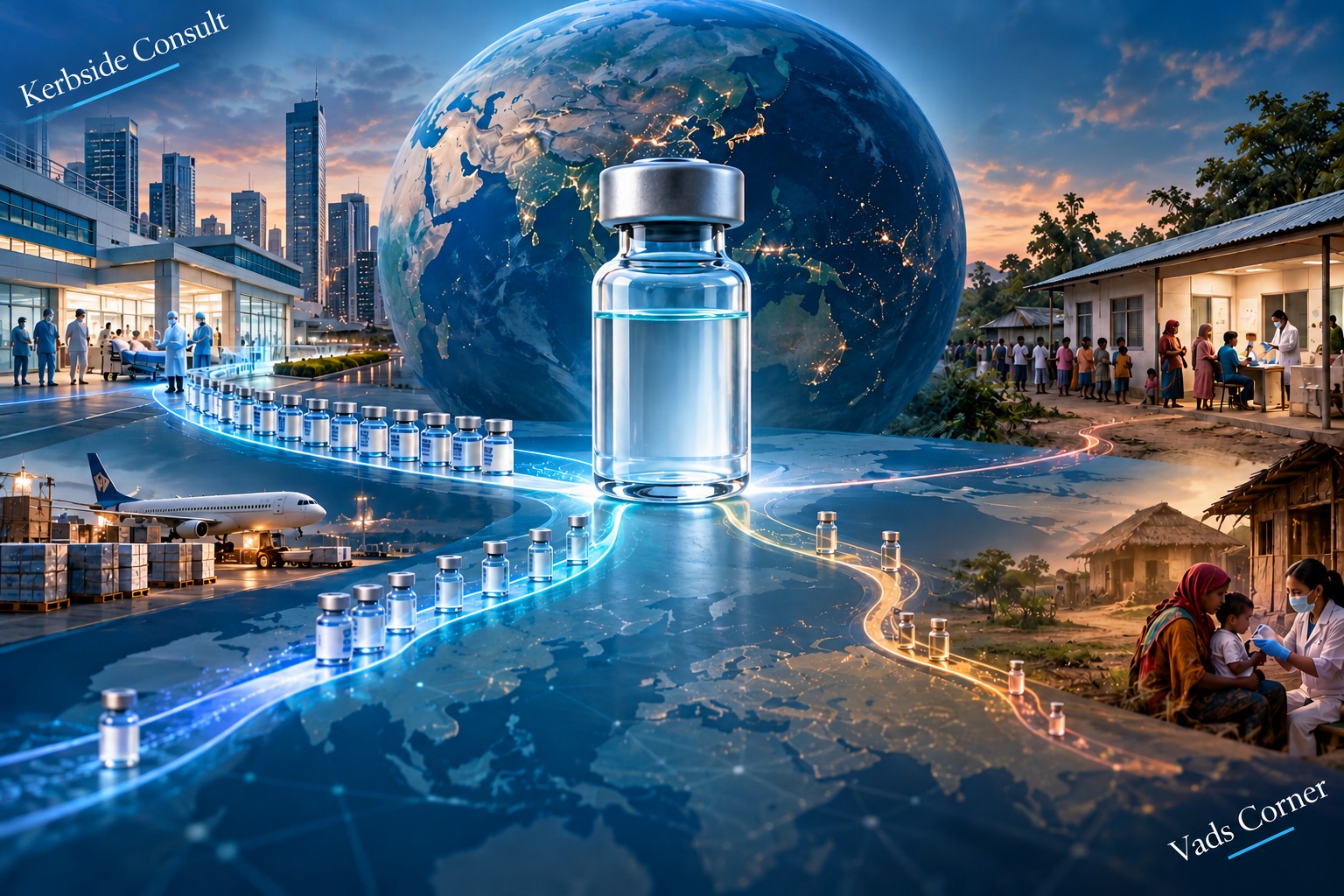
The short answer is COVID-19: the world had vaccines, but not every country could obtain them at the same time (section 2). The World Health Assembly adopted the WHO Pandemic Agreement on 20 May 2025. It is not yet a treaty in force for Malaysia. The outstanding Pathogen Access and Benefit-Sharing (PABS) annex must be adopted before the Agreement opens for signature and ratification, and the Agreement then enters into force on the thirtieth day after the sixtieth instrument of ratification (or equivalent) is deposited (Article 33). [1, 9]
The timetable is a target, not a guarantee. WHO says the PABS outcome is due at the World Health Assembly in May 2027, or earlier at a special session, and the draft annex put to the 2026 Assembly was explicitly not final agreed text. [3, 4] Malaysia’s Health Minister, in remarks reported on 20 October, reaffirmed a joint commitment with WHO to finalise the Agreement by May 2027. [6] The UN General Assembly’s political declaration, welcomed by WHO on 12 October, supports timely access to pathogens with fair benefit-sharing, but it does not complete the annex. [3]
Influenza viruses continue to evolve and reassort, particularly in Asia, and we cannot reliably predict the next pandemic pathogen. [10] This Agreement addresses a complementary question: will countries share both the science and the medical countermeasures that follow?
2. What did COVAX teach us?
COVAX delivered nearly two billion COVID-19 vaccine doses to 146 economies, including 92 lower-income economies eligible for free doses through its Advance Market Commitment (AMC). Modelling by Imperial College London, reported in a Gavi white paper, estimated that COVAX averted over 2.7 million deaths across AMC participants by the end of 2022; WHO repeated this as “at least 2.7 million” in its closing statement. The modelling was commissioned by COVAX itself and is not a peer-reviewed study. [8, 14]
Coverage tells the other half of the story. By the end of May 2023, primary-series coverage was 55% across the AMC economies, against 66% globally, and only 27% in low-income countries, against 76% in high-income countries. [16] WHO’s later closing statement gave 57% against 67% without a date or data source. [8] The exact figures vary by date and source, but the gap between groups is consistent.
Why did access lag? Unilateral deals signed by wealthier countries pushed COVAX to the back of the supply queue, and manufacturers prioritised their most lucrative markets and, once export restrictions were imposed, their domestic ones; India’s export ban disrupted the Serum Institute’s planned AstraZeneca supply to COVAX. COVAX delivered less than half of the two billion doses it originally aimed to deliver in 2021. [13, 14] COVAX was neither a total failure nor an adequate guarantee of timely access.
PABS is the attempt to write that lesson into the rules before the next emergency, rather than negotiating it during one.
3. Who shares the virus, and who gets the vaccine?
Imagine Malaysian laboratories rapidly share samples and sequence information from a newly emerging virus. Other laboratories and manufacturers use that information to develop tests, medicines and vaccines. Should Malaysia and other countries that share pathogen information then have to compete for scarce products against much wealthier purchasers? PABS attempts to link rapid sharing of pathogen materials and sequence information with fair sharing of benefits. Its laboratory arrangements, contracts and benefit definitions remained under negotiation in September 2026. [2, 4]
In a pandemic emergency, the adopted Agreement sets a target of rapid access for WHO to 20% of real-time production of vaccines, therapeutics and diagnostics from manufacturers participating in PABS, including at least 10% as donations and the remainder at affordable prices. This is not an automatic obligation on every manufacturer worldwide; the detailed PABS arrangements remain under negotiation. [9]
Kerbside reality check: a percentage target in a treaty is not a vial in an arm. What matters is who signs the contracts, who enforces them and how fast the doses move.
4. Who owns the science?
Protecting innovation and improving access are not mutually exclusive; Malaysia’s Health Minister has said Malaysia is pushing for a balance between intellectual property protection and fair access to medical countermeasures. [6] The adopted Agreement points to several tools: conditions on publicly funded research, including non-exclusive licensing to manufacturers in developing countries (Article 9.5); technology transfer “willingly undertaken and on mutually agreed terms” and non-exclusive, transparent licences (Article 11.1); regional production partnerships (Article 10.2); and publication of the terms of purchase agreements (Article 14.1). [9] But technology transfer must convey hands-on know-how and detailed documentation, not just the right to fill vials, and voluntary licences can leave out countries with strong manufacturing capacity, such as Brazil. WHO’s mRNA technology transfer programme in South Africa illustrates both the promise of regional hubs and the fragility of the partnerships behind them. [15] In my view, the final arrangements must protect rapid scientific research while ensuring that countries supplying pathogen information do not lose access to resulting products.
5. Can WHO tell Malaysia what to do?
No. The adopted text states that WHO, including its Director-General, has no authority to direct or prescribe national law or policies, or to require countries to impose lockdowns, vaccination mandates or travel restrictions (Article 22.2). Malaysia retains its sovereign public-health decision-making authority, while any treaty obligations it voluntarily accepts would still deserve legal, parliamentary and public scrutiny. The Pandemic Agreement should also be distinguished from the separately existing International Health Regulations. [1, 9]
6. What is Malaysia asking for?
Malaysia was among the IGWG members listed as submitting initial text proposals in 2025, in response to a call for proposals by 10 August 2025, emphasising accountability, transparency, traceability and benefit sharing. Its proposal is an early negotiating position, not an adopted annex, and positions may have moved since. The critical questions are whether the final system will guarantee meaningful benefits, how its contracts will be enforced and whether tracking requirements can coexist with rapid open scientific collaboration. A definitive clause-by-clause comparison requires the latest consolidated negotiating text. [5, 17, 18]
7. Can Malaysia make its own vaccines?
Malaysia should distinguish research and development, active-substance manufacture, fill-and-finish, quality control, regulatory approval and commercial distribution. Following the Vaccine Fraternity Meeting on 15 October 2026, the Ministry of Science, Technology and Innovation reported targets for the National Institutes of Biotechnology Malaysia: an animal biosafety level 3 facility to begin operating in January 2027 and a good manufacturing practice facility in July 2027, subject to technical, quality and biosafety requirements. These are planned start dates, not proof of operational end-to-end vaccine production. Independent feasibility, reliable procurement, skilled staff and sustained demand matter more than announcements. [7]
For an established example of the decades of investment, technical partnerships and supply challenges involved, see my earlier Kerbside Consult article, The Serum Institute of India — Vaccinating the World, One Dose at a Time [11]. Its experience illustrates why vaccine security requires more than simply building a facility.
8. Are we prepared at home?
The Agreement, even once in force, cannot replace domestic outbreak surveillance, hospital surge capacity, a protected health workforce or trustworthy public communication. Malaysia needs to connect human, animal and environmental surveillance and practise how those systems will respond together. As explored in COVID-19: The Virus That Keeps Reinventing Itself [12], viral evolution continues even after an emergency is declared over. Preparedness therefore requires sustained genomic surveillance and the ability to update medical responses, not a one-off plan.
9. What must happen before May 2027?
A treaty will not fill gaps at home. Before May 2027, Malaysia should:
- strengthen laboratory and genomic surveillance and One Health coordination (linking human, animal and environmental surveillance);
- protect and retain healthcare workers;
- test hospital surge plans;
- audit stocks and procurement;
- build realistic regional manufacturing and regulatory partnerships;
- publish Malaysia’s negotiating objectives; and
- independently measure preparedness spending against practical outcomes.
Simulation exercises should test whether laboratories, hospitals, logistics and public communications work together. [1, 7]
Take home message
International cooperation is necessary because pathogens cross borders. But no treaty alone can guarantee preparedness. When the next pandemic arrives, Malaysians will judge the system by whether threats were detected early, hospitals functioned, staff were protected and essential products reached patients when needed.
The next pandemic will test not what the world promised, but what it actually prepared.
Sources
- World Health Organization. WHO Pandemic Agreement. Geneva: WHO. Source
- World Health Organization. Member States advance negotiations on pathogen access and benefit-sharing ahead of UN General Assembly meeting on pandemics. 18 Sep 2026. Source
- World Health Organization. WHO welcomes adoption of United Nations political declaration on pandemic prevention, preparedness and response. 12 Oct 2026. Source
- World Health Assembly. Open-ended Intergovernmental Working Group on the WHO Pandemic Agreement: draft PABS annex text. A79/8. 13 May 2026. Source
- Government of Malaysia. Proposed text for the PABS annex (initial text proposal, IGWG2). 2025. Source
- Bernama. Malaysia, WHO aim to finalise pandemic agreement by May 2027, says Dzulkefly. Malay Mail. 20 Oct 2026. Source
- Ministry of Science, Technology and Innovation Malaysia. Mesyuarat Fraterniti Vaksin 2026: fasiliti NIBM disasar beroperasi pada 2027. 16 Oct 2026. Source
- World Health Organization. COVID-19 vaccinations shift to regular immunization as COVAX draws to a close. 19 Dec 2023. Source
- World Health Assembly. WHO Pandemic Agreement. Resolution WHA78.1, Annex. Geneva: WHO; 2025. Source
- Vadivale M. The Next Pandemic May Already Be Mixing. Kerbside Consult. 4 Oct 2026. Source
- Vadivale M. The Serum Institute of India — Vaccinating the World, One Dose at a Time. Kerbside Consult. 10 Oct 2026. Source
- Vadivale M. COVID-19: The Virus That Keeps Reinventing Itself. Kerbside Consult. 8 Oct 2026. Source
- de Bengy Puyvallée A, Storeng KT. COVAX, vaccine donations and the politics of global vaccine inequity. Globalization and Health. 2022;18:26. DOI 10.1186/s12992-022-00801-z. Source
- Gavi, the Vaccine Alliance. A preliminary assessment of COVAX’s impact in lower-income countries. White paper. May 2023. Source
- Herder M, Benavides X. “Our project, your problem?” A case study of the WHO’s mRNA technology transfer programme in South Africa. PLOS Glob Public Health. 2024;4(9):e0003173. DOI 10.1371/journal.pgph.0003173. Source
- COVID-19 Vaccine Delivery Partnership (CoVDP). Final situation report, January 2022–May 2023. Hosted by the World Health Organization. Source
- World Health Organization. First and organizational meeting of the open-ended Intergovernmental Working Group on the WHO Pandemic Agreement (resolution WHA78.1): report of the meeting. A/IGWG/1/5. 17 July 2025. Source
- World Health Organization. IGWG2 initial text proposals from IGWG members. Source