Eight in a Hundred, or One in Four? Counting Depression in Young Malaysians
Cyberdoc — writing on medicine since 1995
In October 2026 the Health Minister told Parliament, in a written reply, that young Malaysians have the highest rates of depression: 7.9% of those aged 16 to 19, or nearly eight in every hundred. [1] About three weeks later a family medicine specialist in Penang said that one in four adolescents has depression. [2]
Both numbers come from national surveys run by the Institute for Public Health. Both used the same nine-question questionnaire and the same cut-off score. Yet one is more than three times the other. [3] [5]
This article puts the figures side by side. My conclusion is modest: the numbers are not wrong, but they answer different questions, and we should say so before we quote them.
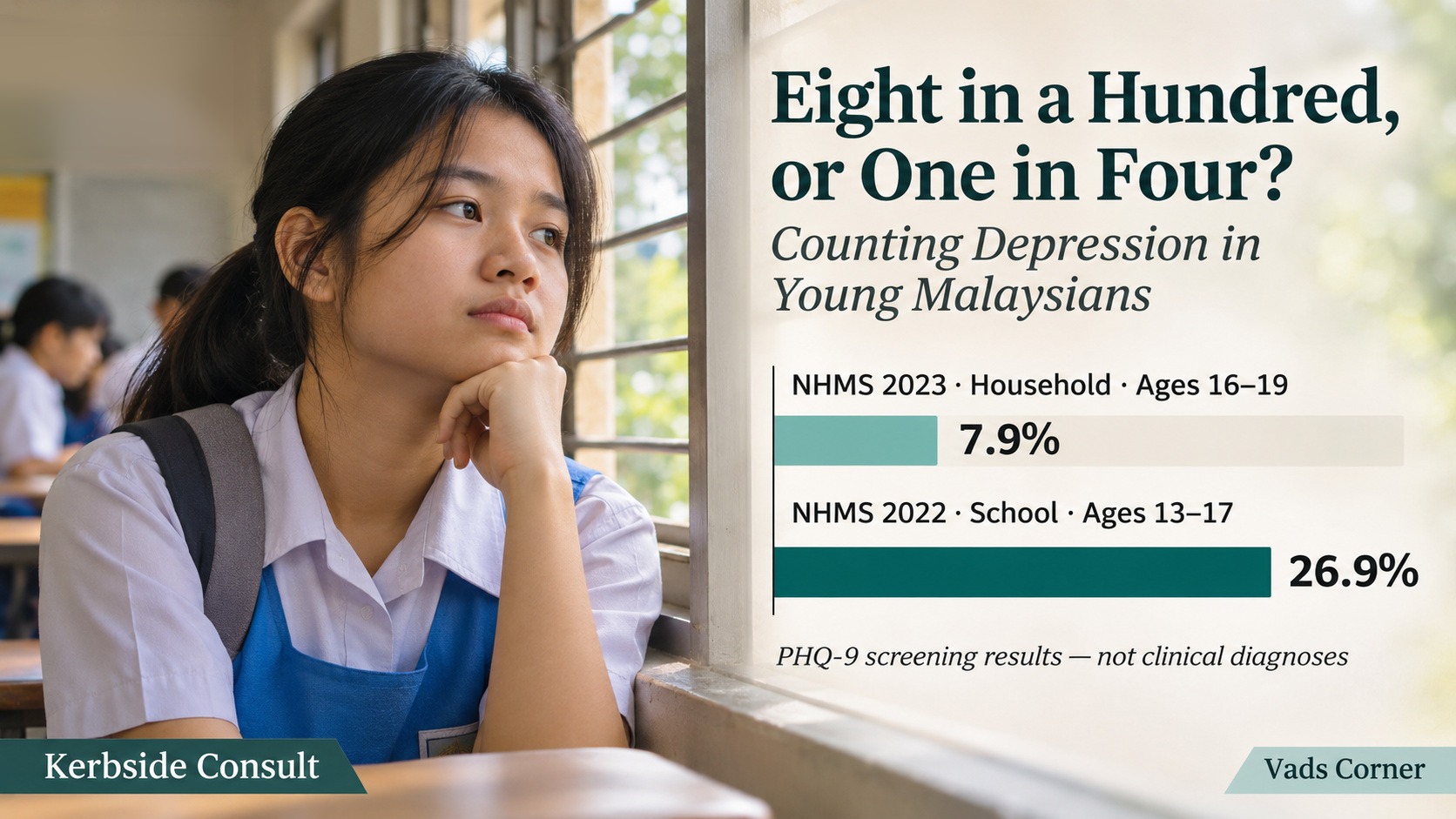
The image is inspired by the subject, is AI-generated, and is not a photograph of any real patient or student.
1. Two numbers, one questionnaire
Both surveys measured depression with the Patient Health Questionnaire-9, or PHQ-9: nine questions about the past two weeks, each scored from 0 to 3, giving a total from 0 to 27. In both, a total of 10 or more was counted as depression, and the questionnaire was filled in by the respondent. [3] [5] The 2019 survey report states that the Malay version of the PHQ-9 has a sensitivity of 87% and a specificity of 82%. [8]
It is a screening tool, not a diagnosis. A score of 10 or more tells us that someone reports a burden of symptoms that deserves a proper assessment. The survey reports call this "depression"; a paper from the same Institute that analysed the school survey calls it "depressive symptoms". [7] I think the second label is the more careful one.
The two figures are these:
- 26.9% (95% CI 25.84 to 27.96) of secondary school students aged 13 to 17, in the NHMS 2022 Adolescent Health Survey. [5]
- 7.9% (95% CI 5.81 to 10.71) of people aged 16 to 19, in the NHMS 2023. [3]
The age bands overlap at 16 and 17, so these are not figures for two different generations.
2. Two surveys, two settings
| NHMS 2022 Adolescent Health Survey | NHMS 2023 | |
|---|---|---|
| Who | Secondary school students, Forms 1 to 5 (ages 13 to 17) | Household members aged 16 and above |
| Where | In class, in 239 of 240 selected schools | At home, in randomly selected households |
| How | Self-administered questionnaire, completed on optical-mark answer sheets collected by field teams [6] | Self-administered paper form handed out in a sealed envelope and collected later that day or the next [4] |
| When | 12 June to 8 July 2022 [13] | July to September 2023 [4] |
| Response | 33,523 students, overall response 89.0% [6] | 13,616 people aged 5 and above, overall response 83.2% [4] |
| People with depression behind the estimate | 9,103 (unweighted) [5] | 456 of 10,487 across all ages; 59 in the 16 to 19 band [3] |
| Result | 26.9% of those aged 13 to 17 | 4.6% overall; 7.9% of those aged 16 to 19 |
Other countries show the same pattern: the way depression is measured decides the size of the number. Section 7 sets the figures side by side.
What I cannot tell you is why the figures differ. The reports do not test it, and I did not find a study that compares the two surveys directly. These are possibilities, not findings:
- Setting. A student answering in a classroom and a young person answering at home with family nearby may not answer in the same way. I do not know in which direction that would push the result.
- Who is counted. A school survey reaches only those in school. A household survey also reaches those who have left school, but may miss those living away from home.
- Precision. The 7.9% rests on 59 people with depression. The confidence interval runs from about 6% to about 11%. [3]
- Timing. The surveys were a year apart.
Age alone does not explain it. In the school survey the figure was 28.4% in Form 4 and 30.1% in Form 5, the students aged 16 and 17, which sits well above the 7.9% for the 16 to 19 band. [5] Even when the household survey is cut by occupation, students reported the highest prevalence at 9.0% (95% CI 6.79 to 11.85), although that group takes in university students of all ages from 16 up. [3]
3. What the school survey found
Girls reported depression at 36.1% (95% CI 34.58 to 37.68) and boys at 17.7% (95% CI 16.69 to 18.67), about twice as often. By form, the figure rose from 22.6% in Form 1 to 27.2%, 27.0%, 28.4% and then 30.1% in Form 5. [5]
The same survey asked about suicidal behaviour in the past 12 months. Suicidal thoughts were reported by 13.1% of students, a plan by 10.0%, and at least one attempt by 9.5%. [5] I will not say more about this than the figures. They are the reason the depression number matters, whichever of the two we prefer.
A later analysis of the same data looked at what went with depressive symptoms. Among the findings: persistent loneliness (adjusted odds ratio 6.52, 95% CI 5.90 to 7.21), being unable to sleep because of worry (5.93, 5.26 to 6.67), current school bullying (2.85, 2.46 to 3.30), having no close friends (2.05, 1.70 to 2.47), and truancy (1.43, 1.31 to 1.56). Female students had an adjusted odds ratio of 2.39 (2.19 to 2.61), and students of Chinese and Indian ethnicity had lower odds than the reference group. [7]
This was a cross-sectional survey, so it shows association and not cause. Loneliness and sleeplessness may be causes, or they may be symptoms of depression, and the data cannot say which came first. That is my reading, not the authors' wording.
4. What the household survey found
In the NHMS 2023, 4.6% of people aged 16 and above had depression (95% CI 4.08 to 5.22), an estimated one million people. By age, the figures were 7.9% for ages 16 to 19, 7.6% for 20 to 29, 4.1% for 30 to 39, 3.1% for 40 to 49, 2.4% for 50 to 59, and 3.1% for 60 and above. The report describes the higher rates in the two youngest groups as significant. [3]
Women reported 5.4% and men 3.9%, a much smaller gap than the school survey found between girls and boys. People who had never married reported 8.0%, against 2.9% for those married or living with a partner. [3]
Among those with depression, 43.6% (95% CI 37.53 to 49.87) had thoughts that they would be better off dead, or of hurting themselves. The report's own conclusion says "almost half", and the Institute's key-findings leaflet says "about half". I would use the number. [3] [12]
5. Is it rising?
Adults. The 2023 report puts 2.3% in 2019 beside 4.6% in 2023 and describes an increasing trend. [3] That is likely to be real. But the 2019 survey asked the depression module of adults aged 18 and above, with the PHQ-9 and the same cut-off of 10. [8] The 2023 module covered those aged 16 and above. The 2023 report gives no age range in its trend table and does not discuss whether the two years are comparable. [3] Press statements, including the Penang specialist's, say "16 and above" for both years. [2] I would call it "about double, with a different lower age limit". The same caution about comparing survey rounds runs through Beyond Glucose: The Waist Deserves a Consultation, where the 2019 and 2023 surveys also used different methods.
The 2019 report does list a figure for ages 15 to 19: 2.1% (95% CI 1.00 to 4.37), based on 12 people with depression, and marked as having a high relative standard error. [8] That sits oddly in a module meant for those aged 18 and over. I would not set it beside 7.9% and call it a quadrupling.
Adolescents. The two earlier school surveys used a different instrument, the DASS-21 questionnaire. They found 17.7% (95% CI 16.71 to 18.67) in 2012 and 18.3% (95% CI 17.20 to 19.38) in 2017. [9] [10] In the 2017 report, depression was "suspected" with a depression severity score of more than 13. [9] That is a different questionnaire with a different threshold from the PHQ-9 at 10, so lining up 18.3% against 26.9% as a rise is not like for like. It is often done, and I would not.
A 2023 ministry statement compared one in four adolescents in 2022 with one in five in 2019. [11] I found no national adolescent depression survey from 2019. The nearest match is the 2017 DASS-21 school survey result of 18.3%, which The Star reported in October 2018 as "one in five". [23] It is likely, though I cannot confirm it, that the statement meant 2017. If so, the comparison sets a DASS-21 result against a PHQ-9 result, which is the like-for-like problem described above. The ministry or the Institute for Public Health could say which survey was meant.
One trend that does come from the same school survey series, with the same age band (Form 1 to Form 5, ages 13 to 17), is suicidal behaviour in the past 12 months. Suicidal thoughts rose from 10.0% (95% CI 9.24 to 10.79) in 2017 to 13.1% in 2022, plans from 7.3% to 10.0%, and attempts from 6.9% to 9.5%. [14] [5] In 2017 the report found no difference by sex; in 2022 girls reported more than boys. [14] [5]
Selected references: [2], [3], [8], [9], [10], [11], [13], [14], [23]
6. The children's figure, and a coincidence
For the weight side of the same age group, see When a Child Is Obese — How Big Is the Problem?. The NHMS 2023 also reported on children aged 5 to 15, using the Strengths and Difficulties Questionnaire, filled in with information from parents or guardians. A total difficulties score of 14 or more counts as a mental health problem. The proportion was 12.1% in 2015, 7.9% in 2019 and 16.5% in 2023. [3]
This is not a measure of depression. It adds up emotional, conduct, hyperactivity and peer problems. Scored separately, 45.9% of children scored in the abnormal range for peer problems, 24.5% for conduct, 16.5% for emotional problems and 7.7% for hyperactivity, so the overall figure is mostly driven by peer and conduct difficulties. [3]
Now the coincidence. The 7.9% for children in 2019 is the same number as the 7.9% for depression at ages 16 to 19 in 2023. Different surveys, different ages and different measures; the match is an accident of arithmetic. Readers who see "7.9%" twice in the news may think they have found a connection. They have not.
Selected references: [3]
7. How other countries count
| Survey | Ages | How depression was measured | Result |
|---|---|---|---|
| Malaysia, NHMS 2022 (school) [5] | 13–17 | PHQ-9 of 10 or more, self-completed in class | 26.9% |
| Malaysia, NHMS 2023 (household) [3] | 16–19 | PHQ-9 of 10 or more, self-completed at home | 7.9% |
| Indonesia, I-NAMHS 2021 [18] [19] | 10–17 | Diagnostic interview (DISC-5, DSM-5), household | Any mental disorder 5.5%; major depressive disorder 1.0%* |
| Australia, Young Minds Matter 2013–14 [20] | 11–17 | Diagnostic interview (DISC-IV), self-completed on tablet | 7.7%; girls aged 16–17 19.6%, boys 7.2% |
| Australia, National Study 2020–22 [22] | 16–24 | Diagnostic interview (CIDI 3.0) | Affective disorders 13.5% (males 10.4%, females 16.7%) |
| United States, NSDUH 2022–24 [21] | 12–17 | DSM-5-based questions on a major depressive episode, past year | 17.7%; boys 9.8%, girls 26.0% |
*Study-team figure; see the sources list.
The table is context, not a league table. None of the overseas surveys used the PHQ-9 at 10, and they cover different ages, years and time frames. What it shows is a pattern: diagnostic interviews, which also require that symptoms interfere with daily life, give single digits, while questionnaire-style measures give figures in the teens and twenties, and in the US and Malaysia girls report much more than boys. On that reading, Malaysia's 7.9% and 26.9% are not odd for their methods. They differ because the methods and settings differ.
8. What is being done
In his written reply, the Minister listed academic and career pressure, relationship problems, social media and financial difficulties as among the factors affecting young people. That is the Minister's list; it is not drawn from the survey analyses above, which measured different things such as loneliness, bullying and sleep. [1]
He named several existing programmes: a Healthy Mind Programme in schools with the Education Ministry, a Healthy Students Programme with the Higher Education Ministry, mental health training through Kem Belia @ Rakan Prihatin, the PLKN 3.0 national service programme, and KafeTeen, where the Health Ministry acts as a referral centre. The ministry welcomed a proposed inter-ministerial task force for early intervention. The report of the reply does not say that one has been set up. [1]
The NHMS 2023 report recommends earlier recognition of depression and more mental health promotion among younger people, students and women. [3] The Penang specialist said more people, including parents worried about their children, are coming to government clinics. [2]
Recent cases of violence in Malaysian schools, reported in the press since October 2025, have understandably worried parents and teachers. [15] [16] This article cannot explain any of them. The surveys above did not study those students, some cases are still before the courts, and a court-ordered mental assessment is not a diagnosis. Most young people with depression are not violent, and most of the distress in these surveys, such as low mood, loneliness, bullying and thoughts of self-harm, is turned inward and goes unnoticed. That is the reason to ask early, not a reason to fear the students who report it.
The concern has reached the highest levels. On 23 October 2026 the Queen, Raja Zarith Sofiah, expressed concern about worsening mental health among children and adolescents and said it must be prioritised. Istana Negara has held discussions, with the Education, Women, Family and Community Development and Communications ministries, the police and the Malaysian Communications and Multimedia Commission, on strengthening complaint and support channels for students, and a counselling association is to work with the Women, Family and Community Development Ministry to involve registered counsellors. [17]
What none of these documents tells us is how many young people who score 10 or more on a screening questionnaire go on to be assessed, and how long that takes. I could not find national figures on that.
9. At the kerbside
Whichever number we choose, the message from the reports is the same. In the household survey the young carry the heaviest burden, and in the school survey a large share of students report symptoms at a level that deserves a conversation.
The number is a starting point. The young person behind it is the reason to ask.
For parents and teachers. Do not wait for a diagnosis. Persistent low or irritable mood, withdrawal, changes in sleep, falling marks or skipping school are reasons to ask, and to ask directly. Loneliness, bullying and sleeplessness from worry stood out in the school survey, so they are good places to begin. [7]
For clinicians. A PHQ-9 of 10 or more is a screen. It calls for a proper assessment, not a label.
For the rest of us. Before quoting a figure on depression, ask five things: who was asked, where, with which questionnaire and cut-off, in which year, and how many people sit behind the number.
If you or someone you know is thinking of suicide or self-harm, talk to someone today. The Ministry of Health's mental health crisis helpline is 15555. [11] Befrienders Kuala Lumpur runs a 24-hour line at 03-7627 2929. [2] If there is immediate danger, go to the nearest emergency department.
Sources & further reading
- The Vibes. Young Malaysians record highest rates of depression – Dr Dzulkefly, 22 October 2026. [Source]. Reports the Minister's written parliamentary reply to Datuk Mumtaz Md Nawi (PAS-Tumpat); I have not seen the original on the Parliament website. Used for the Minister's statements only.
- Lo A. Early help key to tackling mental health issues among minors. The Star, 11 November 2026. [Source]. Dr Leow Hong Tee, Tanjung Bungah Health Clinic, speaking on 10 November 2026. His "one in four" and "one in six" figures are not sourced in the article; the 26.9% he cites is the NHMS 2022 result, which I took from [5]. Also lists the Befrienders helplines.
- Institute for Public Health (IKU). National Health and Morbidity Survey (NHMS) 2023: Non-Communicable Diseases and Healthcare Demand: Technical Report. Ministry of Health Malaysia; 2024. [Source]. Section 4.14 Depression (pp. 133 to 135; Tables 4.14.1 and 4.14.2) and section 4.15 children's mental health (Table 4.15.3, p. 138).
- Mat Rifin H, Mohd Yusoff MF, Abd Hamid HA. Conducting the National Health and Morbidity Survey 2023 in Malaysia with focus on methodology and main findings on non-communicable diseases. Sci Rep 2025. [Source]. Used for the 2023 survey's dates, response rate and the way the mental health forms were handled.
- Institute for Public Health (IPH). Technical Report National Health and Morbidity Survey (NHMS) 2022: Adolescent Health Survey, Malaysia. Ministry of Health Malaysia; 2022. [Source]. Section 3.7.2 Depression (p. 57) and Tables 3.7.3 to 3.7.7.
- Lim KK, Mahjom M, Awaluddin SM, et al. Methodology of National Health and Morbidity Survey (NHMS): Adolescent Health, Malaysia 2022. Int J Public Health Res 2023;13(2). [Source].
- Sahril N, Abd Hamid HA, Abd Razak MA, Sheikh Ilman SS, Ansari FN, Ahmad NA. Risk and protective factors associated with depressive symptoms among school-going adolescents in Malaysia: a cross-sectional study. BMC Psychiatry 2025;25:891. [Source]. Open access. Odds ratios are adjusted odds ratios from the paper's multivariable model.
- Institute for Public Health (IKU). National Health and Morbidity Survey (NHMS) 2019, Technical Report Volume I: Non-Communicable Diseases: Risk Factors and other Health Problems. Ministry of Health Malaysia; 2020. [Source]. Chapter 20 Depression (pp. 256 to 258) and Table 20.1: adults aged 18 and above, PHQ-9 of 10 or more, 2.3% (95% CI 1.87 to 2.78).
- Institute for Public Health (IPH). National Health and Morbidity Survey 2017 (NHMS 2017): Adolescent Mental Health (DASS-21). Ministry of Health Malaysia; 2017. [Source]. 18.3% (95% CI 17.20 to 19.38); depression "suspected with severity score of more than 13". The report gives the 2012 comparison at 17.7%.
- Kaur J, Cheong SM, Mahadir Naidu B, et al. Prevalence and correlates of depression among adolescents in Malaysia. Asia Pac J Public Health 2014;26(5 Suppl):53S–62S. [Source]. Malaysia Global School-based Health Survey 2012, DASS-21; 17.7% (95% CI 16.7 to 18.7). I read this through a repository copy.
- New Straits Times. One in four adolescents suffer from depression, October 2023. [Source]. Ministry statement on World Mental Health Day: one in four in 2022 against one in five in 2019; mentions the crisis helpline 15555. Used only to report that statement and the helpline.
- Institute for Public Health (IKU). NHMS 2023: Non-Communicable Diseases and Healthcare Demand: Key Findings. 2024. [Source]. Used for the leaflet's wording ("about half") on self-harm thoughts.
- Institute for Public Health (IKU). NHMS 2022 Adolescent Health Survey: Key Findings (infographic), June 2023. [Source]. Used for the fieldwork dates and the suicidal-thought chart; chart values were read from the text layer of the PDF.
- Institute for Public Health (IPH). National Health and Morbidity Survey 2017: Adolescent Health Survey, Malaysia. Ministry of Health Malaysia; 2017. [Source]. Section 3.7 and Tables 3.7.3 to 3.7.5: suicidal ideation 10.0% (95% CI 9.24 to 10.79), plan 7.3% (6.67 to 8.05), attempt 6.9% (6.24 to 7.71); Form 1 to Form 5, ages 13 to 17.
- Daily Express. Two school stabbings within year serious, 12 July 2026. [Source]. Editorial on the Banting stabbing and the Selangor case less than a year earlier. Used only to show that such cases have been reported.
- The Vibes. Student stabbing case: Psychiatric report not ready, case mention postponed, 21 November 2025. [Source]. Used only for the point that the accused was to undergo a mental assessment.
- Bernama. Queen Expresses Concern Over Mental Health Issues Among Children, Adolescents, 23 October 2026. [Source]. Reports a post on Sultan Ibrahim's official Facebook page; also NST, 23 October 2026, [Source]. Both reports quote the same post; I have not seen the original post, which is not linked in either.
- Center for Reproductive Health, University of Queensland, Johns Hopkins Bloomberg School of Public Health. Indonesia – National Adolescent Mental Health Survey (I-NAMHS) Report. Center for Reproductive Health, Universitas Gadjah Mada; 2022. [Source]. 5,664 adolescent and caregiver pairs, ages 10 to 17; DISC-5 diagnostic interview. The report's figure for disorders by type could not be read from the text.
- Erskine HE, Maravilla JC, Wado YD, et al. Prevalence of adolescent mental disorders in Kenya, Indonesia, and Viet Nam measured by the National Adolescent Mental Health Surveys (NAMHS). Lancet 2024;403(10437):1671–1680. [DOI]. Indonesia any mental disorder, past 12 months, 5.5% (4.3 to 6.9). Via PubMed. The 1.0% for major depressive disorder is from the Universitas Gadjah Mada press release on I-NAMHS ([Source]); I did not find it in the abstract.
- Young Minds Matter research team. Young Minds Matter: Depression, psychological distress, self-harming and suicidal behaviour in Australian adolescents. Australian Institute of Family Studies. [Source]. Survey conducted 2013–14; DISC-IV self-report on a tablet, just under 3,000 young people aged 11 to 17. An overview of the survey: [Source].
- Substance Abuse and Mental Health Services Administration. Major Depressive Episode or Serious Thoughts of Suicide in the Past Year among Adolescents. NSDUH Population Statistics Reports, Vol. 1, No. 6, September 2025. [Source]. Pooled 2022–2024 average; DSM-5-based questions, in-person or web interview.
- Australian Bureau of Statistics. National Study of Mental Health and Wellbeing, 2020–2022. [Source]. Affective disorders (depressive episode, dysthymia and related), CIDI 3.0 diagnostic interview, ages 16 to 24: 13.5%.
- The Star. Too many teens suffering from stress, 12 October 2018. [Source]. Reports the NHMS 2017 DASS-21 result for ages 13 to 17 (18.3% depression) as "one in five". Used only to show where "one in five" appeared.
Published 85/2026 · 23 November 2026 · No corrections to date · Corrections policy