TUBERCULOSIS
VADS CORNER — Tuberculosis (TB) · Global · Malaysia · Singapore · ASEAN
First posted 19 October 2026 · Figures and links checked 19 October 2026
Tuberculosis is not a news-cycle outbreak. It is the oldest epidemic we still have, and it kills more people each year than any other single infectious agent: WHO estimates 10.7 million people fell ill and about 1.2 million died in 2024, and the global milestones for 2025 have been missed. This page is a one-stop reference. It starts with the disease, its management and the vaccine, gives the global picture, then has a section on the ASEAN region, covering Malaysia and Singapore, followed by the journal articles and general resources, with dated figures, official reports and links. TB is caused by Mycobacterium tuberculosis, a bacterium, so unlike the viruses covered elsewhere on this site it is curable with drugs, and the drugs are the same wherever you live.
My own writing on TB
Kerbside Consult 54/2026, 18 October 2026. Malaysia’s notified TB cases have held at about 25,000 to 27,000 a year since 2022. What the figures show, what they do not, and what should happen next. The Malaysian figures and analysis are there; this page gives the links.
NEW added in this edition CHECK could not be re-opened or fully confirmed — verify before relying on it
The disease Management Vaccination and prevention Global picture ASEAN Malaysia Singapore Journal articles General resources About the figures
Tuberculosis: the disease
TB spreads through the air when a person with active lung disease coughs, sings, talks or sneezes. Most people who inhale the bacteria never become ill. According to the WHO fact sheet (updated 24 March 2026), about a quarter of the world’s population has been infected, and roughly 5–10% of those infected go on to develop disease, usually within the first two years but sometimes decades later.
- Infection versus disease. Latent TB infection has no symptoms and is not infectious. Active TB disease, mostly in the lungs, is. Only active disease is counted in the case figures on this page.
- Symptoms. Cough lasting more than two weeks, sometimes with blood, fever, night sweats, weight loss and tiredness. TB can affect any organ: lymph nodes, pleura, bones and spine, the brain and its coverings, and the kidneys.
- Who is at risk. Close contacts of an infectious case; people with HIV, diabetes, undernutrition, silicosis or other immune suppression; tobacco smokers and heavy drinkers; the elderly; people in prisons, shelters, crowded housing and some workplaces; health workers. Young children who are infected progress to severe disease more often than adults.
- Burden. The WHO Global Tuberculosis Report 2025 estimates 10.7 million people fell ill with TB in 2024 and just over 1.2 million died. Drug-resistant TB remains a public-health crisis: only a part of the people with rifampicin-resistant disease are detected and treated.
Authoritative disease information
- WHO — Tuberculosis fact sheet (24 March 2026)
- WHO — Tuberculosis health topic
- CDC — About TB · Information for health care providers — CDC page paths change often.
- ECDC — Tuberculosis
- Stop TB Partnership
- Mycobacterium tuberculosis (the organism): NCBI Taxonomy · UniProt Taxonomy
Management
- Diagnosis. WHO recommends a rapid molecular test (such as Xpert MTB/RIF Ultra) as the first test for anyone with signs or symptoms of TB, because it also detects rifampicin resistance. Chest X-ray, including with computer-aided detection, is used for screening and triage. Latent infection is detected by tuberculin skin test, interferon-gamma release assay (IGRA) or TB antigen-based skin tests; none distinguishes latent from active disease.
- Drug-susceptible TB. The standard regimen is six months: two months of isoniazid, rifampicin, pyrazinamide and ethambutol, then four months of isoniazid and rifampicin. WHO also recommends a four-month rifapentine-moxifloxacin regimen for people aged 12 and over, and a four-month regimen for children with non-severe disease. Directly observed therapy (DOT) or video-observed therapy (VOT) and patient support are part of the package.
- Drug-resistant TB (MDR/RR-TB). Six-month all-oral regimens (BPaLM, or BDLLfx/C where pretomanid cannot be used) are now standard in WHO guidance, with regimens for pre-extensively drug-resistant TB set by severity and palliative care recommended alongside treatment. Seek specialist advice before starting.
- TB and HIV. Test every TB patient for HIV and every person with HIV for TB; co-treat with antiretrovirals.
- TB preventive treatment (TPT) is recommended for household contacts and other high-risk groups once active disease is excluded. WHO-listed options include 6 or 9 months of isoniazid, 3 months of weekly rifapentine plus isoniazid (3HP), 1 month of daily rifapentine plus isoniazid (1HP), 3 months of isoniazid plus rifampicin (3HR), 4 months of rifampicin, and 6 months of levofloxacin for contacts of rifampicin-resistant TB.
- Infection control. Prompt diagnosis and treatment comes first; then ventilation, respirators for health workers and cough etiquette.
Regimens, doses and eligibility depend on age, weight, comorbidity and national guidance. Check with a clinician and the current national guideline. For what Malaysia’s guideline says about the newer regimens, see Flat Is Not Falling, section 6.
Diagnosis: what a positive looks like
Links to examples, with credit; images are not hosted on this page. No single test makes the diagnosis: read the chest film, the microbiology and the clinical picture together.
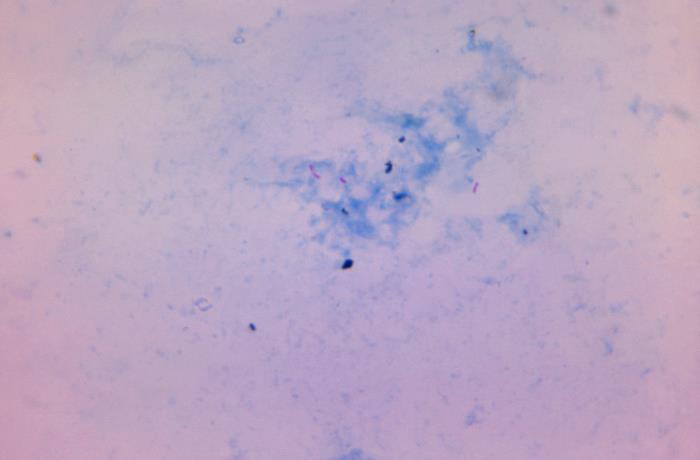
- Acid-fast bacilli on microscopy. See the figure above (CDC Public Health Image Library 23001).
- Chest X-ray. Typical patterns are upper-lobe infiltrate with cavitation, and miliary disease. See tuberculosis cases on Radiopaedia and the Wikimedia Commons tuberculosis category — check each image’s licence before reuse.
- A positive test is not disease. Normal lateral chest radiograph (Radiopaedia, contributed by Kevan English; doi:10.53347/rID-175064): a patient with a positive Mantoux skin test and prior BCG, with no radiographic evidence of TB. Linked, not reproduced: Radiopaedia states no licence on the case page.
- Tuberculin skin test. A nurse giving the test to schoolchildren (CDC PHIL 29653; credit CDC/Dr Charles N. Farmer, 1963). This shows the procedure, not a positive reading; the result is read as induration, in millimetres, after 48–72 hours. It can be falsely positive after BCG or exposure to environmental mycobacteria (Coulter, Aust Fam Physician 2012, below).
- Rapid molecular test (Xpert MTB/RIF Ultra). A positive report reads “MTB detected” and states whether rifampicin resistance is detected. WHO’s handbook section on molecular WHO-recommended rapid diagnostic tests (Xpert MTB/RIF, Xpert MTB/RIF Ultra, Truenat) explains how to read results, including “trace” results in children, people with HIV and suspected extrapulmonary TB. For a worked interpretation, see the Curry International Tuberculosis Center webinar Experts on Xpert: a laboratorian and a clinician discuss interpretation of Xpert MTB/RIF results (video, about 85 minutes; recorded 26 September 2018, so it predates Ultra).
- Interferon-gamma release assay (IGRA). A blood test that measures interferon-gamma released in response to M. tuberculosis antigens (ESAT-6 and CFP-10), which are absent from BCG and most other mycobacteria. CDC: a positive result usually means TB infection, and a chest radiograph and sputum bacteriology are still needed to rule out disease; a negative result makes infection unlikely but does not exclude it, especially in recent infection or severe immunosuppression. Samples must be processed within a set time, and indeterminate results are not informative (CDC — Clinical testing guidance: interferon gamma release assay, last reviewed 9 May 2024). Neither IGRA nor the skin test can distinguish latent infection from active TB or predict who will progress (Pai et al., Clin Microbiol Rev 2014). In Australia, the National Tuberculosis Advisory Committee’s 2017 position statement recommends either the skin test or an IGRA for investigating latent infection in most circumstances, supersedes its 2012 statement (which preferred the skin test; described in an Australian Family Physician review), advises that neither should be used to investigate active TB (though either may supplement the work-up in children), and still prefers the skin test for serial testing of health workers (Bastian, Coulter and NTAC, Commun Dis Intell 2017). — a 2017 statement; see the NTAC page for any revision.
- Culture. Positive culture is growth of M. tuberculosis on solid or liquid medium; it can take weeks and also allows full drug-susceptibility testing.
Guidelines and management links
- WHO consolidated guidelines, Module 4: treatment and care, second edition (25 September 2026)
- WHO Module 4, drug-resistant TB treatment (2025) · 2022 update (superseded)
- WHO Module 4, drug-susceptible TB treatment (2022)
- WHO operational handbook — recommended TPT regimens (TBKSP)
- WHO Global TB Programme — guidelines and reports
- CDC — Interferon gamma release assay
- CDC — Clinical treatment of tuberculosis
- Europe: ECDC — European Union Standards for Tuberculosis Care (with the European Respiratory Society) · ECDC — Tuberculosis
- Australia: National Tuberculosis Advisory Committee (NTAC) — national guidance, including the CDNA national guidelines for public health units (Word file) and NTAC guideline on TB risk in healthcare workers
- Country guidelines for the region: see Malaysia and Singapore.
Vaccination and prevention
- BCG is the only licensed TB vaccine. Given once at or soon after birth in most high-burden countries, it protects infants and young children against severe forms (disseminated TB and TB meningitis). Protection against adult pulmonary disease is variable and limited, which is why vaccination alone cannot end the epidemic.
- New vaccines. The leading candidate, M72/AS01E, showed about 50% efficacy in a phase 2b trial in adolescents and adults with latent infection and is now in a phase 3 efficacy trial. See the key papers and the sponsor’s FAQ. No new TB vaccine is licensed for adults.
- Other prevention. Treating the infectious person is prevention. TPT for contacts, screening of high-risk groups, managing HIV, diabetes, undernutrition, smoking and alcohol, and better ventilation all reduce transmission and progression.
Check vaccination schedules with a clinician or your national immunisation service.
Vaccine and prevention links
- WHO Immunization, Vaccines and Biologicals — Tuberculosis
- Gates Medical Research Institute — M72/AS01E phase 3
- Stop TB Partnership · CDC — About TB
The global picture
| Measure | Figure | Source |
|---|---|---|
| People who fell ill with TB, 2024 (estimated) | 10.7 million | WHO news release |
| Deaths from TB, 2024 (estimated) | over 1.2 million | WHO news release |
| Global incidence rate, 2024 | 131 per 100,000 | WHO South-East Asia Region note quoting the global average |
| Change 2023 to 2024 | incidence rate down by nearly 2%; deaths down 3% | WHO news release |
| Change 2015 to 2024 against End TB milestones | global incidence rate down about 12% against the 50% milestone; Western Pacific Region rate 1.7% higher than in 2015 | WHO Global TB Report 2025, via Morishita et al. 2026 |
| WHO South-East Asia Region incidence, 2024 | 201 per 100,000; down 16% since 2015 | WHO SEARO |
The 2025 milestones of the WHO End TB Strategy (50% fewer new cases and 75% fewer deaths than 2015) have been missed worldwide; the 2030 targets are 80% and 90%. Funding for TB services, including from international donors, fell short of what is needed.
- WHO Global Tuberculosis Report 2025
- WHO TB country, regional and global profiles — the best place to check any single country’s WHO estimates
- WHO Global TB database
ASEAN: Malaysia, Singapore and the region
ASEAN has eleven members, Timor-Leste having joined on 26 October 2025. Most of the bloc sits in the world’s highest-burden region. The WHO South-East Asia Region (which includes Myanmar, Thailand and Timor-Leste) has an estimated incidence of 201 per 100,000, well above the global 131. WHO classifies Indonesia in the South-East Asia Region and the other members in the Western Pacific Region CHECK — confirm each country’s WHO region on its profile page. ASEAN has also set up an Airborne Infection Defense Platform for regional cooperation.
Notified and WHO-estimated figures are different things, and countries define cases differently. Check every number against the source and use the WHO TB country profiles for like-with-like comparison.
Malaysia
Ministry of Health and national documents
- Ministry of Health Malaysia — press statements (kenyataan media) carry the weekly TB figures
- MOH statements in 2026: 10 February · 15 February · 21 February (with state rates) (in Malay)
- National Strategic Plan to End TB (2021–2030)
- Clinical practice guideline, Management of Tuberculosis (4th edition, 2021) · quick reference
- Guideline, Management of Drug Resistant TB (1st edition, 2016)
- Health technology assessment: computer-aided chest X-ray detection of TB (2024)
- National Health and Morbidity Survey 2023 fact sheet
- WHO TB country profile — Malaysia
Reports and news (secondary; each reports a Ministry or ministerial statement)
- Bernama — Kota Tinggi cluster (5 February 2026, in Malay) · Malay Mail — the Johor outbreak (11 February 2026)
- Malay Mail — 2,571 cases and 10 active clusters (11 February 2026)
- Malay Mail — 35 clusters remain active; Dewan Rakyat (10 February 2026) · Healthcare Asia
- Malay Mail — seventh-week count (2 March 2026)
- IFRC GO — Malaysia: Epidemic, Tuberculosis (24 February 2026)
- Utusan — no TB vaccine for adults (February 2026, in Malay)
- The Star — Ministry committed to minimise TB cases by 2030 (20 March 2025) · CodeBlue — Sarawak mortality (20 March 2025)
Later 2026 Malaysian figures are not included CHECK; check MOH press statements.
Singapore
Singapore is a low-to-intermediate burden country with an ageing, mostly older-male case profile and a high proportion of latent infection in the elderly. The Communicable Diseases Agency (CDA) publishes annual figures ahead of World TB Day; they cover residents only.
| Year | New active cases | Incidence per 100,000 | Deaths | New MDR-TB cases |
|---|---|---|---|---|
| 2022 | — | 30.4 | — | — |
| 2023 | 1,201 | 28.9 | — | 2 |
| 2024 | 1,156 | 27.6 | 20 | 3 |
| 2025 | 1,019 | 24.2 | 11 | 1 |
Source: Singapore CDA and MOH annual releases (23 March 2026 for 2025). A dash means I did not extract the figure; the CDA release carries the full 2016–2025 table.
- 2025 detail. 788 of 1,019 new cases (77.3%) were aged 50 or older; 668 (65.6%) male. There were 72 relapse cases. By ethnic group: 694 Chinese, 185 Malay, 85 Indian, 55 other. Up to 20% of people aged 70 and over have latent infection, although prevalence has been falling since 2015.
- Programme. The National TB Programme runs screening, notification, contact tracing and DOT/VOT; BCG is given at birth.
Official sources and news
- Communicable Diseases Agency — tuberculosis situation update (23 March 2026)
- Ministry of Health Singapore — earlier annual releases (2023, 2024) · SingStat
- WHO TB country profile — Singapore
- TB cases in Singapore down in 2025, with 11 deaths — Straits Times, via Asia News Network (March 2026)
Regional sources
- WHO TB country, regional and global profiles — the place to check any country’s WHO estimates
- WHO South-East Asia Region — Tuberculosis · WHO Western Pacific Region — Tuberculosis
- ASEAN Secretariat
Journal articles
Key international papers
- Dorman SE et al. Four-month rifapentine regimens with or without moxifloxacin for tuberculosis. N Engl J Med 2021;384:1705–18 (PubMed 33951360)
- Tait DR et al. Final analysis of a trial of M72/AS01E vaccine to prevent tuberculosis. N Engl J Med 2019;381:2429–39
- Pai M, Denkinger CM, Kik SV, et al. Gamma interferon release assays for detection of Mycobacterium tuberculosis infection. Clin Microbiol Rev 2014;27(1):3–20
- Bastian I, Coulter C, National Tuberculosis Advisory Committee. Position statement on interferon-γ release assays for the detection of latent tuberculosis infection. Commun Dis Intell Q Rep 2017;41:322–336
- Coulter C. Tuberculosis testing. Aust Fam Physician 2012;41(7) (superseded on IGRA preference by the 2017 statement above)
- Sava C et al. The use of Xpert MTB/RIF Ultra testing for early diagnosis of tuberculosis: a retrospective study from a single-center database. Genes 2023;14(6) (PMC10298219; PubMed 37372411). A single-centre retrospective study in Oradea, Romania (2018–2020) of 862 patients with suspected TB, 74.6% adults, with sputum and other specimens. Against Lowenstein-Jensen culture, Xpert Ultra sensitivity was 95% (284 of 299 culture-positive samples detected) and specificity 96.4%; Ziehl-Neelsen microscopy was 54.8% and 99.5%. The “30 days gained” is the median time to culture positivity (mean 34.07 days), on the assumption that patients with a positive Xpert were started on treatment at once. Of 306 Xpert-positive results, 27 (8.8%) showed rifampicin resistance. The paper itself notes that a negative molecular result does not exclude TB. Open access (CC BY).
- Oh KH et al. Changing epidemic of TB amidst the COVID-19 pandemic in the Western Pacific Region. Lancet Reg Health West Pac 2024;47:101104
- Morishita F et al. TB epidemiology and programmatic progress in the WHO Western Pacific Region, 2010–2024. Trop Med Health 2026;54
- WHO Global Tuberculosis Report 2025 (report, not a journal article)
Malaysia
- Lim MC et al. Modelling tuberculosis transmission dynamics in Malaysia. Front Public Health 2026;14:1843471
- Fadzil FA, Ramli SR, Neoh H. Tuberculosis in Malaysia: disease timeline, epidemiology, control initiatives and outlook. Malays J Pathol 2025;47(1):13–23
- Ideris I et al. TB preventive treatment completion among contacts in Selangor, 2022–2024. Med J Malaysia 2026;81(2):304–312
- Mohamed AF et al. Factors associated with incomplete LTBI preventive treatment in Sabah. PeerJ 2025;13:e19736
- Medical Journal of Malaysia 2026;81(4), July 2026 (issue contents), a TB-themed issue:
- Chew KS, Liew BS. Beyond the treatment episode: closing gaps across the continuum of care (editorial). 407–408
- Ganesan V, Jastin HG, Jayaraman S, Gangatharan S, Avoi R. Psychosocial and health system factors associated with tuberculosis treatment adherence in Kota Kinabalu, Sabah
- Jastin HG, Ganesan V, Abdul Hamid MH, Avoi R. Factors associated with non-attendance at initial tuberculosis screening among contacts in Kudat, Sabah. 504–512
- Che Rameli NA, Razak TR, Ismail N, Ismail AI, Isa MR. Quantifying the risk of tuberculosis recurrence in Asia: a systematic review of hazard estimates. 610–620
Singapore
- Clinical Tuberculosis Guidelines Development Team (Ang MLT, Chan SM, Cheng LT-E, et al.). Singapore tuberculosis (TB) clinical management guidelines 2024: a modified Delphi adaptation of international guidelines for drug-susceptible TB infection and pulmonary disease. Ann Acad Med Singap 2024;53(3):170–186 (published 19 March 2024; doi:10.47102/annals-acadmedsg.2023391)
PubMed searches
- Tuberculosis · Malaysia · Singapore · ASEAN
- Multidrug-resistant tuberculosis · Preventive treatment · Vaccine M72 · TB and diabetes
Journals
- Medical Journal of Malaysia · Annals, Academy of Medicine, Singapore
- International Journal of Tuberculosis and Lung Disease
- Emerging Infectious Diseases · MMWR
- Vads Corner — Medical Journal Sites
General resources
- World Health Organization · Global Programme on Tuberculosis and Lung Health
- Stop TB Partnership
- The Global Fund
- The Union (International Union Against Tuberculosis and Lung Disease)
- Centers for Disease Control and Prevention · ECDC
- Ministry of Health Malaysia · Communicable Diseases Agency Singapore · ASEAN
- Kerbside Consult — Flat Is Not Falling · HIV Never Left · The Antibiotic That Didn’t Work
- Vads Corner · Kerbside Consult — Vads Corner · Cybermed — Vads Corner
- Mycobacterium tuberculosis (the organism): NCBI Taxonomy · UniProt Taxonomy
- PubMed (NLM)
About the figures on this page
The case counts here are a snapshot as of 19 October 2026. This page does not update itself, and the Malaysian situation in particular is still moving, so the numbers will be out of date soon after you read them. Each figure is shown with its source, reporting period and classification so you can check it against the original.
- For the latest Malaysian figures, use the MOH Malaysia press statements.
- For the latest Singapore figures, use the CDA annual World TB Day release.
- For global and other ASEAN figures, use the WHO TB country profiles and the next Global TB Report.
- Counts are provisional. Reporting delays and reclassification mean totals can be revised.
- Compare like with like. Only compare two figures from the same source that cover the same period and use the same definition. A rise in notifications is not necessarily a rise in transmission.
This page is revised from time to time as new official reports are published.
First posted 19 October 2026
Disclaimer ·
cyberdoc@vadscorner.com