The Sugar Tax and the NCD Bill — What Should It Pay For?
Cyberdoc — writing on medicine since 1995
In January 2026 the Health Minister told the Dewan Rakyat that the sugar tax on sweetened drinks is not ringfenced for his Ministry. The money goes into the Consolidated Fund, and the Finance Ministry decides who gets what. [1] Recent Budgets have named some uses for it, and the Malaysian Medical Association has asked for a proper ringfence. [2]
In my preceding article on the National Health Fund, I asked who should pay for Malaysia's health care. Here I ask a smaller but related question. What should the money from a health tax pay for? The sum at stake was about RM86 million in 2025 [1] [3], against a Health Ministry budget of about RM45 billion. [4] That is less than two-tenths of one per cent.
The reason it matters is the noncommunicable diseases (NCDs), such as diabetes, heart disease, cancer and chronic lung disease, that the tax is meant to help prevent. My view is modest. The tax is worth having, but it cannot carry the NCD bill. What it raises should be spent on the right things, under a rule and not only by announcement.
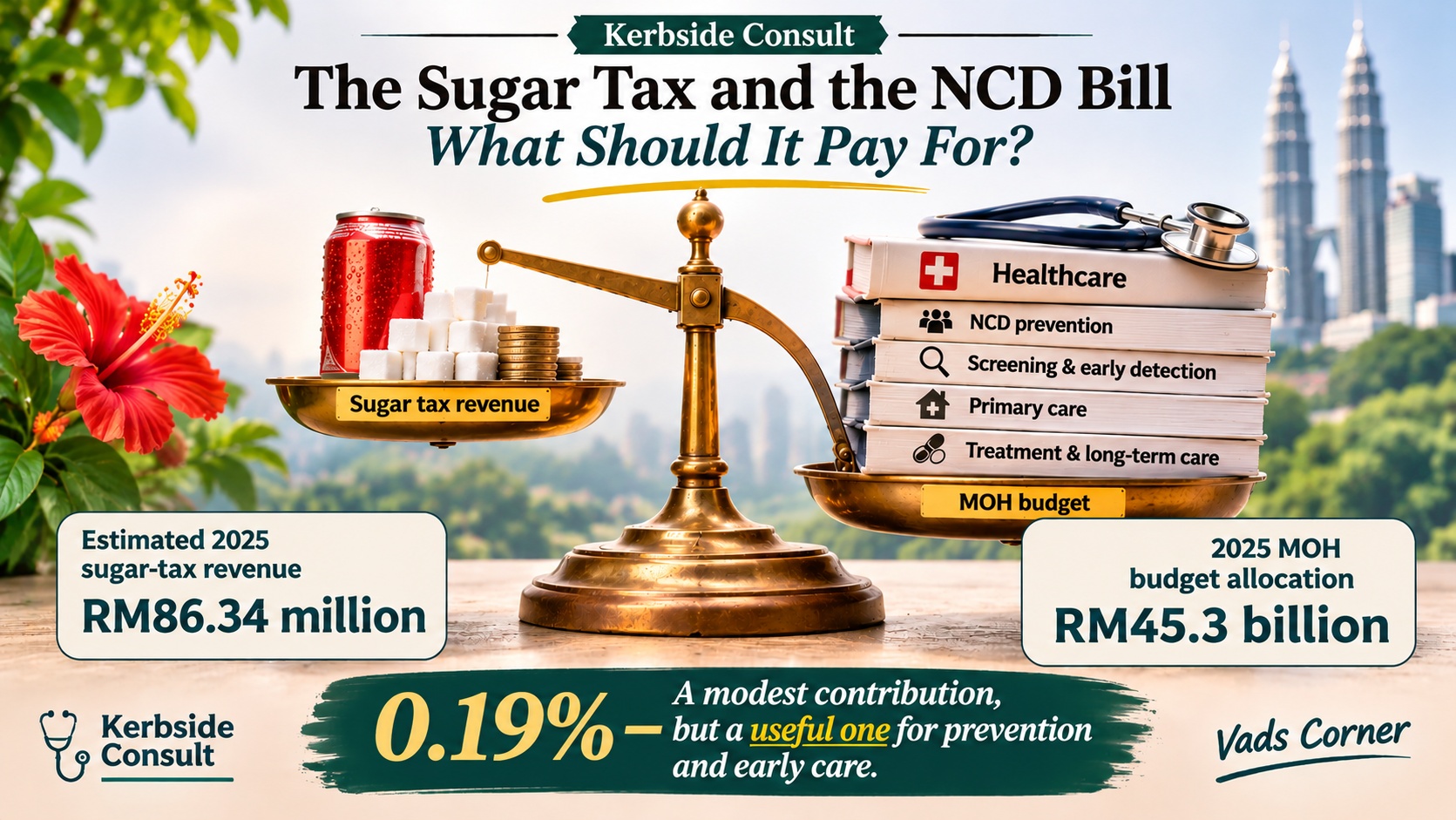
The image is inspired by the subject, is AI-generated, and is not a photograph. The figures on it are those given in the article (my arithmetic for the 0.19%).
1. What the sugar tax has raised
A disclosure, since this article mentions the Malaysian Medical Association (MMA): I am a Life Member and have contributed to its newsletter, Berita MMA. I respect the MMA's call in October 2025 for the revenue to be ringfenced, and I have tried to set out its case fairly. I have no other relevant interests to declare.
The duty on sugar-sweetened beverages started on 1 July 2019 at 40 sen a litre, depending on the sugar content of the drink. It went up to 50 sen on 1 January 2024 and to 90 sen on 1 January 2025. [3] [5] [6]
| Period | Rate (sen per litre) | Collected |
|---|---|---|
| 1 Jul 2019 to 31 Dec 2023 | 40 | RM447.54 million, 1 Jul 2019 to 31 Dec 2024 [3] |
| 1 Jan 2024 to 31 Dec 2024 | 50 | |
| From 1 Jan 2025 | 90 | RM86.34 million in 2025 (my subtraction*) |
*Cumulative collections to 31 December 2025 were RM533.88 million. [1] Take away the RM447.54 million reported to the end of 2024 and you are left with RM86.34 million for 2025. The two figures come from different replies, so treat the difference as an estimate.
Is the base shrinking? The Health Minister told Parliament in December 2025 that collections were RM54.9 million from January to August 2025, against RM68.6 million in 2024. [7] [8] I take the 2024 figure as the full year; Berita Harian reports it as recorded throughout 2024, though the English reports do not say so. [9] [10] The rate rose by 80% in 2025, but receipts rose by only about 26% (RM86.34 million against RM68.6 million; my arithmetic). That suggests the taxable base may have contracted. Without volume and reformulation data, though, we cannot say how much of it is people drinking less, and how much is manufacturers cutting sugar, a change in product mix or the timing of payments.
Here is the thing to remember. A sugar tax that works shrinks its own base, and that makes its revenue harder to predict.
2. Is the sugar tax working?
Before deciding what the money should buy, ask what the tax itself achieves. The Ministry's 2024 technical report found that real retail prices of the drinks it tracked rose only about 2.2% on average after the 2019 duty, against 8.3% projected, because producers absorbed much of it. A school survey of 5,211 students and parents found no significant tax-related change in consumption, although about half said they drank less, mostly for health-awareness reasons. The three large producers interviewed had reformulated at least half their sweetened products. [11]
Read that fairly. The first price signal was weak, and reformulation was real. The report predates the increases to 50 and 90 sen, and I have not seen an evaluation of how much of those reached shelf prices. So the tax looks more like a nudge than a lever, and nobody should plan NCD financing as if it were a large and growing river of money. There are also gaps. The Ministry has said it will not tax freshly made drinks in cafés and stalls, preferring its Healthy Dining Programme. [12]
3. The problem of scale
Start with the burden. The National Health and Morbidity Survey 2023 found diabetes in 15.6% of adults, hypertension in 29.2%, high cholesterol in 33.3%, and overweight or obesity in 54.4%. [13] The Ministry's 2024 investment case puts the yearly economic cost of the four main NCD groups at RM64.2 billion for 2021, about 4.2% of GDP. Of that, RM12.4 billion is direct cost and RM51.8 billion is lost productivity. [14] The economic burden is not the same as the government's health bill.
Now put the duty beside the budget. The Ministry's 2025 allocation was RM45.3 billion. [4] RM86.34 million is about 0.19% of that (my arithmetic). Against the RM11.6 billion spent on the four main NCD groups in 2021 [14], it is about 0.74% (my arithmetic, and the years differ). A bigger slice, but still a small one.
The state also pays to keep sugar cheap. In January 2026 the deputy domestic trade minister said no decision had been made on ending a sugar subsidy of RM42 million a month, paid to local producers at RM1 for each kilogram of standard sugar. [15] Annualised, that is about RM504 million (my arithmetic, not a verified annual spend), roughly six times what the drinks duty raised in 2025. I found no mention of the drinks duty or the subsidy in the Budget 2027 speech and its appendices [16], and commentary says the subsidies were kept. [17] We tax the drink with one hand and subsidise the sugar with the other, as one MP put it in the Dewan Rakyat. [8]
To be fair, the subsidy has a defence. The retail price has been capped at RM2.85 a kilogram, among the lowest in Asean, and the industry says costs have outrun the cap. [15] [18] The two policies send conflicting signals, but I cannot say what their net effect on consumption is. The domestic trade ministry said in November 2025 that it was finalising a targeted subsidy mechanism for Cabinet. [19] In February 2026 the Minister told the Dewan Rakyat that the incentive is temporary and targeted at household packs of 1 kg and 2 kg, not at sugar used by large food and drink makers. He said it is under review with the Finance Ministry, and that the rate will be reduced soon. [20] [21] That is the one to watch. The household focus also means the subsidy does not reach the large beverage makers directly, so the two policies may be less at odds than they first look.
4. Where the money goes now
The legal position is plain. Article 97 of the Federal Constitution pays federal revenue into the Federal Consolidated Fund. [22] The Article itself says "subject to the provisions of this Constitution and of federal law", so the idea of a statutory fund is not a silly one. [22] On 20 January 2026, in the Dewan Rakyat's special chamber session, the Health Minister said the sugar duty is not ringfenced for his Ministry, though the Ministry does get "a little" from the collection [1], and the Ministry's own 2024 report says the same: ministries apply for money from the pool. [11]
In practice, though, the Budgets have named uses. In tabling Budget 2025, the Prime Minister said revenue from the higher duty would go towards health spending, including SGLT2 inhibitors for diabetes. [23] [3] Budget 2026 went further for other taxes. Additional revenue from tobacco and alcohol was to go to the Ministry for its Lung Health Initiative and for diabetes and cardiovascular programmes, which the Health Minister called unprecedented. [24] [4] The Prime Minister has also said pro-health taxes will widen from sugar to tobacco, vape and alcohol. [25]
So a soft earmark by announcement already exists. What is missing is a rule, a floor and a report. As I argued in my earlier article on Budget 2027, what matters is not only how much we allocate, but what each ringgit achieves.
What has the Ministry received? The Finance Ministry told Parliament that RM25 million from the duty went to the Ministry for 2025, for the War on Sugar campaign, SGLT2 inhibitors and peritoneal dialysis facilities. [3] That is about 29% of the year's collections (my arithmetic). Of it, RM21 million went on SGLT2 inhibitors, and the Health Minister told the Dewan Rakyat that it was distributed to all states from September 2025 and benefited 49,128 patients. [9] [7] [8]
The choice of SGLT2 inhibitors makes clinical sense. These drugs protect the heart and the kidneys as well as lowering glucose, which is the reason the Minister gave Parliament. [8] My concern is not the purchase but the funding. A patient takes them year after year, and the money comes from a tax that is meant to shrink.
5. Does earmarking work?
In October 2025 the MMA asked for the sugar-tax revenue to be ringfenced for the Health Ministry, the sugar subsidy removed, and public health spending raised from 2.4% to 5% of GDP. [2] Its Budget 2027 statements have been mainly about the health workforce, and I found no 2026 statement on the sugar tax or the ringfence. [26] The Ministry's own report notes that earmarking would likely raise public and political support. [11] Experience elsewhere is mixed, and worth knowing before we copy anyone.
The best case for a hard ringfence is a political one. Resolve to Save Lives, an advocacy organisation, says that in some settings an earmark tied to a popular, tangible service may be the only way to start or raise a health tax. [27] A 2017 systematic review agrees that earmarking helps support, but only if governments keep their spending commitments. It also found that taxes which succeed in changing behaviour make their own revenue less predictable. [28]
The same primer argues that a "soft" earmark, with named programmes funded through the annual budget and a review clause, may serve better than a hard one. It cites Ghana as a cautionary case. [27] The WHO working paper behind this point, which I have now read, is more measured. In Gabon, the early gain from an earmarked tax on mobile phone company revenues was washed out, and health budget resources returned to their pre-earmark levels. In Ghana, the earmark raised extra money, but health's share of government spending went back to its earlier level, so the money was reprioritised within health, not drawn from other sectors. The Philippines is the better news. Its soft earmark, with allocations decided each year, saw health revenue from alcohol and tobacco taxes triple between 2012 and 2016. [29] The paper concludes that earmarks work better when they are softer, with broader purposes and more flexible links to spending. The World Bank brief summarises Gabon, Ghana and Estonia more strongly, as a net decrease in revenue going to health; I have followed the WHO paper's wording. [30]
Thailand is the model people point to. Its Health Promotion Foundation, ThaiHealth, has been financed since 2001 by a 2% surcharge on tobacco and alcohol excise [31], about 4 to 4.5 billion baht a year. [32] That is a hard earmark, outside the ministry and the annual budget.
Even so, in late 2026 amendments from Bhumjaithai members, one submitted by the Prime Minister himself, proposed to end the earmarked levies for ThaiHealth and three other bodies, about 14 billion baht a year in all, and to replace them with annual budget allocations. The ThaiHealth bill would also make the government's yearly subsidy one provided "as necessary". [33] [32] The Excise Department says the 2% would be folded into higher standard excise rates. [34] On 24 November 2026 the Thai parliament's hearing page listed the ThaiHealth bill, whose public hearing ran from 30 September to 14 October, as awaiting certification from the Prime Minister. [35] I found no sign that any of the bills had become law. The lesson I take is that an earmark is a political settlement. It can be attacked for being an earmark, whatever the fund has achieved.
6. What should the money pay for? Six rules
If I were advising the Ministry, I would not ask for the tax to be ringfenced and left there. These six rules are my own recommendations, not established evidence.
- Behaviour first, revenue second. Judge the tax by how much less sugar people take, not by how much money it collects. If the tax works, collections will fall, so plan for that.
- Protect the allocation. The Budgets already name uses for sugar and sin-tax money, so make it a rule. Give prevention and primary care its own line in each Budget, on top of the Ministry's usual allocation. Set a minimum based on the previous year's duty collected, and review it regularly. One recent CodeBlue writer proposes a similar floor. [36] Written strictly, this could end up close to a hard earmark. Who should contribute is the harder question, which I discuss in my National Health Fund article. [37] Whether a statutory fund can sit beside the Consolidated Fund is a question for a constitutional lawyer.
- Match the funding to the commitment. Use the uncertain tax money for things that can start and stop, such as screening drives and pilot programmes. Pay for continuing treatment and essential medicines from the regular budget. Equipment has running costs too: dialysis machines need staff, maintenance and supplies. Keep the link between the tax and the service visible, because that helps it survive politically. [27]
- Prevention before complications. Start with prevention: labelling, reformulation, schools, workplaces and Healthy Dining. Then detect and control disease in primary care. In NHMS 2023, 5.9% of adults had raised blood glucose but no known diagnosis, against 9.7% with known diabetes. So about two in five people with diabetes did not know (my arithmetic). [13] Treating complications comes last, with clear targets. I have written on childhood obesity and on looking beyond glucose; both show why prevention and early detection deserve more of our health budget.
- Publish the books. Report each year what was collected, allocated and spent, and what it achieved. An earmark that cannot be audited is only a promise.
- Make policy consistent. If sugar is a health problem in one policy and a cost-of-living item in another, the two will keep sending conflicting signals. Review the subsidy together with the tax, and protect vulnerable households. [15] [19]
7. At the kerbside
If you remember one number from this article, make it 0.19%. That is what the sugar tax raised in 2025 as a proportion of the Health Ministry's budget.
The tax is worth having. But its success should be measured by how much less sugar we consume, not simply by how much money we collect. What it does raise should be protected, spent wisely and accounted for. Prevention, early detection and primary care would be a good place to start. And perhaps it is time we looked at the sugar subsidy and the sugar tax together.
The sugar tax can tell us we are serious. The main health budget has to do the work.
Before you quote a figure on what the sugar tax "pays for", ask which year, collected or allocated, new money or old, and compared with what.
Sources & further reading
- CodeBlue. Sugary Drinks Tax Revenue Not Earmarked For Health Ministry: Dzulkefly, 20 January 2026. [Source]. Journalistic. The Minister's reply in the Dewan Rakyat's special chamber session: Consolidated Fund and cumulative collections to 31 December 2025 (RM533.88 million). That session is not in the main Hansard of 20 January 2026.
- The Star. MMA urges increased healthcare spending in Budget 2026, 6 October 2025. [Source]. Journalistic report of an MMA statement: 2.4% to 5% of GDP, sugar subsidy removed, sugar tax expanded, revenue ringfenced.
- The Star. RM73.81mil in sugar tax collected from Jan–Nov, says Finance Ministry, 25 November 2025. [Source]. Journalistic report of a Finance Ministry written reply: rates, collections to 31 December 2024 (RM447.54 million) and the RM25 million to the Health Ministry for 2025.
- Bernama. Budget 2026 Gives New Impetus To National Healthcare System – Dzulkefly, 10 October 2025. [Source]. Journalistic. The tobacco and alcohol channelling described as unprecedented. The RM45.3 billion for 2025 is the Budget 2025 allocation: [CodeBlue], [The Star]. It is an allocation, not actual spending.
- PwC Customs and Trade News. Recent updates on sales tax exemptions and the increase of excise duty rates in Malaysia, January 2024. [Source]. Professional summary: RM0.40 to RM0.50 a litre on 1 January 2024.
- Excise Duties (Amendment) (No. 2) Order 2024. [Source]. Rate in the listed subheadings of headings 20.09 and 22.02 from RM0.50 to RM0.90, in operation from 1 January 2025.
- Malay Mail. Sugar tax sweetens healthcare: RM21m funds diabetes and kidney treatments, 2 December 2025. [Source]. Journalistic. RM54.9 million January to August 2025 against RM68.6 million in 2024; RM21 million for SGLT2 inhibitors.
- Dewan Rakyat Hansard, 2 December 2025, oral question 1 (Kluang), Health Minister's reply, pp. 19–22. Unrevised draft. In Malay. Collections RM54.9 million January to August 2025 and RM68.6 million for the previous year (the draft prints "2004", evidently a slip for 2024); RM21 million for SGLT2 inhibitors from September 2025, 49,128 patients; the Minister's rationale for SGLT2 inhibitors; the Muar MP's RM500 million subsidy remark. [Source].
- The Star. Sugar tax revenue used for diabetes and kidney disease drugs, Dewan Rakyat told, 2 December 2025. [Source]. Journalistic. The SGLT2 inhibitor funding and the 49,128 patients; 2024 comparator given as "the amount last year".
- Berita Harian. Report on the Health Minister's Dewan Rakyat reply, December 2025. [Source]. In Malay: RM68.6 million "sepanjang 2024". English report: Bernama, [Source].
- Ministry of Health Malaysia. The Impact and Effectiveness of Sugar-Sweetened Beverage (SSB) Taxation in Malaysia: Technical Report, 2024. [Source]. Price rise of about 2.2% against 8.3% projected (Section 4.2.1); school survey of 5,211 (Section 4.3.3); reformulation by three large producers (Section 4.2.2); consolidated fund and earmarking (Section 4.1.2).
- The Vibes. Putrajaya will not tax freshly made drinks, says healthier dining drive is priority. [Source]. Journalistic.
- Institute for Public Health. National Health and Morbidity Survey 2023: fact sheet. Ministry of Health Malaysia. [Source]. Diabetes 15.6% (known 9.7%, raised glucose not known 5.9%), hypertension 29.2%, hypercholesterolaemia 33.3%, overweight or obesity 54.4%. Same figures in the peer-reviewed methods paper: Mat Rifin H, et al. Sci Rep 2025;15:25531, [Source].
- Ministry of Health Malaysia, WHO and UN Inter-Agency Task Force on NCDs. Prevention and control of noncommunicable diseases in Malaysia: the case for investment, 2024. [Source]. RM64.2 billion for 2021 (RM12.4 billion direct, RM51.8 billion indirect; Table 6); RM11.6 billion on the four main NCD groups (Section 5.1.1).
- Free Malaysia Today. No decision yet on ending RM42mil monthly sugar subsidy, says Fuziah, 21 January 2026. [Source]. Journalistic report of the deputy minister's statement: RM42 million a month, RM1 a kilogram, RM2.85 price cap.
- Ministry of Finance Malaysia. Budget 2027 Speech (English), 9 October 2026. [Source]. Text, including appendices, searched: no mention of the drinks duty, a pro-health tax or the sugar subsidy.
- CodeBlue. Budget 2027 Omits NCD Control, Health Workforce Reforms, 9 October 2026. [Source]. Galen Centre commentary; used only for the statement that sugar subsidies were kept.
- Ministry of Finance Malaysia, citing Bernama. Refined sugar or white sugar remains tax-free under SST revision, 20 June 2025. [Source]. Reports the industry's case for the RM2.85 cap.
- Bernama. Targeted Sugar Subsidy Mechanism To Be Presented To Cabinet Soon – Fuziah, 6 November 2025. [Source]. Journalistic; status since then not confirmed.
- Dewan Rakyat Hansard, 9 February 2026, Domestic Trade Minister's reply (Pulai), pp. 79–81. Unrevised draft. In Malay. [Source]. Incentive temporary and targeted, 1 kg and 2 kg packs, not for large food and beverage industry; under review with the Finance Ministry; rate to be reduced soon.
- Bernama. KPDN Studies Legislative Amendments To Close RON95 Subsidy Loopholes, 9 February 2026. [Source]. Journalistic. Quote on reducing the incentive; see also CodeBlue, [Source].
- Federal Constitution of Malaysia, Article 97 (Consolidated Funds). [Source]. Official text via WIPO Lex.
- New Straits Times. Continued 'war on sugar' is sweet music to CAP, October 2024. [Source]. Journalistic. Reports the Prime Minister's statement in tabling Budget 2025 that revenue from the higher duty would go to health spending, including SGLT2 inhibitors.
- The Vibes. Budget 2026: RM46.5 billion outlines major healthcare overhaul, 10 October 2025. [Source]. Journalistic. Additional tobacco and alcohol revenue to the Health Ministry.
- CodeBlue. RMK-13: RM40 Billion Allocation For Health, Taxes To Curb NCDs, Local Pharma, July 2025. [Source]. Journalistic. The Prime Minister's statement on widening pro-health taxes.
- Malaysian Medical Association. Revert to percentage-based BIW allowance, give relocation assistance before doctors relocate, press statement, October 2026. CodeBlue. [Source]. The MMA's repeated call for public health spending towards 5% of GDP. The MMA website's press statements to 3 November 2026 carry nothing on the sugar tax.
- Resolve to Save Lives. Should health tax revenue be earmarked? A primer, 2026. [Source]. Advocacy organisation.
- Wright A, Smith KE, Hellowell M. Policy lessons from health taxes: a systematic review of empirical studies. BMC Public Health 2017;17:583. [Source]. Full text read.
- Cashin C, Sparkes S, Bloom D. Earmarking for health: from theory to practice. Health Financing Working Paper No. 5. World Health Organization, 2017. [Source]. Full text read: results section and Table 2 (Philippines).
- Ozer C, Bloom D, Martinez Valle A, et al. Health Earmarks and Health Taxes: What Do We Know? World Bank Knowledge Brief, December 2020. [Source]. Its "net decrease" wording for Gabon, Ghana and Estonia is stronger than the WHO working paper it cites; see the next entry.
- Pongutta S, Suphanchaimat R, Patcharanarumol W, Tangcharoensathien V. Lessons from the Thai Health Promotion Foundation. Bull World Health Organ 2019. [Source]. The 2% surcharge on tobacco and alcohol excise.
- Arthit Khwankhom. Tax revenue shake-up draws fire. Bangkok Post, 29 October 2026. [Source]. Journalistic. About 14 billion baht a year across four bodies, ThaiHealth about 4 to 4.5 billion.
- The Nation (Thailand). Bhumjaithai proposes four bills to redirect alcohol and tobacco taxes, 2 October 2026. [Source]. Journalistic. The four bills; the ThaiHealth bill submitted by the Prime Minister as an MP; "as necessary" subsidy wording.
- Thailand excise chief backs restructuring of sin taxes and 2% surcharge. Pattaya Mail, 6 October 2026. [Source]. Journalistic. The Excise Department's account of the restructuring.
- Parliament of Thailand, Public Hearing System (Section 77). Draft Health Promotion Fund Act (No. ..) B.E. ...., hearing 30 September to 14 October 2026; page viewed 24 November 2026. [Source]. Primary source. The proposal to abolish the 2% levy under the liquor and tobacco laws, replace it with annual budget money, and make the government subsidy "as necessary"; the page status.
- Muhammad Hafeez Basri. Budget 2027 Can Detect NCDs. Who Is Paid To Prevent Them? CodeBlue, 12 October 2026. [Source]. Opinion piece; used for the proposed floor.
- Kerbside Consult 86/2026. Who Will Pay for Malaysia's Health Care? The National Health Fund in Plain Words, 24 November 2026. [Source]. My own article, for further reading; it sets out the Ministry's statements on the fund.
Published 87/2026 · 24 November 2026 · No corrections to date · Corrections policy