Imagine being diagnosed with a serious illness. Your doctor has several medicines to choose from, but cannot be certain which will work best for you. Sometimes the first treatment works. Sometimes it does not, and another must be tried.
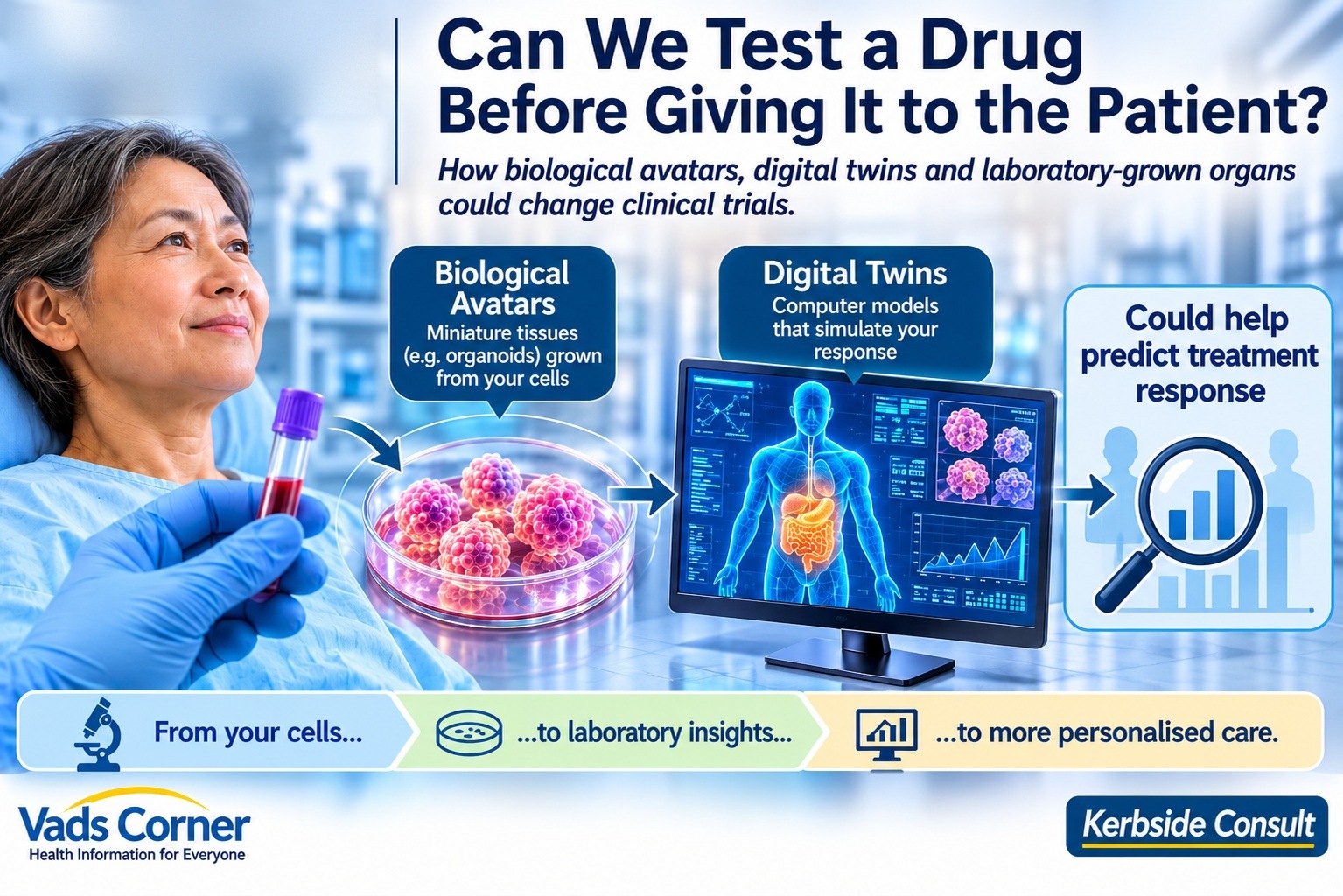
But what if some of those medicines could first be tested on living models made from your own cells, with a computer helping to predict the response? Could we learn something useful before exposing you to the drug?
Charles Howe of Mayo Clinic is exploring this idea. He calls it an ex vivo clinical trial — literally, testing outside the living body. It is an appealing prospect. It is also important to be clear: the integrated approach is a proposal, not a clinically validated substitute for treating and studying patients.[1], [2]
 AI-generated illustration
Contents
Why we need better predictions
Before a new medicine reaches patients, researchers usually study its chemistry, effects on cells and tissues, and safety in suitable preclinical models. Promising findings may justify human studies. But a result in a laboratory or an animal does not reliably tell us what will happen in a person. Many candidates fail during clinical development because they do not work well enough or cause unacceptable harm.[1]
The problem is not that clinical trials are poorly conceived. Human biology is extraordinarily complex. We are trying to predict how a drug behaves in a whole person, often from systems that represent only a small part of that person.
Selected references: 1.
A patient's disease in a dish
A biological avatar is a living model of selected aspects of human biology. Researchers can obtain cells from a patient, grow them under controlled conditions and sometimes form three-dimensional structures called organoids. An intestinal organoid, for example, can reproduce some features of the lining of the intestine. It is not a complete intestine, with its full blood supply, immune system, nerves and connections to the rest of the body.[1]
Other approaches use an organ-on-a-chip: cells grown in a small engineered device that can reproduce selected conditions, such as flowing fluid or mechanical movement. These systems allow researchers to expose human-derived tissue to medicines and measure what happens.
In an earlier Kerbside Consult article, The Cell That Could Become Almost Anything, I described how reprogrammed human cells can help us model disease. The important distinction here is that a disease model is being proposed not just to understand illness, but to help select which treatment to test next.
Selected references: 1.
The digital twin
A digital twin is a computer model built from information about a biological system. It might use measurements from cells, clinical findings, laboratory results and other data to estimate how that system could respond to treatment. As new information arrives, the model can be updated. It is a prediction tool, not an electronic copy of an entire human being.[1]
Artificial intelligence may help analyse complex data, but a digital twin is not necessarily the same thing as generative AI. I discussed the wider possibilities of AI-assisted science in When AI Stops Answering Questions and Starts Making Discoveries. Here the harder test is whether a model's prediction is sufficiently accurate to guide a real research or treatment decision.
Selected references: 1.
Putting them together
Howe proposes combining the living avatar and the digital twin in a repeated cycle. Researchers test a medicine on the avatar, feed the measured response into the computer model, use the updated model to suggest another experiment, and test again. Each round should improve the next prediction — provided the underlying models are reliable.[1], [2]
Patient's cells → laboratory model → drug test → measured response → updated computer model → next experiment.
Howe himself distinguishes two uses. The nearer-term one is population-level: helping to rank candidate drugs and refine trial design during drug development. Choosing treatment for an individual patient, as in the examples below, is the longer-term ambition. It would need results within the clinical decision window and prospective validation against individual outcomes.[1]
What is already possible?
There is real scientific progress behind this proposal. Patient-derived models are being investigated in cancer, cystic fibrosis and drug toxicity research.[1] Computer-based models have also been explored in critical care. A Mayo Clinic digital-twin model for sepsis was tested prospectively on 145 observations in 29 patients; its predictions agreed with what the patients actually did only fairly for the primary response (kappa 0.41) and well for the secondary response (kappa 0.65).[3] These examples demonstrate that parts of the approach can be studied and compared with clinical observations. They do not prove that the entire avatar–digital twin loop improves treatment outcomes.
Inflammatory bowel disease shows both the hope and the gap. A patient may need to try several treatments before finding one that controls the illness. Howe imagines growing intestinal organoids from a patient's biopsy and testing many possible therapies at the same time, to identify promising choices sooner. Mayo researchers already grow colonic organoids from patients with ulcerative colitis, but, as the Mayo report notes, such models capture only part of a patient's biology.[2]
A 2025 prospective study in metastatic colorectal cancer provides a more concrete example. Researchers recorded 232 enrolments (nine patients were enrolled more than once) and obtained 205 biopsies. They succeeded in growing patient-derived organoids from about 52% of biopsies overall (107 of 205). In a smaller analysis involving 42 organoids, laboratory sensitivity to chemotherapy correlated with how patients’ tumours responded. For fluorouracil and oxaliplatin, predictive performance was encouraging (positive predictive value 0.78, negative predictive value 0.80), but that subgroup was only 23 patients, and the negative predictive value rests on four of five. Organoid sensitivity also went with longer progression-free survival (median 10.1 against 2.4 months; p = 0.016). That shows organoids can predict how patients fare on a treatment. It does not establish that choosing treatment by organoid improves survival, which the authors say needs a trial of organoid-directed treatment. The difficulty growing organoids from every sample is itself a major limitation. The organoid company HUB Organoids, part of Merck KGaA, generated the laboratory data, helped fund the study and has authors on the paper.[4]
Personalised cancer treatment offers a useful parallel. In mRNA — From COVID Vaccines to Cancer Treatment, I examined how treatments can increasingly be designed around an individual's tumour. Designing a personalised medicine and predicting whether it will work are different challenges. Both require careful clinical validation.
Where the models fall short
There are several reasons to be cautious. Results can vary with the source of the cells, the method of growing them and the laboratory doing the work, and batch-to-batch and site-to-site variability can matter. A computer model can be precise and still be wrong if its assumptions or data are incomplete.[1]
Speed matters too. In the 2025 colorectal cancer study, growing sufficient organoid material for biobanking took a median of 61 days (range 22–166 days), followed by approximately two more weeks of expansion for drug screening. A prediction that arrives too late may be of little use to the patient. Cost, access, consent to use tissue and medical data, and independent validation also matter. A model must be judged by how accurately it predicts outcomes in patients it has not already been trained or adjusted to fit.[4]
Will human clinical trials disappear?
No. The US FDA Modernization Act 2.0 expanded the legal scope for non-animal methods in drug development. That should not be confused with blanket regulatory acceptance of any particular organoid or digital-twin system, or with abolition of human clinical trials. The usefulness of each method still has to be established for its intended purpose.[5]
Clinical trials do more than show whether a drug acts on cells. They establish dosing, safety, clinical benefit and adverse effects in people. They also test outcomes that matter to patients: whether they survive longer, feel better or function better.
In The Clinical Trial Has Changed, I looked at how Good Clinical Practice has evolved. New technologies may alter how we design trials and choose candidates, but they do not remove the obligation to protect participants and produce trustworthy evidence.
Selected references: 5.
What about Malaysia?
Malaysia has spent decades developing its clinical research infrastructure, from ethics oversight and clinical research centres to first-in-human capabilities. I discussed that history in A Clinical Trial Needs More Than a Doctor.
If these newer approaches become useful, we will need more than computer software. We will need reliable tissue collection, cell-culture facilities, bioinformatics, trained laboratory and clinical teams, data governance, independent validation and collaboration between hospitals, universities, regulators and industry. Malaysia need not attempt to reproduce every platform. A sensible starting point would be to identify a disease area where local clinical samples, expertise and a clearly defined research question can come together.
At the kerbside
Having worked in clinical research and pharmaceutical medicine, I know how costly a late failure is. If a weak candidate can be identified before a patient is exposed, that could spare time, money and potentially unnecessary risk. If a better candidate can be selected, the next clinical trial may be more informative.
But I would ask the same questions of this technology as of any new treatment. What has actually been demonstrated? How reproducible is the result? Does it predict what happens in patients? And has anyone shown that using the prediction improves a clinical decision?
The proposed ex vivo clinical trial is an imaginative way of bringing human biology and computation together. Whether it becomes part of everyday medicine depends on evidence that has still to be generated.
Testing before treatment is an attractive ambition. Predicting correctly is the real achievement.