RSV — Can We Keep Babies Out of Hospital?
Cyberdoc — writing on medicine since 1995
In October 2025 Denmark began a national programme against respiratory syncytial virus (RSV): a vaccine for pregnant women, and a long-acting antibody for high-risk and premature babies whose mothers were not vaccinated. By the end of the following April, admissions of babies under six months with RSV were about a quarter of the usual number. [1]
That is a striking number, but it is a comparison between seasons, not a trial. Still, Malaysian paediatric wards know RSV well, and there are now two ways to protect these babies. The more useful question for us is not whether prevention works. It is how, and for whom, we make it available.
Disclosure: I am now a freelance consultant. I previously worked at Servier, Sanofi, Celgene, BMS and Novavax, and nirsevimab, discussed below, is a Sanofi and AstraZeneca product.
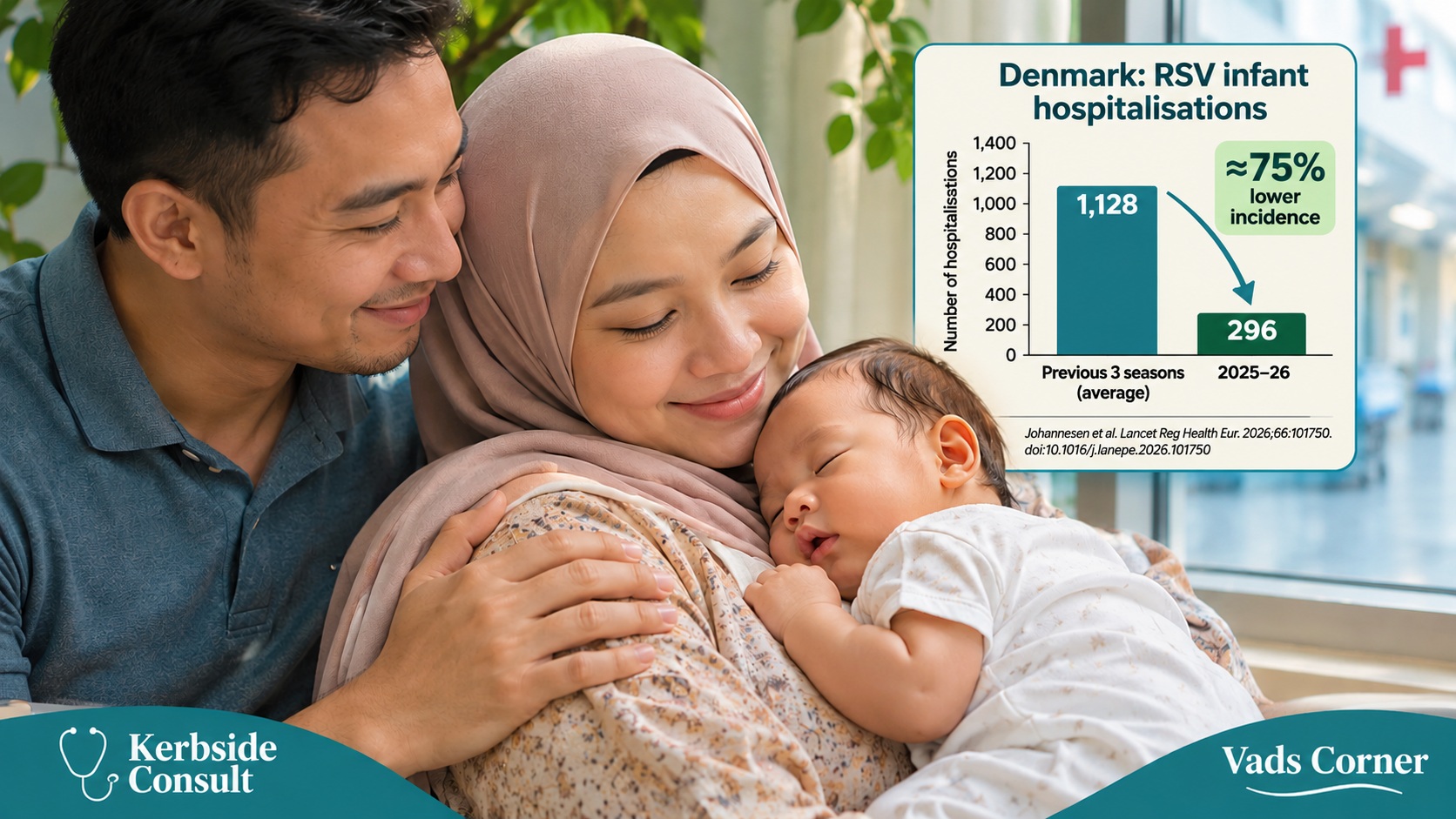
The image is inspired by the subject, is AI-generated artwork, and is not a photograph of any patient or hospital.
1. The winter that did not arrive
The Danish report is a short letter (a Correspondence) from Nordsjællands Hospital and the University of Copenhagen, in The Lancet Regional Health – Europe. [1] It uses national surveillance data, and counts an RSV admission as a stay of more than twelve hours with laboratory-confirmed RSV. In babies aged 0 to 5 months there were 296 such admissions by 29 April 2026 (9.9 per 1,000 babies), against an average of 1,128 a season (39.3 per 1,000) over the three previous full seasons. The 2025–26 count stops at the end of April, so it is slightly short of a full season. The incidence rate ratio was 0.25 (95% CI 0.22 to 0.29): a 75% fall, or a little over 800 fewer babies in hospital. [1]
The programme combined two things. Pregnant women were offered the vaccine from week 32, between October 2025 and February 2026, and 72% accepted. High-risk and premature babies not covered by maternal vaccination were offered a long-acting antibody. [1] So the fall cannot be credited to the vaccine alone.
Now the cautions. One winter is being compared with three earlier ones, and the authors say the observations do not prove cause: changes in healthcare behaviour, testing or viral interference may play a part. Their reasons for thinking the programme matters are that the fall was concentrated in the targeted age group, testing stayed high while positive results fell, and Spain and England report similar reductions. [1] I would call it strong, encouraging evidence, not proof. One author declares grants and fees from Pfizer and GSK, paid through a consultant company. [1]
Selected references: [1]
2. Why RSV matters
RSV is a common cold-type virus in adults. In small babies it can inflame the tiny airways of the lungs, causing bronchiolitis. Globally, the College of Paediatrics paper cites about 3.6 million RSV-related hospital admissions in children under five in 2019. [5]
What it looks like. The Ministry of Health's Paediatric Protocols for Malaysian Hospitals (5th edition, 2025) describe bronchiolitis, of which RSV is the commonest cause here, as a clinical diagnosis. A blocked or runny nose, low-grade fever and cough come first, then fast breathing, chest recession, wheeze and distress. Babies under six weeks may present with apnoea alone. It peaks at 3 to 6 months, and only about 1% of children need admission. [16] Among 80 children admitted with RSV to Hospital Tuanku Ja'afar Seremban (July to October 2022), all had cough, 76% a runny nose, 74% fever, 89% fast breathing and 88% chest recession; 5% had oxygen saturation below 92%. A quarter had no fever. Of the same 80, 31% needed high-flow nasal cannula oxygen, 11% non-invasive ventilation, 2.5% mechanical ventilation and 15% intensive care. [6]
Who needs the ward. The protocol favours admission for a baby under 3 months, one who looks toxic, has moderate or severe recession, grunting, cyanosis or apnoea, is feeding poorly, has oxygen saturation below 95%, or is in a high-risk group: under 12 weeks, premature, or with heart, lung, immune or neuromuscular disease. Treatment is supportive: small frequent feeds, tube feeding or intravenous fluids if needed, oxygen, and high-flow or CPAP support for moderate to severe disease. It does not routinely recommend hypertonic saline, bronchodilators, corticosteroids or antibiotics. [16] The CDC likewise describes supportive care. [15]
How it spreads. Through droplets from a cough or sneeze, direct contact such as kissing a child's face, and contaminated surfaces; the virus survives many hours on hard surfaces such as crib rails. People are usually contagious for 3 to 8 days, sometimes a day or two before symptoms, and some infants and people with weakened immunity shed it for 4 weeks or longer. Nearly all children are infected by their second birthday, and reinfection occurs throughout life. [15]
Mild infection can still be a long illness. The College paper cites a study in which half of healthy term infants with non-medically attended RSV still had symptoms beyond 15 days, and it lists recurrent wheezing, asthma and abnormal lung function as later problems reported after early RSV infection. [5]
In Malaysia, the College paper summarises local studies: children under two make up roughly 85% of RSV hospitalisations, with a median age of 8 to 12 months, and about 15% needed intensive care in two local studies. A 2008–2013 Seremban series of 450 children reported a case fatality of 1.6% in under-fives. [5]
Here is the point that matters for policy. In the Seremban series of 80, only 6 (7.5%) had a documented underlying condition, and 2 had been born premature. [6] One hospital over four months is a small window, so I would not push the number far. But it matches what many of us see on the ward: most babies admitted with RSV were previously well.
3. Two ways to protect a baby
Maternal vaccination. The mother is given a single dose of the RSV prefusion F vaccine late in pregnancy. Her antibodies cross the placenta, so the baby is born already protected. In the phase 3 trial (MATISSE: double-blind, 18 countries, funded by Pfizer; an interim analysis), severe medically attended RSV lower respiratory illness within 90 days of birth occurred in 6 babies of vaccinated mothers and 33 on placebo, a vaccine efficacy of 81.8% (99.5% CI 40.6 to 96.3). By 180 days efficacy was 69.4% (19 against 62 cases). Against all medically attended RSV lower respiratory illness at 90 days the vaccine did not meet the trial's statistical bar. [2] The authors reported no safety concern but noted the numbers were small; births before 37 weeks were somewhat more frequent in the vaccine group (5.6% against 4.7%, my calculation from the paper's table). [2] The College paper notes that slightly higher, non-significant preterm rates may be why the US FDA limited use to weeks 32 to 36. [5]
Nirsevimab. This is not a vaccine. It is a long-acting monoclonal antibody, a ready-made antibody given to the baby by injection. The HARMONIE trial (France, Germany and the UK; open-label; funded by Sanofi and AstraZeneca) randomised 8,058 infants. RSV-related lower respiratory tract hospitalisation occurred in 11 of 4,037 babies given nirsevimab (0.3%) and 60 of 4,021 given standard care (1.5%), an efficacy of 83.2% (95% CI 67.8 to 92.0). [3]
Clesrovimab. MSD's Enflonsia is a second long-acting antibody, given as a single 105 mg injection. In the CLEVER trial (double-blind, placebo-controlled, funded by MSD), 3,614 healthy preterm and full-term infants entering their first RSV season were randomised 2:1. Through 150 days, RSV-associated medically attended lower respiratory infection occurred in 60 of 2,398 infants given clesrovimab and 74 of 1,201 given placebo, an efficacy of 60.4% (95% CI 44.1 to 71.9). RSV-associated hospitalisation occurred in 9 and 28, an efficacy of 84.2% (95% CI 66.6 to 92.6). [17] The US FDA licensed it in June 2025, and the US advisory committee recommended it as an alternative to nirsevimab for infants whose mothers were not vaccinated. [18] I know of no head-to-head trial of the two antibodies, so I would not rank them.
They are not rivals, and several countries use both. But be careful lining up the percentages: one trial counted severe illness in a double-blind design, the other hospitalisations in an open-label design, and the populations differ.
4. What other places have found
A multinational analysis compared bronchiolitis visits in the 2024–2025 season with earlier seasons. [4] The results varied a lot:
| Place | Main product | Bronchiolitis admissions, infants under 6 months (risk ratio) | Uptake reported |
|---|---|---|---|
| Catalonia (Spain) | Nirsevimab | 0.40 (95% CI 0.37–0.43) | 90.3% of babies born in season; 93.6% in catch-up cohort |
| Rome (Italy), one hospital | Nirsevimab | No fall: 1.12 (95% CI 0.83–1.52) | About 75% |
| UK, four hospitals | Maternal vaccine | Fall in Leicester (0.80) and Edinburgh (0.85); none in Bristol or Glasgow | 34% (England) and 41% (Scotland) of newborns covered in September 2024; about 54–56% a year later |
The authors think the missing effect in Rome and the UK is likely to relate to uptake; in the UK, the first-season catch-up campaign also meant many women were vaccinated too close to delivery. [4] A good product with low uptake does little for the ward. That is the lesson I take from Europe, and why the Danish 72% matters as much as the 75%.
Read the UK row with care: it covers four hospitals, and counts bronchiolitis diagnoses rather than laboratory-confirmed RSV. [4] The Danish letter cites national UK Health Security Agency data showing reductions above 80% in infant RSV hospitalisation in England, and Spanish data of up to 80–85% with universal nirsevimab, [1] which I have not read myself.
Australia shows the two routes side by side. Its immunisation handbook recommends the maternal vaccine for every pregnancy from 28 weeks, and nirsevimab for infants whose mothers were not vaccinated, or were vaccinated less than two weeks before delivery. [12]
5. Where does Malaysia stand?
This is where the story gets untidy, because "available" means different things. I would separate five layers.
Regulatory approval. Pfizer's Abrysvo is registered with the NPRA; Pfizer Malaysia announced the approval on 20 August 2025. [9] The agency's list of additional indications from the Drug Control Authority meeting of 6 August 2026 gives infant protection from birth to 6 months after maternal immunisation, and active immunisation of adults aged 18 and over, with one dose in pregnancy between weeks 24 and 36. [8] For nirsevimab, Sanofi announced NPRA approval and availability on 24 November 2025, and the MIMS Malaysia database carries a prescribing-information page for Beyfortus. [10] Both are a company's or a database's word; I could not find an NPRA document to cite for nirsevimab. For clesrovimab, the Drug Control Authority approved Enflonsia 105 mg at its meeting of 8 October 2026, registration number MAL26106001ACZ, held by Merck Sharp & Dohme (Malaysia). [20] The NPRA lists do not state the indication, and I found nothing on launch or funding. Singapore's Health Sciences Authority approved it in June 2026, which MSD described as the first approval in the region. [19]
Professional guidance. The College of Paediatrics, Academy of Medicine of Malaysia, published a position paper in January 2026. It recommends targeted nirsevimab for high-risk infants as a pragmatic first step, scaling up to all infants as resources permit, and suggests that year-round maternal vaccination might help get around the unclear seasonality. [5] The panel acknowledges industry links; several members declared honoraria or advisory roles with Sanofi, AstraZeneca, Pfizer or MSD. [5] The Obstetrical and Gynaecological Society's 2024 consensus guideline says maternal vaccine should be given at 32 to 36 weeks "when available", written before the vaccine reached us. [7] The Ministry of Health's 2025 paediatric protocols, written for hospital use, also mention maternal vaccination at 32 to 36 weeks, and describe a long-acting antibody such as nirsevimab as better than a short-acting one, for infants with chronic lung disease of prematurity, significant congenital heart disease or severe immunodeficiency (and, for palivizumab, extreme prematurity). [16] That is guidance, not funding. The documents do not even agree on the weeks: the NPRA text allows 24 to 36, the College paper's conclusion says 28 to 36, and the OGSM and the protocols say 32 to 36. [5] [8]
Hospital decisions. The results of the Drugs and Therapeutics Committee meeting 1/2026 at Hospital Canselor Tuanku Muhriz (UKM), held on 5 March 2026, list nirsevimab restricted to neonatologists, with a purchase limit of RM300,000 a year, and remove palivizumab 100 mg from the formulary. The hospital's pharmacy bulletin shows nirsevimab as a new entry, with palivizumab withdrawn once existing stock is used up. [11] That looks like a real decision with real money attached. It is also one hospital.
Ministry of Health access. I could not confirm from the MOH Medicines Formulary what restrictions apply to nirsevimab in public hospitals, and I would rather say so than guess. The College paper notes that most public hospitals give palivizumab ad hoc, without specific funding, reflecting "the absence of a coordinated national policy". [5]
A national programme. I found none, and no sign that either product is in the National Immunisation Programme. The College paper cites the maternal Tdap vaccine in the programme as a precedent. [5]
Selected references: [5], [7], [8], [9], [10], [11], [16], [19], [20]
6. And the grandparents?
RSV is not only a baby's problem. In healthy older adults it is usually a mild cold lasting one to two weeks, but it can worsen asthma, COPD and heart failure. [15] The NPRA indication for Abrysvo now covers adults aged 18 and over. [8] The National Vaccine-Preventable Diseases Recommendations for Older Persons in Malaysia 2025, from the Malaysian Society of Geriatric Medicine, advises one lifetime dose for all adults aged 60 and above, and for those aged 50 to 59 at increased risk, such as chronic heart or lung disease, diabetes with complications or on insulin, kidney or liver disease, severe obesity, weakened immunity, or nursing-home residence. It also calls for a national immunisation programme for older adults. [13] That is a professional society's recommendation, not a funded programme. Two Malaysian doctors argued in CodeBlue in September 2026 that registration is not the same as access, putting private prices at RM850 to RM1,888 a dose with no public subsidy. [14] This deserves its own article.
7. The question for Malaysia
Should we start with high-risk infants, or plan for all of them?
The College's answer is to start with the high-risk group and widen when we can. [5] That is sensible. But if most babies on the ward were previously well, as the Seremban numbers suggest, a high-risk-only programme would miss most admissions. [6] The honest position is that both statements are true, and the choice is partly about money.
Three things would help any decision:
- Local counts. How many babies are admitted with RSV each year, in which months, and how many are high-risk? The College paper itself calls for better surveillance, and Malaysian seasonality is unclear, with peaks in the third quarter or year end in the Peninsula and a different pattern in Sarawak. [5] The Ministry's protocols call RSV endemic through the year, with annual peaks from October to January. [16]
- Uptake, not just supply. Europe shows that the product on the shelf is not the same as the product in the baby. [4]
- A written plan with a budget that says who is eligible, who gives it, and when.
8. At the kerbside
Prevention of RSV in infants is no longer a hope. Two routes work in trials, and Denmark suggests that with good uptake they can empty a winter's worth of hospital beds. What Malaysia does not yet have, as far as I can find, is a funded, national decision on who gets them.
We have the tools. What we are still missing is the plan.
If a baby in your family is due soon, ask your obstetrician or paediatrician what is available in your hospital and what it costs. The answer today depends heavily on where you deliver.
Sources & further reading
- Johannesen CK, Egeskov-Cavling AM, Lund S, Harboe ZB, Fischer TK. Early impact of RSV prevention on infant hospitalisations in Denmark (Correspondence). Lancet Reg Health Eur 2026;66:101750. [Source]. Open access. The last author declares Pfizer and GSK grants and fees, paid via a consultant company. Also: University of Copenhagen press release, 28 August 2026. [Source]. The release describes the vaccine only; the letter describes a combined programme. The Spanish and UK figures are quoted via this letter.
- Kampmann B et al. Bivalent prefusion F vaccine in pregnancy to prevent RSV illness in infants. N Engl J Med 2023;388:1451–64. [Source] · [PubMed]. Funded by Pfizer.
- Drysdale SB et al., HARMONIE Study Group. Nirsevimab for prevention of hospitalizations due to RSV in infants. N Engl J Med 2023;389:2425–35. [Source]. Open-label phase 3b; funded by Sanofi and AstraZeneca.
- Real-world impact of nirsevimab immunisation and maternal RSV vaccination on emergency department attendances and admissions: a multinational retrospective analysis. Lancet Reg Health Eur 2026;63:101597. [Source] · [PubMed]. No funding source declared.
- Cheah FC, Khoo EJ, Ali A, Ismail Z, et al., College of Paediatrics, Academy of Medicine of Malaysia. Recommendations on RSV immunization strategies for infants and young children in countries with year-round RSV activity. Vaccines 2026;14(1):59. [Source] · [Full text]. Burden figures are as quoted in the paper from its own references.
- Ng DC-E, Liew CH, Tan KK, et al. Clinical comparison of HMPV and RSV infections in hospitalised Malaysian children: a propensity score matched study (Hospital Tuanku Ja'afar Seremban, 1 July–30 October 2022). Clin Respir J 2024;18:e13747. [Source].
- Obstetrical and Gynaecological Society of Malaysia. Malaysian Maternal Immunisation Consensus Guidelines, 2024. [Source]. RSV section (2.4).
- National Pharmaceutical Regulatory Agency. Tambahan Indikasi yang diluluskan, PBKD 423, 6 Ogos 2026 (products approved for additional indication). [Source]. Lists products approved for additional indications; the full indication wording is given in the list.
- Bernama. ABRYSVO, New Vaccine Protects Babies and the Elderly From RSV, 20 August 2025 (credit: Pfizer). [Source]. Page shows the headline and date only; the full story is not public. And Maganathan DK. Safeguarding every generation from respiratory syncytial virus. Free Malaysia Today, 20 August 2025. [Source]. The FMT article reports Pfizer Malaysia's announcement of NPRA approval for pregnancy (24 to 36 weeks) and adults aged 60 and over. Both report the company's announcement; used only to date it.
- Sanofi. Beyfortus (nirsevimab) now available in Malaysia to protect all infants against RSV disease, press release, PR Newswire APAC, 24 November 2025. [Source]. Company release; it states NPRA approval but gives no registration number. And MIMS Malaysia, Beyfortus, full prescribing information. [Source]. A drug database listing, not a regulator record. Both used only for approval and availability.
- Hospital Canselor Tuanku Muhriz, UKM Pharmacy. Keputusan Mesyuarat Jawatankuasa Terapeutik & Ubat-ubatan (JKTU), meeting JKTU 1/2026 held 5 March 2026 (results page dated 4 May 2026): [Source]. And Pharmacy Bulletin, Edition 26 Issue 3: [Source]. The results page gives the restriction, the purchase limit and the palivizumab removal; the "until stock is used up" detail is from the bulletin. These are one hospital's decisions, not national policy.
- Australian Immunisation Handbook, Respiratory syncytial virus (RSV). [Source] · NSW Health, Eligibility for Abrysvo and nirsevimab (Beyfortus), March 2026. [Source]. The NSW sheet carries two dates, March 2026 and November 2025.
- Malaysian Society of Geriatric Medicine. National Vaccine-Preventable Diseases Recommendations for Older Persons in Malaysia 2025, 1st edition, August 2025 (Dr Kejal Hasmukharay, chair of the writing group). [Source]. RSV quick guide and RSV chapter (p. 54). See also the conference abstract by Ismail AI, “Vaccination strategies in respiratory diseases”, Med J Malaysia 2026;81(Suppl 1):22, which summarises these recommendations. [Abstract].
- Musa Mohd Nordin (paediatrician) and Ahmad Faizal Mohd Perdaus (chest physician), Damansara Specialist Hospital. RSV vaccines work, but older Malaysians are being left behind. CodeBlue, 22 September 2026. [Source]. Opinion piece; the prices are the authors' statement.
- Centers for Disease Control and Prevention. Clinical overview of RSV, last reviewed 18 August 2025. [Source]. Used for symptoms in adults and supportive care. And How RSV spreads, 20 February 2026. [Source]. Used for transmission and contagiousness. Neither page gives an incubation period.
- Hussain Imam Hj Muhammad Ismail, Ng Hoong Phak, Sabeera Begum Kader Ibrahim, Muhammad Ghazali bin Ahmad Narihan, Janet Hii Lin Yee, Tan Yuong Chin. Paediatric Protocols for Malaysian Hospitals, 5th edition. Kementerian Kesihatan Malaysia; 2025. Chapter 32, Acute Bronchiolitis, pp. 187 to 191 (and the BPD section for palivizumab and nirsevimab). A bronchiolitis protocol, not RSV-specific.
- Zar HJ, Simões EAF, Madhi SA et al., CLEVER (MK-1654-004) Study Group. Clesrovimab for prevention of RSV disease in healthy infants. N Engl J Med 2025;393:1292–1303. [Source]. Phase 2b/3, double-blind, placebo-controlled; funded by Merck Sharp & Dohme.
- Moulia DL, Link-Gelles R, Chu HY et al. Use of clesrovimab for prevention of severe RSV-associated lower respiratory tract infections in infants: recommendations of the Advisory Committee on Immunization Practices, United States, 2025. MMWR 2025;74(32):508–514. [Source].
- BioSpectrum Asia. Singapore becomes first APAC market to approve MSD's Enflonsia for infant RSV prevention, 2 June 2026. [Source]. Reports MSD's announcement; I have not seen the HSA record.
- National Pharmaceutical Regulatory Agency (NPRA). Senarai produk yang diluluskan dalam PBKD 425, Drug Control Authority meeting of 8 October 2026, entry 155: ENFLONSIA 105 mg solution for injection in pre-filled syringe, MAL26106001ACZ, Merck Sharp & Dohme (Malaysia) Sdn Bhd; registration date 8 October 2026. [Source]. The list gives no active ingredient or indication. The active ingredient, clesrovimab, is from the NPRA Quest3+ product record ([Source]), which gives no registration date.
Published 84/2026 · 22 November 2026 · No corrections to date · Corrections policy